
Checked 25 Nov 2026. Facts from JIBC's AST, AST theory, AST assessment and BST pages and from gov.bc.ca's security licensing pages (updated 9 Mar, 21 Apr, 25 May and 28 Sep 2026), plus the Security Services Regulation (current to 17 Nov 2026), all read 25 Nov 2026. Fees, exam dates, instructor lists and policies change: check the linked pages before you rely on a number.
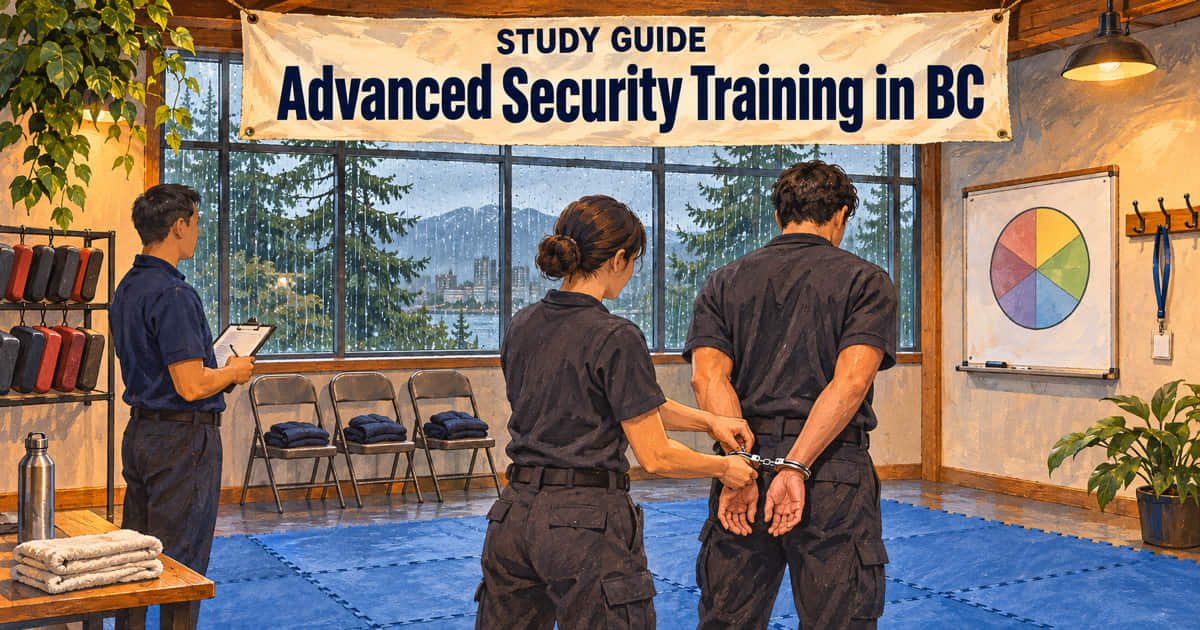
Advanced Security Training (AST) is the 24-hour, Ministry-approved course that, unless you have equivalent training the registrar accepts, a security guard in British Columbia needs before the registrar will authorize them to carry or use handcuffs. A basic guard licence does not require it, and no official rule ties it to a supervisor job: it is the training behind the restraint authorization (JIBC calls it the "Restraint Endorsement") on a security worker licence. JIBC requires a minimum of 75% to complete the training, the exam booked through the Justice Institute of British Columbia (JIBC) costs $64.41, you get two attempts within six months, and AST must be renewed every three years (JIBC and gov.bc.ca, read 25 Nov 2026).
The rules and fees below come from official pages: JIBC, which delivers security training on behalf of the province and approves the AST instructors, the Government of British Columbia's Security Programs Division, and the Security Services Regulation. The commentary, the comparison, the two tools and the product mention are ours. One thing to be clear about first: our BC Security Guard (BST) practice test practises the Basic Security Training (BST) exam, the usual training route to a guard licence. We do not sell AST practice, and we know of no official AST practice test.
JIBC Advanced Security Training pages and SCRT-1665 assessment page; JIBC BST page. Read 25 Nov 2026.
Still working towards your first licence? JIBC says AST builds on BST, and the restraint authorization sits on a guard licence. The free sample below is from our BST practice test.
FreeTests: Licensing and the Security Services Act · Legal authority: arrest, force and offences · Patrol, access control and communication · Notes, reports and evidence
BC Security Guard (BST) Practice Test: free sample
Answer 4 questions against the clock, like the real exam. You then see the right answer, the reason and your time on each. About 5 minutes · free · no sign-in.
4 questions to answer▶ Start nowThis one is free · no sign-in neededYour result shows how long each question took you.- 3 mocks, no question repeated
- 75 questions in 90 minutes, the length and time JIBC publishes
- Arrest and use of force, the Security Services Act, patrol, reports, emergencies
- Your score to compare with the 70% pass mark, every answer explained
- 4 questions free
Disclaimer
About this materialNot made or endorsed by JIBC or the Government of BC.Terms Privacy Refund policyWhat Advanced Security Training is
The starting point is the law. Section 11(1) of the Security Services Regulation says a security worker licensee must not carry or use a restraining device while doing security work, and no one may make them do so. Section 11(2) lets the registrar authorize a licensee to carry and use one, on any conditions the registrar sets. AST is the training the registrar accepts for that authorization.
The registrar's published policy (section 3.3, gov.bc.ca, updated 25 May 2026) explains why. The policy says security worker licensees generally do not need to restrain members of the public while engaged in security work. Security guards are the exception: the policy says they have the legal authority to detain or arrest someone they see committing a crime in relation to the property they guard, and a restraint may be needed then for the safety of the guard and the person detained. Because of the impact on civil liberties and public safety, the registrar grants the authorization only in limited circumstances, and the licence condition that comes with it allows metal chain-link handcuffs only.
JIBC describes AST as a 24-hour course that builds on BST and stresses the safe, lawful and respectful use of force and proper reporting. It lists six subjects:
| AST subject (JIBC) | What it covers, in short (JIBC's short description) |
|---|---|
| Security Services Act and Regulations | Understanding the legal framework governing security work |
| Advanced force options theory | Applying appropriate use-of-force decision-making models |
| Introduction to control tactics | Learning safe and effective physical control methods |
| Application of restraints | Using handcuffs properly and within legal limits |
| Excited delirium and positional asphyxia | Recognizing and managing high-risk situations |
| Reporting and documentation | Recording incidents accurately and professionally |
JIBC also says AST is practical skills training combined with applied theory, taught face-to-face. On its course list, the 24 hours appear as the AST course (SCRT-1609) and the AST theory course (SCRT-1660), and the exam is a separate assessment (SCRT-1665).
Who needs AST, and who can apply for the restraint authorization
The rule is about the equipment, not the job title. JIBC puts it plainly: if you are a licensed security professional who carries and uses handcuffs, you must complete AST to add the restraint endorsement to your licence. Section 11 bans carrying or using a restraining device without authorization, so if you will neither carry nor use handcuffs, the licence rules do not require AST, whatever your rank.
| Your situation | Do you need AST? | Official basis |
|---|---|---|
| Licensed security guard who will carry and use handcuffs (for example, a post where guards may detain people) | Yes, AST or one of the accepted alternatives, then the registrar's authorization | Regulation s. 11; gov.bc.ca training page; policy 3.3 |
| Security guard who will neither carry nor use handcuffs | Not for your licence. Ask any employer whether a post needs the authorization | Licence requirements on gov.bc.ca list BST (or an alternative) only |
| Supervisor or site lead | Only if you carry or use handcuffs. No official page we read requires AST for supervising | Regulation s. 11 applies to carrying or using restraints, not to roles |
| Applicant who is qualified for, or already holds, the security guard licence type | Eligible to apply for the authorization once trained | Policy 3.3.1.1 |
| Locksmith, alarm, CCTV, electronic locking device installer, private investigator, security consultant, armoured car guard licence only | Another licence type alone does not make you eligible: the registrar only considers people qualified to apply for, or already holding, the security guard licence type | Policy 3.3.1.1 |
| Experience as a Canadian police officer, correctional officer, sheriff, or auxiliary, reserve or border services officer (a member of a police force as defined by the B.C. Police Act cannot hold a security worker licence at all; retired police officers and peace officers may be eligible) | Not necessarily: recent use-of-force or restraint training, proven by an employer letter, can be accepted instead (see the section below) | gov.bc.ca training page, restraints Option 2; policy 3.3.2.4; gov.bc.ca eligibility |
Two points readers often miss. First, the authorization sits on a valid security worker licence: gov.bc.ca says that to have it you need both the licence and the required training. Second, the policy wording is "security worker licence type security guard". If you hold a security guard licence under supervision, ask the Security Programs Division (securitylicensing@gov.bc.ca, 1-855-587-0185) whether you can apply before you pay for a course; we did not find that case spelled out.
Why might a job ad ask for AST when the law does not tie it to the role? Our reading: a post where guards are expected to carry or use handcuffs can only be staffed with guards who hold the authorization, so the requirement follows the post, not the job title. The official pages do not list which employers or sites expect it, so ask before you pay for a course.
Prerequisites: what you need before AST
JIBC's AST course pages list no prerequisite course, and its FAQ sets the age at 19. In practice there is a longer list, because the course is only useful if you can get the authorization at the end:
| Requirement | What the official pages say |
|---|---|
| Age | You must be 19 to take AST (JIBC FAQ). A security guard licence also needs you to be 19 or older (gov.bc.ca; the 16-plus exception is only for locksmith or alarm installer under supervision) |
| Security guard licence (or qualifying for one) | The authorization needs a valid security worker licence; the registrar only considers the security guard licence type (gov.bc.ca; policy 3.3.1.1) |
| Basic Security Training | Not a listed prerequisite for the AST course. BST is one route to the guard licence (gov.bc.ca also accepts some experience and other licences), and JIBC says AST builds on BST |
| Licence eligibility and documents | For the licence itself: ordinarily resident in Canada, fluent in English (for most licence categories), not a member of a police force as defined by the B.C. Police Act; fingerprints, consent to a criminal record check, photo ID, a passport-quality photo, proof of the right to work in Canada and, if applicable, a mental health condition form (gov.bc.ca Application and Licence Management Process, updated 28 Sep 2026) |
| Prerequisite for the AST exam | The AST assessment (SCRT-1665) lists the AST theory course (SCRT-1660) as its prerequisite |
If you are at the start, one possible sequence is BST course and exam, then the licence application, then AST; the AST course lists no prerequisite, and policy 3.3.1.1 also lets people who qualify to apply for a guard licence seek the authorization. Our sibling guides cover the first two steps: the BST course in BC (cost, online or classroom), the JIBC BST exam (booking, fee, format and pass mark) and how to get a BC security licence.
AST vs BST: the differences in one table
BST is training that qualifies you to apply for a licence; AST is training for one authorization on a guard licence. Here is everything the two JIBC pages and gov.bc.ca say, side by side:
| Basic Security Training (BST) | Advanced Security Training (AST) | |
|---|---|---|
| What it is for | The training JIBC calls mandatory to apply for a security worker licence (listed for guards and several other licence categories); for a guard licence, gov.bc.ca also accepts some police or similar experience, gaming security training or a licence from Alberta, Saskatchewan, Manitoba or Ontario | The training for the registrar's authorization to carry and use handcuffs |
| Who must take it | People new to security who need the training to be eligible for a licence (exemptions exist for some experience) | Security guards who will carry or use handcuffs, unless they have equivalent training the registrar accepts or an exemption |
| Length | 40 hours | 24 hours |
| How it is taught | JIBC in person or self-paced online (up to two months), or an approved training school | Face-to-face through JIBC-approved instructors; practical skills plus applied theory |
| Course price | $343.77 at JIBC, plus a $3.26 learner services fee | Set by each instructor; no single price published |
| Exam | SCRT-1656: 75 questions in 90 minutes (JIBC BST page), $64.14 | SCRT-1665: listed at 2 hours and $64.41; JIBC publishes no question count |
| Pass mark | 70% | 75% minimum for successful completion of the training (JIBC); no separate figure on the assessment page |
| Attempts | Two, then retake the BST theory course | Two in total, then retake the AST course |
| Time limit for the exam | Within six months of finishing the theory course | Within six months of finishing the theory course; rewrites within six months of attending the course |
| Where you write it | JIBC New Westminster; online proctored only for students outside the Lower Mainland | Exam within Metro Vancouver: booked through JIBC (sittings at New Westminster); course taken outside Metro Vancouver: exam with your instructor |
| Renewal | None stated on JIBC's BST page | Every three years |
| What you get | Eligibility to apply for the licence; JIBC transcript as proof (no certificates as of 15 Dec 2025) | Eligibility for the restraint authorization; JIBC transcript as proof (no certificates as of 15 Dec 2025) |
The biggest practical differences: AST is shorter but sets the higher bar (JIBC: 75% to complete AST, against 70% on the BST exam), it is taught face-to-face by an approved instructor with no online option on the official pages (BST has both in-person and online delivery), and it expires. The BST page we read states no periodic renewal; AST must be renewed every three years for as long as you carry or use handcuffs.
JIBC BST, AST and SCRT-1665 pages; gov.bc.ca Application and Licence Management Process; registrar's policy 2.7.1.1. Read 25 Nov 2026. The AST course has no single published price, so it shows no bar.
What AST costs in BC
JIBC does not publish an AST course fee. Its FAQ says the instructors set the course prices and asks you to contact them; its AST theory course page shows no price and, when we read it, no scheduled sections. So any single "AST costs $X" figure you see is not a province-wide fee: ask what any quote includes (course, exam, rewrite). These are the costs that are published:
| Item | Amount | Source |
|---|---|---|
| AST course (24 hours) | Set by each approved instructor | JIBC AST page: "contact your preferred Advanced Security Training instructor for course tuition information" |
| AST exam booked through JIBC's Registration Office (Metro Vancouver) | $64.41 | JIBC AST page and SCRT-1665 assessment page |
| AST exam when you took the course outside Metro Vancouver | Written with your instructor; ask them what it costs | JIBC AST FAQ |
| Rewrite (second and last attempt) | At JIBC New Westminster through the Registration Office, or with an instructor who hosts rewrites; JIBC lists each assessment sitting at $64.41 | JIBC AST FAQ; SCRT-1665 page |
| After two failed attempts | The AST course again, at the instructor's price | JIBC AST FAQ |
| Adding the authorization to your licence | No fee published for the authorization itself. Related fees: $20 to add a licence type outside renewal (policy 2.7.1.1) and $20 to reissue a licence except on renewal (Regulation s. 16(4)); gov.bc.ca says renewal and change fees are shown in the Security Services Platform | Policy 2.7.1.1; Regulation s. 16(4); gov.bc.ca application page |
| Replacement AST certificate | Not available: certificates ended 15 Dec 2025; your JIBC transcript is the proof | JIBC AST and BST pages |
Two money tips that follow from the official rules. Aim to pass first time: JIBC lists each assessment sitting at $64.41 (an instructor may charge differently), and after two unsuccessful attempts you must retake the course. And if your licence is up for renewal soon, ask the Security Programs Division whether adding the authorization at renewal saves a fee: the registrar's policy charges $20 to add a licence type outside renewal, and the regulation charges $20 to reissue a licence except on renewal, but no page we read names a fee for the restraint authorization itself. Renewal is cheaper than a new licence anyway: under section 16(1) of the regulation, the standard fee to renew a worker licence for up to one, two or three years is $60, $120 or $180, against $120, $180 or $240 for a new licence of that length (renewing a 90-day licence is charged differently, and a security business licensee renewing a worker licence of the same type is exempt). Check the fee shown in the Security Services Platform before you pay.
A worked example with our arithmetic: if an instructor quotes $300 for the course, you write once through JIBC and a $20 fee applies to adding the authorization mid-term, the total is $300 + $64.41 + $20 = $384.41, about $128 a year over the three years AST lasts. With one rewrite it is $448.82. The $300 is an example only, not a price we found.
FreeTests: Licensing and the Security Services Act · Legal authority: arrest, force and offences · Patrol, access control and communication · Notes, reports and evidence
BC Security Guard (BST) Practice Test: free sample
Answer 4 questions against the clock, like the real exam. You then see the right answer, the reason and your time on each. About 5 minutes · free · no sign-in.
4 questions to answer▶ Start nowThis one is free · no sign-in neededYour result shows how long each question took you.The AST exam: format, pass mark and dates
What is published about the exam: it is the AST assessment, course SCRT-1665, and JIBC says it tests your understanding of the theory components of AST, "to perform effectively as an Advanced Security Guard". JIBC lists it at 2 hours; its scheduled sittings run 9:30am to 12:00pm, a two-and-a-half-hour window. JIBC says students need a minimum of 75% for successful completion of the AST training; its assessment page gives no separate figure. JIBC does not publish the number of questions, so we do not give one. Your grade goes on your JIBC transcript after processing, which JIBC says typically takes one to two weeks.
JIBC's FAQ says that if you take the course outside the Metro Vancouver area, you write the exam with your instructor; within Metro Vancouver, you book it through JIBC's Registration Office (604-528-5590, 9am to 4pm, Monday to Friday). These were the AST assessment sittings JIBC listed for its New Westminster campus on 25 Nov 2026, all on Saturdays, 9:30am to 12:00pm, in class, $64.41, with seats shown as available:
| # | Sitting (New Westminster campus) | Time | Fee |
|---|---|---|---|
| 1 | Sat 28 Nov 2026 | 9:30am to 12:00pm | $64.41 |
| 2 | Sat 5 Dec 2026 | 9:30am to 12:00pm | $64.41 |
| 3 | Sat 12 Dec 2026 | 9:30am to 12:00pm | $64.41 |
| 4 | Sat 9 Jan 2027 | 9:30am to 12:00pm | $64.41 |
| 5 | Sat 16 Jan 2027 | 9:30am to 12:00pm | $64.41 |
| 6 | Sat 23 Jan 2027 | 9:30am to 12:00pm | $64.41 |
| 7 | Sat 30 Jan 2027 | 9:30am to 12:00pm | $64.41 |
That is seven Saturday sittings between 28 Nov 2026 and 30 Jan 2027. Check the SCRT-1665 page for the current list before you plan.
Two attempts, six months. JIBC says the AST exam may be written a total of two times; after that you must retake the course to get access to the exam again. You must complete the assessment within six months of finishing the theory course, and a rewrite must be done within six months of the date you attended the course. The two limits look like BST's, but the BST rules are on a different page, and the bar differs: JIBC specifies 75% for successful completion of AST training, against 70% on the BST exam; the AST assessment page gives no separate pass mark.
How to prepare: the official pages publish no AST study guide or sample questions, and we sell no AST practice. JIBC says AST builds on BST, whose published topics include professionalism and ethics, legal studies, report writing and personal safety. If those are rusty, our BC Security Guard (BST) practice test is built for the BST exam, and our BST practice questions guide is a place to start.
How long AST takes, start to finish
The published course length is 24 hours; ask your instructor for the teaching dates. The longer clocks are the official deadlines around it:
| Step | How long or by when | Source |
|---|---|---|
| AST course | 24 hours of instruction | JIBC AST page and SCRT-1609 |
| AST exam (both attempts) | Within six months of finishing the theory course; a rewrite within six months of the date you attended the course; 2-hour assessment in a 2.5-hour sitting window | JIBC AST FAQ; SCRT-1665 |
| Result | On your transcript, typically one to two weeks after the exam | JIBC AST FAQ |
| Apply to the registrar for the authorization | Training within one year before the application | Registrar's policy 3.3.2.2 |
| Licence processing | No fixed time: gov.bc.ca says timelines vary with volumes and are longer if the application is incomplete, the fee is late, more information is needed or a risk assessment is done | gov.bc.ca Security worker licence page |
| Renew AST | Every three years | JIBC AST page; gov.bc.ca training page; policy 3.3.3 |
How to add the restraint endorsement to your licence
The steps, in order, from the official pages:
- Hold, or qualify for, a BC security worker licence of the security guard type (policy 3.3.1.1).
- Take AST face-to-face with a JIBC-approved instructor (JIBC lists them by region; see below).
- Complete the AST training successfully (JIBC: a minimum of 75%), writing the exam within six months and in at most two attempts.
- Do not wait for a paper certificate: JIBC stopped issuing AST certificates on 15 Dec 2025. Gov.bc.ca says that for training completed after that date it verifies completion with JIBC, and JIBC says its Security Training Programs notify the Security Programs Division that you passed. Your JIBC transcript is your own proof.
- Apply through the Security Services Platform to update your licence (gov.bc.ca says you can apply there to modify the type of security work you are authorized for, including the use of restraints), within one year of your training (policy 3.3.2.2).
- Once authorized, carry and use only metal chain-link handcuffs (licence condition, policy 3.3.4.1).
- Re-qualify every three years and re-apply for the authorization with proof of the re-qualification (policy 3.3.3.4). The policy still speaks of JIBC certificates, which JIBC stopped issuing on 15 Dec 2025; for training after that date gov.bc.ca verifies completion with JIBC, and your JIBC transcript is your proof if you are asked for one.
The registrar's policy opens the authorization to people who are qualified to apply for a guard licence as well as those who hold one, so if you are licensing for the first time and already have AST, ask the Security Programs Division whether to request the authorization with your first application. The licence steps themselves (BST, fingerprints, record check, fees) are in our guide on how to get a BC security licence.
Renewing AST every three years
AST does not last for the life of your licence. JIBC and gov.bc.ca both say it must be renewed every three years, and the registrar's policy explains the mechanics: you re-qualify through an approved re-qualification course; the expiry date is three years from the day you completed the training or re-qualification; your authorization to carry and use restraints ends on that expiry date (the policy says the date on the JIBC certificate; since certificates ended on 15 Dec 2025, JIBC's record of your completion is what remains); and keeping the training current is your own responsibility. To renew the authorization you re-apply and send proof of the re-qualification.
Two practical points. Your security worker licence and your AST run on separate clocks: a three-year licence bought today and AST taken next month will not expire together, so put both dates in your calendar (the planner above estimates the AST one from your course dates; your JIBC record has the date that counts). And JIBC no longer issues replacement AST certificates; if you need to prove completion, JIBC points you to your transcript. JIBC also says that when you renew your security worker licence you need no replacement certificate: you upload your current or expired licence and JIBC tells the Security Programs Division you passed. That is about proving training you already have; it does not replace the three-yearly AST re-qualification.
Police, corrections, sheriffs and border officers: the AST exemption
You may not need AST. Gov.bc.ca lists a second way to qualify for the restraint authorization: experience as a Canadian police officer, correctional officer, sheriff, or auxiliary, reserve or border services officer, together with use-of-force training within the past 12 months of applying for a security licence, proven by a letter from your employer. First check you can hold a licence at all: gov.bc.ca says a member of a police force as defined by the B.C. Police Act cannot, while peace officers and retired police officers may be eligible.
The registrar's policy (3.3.2.4) calls this an AST exemption and is more specific. It covers people with training or experience providing general duties in one of those roles. You apply directly to the registrar with letters from your employment supervisor or human resources office showing you completed training in the use of restraints (handcuffs) and certifying that the training equals the provincial use-of-force guidelines. The policy says that training must be no more than one year before you apply for the exemption (the gov.bc.ca page words its window as 12 months before applying for a security licence; if the two dates differ for you, ask the Security Programs Division). Under policy 3.3.2.5 the exemption lasts three years from that restraint training, and while you are still employed in the role you can renew it with proof of re-certification from your employer. If you are no longer employed in that service, the policy says JIBC can re-certify you through one-day re-certification training, based on documentary proof, from you or from the registrar at JIBC's request, that you were certified in the previous three years.
Where to take AST in BC
JIBC lists the instructors it has approved to teach AST, with a region for each; you register with the instructor, not with JIBC. We do not name or rank them: use JIBC's own list, which has their contact details. On 25 Nov 2026 it had 14 listings, which we counted by region (a listing serving two regions counts in both):
| Region on JIBC's list | Approved instructor listings | Note |
|---|---|---|
| Lower Mainland | 9 | Includes two listings that also cover the Okanagan |
| Okanagan | 4 | Two listings are Okanagan only; two also cover the Lower Mainland |
| Vancouver Island | 2 | Both listings are Vancouver Island only |
| BC-wide | 1 | One listing says it serves the whole province |
Our count of JIBC's AST instructor list, 25 Nov 2026. A listing serving two regions counts in both, so the bars add up to more than 14.
JIBC's BST page describes the Lower Mainland as the area from Squamish to Abbotsford, so Surrey, Burnaby and Vancouver fall in that group; by our reading of the regions, Kelowna is in the Okanagan, and Victoria and Nanaimo are on Vancouver Island. JIBC says most instructors travel to hold courses in different places, and some run private courses for companies or groups on request. Applications to become a new AST instructor were closed when we read the page.
Can you take AST online? Not on the official pages we read: JIBC says you may take the course face-to-face through any JIBC-approved school, and the course includes practical control-tactics and handcuffing skills. BST, by contrast, has a self-paced online option at JIBC.
Is AST worth it?
Only you and the posts you want can answer that, but the official rules frame the decision. If you will neither carry nor use handcuffs, the restraint authorization, and so AST for that authorization, is not required. Posts where guards carry or use handcuffs require the registrar's restraint authorization; AST is the usual training route to it (equivalent training the registrar accepts, or an AST exemption, may also qualify), and it comes with costs you should count: the course at your instructor's price, the exam, any licence change fee, and a renewal every three years. Ask an employer before you pay whether the post requires the authorization and whether they arrange or fund the training; JIBC says some instructors run private courses for companies or groups on request.
If BST is still ahead of you, start there: it is the usual training route to a guard licence, an exam you get two tries at, and the one our BC Security Guard (BST) practice test is built for.
FreeTests: Licensing and the Security Services Act · Legal authority: arrest, force and offences · Patrol, access control and communication · Notes, reports and evidence
BC Security Guard (BST) Practice Test: free sample
Answer 4 questions against the clock, like the real exam. You then see the right answer, the reason and your time on each. About 5 minutes · free · no sign-in.
4 questions to answer▶ Start nowThis one is free · no sign-in neededYour result shows how long each question took you.Frequently asked questions
What is AST training in BC?
Advanced Security Training (AST) is a 24-hour, Ministry-approved course for licensed security workers in British Columbia, taught face-to-face by JIBC-approved instructors. It covers the Security Services Act and Regulations, use-of-force options, control tactics, applying restraints, excited delirium and positional asphyxia, and reporting. It is the training the registrar accepts for authorizing a security guard to carry and use handcuffs.
Do I need AST to work as a security guard in BC?
No. A full security guard licence needs Basic Security Training (BST) or an accepted alternative, not AST. You need AST (or an accepted equivalent) only if you will carry or use handcuffs, because the Security Services Regulation bans restraining devices without the registrar's authorization.
Do security supervisors need AST in BC?
Not because of the role. No official page we read ties AST to supervising; the requirement attaches to carrying and using handcuffs. A supervisor who carries or uses handcuffs needs AST or equivalent training the registrar accepts; ask an employer whether a post requires the authorization.
How much does AST cost in BC?
There is no single provincial price: JIBC says each approved instructor sets the course fee. The published costs are the exam booked through JIBC ($64.41 when we checked on 25 Nov 2026), another sitting if you need a rewrite, and possibly a $20 licence change or reissue fee if you add it outside licence renewal (the policy and regulation set $20 for those; ask the Security Programs Division whether it applies to the restraint authorization).
How long is AST training?
The course is 24 hours. You then have six months from finishing the theory course to complete the 2-hour exam, in at most two attempts (a rewrite within six months of attending the course), and the registrar's policy expects your training to be within one year before you apply for the authorization.
What is the AST pass mark?
JIBC says students need a minimum of 75% for successful completion of the AST training; the assessment page gives no separate figure. That is higher than the 70% needed on the BST exam.
How many times can I write the AST exam?
Twice in total. After two unsuccessful attempts you must retake the AST course to get access to the exam again, and a rewrite must be done within six months of attending the course.
How long is AST certification valid?
Three years. You must re-qualify through an approved course and re-apply for the authorization with proof; the authorization ends on the expiry date if you do not.
Can I take AST online?
Not as far as the official pages show: JIBC says AST is taken face-to-face through its approved instructors, and the course includes practical control and handcuffing skills. BST is the course with a self-paced online option.
When are the AST exam dates?
In Metro Vancouver you book the exam through JIBC's Registration Office. On 25 Nov 2026 JIBC listed Saturday sittings at its New Westminster campus on 28 Nov, 5 Dec and 12 Dec 2026 and 9, 16, 23 and 30 Jan 2027, 9:30am to 12:00pm. If you take the course outside Metro Vancouver, JIBC says you write the exam with your instructor.
What is the difference between BST and AST?
BST is the 40-hour course (70% pass mark) that is the usual training route to a security guard licence. AST is a 24-hour course (JIBC: 75% to complete it) that is the usual training for the registrar's authorization to carry and use handcuffs on a guard licence, and it must be renewed every three years.
Can security guards in BC carry handcuffs?
While engaged in security work, a security worker licensee may carry or use handcuffs only with the registrar's authorization (Security Services Regulation, section 11); the authorization is open to the security guard licence type, needs AST or accepted equivalent training, and allows metal chain-link handcuffs only.
Is there a free AST practice test?
We found no official AST practice test or sample questions on the JIBC or gov.bc.ca pages. Our own practice test covers the BST exam, not AST.
I was a police officer. Do I need AST?
Possibly not. Gov.bc.ca accepts experience as a Canadian police officer, correctional officer, sheriff, or auxiliary, reserve or border services officer, with recent use-of-force training shown by a letter from your employer (supervisor or human resources). The registrar's policy calls this an AST exemption, valid for three years from that training. A retired police officer may hold a security worker licence; a member of a police force as defined by the B.C. Police Act may not.
More in this series
Sources
- official — Justice Institute of British Columbia (JIBC): Advanced Security Training (AST), program page with tuition, approved instructors and FAQs (read 25 Nov 2026)
- official — JIBC: Advanced Security Training, course SCRT-1609 (24 hours, prerequisites none; read 25 Nov 2026)
- official — JIBC: Advanced Security Training Theory, course SCRT-1660 (read 25 Nov 2026)
- official — JIBC: Advanced Security Training Assessment, SCRT-1665 ($64.41; scheduled sittings; read 25 Nov 2026)
- official — JIBC: Basic Security Training (BST), fees, exam and approved schools (read 25 Nov 2026)
- official — Government of British Columbia: Security worker training requirements, including "Authorizations to use dogs or restraints" (last updated 21 Apr 2026; read 25 Nov 2026)
- official — Government of British Columbia: Security worker licence (last updated 9 Mar 2026; read 25 Nov 2026)
- official — Government of British Columbia: Application and Licence Management Process (eligibility, fingerprints, fees; last updated 28 Sep 2026; read 25 Nov 2026)
- official — Government of British Columbia: Security licensing process and licence conditions policies, sections 2.7 and 3.3 (last updated 25 May 2026; read 25 Nov 2026)
- official — Security Services Regulation, B.C. Reg. 207/2008, sections 11 (equipment) and 16 (fees) (BC Laws consolidation current to 17 Nov 2026; read 25 Nov 2026)
official = a document published by the conducting body. reported = a news or coaching site we could not check against an original. Where sources disagree this page says so rather than picking one.


