Checked 23 October 2026. Updated for RIS-3751-TOM issue 4 (in force from 7 December 2024). The day is described from RSSB's December 2024 FAQ, The OPC's candidate guide (04/12/2024) and information sheet (7/12/24), Translink's policy and ORR's guide of 9 April 2026; company stages from Northern, Southeastern, Avanti West Coast and Great Western Railway pages, read 23 Oct 2026. Each company runs its own process and tells you what to expect: follow its instructions where they differ.
On a UK train driver assessment day you will probably sit some or all of the standard's tests: paper-and-pencil tests (the Group Bourdon, TEA-Occ and the two TRP tests), computer tests (WAFV, ATAVT, two-hand coordination and a situational judgement exercise) and possibly the Multi-Modal Interview, which some companies hold as a separate stage. Bring photo ID and proof of your National Insurance number; pencils, paper and test materials are supplied.
Updated for RIS-3751-TOM issue 4 (published 7 December 2024). The official points on this page were checked against RSSB, ORR, assessment-centre and train company documents on 23 October 2026; our own advice is labelled as ours.
ProSyllabus is an independent study site. It is not part of RSSB, the Office of Rail and Road, The OPC or any train company, and nothing here is official test material.
Free · no sign-in
Warm up for the paper attention tests: level 1 free
Three timed sheets of dot groups, 40 seconds each: mark every group of exactly four dots. You see your accuracy, groups per minute, and missed and wrong marks counted apart.
Play level 1 freeIndependent practice by ProSyllabus. Not the official test, not a copy of it, and not produced or checked by RSSB, an assessment centre or a train company.
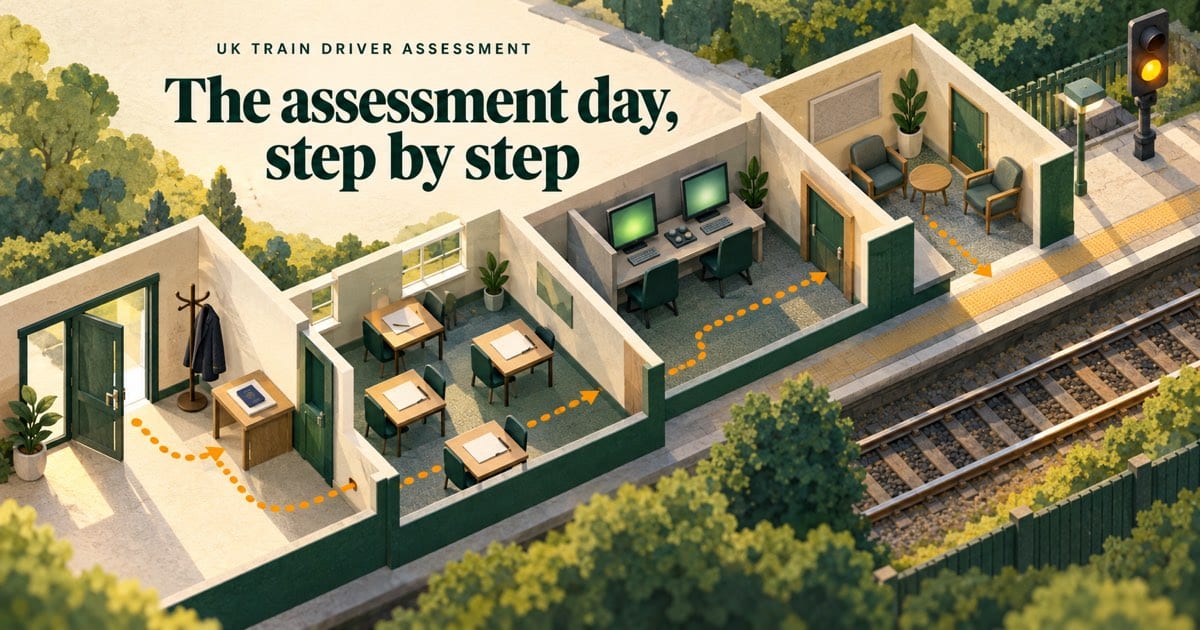
The day in order
The OPC, one of the registered assessment centres, says you will "probably sit some or all" of the standard's exercises, as a mixture of paper and pencil tests and computer-based tests, and that some companies add their own. It also warns: "The day is long", so dress to be comfortable. No source we read gives clock times, so this is an illustrative order, not a timetable; companies split the day differently:
ProSyllabus summary of The OPC's candidate guide (04/12/2024), RSSB's 3751-FAQ and Translink's policy HR023 v1.5, Appendix B. No source we read gives clock times, and companies split the tests and the interview differently (see the company table below). The OPC says you will probably sit "some or all" of these tests.
| Stage | What happens | Source |
|---|---|---|
| Arrival | You show photo ID (passport or driving licence) and proof of your National Insurance number; the company tells you what else to bring | RSSB 3751-FAQ, question 16 |
| Before each test | Instructions; you may be able to try some examples, and the assessor can help with them; ask every question before the test time starts | The OPC guide, page 5 |
| During each test | Complete silence; no questions to anyone once the test time has started; you may be tested alongside other applicants | The OPC guide, page 5 |
| Paper tests | Group Bourdon and TEA-Occ (attention), TRP part 1b (memory), TRP part 2 (reasoning) | Translink HR023, Appendix B; RSSB table 1 |
| Computer tests | WAFV (vigilance, reaction time), ATAVT (perception, reaction time), two-hand coordination, Situational Judgement Exercise | Translink HR023, Appendix B; RSSB table 1 |
| Breaks | At Translink, several breaks, and applicants are told at these points whether they have met the standard to go on to the next set of tests | Translink HR023, Appendix B |
| Interview | The Multi-Modal Interview: you complete a form first, then answer detailed questions about examples from your own past experience | The OPC guide, page 4 |
What each test measures, and how to prepare for each, is in our guide to every train driver psychometric test. The two paper attention tests have their own guides: Group Bourdon practice and the TEA-Occ.
Stage 1, stage 2: how companies split the process
There is no single "stage 1" and "stage 2": companies number their stages differently, and the interview is not always on the test day. The official pages we read:
| Company | Stages it publishes | Source |
|---|---|---|
| Northern | 1 online application; 2 interview with the Driver Management Team in Leeds; 3 the RSSB psychometric assessments, passed to an enhanced standard, in three main stages: paper assessments, computer assessments and a multimodal interview, at its own assessment centre in Leeds; 4 medical; 5 offer and training | Northern careers page |
| Avanti West Coast | 1 application; 1.5 online sift (distance and previous attempts, checked by The OPC); 2 OPC online questionnaire, Visual Search Exercise and Magnificent 7 Situational Judgement Test; 3 OPC assessment centre, paper tests (Group Bourdon, TEA-Occ, TRP 1 and 2); 4 OPC face-to-face assessment centre, computer tests ("Vienna tests") and a competency based interview; 5 driver manager interview, then the talent bank | Avanti West Coast careers page |
| Great Western Railway | Application (CV and questions); psychometric assessments "in stages"; interview with the Driver Management team; an offer, usually into a talent pool, subject to a medical with drugs and alcohol screening | GWR training manager, FirstGroup careers site |
| Southeastern | Its general recruitment-process page describes an online assessment provided by Arctic Shores, an interview (it publishes a selection of the questions to help you prepare), then a talent pool for trainee drivers, and a medical once a position is available. Its trainee driver advert says offers are subject to references, right to work, a basic criminal record check and a pre-employment medical | Southeastern careers pages |
| Translink (Northern Ireland) | Application form; online MiniSCAAT; formal interview; assessment centre (the standard's tests); then the multi-modal interview by separate invitation; then a waiting list and a medical | Translink HR023, Appendix B |
None of the sources we read describes GTR's current stages, so we do not describe them. The OPC's 2020 list records "GTR/Southern" as using an enhanced standard; ask GTR what applies now. In general, The OPC says that after you pass the tests and interview, the usual next step is a final interview with a manager or HR (some companies hold it before the tests), then a medical, after which the company may carry out other checks.
What to bring, wear and eat
The checklist from the official sources
- Bring: photo ID (passport or driving licence) and proof of your National Insurance number, such as a payslip or NI card (RSSB), plus anything the company asks for.
- Not needed: pencils, paper and the like: everything is supplied (The OPC).
- Glasses or contact lenses: bring them if you usually wear them, so that you can see the test paper or screen clearly (The OPC).
- Wear: smart but comfortable, smart casual (RSSB); the day is long, so be comfortable, and dress for the weather (The OPC).
- Eat: breakfast before the session (The OPC).
- Sleep: go to bed early and get a good night's sleep (The OPC). A meta-analysis found that short-term total sleep deprivation harms attention (Lim and Dinges, 2010).
- Travel: know exactly where the centre is and allow for severe delays such as cancelled trains or heavy traffic (The OPC).
RSSB 3751-FAQ, question 16; The OPC candidate guide (04/12/2024): glasses on page 4; sleep, pencils and breakfast on page 5; travel and ID on page 6; dress on page 8.
| If… | What the sources say |
|---|---|
| you are running late | Tell the assessment centre as soon as you can, with an estimated arrival time. You may be accommodated, or turned away if you arrive after the start time; then contact the train company (The OPC) |
| you cannot attend | Contact the company you applied to as soon as possible (RSSB); it may offer another date (The OPC) |
| you need adjustments | Ask the train company's recruitment team as soon as possible, with evidence of your disability or condition, including neurodiversity; without prior notice, support is not guaranteed (RSSB). Translink says adjustments cannot be requested on the day |
| you are ill or have just had a bereavement | Translink asks candidates to declare that they are fit to sit, and advises those with circumstances that will affect their performance not to attend that session. Our advice for other companies: tell them before the day |
The week before: once the practice materials arrive
RSSB says invited candidates are given the approved practice materials at least a week before the assessment; The OPC says at least 7 days, sent by the company you applied to. Their purpose, in RSSB's words, is to let you "familiarise" yourself with what to expect. Translink says its own come with correct responses. If yours have not arrived, contact the train company.
7 days before your assessment
One short task a day, plus a few minutes of attention practice
| Day | Task | Concentration run (our trainer) |
|---|---|---|
| 7 days before | Practice materials should have arrived (RSSB: at least a week before). Read every set of instructions once, slowly. If they are not there, contact the train company today. | Level 1, one run: your baseline |
| 6 days before | Work through the approved materials exactly as their instructions say. | One run at your highest cleared level |
| 5 days before | Plan the journey: where the centre is, how long it takes, a back-up route. Allow for cancelled trains or heavy traffic (The OPC). | Two runs; note missed and wrong marks apart |
| 4 days before | Write down two or three examples from your own life for the interview: what you did, not what others did (The OPC). | One run, then read your errors by row |
| 3 days before | Go back over any part of the approved materials you found hardest. | Two runs at the same level: hold accuracy |
| 2 days before | Find your photo ID and proof of your National Insurance number; put your glasses or lenses with them. | One short run only |
| The day before | No long practice session (our advice). Go to bed early (The OPC). | Optional: one level 1 run to stay warm |
Each run takes a few minutes: level 1 is three 40-second sheets, free with no sign-in. The approved materials always come first; the runs only keep your attention habit warm.
Our plan, not official guidance. Independent practice by ProSyllabus, not the official test and not a copy of it; not produced or checked by RSSB, an assessment centre or a train company.
After the day: results and what comes next
| Question | Answer |
|---|---|
| When will I hear? | The OPC's guide says results go to the company, which contacts you, typically in 5 to 10 working days; its information sheet tells candidates to expect the outcome from the company within 7 to 10 working days. For some companies or assessments you are told on the day |
| Who tells me? | The company you applied to or The OPC, and not always on the day itself (The OPC) |
| Who owns my results? | The company you applied to, not you or the centre; they sit on the national RACF database (The OPC) |
| If I pass | Usually a final interview with a manager or HR; if you are successful there, a medical; after the medical, the company may carry out other checks such as references or criminal record checks (The OPC). Some companies keep successful candidates in a pool until a vacancy opens, at different points: GWR offers a talent-pool place subject to a medical; Southeastern pools you after the interview and holds the medical when a position is available; Avanti's final stage leads to its talent bank; Translink holds a waiting list, then calls applicants to the medical |
| If I fail | Ask for feedback (with The OPC, request it within 3 months). The retake rules are in our guide to pass rates and retakes |
The medical comes after the tests. ORR's guide lists what the pre-appointment medical must include as a minimum: a general medical examination, vision (including colour perception), hearing, blood or urine tests where needed, an ECG at rest, tests for drugs and alcohol, and cognitive, communication and psychomotor tests; it adds that those last three are usually covered by the occupational psychological fitness examination, which the doctor should confirm you have passed. Northern's page adds that applicants must not have defective colour vision. For the retake rules and feedback, read train driver assessment pass rate and retake rules.
Between now and your invitation
Build the attention habit before the pack arrives
Short timed runs of dot-group sheets, with your misses and wrong marks counted apart and your first half compared with your second. Level 1 is free; for what to aim for, see how the Group Bourdon is scored.
Try level 1 freeIndependent practice by ProSyllabus. Not the official test, not a copy of it, and not produced or checked by RSSB, an assessment centre or a train company.
Frequently asked questions
Can I wear glasses for the train driver assessment?
Yes. The OPC asks you to bring your glasses or contact lenses if you usually wear them, so that you can see the test paper or screen clearly.
How long is a train driver assessment day?
No source we read gives a length in hours. The OPC says the day is long, so wear something comfortable. Some companies split the tests across stages: Avanti West Coast, for example, holds the paper tests and the computer tests as separate stages.
Do you get your results on the same day?
Sometimes. The OPC says that for some companies or assessments you are told on the day; otherwise the company contacts you, typically in 5 to 10 working days. Translink tells applicants at breaks whether they have met the standard to go on.
What should I wear to a train driver assessment?
Smart casual: smart but comfortable (RSSB), and dressed for the weather (The OPC).
Do I need to bring a pencil?
No. The OPC says you will not need pencils or paper: everything is supplied. Bring photo ID and proof of your National Insurance number.
Is the interview on the same day as the tests?
It depends on the company. Northern lists the multimodal interview within its psychometric assessments; Translink invites successful applicants to the multi-modal interview after the assessment centre; Avanti holds a competency based interview at its computer-test stage and a driver manager interview later.
What happens if I am late?
Tell the assessment centre as soon as you can. The OPC says it may be able to accommodate you, but you may be turned away if you arrive after the start time, and then you need to contact the train company.
Can I ask questions during the tests?
Only before the test time starts. The OPC says you are not allowed to ask anyone questions once the actual test time has started, and the tests are done in complete silence.
The concentration trainer
Ten levels of timed attention practice, with missed and wrong marks counted apart
- Level 1 free with no sign-in; levels 2 to 10 unlock with one payment, no subscription.
- From 48 to 126 groups a sheet, three to six sheets a run, 40 to 50 seconds a sheet.
- Freshly generated sheets for every run, so you are not repeating a sheet you have learned.
- Accuracy, groups per minute, missed and wrong marks by sheet and by row, and your first half against your second half.
The price is on the trainer page.
Start with level 1 freeIndependent practice by ProSyllabus. Not the official test, not a copy of it, and not produced or checked by RSSB, an assessment centre or a train company.
Every test in the standard is explained in our hub guide to the train driver psychometric tests, and what free practice exists is compared in free train driver practice tests. Our guides on this assessment are collected on the UK train driver exam page.
Sources
- official — RSSB and the Rail Assessment Centre Forum: 3751-FAQ, "Frequently asked questions", issue one, on RIS-3751-TOM issue four "Psychometric Assessment in Train Driver Selection" (read 23 Oct 2026): the tests by selection criterion, attempts, pass marks, validity, practice materials, minimum age
- official — The OPC (a registered assessment centre): "Train Driver Assessment: A guide for candidate's who undertake their assessment with The OPC" (read 23 Oct 2026): the tests, hints and tips, the day, results and feedback
- official — The OPC: candidate information sheet (7/12/24; read 23 Oct 2026): when the outcome arrives, attempts and waiting periods, feedback
- official — Translink: train driver psychometric testing policy, HR023 version 1.5 (read 23 Oct 2026): Translink's train driver assessment process, Appendix B
- official — Office of Rail and Road: "A guide to the occupational psychological fitness and medical requirements" (read 23 Oct 2026): the occupational psychological fitness examination, RIS-3751-TOM, the three-attempt rule
- official — Northern: "Train Driver" careers page (read 23 Oct 2026): eligibility, the five stages, the enhanced standard and its Leeds assessment centre
- official — Avanti West Coast: "Train Driver Recruitment" careers page (last updated 23 January 2025; read 23 Oct 2026): application stages 1 to 5, with the stage 1.5 online sift
- official — FirstGroup careers, "Talk to our insiders": answer by a Great Western Railway Customer Services Training Manager on the train driver process (30 May 2025; read 23 Oct 2026)
- official — Southeastern: "Recruitment process" careers page, general (read 23 Oct 2026): online assessment, interview, talent pools, medical
- official — Southeastern: "Trainee Train Driver" advert (closing date 1 January 2026; read 23 Oct 2026): requirements, the checks offers are subject to, waiting six months to re-apply
- official — The OPC: "Assessment Advice - Train Driver Assessment - Which organisations use which standard?" (dated 01/09/2020; read 23 Oct 2026): organisations that gave permission to be listed, national or enhanced standard
- official — Lim, J. and Dinges, D. F. (2010). "A meta-analysis of the impact of short-term sleep deprivation on cognitive variables." Psychological Bulletin 136(3), 375-389 (PubMed record read 23 Oct 2026)
official = a document published by the conducting body. reported = a news or coaching site we could not check against an original. Where sources disagree this page says so rather than picking one.