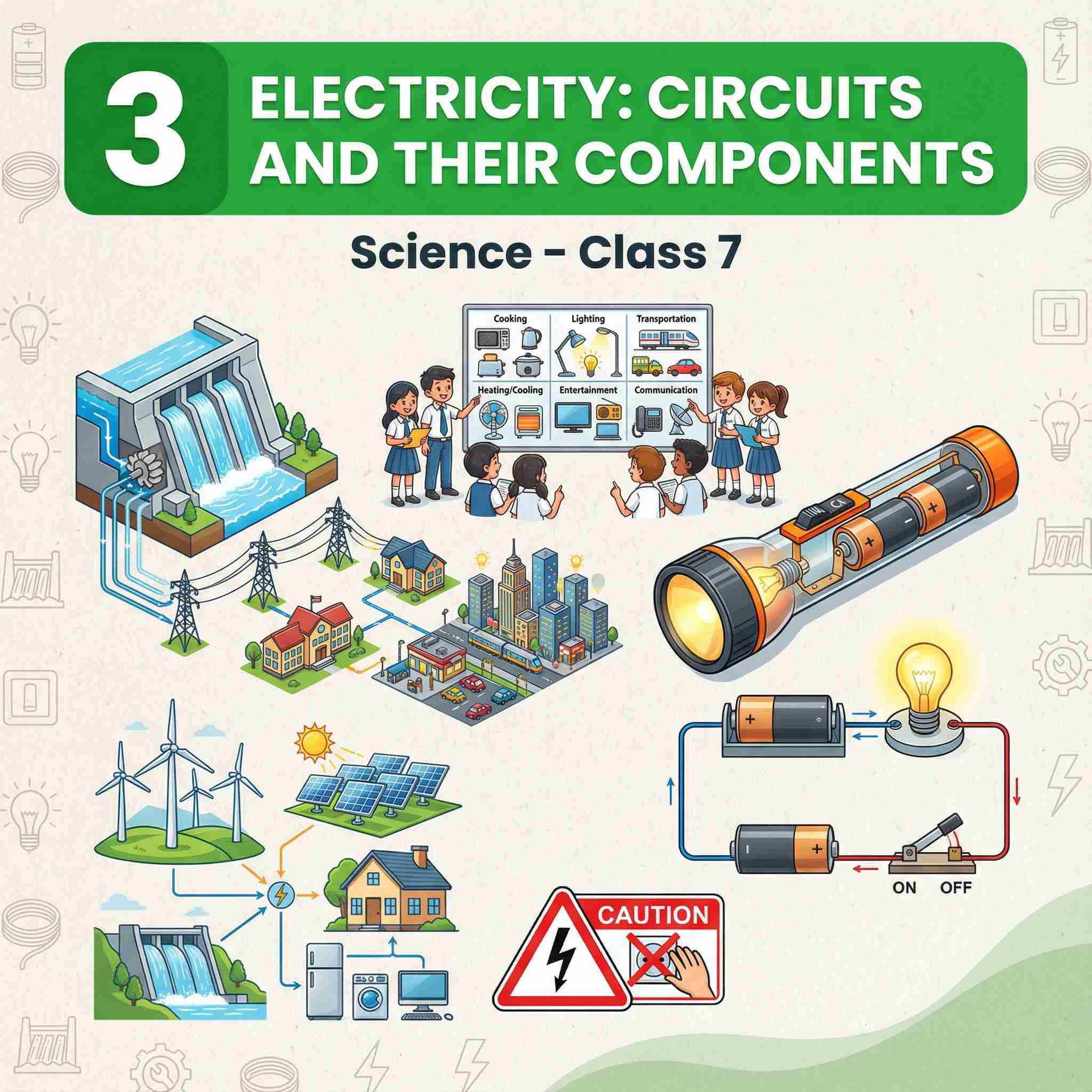
Complete Summary and Explanation of Electricity: Circuits and their Components – Curiosity/NCRT Class 7 Science Chapter 3 – Full Chapter Notes, Torchlight Activity, Uses of Electricity, Safety Rules, Components, and Solutions
A detailed, super-easy and student-friendly explanation of Curiosity Class 7 Science Chapter 3 “Electricity: Circuits and their Components” covering school trip to Bhakra Nangal Dam, uses of electricity in daily life (cooking, lighting, transportation, heating-cooling, entertainment, communication, others), sources of electricity (hydroelectric, wind, solar), danger of touching electric poles and mains supply, why we must use only cells/batteries for experiments, torchlight exploration (Activity 3.1), parts of a torch (cell, bulb, switch, reflector, spring, metal strips), why the bulb glows only in one switch position, open & closed circuit concept, how a torch produces light, precautions, and all textbook questions & answers.
Updated: just now
Categories: NCERT, Class 7, Science, Chapter 3, Electricity, Circuits and Components, Torchlight Activity, Uses of Electricity, Bhakra Nangal Dam, Safety Rules, Electric Cell, Switch, Bulb, Simple Circuit, Renewable Energy, Curiosity Textbook, School Notes, Summary, Explanation
Tags: class 7 science chapter 3, electricity class 7 notes, curiosity class 7 chapter 3, electricity circuits and components, torchlight activity class 7
Electricity: Circuits and Components – Class 7 Chapter 3
Electricity: Circuits and Components
Class 7 Science — Chapter 3 | Curiosity Textbook of Science | Study Guide, Activities & Quiz
Full Chapter Summary & Detailed Notes
Overview
This chapter introduces electric cells and batteries, lamps (incandescent and LED), electric circuits, switches, circuit diagrams, and the difference between conductors and insulators. It explains how a torch works and gives simple activities to understand circuit construction and testing.
Context & Story
Nihal's school trip to Bhakra Nangal Dam and the group's assignment to list uses of electricity set the stage for this chapter. They discover many real-life applications (lighting, communication, heating/cooling, transport) and then focus on portable sources like cells and batteries. (Content source: Chapter 3 PDF). :contentReference[oaicite:2]{index=2}
Key Sections
A torchlight: Components inside—cells, lamp, switch. How changing the switch position makes the lamp glow or not.
Electric cell & battery: Positive and negative terminals; connecting cells in series to make a battery.
Lamps: Incandescent lamp (filament) and LED (directional current; longer lead = positive).
Making a lamp glow: How to connect lamp, cell(s) and wires to complete a circuit.
Switches: How a simple switch completes or breaks a circuit (ON/OFF positions).
Circuit diagrams: Symbols for cells, battery, lamps, LED, switch and wires.
Conductors & insulators: Metals conduct electricity; plastics, rubber and ceramics are insulators.
Fig. 3.1 – A Torchlight
Typical torch contains two or more cells, a lamp (incandescent or LED), and a switch. Cells provide portable electric energy to the lamp when the circuit is complete.
In a nutshell:
An electric cell is a portable source of electrical energy having two terminals: + (positive) and − (negative).
Incandescent lamp glows when current passes through its filament; LED glows only if connected in correct direction (longer lead → positive).
A complete path (circuit) is required for current flow; switches open/close the circuit.
Metals are good conductors; rubber, plastic, glass are insulators. Safety caution: never experiment with mains supply — use cells for experiments. :contentReference[oaicite:3]{index=3}

Key Definitions & Terms
Electric cell
A portable source of electrical energy with two terminals (+ and −). Example: torch cell.
Battery
Combination of two or more cells connected in series to provide longer life or higher voltage.
Incandescent lamp
A lamp with a filament that gets hot and glows when current passes through it.
LED (Light Emitting Diode)
A diode that emits light when current passes in one direction; has a longer lead (positive) and shorter lead (negative).
Electric circuit
A complete path through which electric current can flow.
Switch
A device that completes (ON) or breaks (OFF) an electrical circuit.
Conductor
Material that allows electric current to pass through easily (e.g., copper, aluminium).
Insulator
Material that prevents the flow of electric current (e.g., rubber, plastic, glass).
Filament
The thin wire inside an incandescent lamp that glows when heated by current.
Terminal
The point of connection on a cell, lamp, or battery (marked + and −).
Tip: Keep this glossary handy while doing activities and drawing circuit diagrams.
Activities & Observations (from the textbook)
Activity 3.1 – Exploring a Torchlight
What to do
Take a torch, observe the lamp and switch.
Slide the switch — note whether the lamp glows or goes off.
Open the torch and observe cells inside — their arrangement matters for the lamp to glow.
Activity 3.2 – Observe an Electric Cell
What to do
Look for + and − signs, the protruding metal cap (positive) and flat metal disc (negative).
Discuss why the cell is a portable source of electrical energy.
Activity 3.3 – Making a Battery
What to do
Use two or more cells; place them so positive of one connects to negative of the next (series connection).
Observe lamp glow with cells placed correctly vs reversed.
Activity 3.6 – Construct a Simple Circuit
Materials
Electric cell, incandescent lamp, cell holder, lamp holder, wires.
Procedure & Observations
Strip wire ends, connect cell to lamp via wires and holders (or tape if holders not present).
Predict whether lamp will glow in different arrangements; observe and fill Table 3.1.
Only arrangements with a complete path (circuit) allow current to flow and lamp to glow. (See textbook examples). :contentReference[oaicite:4]{index=4}
Activity 3.7 – Making an LED Glow
Use two cells in holder, connect longer LED lead to battery +, shorter to battery −.
LED glows only when connected in correct polarity. If reversed, it will not light.
Activity 3.8 & 3.9 – Make a Simple Switch
Use drawing pins and a safety pin mounted on cardboard to make a rotating switch.
Connect it in a circuit; touching the drawing pins closes the circuit (ON), separating opens it (OFF).
Key Concepts — Quick Reference
Series Connection
Cells placed positive to negative increase total voltage (useful to power devices requiring higher voltage).
Polarity & LED
LED is direction-sensitive: positive lead (longer) must connect to positive terminal of battery.
Complete vs Open Circuit
A complete (closed) circuit allows current flow and devices glow; an open circuit prevents flow.
Switch Function
Switches complete or break circuits and can be placed anywhere in the circuit.
Conductors vs Insulators
Conductors (metals) carry current; insulators (rubber/plastic/ceramic) prevent current and provide safety.
Fused Lamp
A filament that is broken prevents current flow — the lamp 'fuses' and does not glow.
Tip: When troubleshooting, check arrangements, loose connections, fused filament, and cell orientation.
Circuit Diagrams & Symbols
Use standard symbols to draw circuit diagrams — they make representation simpler and universal.
Component
Symbol
Notes
Electric Cell
Long line ( + ) and short line ( - )
Long = positive terminal
Battery
Multiple cell symbols in series
Shows combined voltage
Electric Lamp (incandescent)
Circle with filament or simple bulb icon
Filament glows when current flows
LED
Triangle with line + arrows
Direction matters; arrows indicate light emission
Switch (ON/OFF)
Break in line with movable contact
Opens/closes circuit
Wire
Line
Connects components
Fig. 3.14 – Circuit Diagrams
Examples: (a) incandescent lamp circuit diagram (b) LED circuit diagram — use symbols to draw the circuits you build.
Conductors and Insulators
Explore different materials to identify conductors and insulators using a simple conduction tester (cell + lamp + wires).
Activity 3.11 – Identify Materials
Materials to test
Metal spoon, coin, key, pin, aluminium foil (expected: conductor)
Wood, rubber, plastic scale, cork, glass, paper (expected: insulator)
Test and note whether lamp glows (Yes = conductor, No = insulator).
S.No.
Object
Material
Lamp Glows?
Conclusion
1
Spoon
Metal
Yes
Conductor
2
Plastic scale
Plastic
No
Insulator
3
Glass
Glass
No
Insulator
4
Key
Metal
Yes
Conductor
Why use metals? Metals (silver, copper, gold) are excellent conductors; copper is commonly used due to availability and cost. Insulators protect us from shocks — why wires are covered by plastic or rubber.
Examples & Step-by-step Explanations
Example 1 — Will the lamp glow?
Scenario: Lamp connected to a single cell with wires completing a closed loop.
Answer: Lamp will glow because circuit is complete and current flows through filament (if filament intact).
Example 2 — LED not glowing
Scenario: LED is connected but not glowing after swapping wires.
Answer: Check LED polarity — LED lights only when anode (longer lead) is connected to + and cathode to −. Also check cells and connections.