Still Life in Colour
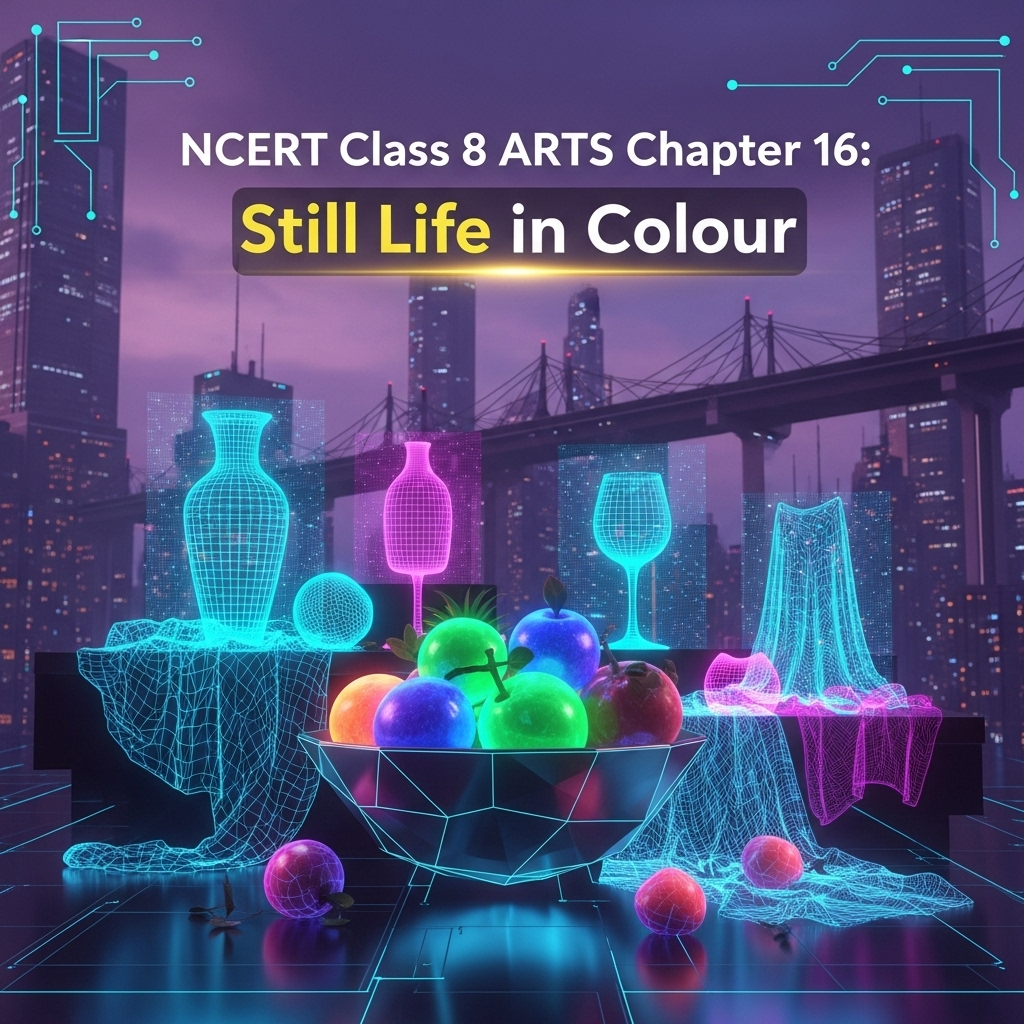
Chapter 16: Still Life in Colour
Complete Study Guide with Interactive Learning
Chapter Overview
What You'll Learn
History of Still Life
From symbolic objects in ancient art to main subject in 16th century.
Symbolic Meanings
Objects like Dharma Chakra, weapons, instruments in Indian art.
Activity 16.1
Arranging still life with objects, backdrop, and composition.
Modern Uses
Still life in ads, photography, sculptures beyond painting.
Historical Context
In Indian art, objects were symbolic in cave paintings, temple sculptures (e.g., wheel of law, swing). 16th century shift: objects main subject, arranged still, painted 3D/lifelike, called still life.
Key Highlights
Still life focuses on composition with varying objects; create visually interesting arrangements exploring contour/form/color/texture; used in ads; activity on choosing/arranging/drawing personal objects.
Comprehensive Chapter Summary
1. History of Objects in Art
From cave paintings to temple sculptures, objects integral but not main subject; depicted for symbolic meanings in composition, e.g., Dharma Chakra (wheel of law), weapons/musical instruments held by deities/courtiers.
2. Emergence of Still Life
16th Century Change
Objects became main subject; artists arranged/studied natural/human-made still objects.
Skill in Painting
Make appear three-dimensional/lifelike, hence called still life.
Mediums
Not restricted to drawing/painting; also photographs, sculptures.
3. Modern Applications
Advertisements
Used for product ads in magazines/hoardings/newspapers/TV.
A Few of My Favourite Things
Visually interesting compositional arrangement; explore contour/form/color/texture/relations; small groups by shared interests.
4. Activity 16.1: Arranging a Still Life
Step 1: Choosing Objects
Everyday/culture conveying identity (basket/clock/ball/toy/shoes/trophies/flowers/fruits); rare/unusual by local artists; 3-4 varying materials/colors/textures/sizes/dimensions.
Step 2: Choosing Backdrop
1-2 large single-colored cloth complementing, not distracting; or other material for plain backdrop focusing objects.
5. Composition Importance
Visually interesting leads eye to explore every object/perceive contour/form/color/texture/relate to others.
Key Concepts and Definitions
Still Life
Artworks where arranged still objects main subject, appear 3D/lifelike.
Symbolic Objects
In Indian art, convey meanings, integral to composition (Dharma Chakra/swing).
Composition
Visually interesting arrangement exploring contour/form/color/texture/relations.
Backdrop
Plain/single-colored complementing objects, not distracting.
Object Selection
Varying materials/colors/textures/sizes/dimensions; everyday/rare/local.
Modern Still Life
Photography/sculptures/ads beyond painting.
Important Facts and Figures
Questions and Answers from Chapter
Short Questions
Q1. What were objects in ancient art?
Q2. How depicted in Indian art?
Q3. Example of symbol?
Q4. When big change?
Q5. What became main subject?
Q6. What artists interested in?
Q7. Skill in painting?
Q8. Why called still life?
Q9. Not restricted to?
Q10. Also in?
Q11. Used for?
Q12. In what media?
Q13. Important in still life?
Q14. Leads eye to?
Q15. Perceive what?
Medium Questions
Q1. Describe objects in ancient art.
Q2. Give examples of symbols.
Q3. What change in 16th century?
Q4. Skill in still life painting?
Q5. Still life in other forms?
Q6. Modern use of still life?
Q7. Importance of composition?
Q8. Make small groups how?
Q9. Step 1: Choosing objects.
Q10. Examples of objects?
Q11. Step 2: Backdrop.
Q12. If no cloth?
Q13. What in Kangra painting?
Q14. What in Sanchi Stupa?
Q15. Why enjoy making?
Long Questions
Q1. Discuss objects in Indian art history.
Q2. Explain emergence of still life.
Q3. Describe still life in various mediums.
Q4. Analyze importance of composition.
Q5. Discuss grouping for activity.
Q6. Explain Step 1: Choosing objects.
Q7. Describe Step 2: Choosing backdrop.
Q8. How make still life visually interesting?
Q9. Discuss symbolic examples.
Q10. Explain why called still life.
Q11. How objects in ads?
Q12. Describe activity preparation.
Q13. Why choose personal objects?
Q14. What varying in objects?
Q15. Purpose of backdrop?
Interactive Knowledge Quiz
Test your understanding of Still Life in Colour
Quick Revision Notes
History
- Symbolic in ancient
- Main subject 16th cen
- 3D/lifelike
Mediums
- Painting/photo/sculpture
- Ads in media
- Composition key
Activity
- Choose objects
- Backdrop
- Varying attributes
Examples
- Dharma Chakra
- Swing in Kangra
- Personal favorites
Exam Strategy Tips
- Describe history
- Explain still life
- Activity steps
- Composition importance
- Modern uses