Checked 7 October 2026. The cut-offs are from the SSC final result write-up of 15.01.2026 (Examination 2025) and its shortlisting write-ups of 17.06.2025 and 13.10.2025. They are for a different exam cycle, normalised by the older formula. The result of the 2026 exam was not out on 7 October 2026 and its cut-offs will differ; do not use these as a forecast. Results of withheld candidates were sent in a sealed cover to CRPF and are not in the numbers.
In the 2025 Constable (GD) final result, the last selected unreserved man in a general-area row had between 48.43 and 145.88 marks out of 160, with a median of 101.73; for women the range was 49.88 to 142.71 with a median of 106.58. Those are our summaries of 183 male and 125 female state, force and area rows in Annexures II and IV of the final result write-up of 15 January 2026. A "cut-off" there is the normalised marks (with NCC bonus) of the last candidate selected in a force, state, area and category; there is no single cut-off. The 2026 exam has half the posts and a different normalisation, and its result had not been declared by 7 October 2026, so read these as last cycle's evidence.
The counts are printed in the three SSC write-ups; the 15.6 per cent is our division.
ProSyllabus is an independent study site. We are not affiliated with, or endorsed by, the Staff Selection Commission, the Ministry of Home Affairs or any Central Armed Police Force. Every rule below is quoted or summarised from their published documents, and every sum, ratio or estimate is labelled as our own arithmetic. We print no candidate names or roll numbers.
From 25 lakh to 50,047: the 2025 funnel
| Stage | Count | Share of stage above (our division) | Source |
|---|---|---|---|
| Appeared in the computer based exam | 25,21,839 | - | Write-up of 17.06.2025 |
| Shortlisted for PET/PST (40,213 women, 353,908 men) | 3,94,121 | 15.6% | Write-ups of 17.06.2025 and 13.10.2025 |
| Qualified in PET/PST (including 352 withheld) | 1,26,736 | 32.2% | Write-up of 13.10.2025 |
| Shortlisted for DME / document verification | 95,575 | 75.4% | Final write-up of 15.01.2026 |
| Recommended for appointment (para 7) | 50,047 | 52.4% | Final write-up of 15.01.2026 |
Posts available were 53,690, so 50,047 recommended candidates leave 3,643 posts unfilled (our subtraction), which SSC says the forces carry to the next cycle; it also notes that four posts for women were kept vacant for temporarily unfit candidates and 84 posts for men were held under court orders. Results of 2,003 candidates were withheld and a further 345 were debarred and not processed. Three counts do not agree with one another and we print them rather than pick: paragraph 13 of the final write-up lists 4,817 women and 43,296 men recommended (48,113), while paragraph 7 gives 4,932 and 45,115 (50,047); the DME/DV shortlisting write-up lists 9,179 women and 86,085 men (95,264), while the final write-up says 95,575; and the annexure "Filled" columns for men sum to 45,102 against 45,115 printed. The category and gender totals in paragraph 7 are the ones the write-up itself calls recommended, so we use them.
| Category | Women: posts | Women: recommended | Men: posts | Men: recommended |
|---|---|---|---|---|
| SC | 799 | 737 | 7,056 | 6,826 |
| ST | 597 | 578 | 5,355 | 5,299 |
| OBC | 1,155 | 1,036 | 10,573 | 9,854 |
| EWS | 528 | 405 | 4,767 | 3,720 |
| UR | 2,291 | 2,176 | 20,569 | 19,416 |
| Total | 5,370 | 4,932 | 48,320 | 45,115 |
EWS is the category that went most unfilled: 405 of 528 posts for women (76.7 per cent) and 3,720 of 4,767 for men (78.0 per cent), a pattern that fits the many EWS candidates who qualified at the UR standard and were counted there (2,090 EWS men and 188 EWS women selected at UR standard). The percentages and the link to the UR-standard counts are our reading; the write-up gives the figures, not the reason.
Cut-off by category: the national picture
The next tables summarise the "Cut-off marks" column of the general-area rows for each category, men and women. The range is wide because the rows span forces and states; the median is the typical last selected mark. The width of the range is the main message: the same category closes anywhere from the high 40s to the high 140s depending on the state and force.
| Category | Men: rows | Men: lowest | Men: median | Men: highest | Women: rows | Women: lowest | Women: median | Women: highest |
|---|---|---|---|---|---|---|---|---|
| UR | 183 | 48.43 | 101.73 | 145.88 | 125 | 49.88 | 106.58 | 142.71 |
| OBC | 138 | 47.14 | 113.20 | 145.85 | 89 | 71.80 | 108.83 | 140.15 |
| EWS | 122 | 42.57 | 105.30 | 144.09 | 68 | 66.18 | 103.28 | 141.74 |
| SC | 139 | 46.20 | 104.51 | 140.39 | 79 | 59.54 | 104.72 | 136.66 |
| ST | 142 | 40.24 | 94.07 | 138.91 | 66 | 44.59 | 93.30 | 132.88 |
Our median of the printed cut-offs of the force and state rows in the general area (Annexures II and IV).
Reserved categories do not always close below UR. A reserved candidate who qualified at the UR standard counted under UR, which leaves the reserved rows to those who did not; and where a reserved category has few candidates the last selected mark can be low. Compare the lowest values: the lowest general-area ST cut-off for men is 40.24 and the lowest SC cut-off for women 59.54, while the highest UR cut-off for men is 145.88.
Cut-off by force: UR, general area
Forces differ. Allocation to a force is by merit and the order of preference, so the force with the most popular posts closes higher. The table gives, for each force, the lowest, median and highest last-selected UR marks across the states in which it recruited in the general area.
| Force | Men: state rows | Men: lowest | Men: median | Men: highest | Women: median | Women: highest |
|---|---|---|---|---|---|---|
| BSF | 32 | 48.92 | 91.88 | 137.35 | 98.75 | 138.50 |
| CISF | 32 | 48.43 | 106.14 | 142.30 | 110.16 | 142.71 |
| CRPF | 32 | 50.21 | 91.47 | 138.62 | 106.58 | 142.00 |
| SSB | 26 | 70.94 | 121.02 | 145.88 | no posts | - |
| ITBP | 31 | 52.95 | 101.73 | 139.49 | 106.57 | 138.08 |
| AR | 30 | 58.35 | 111.67 | 139.88 | 108.44 | 141.28 |
All-India rows are separate: SSF UR men closed at 150.75, NCB UR men at 152.04 and NCB UR women at 149.13, which are higher than any state row for UR, because those posts are filled from the whole country rather than one state. There were no SSF posts for women. In 2026 NCB is not in the notice's vacancy list and SSF has 23 posts.
State-wise UR cut-offs: called to PET/PST, and last selected
For each state the table shows two numbers for unreserved candidates in the general area: the marks of the last candidate shortlisted for the PET/PST in the write-up of 17 June 2025, and the range of the last selected marks across the forces in the final result. The gap between the two is how much higher than the call line a candidate had to be to end up selected, and it depends on the force. Where a state has no general-area row (some border states) the cell shows a dash.
| State or UT | Men: PET call | Men: final range | Women: PET call | Women: final range |
|---|---|---|---|---|
| Andaman & Nicobar | 60.63 | 108.01 | - | - |
| Andhra Pradesh | 83.09 | 92.09 to 113.84 | 91.86 | 97.17 to 111.59 |
| Arunachal Pradesh | 48.03 | 52.27 to 85.84 | 49.58 | 49.88 to 58.19 |
| Assam | 48.15 | 75.42 to 105.63 | 54.69 | 74.74 to 96.36 |
| Bihar | 116.84 | 128.20 to 141.31 | 113.57 | 122.78 to 131.86 |
| Chandigarh | 76.32 | 89.37 to 117.12 | 89.70 | 98.75 to 98.85 |
| Chhattisgarh | 81.73 | 98.12 to 116.81 | 95.12 | 112.43 to 119.28 |
| Dadra & Nagar Haveli and Daman & Diu | 48.47 | 58.38 to 83.02 | - | - |
| Delhi | 108.12 | 116.89 to 130.50 | 119.64 | 122.38 to 130.22 |
| Goa | 48.47 | 60.75 to 75.66 | 48.99 | 55.96 to 85.77 |
| Gujarat | 80.66 | 92.37 to 121.97 | 82.67 | 92.24 to 106.79 |
| Haryana | 121.34 | 132.61 to 144.67 | 131.07 | 138.08 to 142.71 |
| Himachal Pradesh | 112.10 | 126.85 to 141.51 | 111.99 | 124.31 to 131.56 |
| Jammu & Kashmir | 62.05 | 84.13 to 120.06 | 63.14 | 63.65 to 75.18 |
| Jharkhand | 109.38 | 120.05 to 137.03 | 114.00 | 123.88 to 131.80 |
| Karnataka | 74.64 | 86.12 to 108.05 | 76.70 | 84.28 to 103.99 |
| Kerala | 58.84 | 58.91 to 76.78 | 95.69 | 96.99 to 106.79 |
| Ladakh | - | - | - | - |
| Lakshadweep | - | - | - | - |
| Madhya Pradesh | 118.61 | 129.44 to 144.44 | 125.45 | 131.93 to 137.92 |
| Maharashtra | 91.03 | 109.38 to 128.55 | 89.75 | 99.59 to 108.59 |
| Manipur | 58.31 | 80.07 to 93.27 | 64.49 | 76.46 to 87.24 |
| Meghalaya | 48.09 | 50.44 to 80.22 | 48.15 | 59.17 to 70.75 |
| Mizoram | 48.01 | 48.43 to 71.34 | 48.01 | - |
| Nagaland | 48.48 | 49.44 to 92.21 | - | - |
| Odisha | 82.22 | 96.31 to 118.20 | 90.88 | 99.15 to 112.35 |
| Puducherry | 48.63 | 51.06 to 67.18 | 48.43 | - |
| Punjab | 71.43 | 95.56 to 128.02 | 89.65 | 105.62 to 110.16 |
| Rajasthan | 125.42 | 137.35 to 145.88 | 128.16 | 137.03 to 140.24 |
| Sikkim | 48.54 | 77.73 | 51.29 | 58.93 |
| Tamil Nadu | 61.81 | 76.66 to 88.44 | 69.20 | 73.68 to 84.28 |
| Telangana | 71.92 | 71.94 to 101.48 | 80.76 | 84.83 to 95.99 |
| Tripura | 48.01 | 57.96 to 116.54 | 49.98 | 64.53 to 77.87 |
| Uttar Pradesh | 122.41 | 132.11 to 142.61 | 124.92 | 131.33 to 137.57 |
| Uttarakhand | 112.11 | 127.90 to 141.76 | 117.36 | 127.26 to 133.93 |
| West Bengal | 80.98 | 101.14 to 129.85 | 87.92 | 103.63 to 119.14 |
Among states with both a men's and a women's general-area row, the highest men's last-selected UR mark was in Rajasthan (145.88) and the lowest top mark in Goa (75.66); for women, Haryana (142.71) against Arunachal Pradesh (58.19). The heavily populated north and centre, Haryana, Rajasthan, Uttar Pradesh, Madhya Pradesh and Uttarakhand, close highest; the north east, the islands and small UTs close lowest, because fewer candidates compete for each post. That reading is ours; the notice states no cause.
Where would my marks have stood in last year's result?
Pick your domicile state, gender and category and enter your expected normalised marks out of 160 (add NCC bonus if you have it). The tool lists, from the 2025 final result, every force and area in that state with the last selected marks, and shows the gap to your score. It also shows the cut-off for being called to the PET/PST. These are last cycle's numbers, on the old normalisation and with twice the posts; they are not a prediction for 2026.
Source: Annexures II and IV of the final result write-up of 15.01.2026 and Annexures I and II of the PET/PST shortlisting write-up of 17.06.2025; counts and marks only. "Filled" is the printed number. A reserved-category candidate who qualified at the UR standard was counted under UR, so a reserved row can close lower than UR. Rows with no printed cut-off (no candidate selected) are omitted. Area: G general, B border guarding, N naxal/militancy affected.
How to use these numbers without fooling yourself
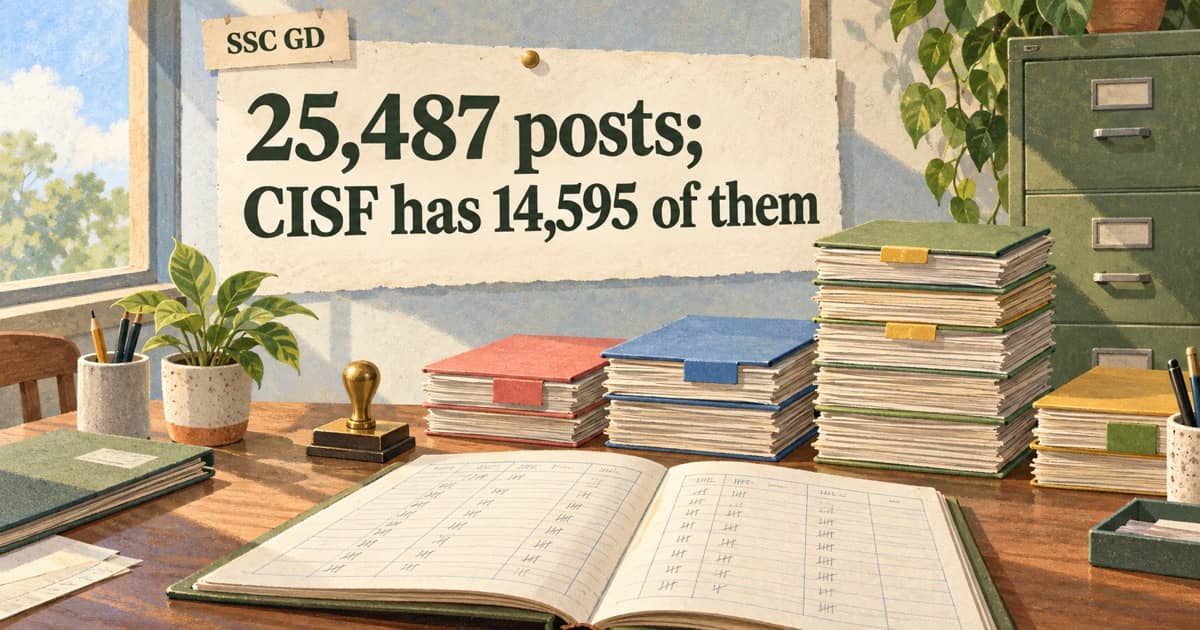
Three reasons they will not repeat. First, posts: the 2026 notice has 25,487 posts against 53,690, so the same applicants chase far fewer seats; the vacancy guide has the force-by-force and state-by-state comparison. Second, normalisation: 2025 used the formula of 2019, 2026 the equipercentile method, so a raw score does not map the same way (see the pattern and normalisation guide). Third, applicants and shifts: the 2026 exam had four weekly windows from 27 April, and we do not know how many candidates appeared because the result is not out. We make no forecast. What these tables can tell you is the spread: how far apart states, categories and forces were, and that the call to the physical test needs fewer marks than the final selection.
If you want a working target, use your own state's row in the table above. The line to be called to the PET/PST in your state and category is a floor; the last selected mark in your preferred force is a ceiling to aim above. Because shortlisting is about eight times the posts and the physical test removes about half of those who attend (see the PST and PET guide), the effective competition at the final stage is far smaller than the shortlist suggests.
Where other pages get this wrong
There is no single SSC GD cut-off; it is a table of marks of the last selected candidate for each force, state, area, category and gender, and the 2025 numbers come from a different normalisation.
Commonly published instead: One cut-off per category (for example "UR 147" or "OBC 140") quoted without a state, force or area, or a 2026 cut-off presented before SSC has declared the result.
In the 2025 final result the last selected unreserved man in a general-area row had 48.43 marks in one state and force and 145.88 in another. A number without a state, force and area is not an SSC figure.
Frequently asked questions
What was the SSC GD cut-off in the 2025 final result?
There is no single figure. For unreserved men in the general area, the last selected marks ranged from 48.43 to 145.88 out of 160 across the state and force rows of the general area (All-India SSF and NCB rows and the border and naxal areas excluded; median 101.73); for women 49.88 to 142.71 (median 106.58). The state and force table above gives the rows.
What is the SSC GD cut-off for 2026?
It does not exist yet. The 2026 computer based exam ran from 27 April to 31 May 2026, the tentative answer key was released on 15 June, and we found no result or cut-off on the SSC listings on 7 October 2026. Any 2026 cut-off published before the official result is an estimate.
What is the PET/PST call cut-off in SSC GD?
The marks of the last candidate shortlisted for the physical tests in a state, area and category. In 2025, for unreserved men in the general area it ranged from 48.01 to 125.42, and for unreserved women from 48.01 to 131.07. The notice says shortlisting is about eight times the posts. The state table gives each state.
Is the SSC GD cut-off higher for women?
Not by a fixed margin. For unreserved candidates in the general area the median last selected mark was 106.58 for women and 101.73 for men, and the ranges overlap widely. Compare within your own state and force using the table, not across genders.
Why do some states have a low cut-off?
The documents do not say. The pattern is that the north east, the islands and small UTs close lowest and Haryana, Rajasthan, Uttar Pradesh, Madhya Pradesh and Uttarakhand highest. We read that as fewer candidates per post, but SSC does not state a cause.
How many candidates were selected in SSC GD 2025?
The final result of 15 January 2026 recommended 50,047 candidates (4,932 women and 45,115 men) against 53,690 posts, with the category counts in paragraph 7 of the write-up. The separate lists in paragraph 13 give 48,113; the write-up does not reconcile the two.
Where can I see my own SSC GD marks?
Candidates shortlisted for medical and document verification in 2025 could log in to view final marks from 16 February to 1 March 2026. SSC says scorecards are not available after the window, so print yours. The 2026 marks will be handled through the candidate login too.
Sources
- official — SSC: Constable (GD) ... Examination, 2025 - Declaration of Final Result (write-up and Annexures I to IV, 87 pages, 15.01.2026)
- official — SSC: Examination 2025 - Shortlisting of candidates for PST/PET (write-up and Annexures I and II, 24 pages, 17.06.2025)
- official — SSC: Examination 2025 - Result for shortlisting for DME/DV (write-up and Annexures, 20 pages, 13.10.2025)
- official — SSC: Examination 2025 - Uploading of final marks (notice of 16.02.2026)
- official — SSC: Important Notice of 09.02.2026 on withheld results of Examination 2025 (sealed cover to CRPF)
- official — SSC: Notice of Constable (GD) in CAPFs and SSF, and Rifleman (GD) in Assam Rifles Examination, 2026 (74 pages, published 01.12.2025; F. No. HQ-C-3007/10/2025-C-3)
- official — SSC: Revised Tentative Vacancies of Constable (GD) ... and Sepoy in NCB Examination, 2025 (as on 21.04.2025)
- official — SSC: Tentative Vacancies of Constable (GD) in CAPFs and SSF, and Rifleman (GD) in Assam Rifles Examination, 2026 (as on 08.12.2025; Appendix A state, force, category, gender and area tables)
- official — SSC: Notice Board, Tentative Vacancy, Results and Answer Key listings (ssc.gov.in, read on 7 October 2026)
official = a document published by the conducting body. reported = a news or coaching site we could not check against an original. Where sources disagree this page says so rather than picking one.