Checked 13 November 2026. We checked the timetable and form details against the Pupillage Gateway’s own pages and documents on 13 November 2026. The recruitment figures come from the Bar Council’s Pupillage Gateway report 2024/25, published 31 October 2025. Forms and timetables can change, and an AETO recruiting on the Gateway shows its own questions in its advert: check both before you write.
A Pupillage Gateway application contains the Bar Council’s standard questionnaire, may include the AETO’s own questions, then a monitoring form and an optional contextual recruitment questionnaire, and finally a summary to confirm. The standard questionnaire is the same for everyone: your education and grades, your work history, scholarships, languages, positions of responsibility, interests and disclosures, with text answers of up to 300 words for each role description and up to 200 for several others. The AETO’s questions come from the chambers or other AETO (authorised education and training organisation): an AETO that manages its recruitment on the Gateway may add up to seven questions of its own, shown in its advert under “How to Apply”. Some AETOs ask you to apply directly instead, as their advert says. Questions such as “why the Bar” and “why this chambers” are not on the standard form, so they come from the AETO. Applications open on Monday 4 January 2027 at 11:00am and close on Thursday 28 January 2027 at 11:59pm, with no extensions (Pupillage Gateway timetable, read 13 November 2026). Below: what each part asks, two illustrative questions each with a weaker and a stronger invented answer, and what to check before you submit. Independent practice. Not affiliated with the Bar Council, the Bar Standards Board or any chambers.
| Date (Gateway timetable) | What happens |
|---|---|
| Friday 20 November 2026, 11:59am | Approved vacancy adverts are published on the Gateway |
| Monday 23 November 2026, 12:01am | Applicants may browse vacancies |
| Monday 4 January 2027, 11:00am | Applications open: start, edit and submit |
| Thursday 28 January 2027, 11:59pm | Applications close; no further applications or amendments |
| From Friday 29 January 2027 | AETOs recruiting outside the Gateway can begin shortlisting and interviews. AETOs using the Gateway can download applications and begin shortlisting and interviews from Monday 1 February 2027 at the latest; they may be able to access them on Friday 29 January 2027, pending the approval of the Bar Council’s Director of Services |
| Friday 7 May 2027, 9:30am | Initial offers made, all on the same day at the same time |
| Friday 14 May 2027, 9:30am | Deadline to accept an initial offer (7 days). If an offer is declined within the 7 days, the AETO may make a second-round offer immediately; if the deadline passes with no acceptance, AETOs should send second-round offers within a reasonable time |
From the Pupillage Gateway “For applicants” page, read 13 November 2026. AETOs recruiting through the Gateway cannot see Gateway applications until the window closes.
FreeWhy the Bar · why this chambers · competency · written argument
Check one pupillage application answer free
Paste an answer you are writing for a chambers or other AETO, with its word limit. See our score, how your words are spent, how many of our criteria it meets, and the change we suggest first.
What the Pupillage Gateway application form asks
The Bar Council publishes a sample of its standard form on the Gateway’s How to use page, so you can draft the standard answers now. If your profile is complete, the form’s first section fills in your personal details and your academic and work experience history from it. The text boxes, with the limits the sample form gives, are below.
| Section of the standard form | Answer box and limit | What the form says |
|---|---|---|
| Employment and work experience history | Description of role and responsibilities: up to 300 words for each role | In the separate Position and employment status field, give the role’s title and its category (for example “Mini pupil or marshal”, “Volunteer (part-time)”) |
| Education history | Grades obtained or pending (no word limit given in the sample form) | Some AETOs will allocate marks for grades you obtained in Higher Education, and most for those in Further Education. Give the grades received or expected for each qualification, including GCSEs and A-levels or equivalent; for Further Education, as well as the final grade (received or expected), it recommends giving the percentage for each module (awarded or expected). If you leave your grades out, you risk not receiving any marks for your academic history |
| Further education, scholarships, awards and prizes | Applied, or planning to apply, for a Vocational Component waiver: Yes/No; if Yes, details up to 200 words. Scholarships, awards and prizes: up to 200 words | Name the award, the awarding body and the date |
| Additional skills, hobbies and interests | Languages; professional qualifications; positions of responsibility; interests and recreational activities: 200 words each | Interests: “If relevant to your proposed area of practice, please explain in what way.” |
| Extenuating circumstances and other disclosure | Extenuating circumstances: 1 to 200 words. Convictions (spent or unspent), cautions or final warnings in any country, save those protected by law; and proceedings by a higher education institution or professional or regulatory body, pending or concluded: up to 200 words each if “Yes” | Extenuating circumstances is a text box: reply “None” if the section is not relevant to you. The convictions and proceedings questions start with Yes/No; on them, give relevant information even if you have already provided it to an Inn of Court, any higher education institute or the Bar Standards Board |
From the Pupillage Gateway sample application form, read 13 November 2026. Our suggestion: read each disclosure question in full before you answer. The form also asks whether you are a member of an Inn of Court. Not every field is a text box: Inn membership is a choice, and the waiver, convictions and proceedings questions start with a Yes/No.
After the standard questionnaire, the applicant user guide says, come the AETO’s own questions (up to seven), then the Bar Council’s equal opportunities monitoring form, then the contextual recruitment questionnaire. The monitoring answers are kept apart from your application. The contextual questionnaire is optional; your answers go to the Bar Council’s partner, Rare, which attaches “education”, “personal” or “socio-economic” flags that recruiters can see; the Gateway says receiving no flag does not put your application at a disadvantage. Once you press Continue on that questionnaire you cannot edit the answers, and if you skip it and submit the application, you cannot go back to complete it.
The 300-word role descriptions are where the standard form gives you room. In our view, a weak one lists duties (“responsible for filing, research and client correspondence”). A stronger one picks the task closest to the Bar and shows what you did and what came of it (“prepared the chronology and bundle for a two-day employment tribunal hearing, and drafted the first version of the witness statements counsel used”). The same goes for interests: the form asks you to explain how an interest relates to your proposed practice, if it does, so a line on what it has given you does more than a list of hobbies.
The questions chambers add: AETO questions
Each AETO that recruits through the Gateway may add up to seven questions of its own, and some AETOs ask you to apply directly to them instead; the advert says which. The Gateway and Bar Council material we read gives no combined list of these questions and no scheme for scoring written answers, and we have not quoted any chambers’ questions. “Why the Bar” and “why this chambers” are not on the standard form, so where you meet them, they are an AETO’s own questions. The four question types below are practice categories of ours, and the four that our answer checker takes; the wordings are illustrations we wrote. Our suggestion: read the real wording, and any word limit attached to each question, in the advert’s “How to Apply” section and the application itself.
| Type | Illustrative wording (ours) | What a strong answer does (our criteria) |
|---|---|---|
| Why the Bar | Why do you want to become a barrister? | Specific reasons from your own experience; an accurate picture of the work; why the Bar rather than another route; what you learned |
| Why this chambers or organisation | Why have you applied to us? | Specific features of that AETO, each tied to you; would not read the same with another name in it; facts you can defend at interview |
| An example of a skill | Describe a time you persuaded someone who disagreed with you. | One situation; what you did, and why; a result; what you learned; most words on the action |
| A short written argument | Argue for or against a stated proposition. | A clear position early; one reason a paragraph, each supported; the best counter-argument answered; a conclusion that follows |
Wordings and criteria are ours, not any AETO’s or the Bar Council’s.
Why do you want to be a barrister: a weak and a strong answer
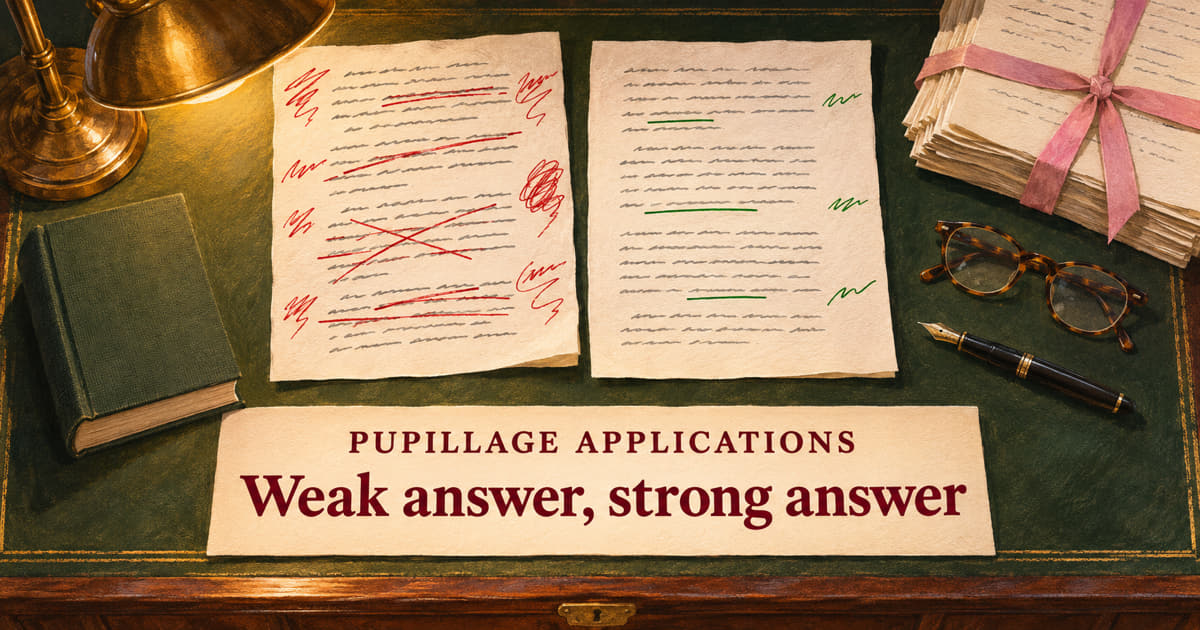
In our assessment, the weak answer below is easy to write and gives a reader little to credit: every sentence could be written by anyone. The strong one is built mainly from two experiences: the mini-pupillage names the work the candidate wants, the appeal gives a lesson learned, and it uses a year as a paralegal to explain, from what the candidate saw, why they chose the Bar over the route they also considered.
Example question · Why the Bar
“Why do you want to become a barrister?”
Weak answer · 89 words
I have wanted to be a barrister for as long as I can remember. I have always loved debating and I have a passion for justice. The Bar would allow me to use my excellent communication skills and my strong analytical mind. I enjoy a challenge and I work well under pressure. Barristers play a vital role in society by upholding the rule of law, and I want to be part of that. I am confident that I have the skills and the determination to succeed at the Bar.
Strong answer · 173 words
Two experiences decided it. On a three-day mini-pupillage with a criminal set, I watched my supervisor rework her cross-examination plan over lunch after a witness gave evidence that differed from his statement. The case turned on her own preparation and judgement, exercised quickly and alone, and that is the work I want to do. Later, volunteering with a tribunal representation charity, I prepared and presented a benefits appeal. Most of my time went on the papers, not the hearing: a chronology, the regulation that applied, and submissions cut to three points the judge could follow. The appeal succeeded. I learned that I enjoy the written preparation as much as the advocacy, and that a client needs someone who will explain a weak point honestly. During a year as a paralegal I considered qualifying as a solicitor and valued the client contact, but the mini-pupillage and the appeal showed me that what I wanted most was the role I had watched there: taking a case into the hearing and answering personally for the argument.
Written for this page; the candidate is invented. The question is an illustration we wrote, not quoted from any chambers. Written for an assumed 200-word limit; check the limit on the real form.
| Our assessment | Weak answer | Strong answer |
|---|---|---|
| Opening | Talks about wanting it “for as long as I can remember”: a feeling, not a reason. | Says in the first sentence that two experiences decided it, then names them. |
| Evidence | Claims skills (“excellent communication”, “strong analytical mind”) with nothing behind them. | Shows the skills in action: a chronology, the right regulation, three points, an outcome. |
| What the work is | Speaks of the rule of law in general. | Describes the work as it was seen: preparation, quick judgement, working alone, written work as well as advocacy. |
| Why the Bar, not another route | Not addressed. | Names the alternative it considered, credits it fairly, and ties the choice to the work the candidate saw, not to a claim about the other profession. |
| Reflection | None. | Says what the appeal taught: enjoying the written preparation, and explaining a weak point honestly. |
| Stock phrases | “a passion for justice”, “loved debating”, “work well under pressure”. | None. |
- 15 full answer reports
- Point-by-point feedback on each answer
- 30 interview questions with model answers
- 5 ethics scenarios on the BSB Handbook
Why this chambers: a weak and a strong answer
Our suggested test for any “why us” answer: replace the chambers’ name with another set’s. If the answer still reads the same, it says nothing about that set. The strong example passes because each of its three reasons is a feature of that particular set, tied to the candidate’s experience or aims.
Example question · Why this chambers
“Why have you applied to us?”
Weak answer · 67 words
I am applying to your chambers because of its outstanding reputation and excellent results. Your chambers is known for the quality of its barristers and its commitment to excellence. I was very impressed by your website, and I share your values of integrity and hard work. I believe your chambers would give me the best possible training, and I would be a valuable member of your team.
Strong answer · 170 words
Three things about the set fit what I have done and what I want to do. First, its practice joins criminal defence with professional regulatory work. My mini-pupillage was in crime and my dissertation was on fitness-to-practise hearings for health professionals, so I would come with a real interest in both halves of the practice. Second, your pupillage moves through three supervisors over the year. I learn fastest by seeing different ways of doing the same job: as a paralegal I asked to sit with two fee earners who worked very differently, and I adopted one’s method for preparing witness bundles. Third, your second-six pupils appear regularly in the magistrates’ courts, which is where I want to build my advocacy. I have read several of the regulatory decisions your members appeared in and followed one on findings of dishonesty closely; I would be glad to discuss it. I would bring a year of preparing bundles to court deadlines and the habit of checking every reference before it reaches a supervisor.
Written for this page; the candidate and the chambers are invented. The question is an illustration we wrote, not quoted from any chambers. Written for an assumed 200-word limit; check the limit on the real form.
| Our assessment | Weak answer | Strong answer |
|---|---|---|
| Facts about the set | “outstanding reputation”, “commitment to excellence”: true of no set in particular. | Three specific features: the mix of practice areas, how the pupillage runs, where second-six pupils appear. |
| The name test | Put any other chambers’ name in and it reads the same. | Would not fit a set without that practice mix and that pupillage structure. |
| Linked to the candidate | No specific, evidenced link: “I share your values” with nothing behind it. | Each feature is tied to the candidate’s experience or aims: a mini-pupillage, a dissertation, a paralegal habit, where they want to build their advocacy. |
| Evidence of interest | “impressed by your website” | Decisions read and one followed closely, offered for discussion at interview. |
| What they would bring | “a valuable member of your team” | A named, checkable skill and a working habit. |
| Flattery | Most of the answer. | None. |
The facts about the set in the strong answer are invented for this example. Our suggestion: use facts you have checked against reliable sources, such as the AETO’s own advert and website, and that you would be happy to be asked about at interview.
Skill examples and written arguments: weak and strong lines
An example of a skill
| Part | Weak line | Strong line |
|---|---|---|
| Situation | I have often had to persuade people in my roles. | As committee secretary of the law society, I had to persuade the treasurer to fund a second mooting competition he thought we could not afford. |
| Action | We discussed it and found a solution together. | I costed it line by line, found a sponsor for half, and offered to drop the spring social if the numbers did not work. |
| Result | It went well in the end. | He agreed; 24 students entered, and the sponsor renewed for the next year. |
| Reflection | This shows I am persuasive. | I learned to answer his real objection, the cost, rather than argue the benefits again; I would use the same approach with a sceptical tribunal. |
A short written argument
| Part | Weak line | Strong line |
|---|---|---|
| Position | There are many arguments on both sides of this question. | I argue that short procedural hearings should be held remotely by default, with any party free to ask for a hearing in person. |
| Reasons | Remote hearings are modern and convenient for everyone. | Where a short directions hearing turns on documents the judge already has, requiring everyone to travel adds cost and, I would argue, little to the quality of the decision. |
| The other side | Some people may disagree. | The strongest objection is that an unrepresented party may struggle with the technology. A right to ask for a hearing in person meets that objection for the people it affects, without making every hearing wait for a room. |
| Conclusion | In conclusion, it depends on the circumstances. | On those premises, a remote default with that safeguard keeps the cost down for the hearings where being in the room adds least. |
All lines are ours and the people in them are invented. The written argument is an example of structure, not a statement of the law or of how hearings work: it rests on premises the writer states. Our suggestion: in a real answer, use only facts you honestly believe to be true and accurate, with or without numbers, and that you can explain if asked.
FreeWhy the Bar · why this chambers · competency · written argument
Check one pupillage application answer free
Paste an answer you are writing for a chambers or other AETO, with its word limit. See our score, how your words are spent, how many of our criteria it meets, and the change we suggest first.
Check your own draft
Our suggestion: two checks before any answer goes in. First, the mechanical one: the counts in the box below. Second, the content: does it answer the question asked, with your own evidence? The counts cannot do the second. The Pupillage Application Pack checks a draft against our criteria for its question type (why the Bar, why this chambers, a skill example, a short written argument) and scores it on our own 1 to 5 scale, not a chambers’ or the Bar Council’s. One answer per visitor is checked free: the free check gives the score, how your words are split and one suggested fix.
Quick draft check: words, “I” against “we”, stock phrases
Paste a draft answer and the word limit from the advert. The counts are worked out in your browser: your draft is not sent to us. It counts; it does not judge the content.
The phrase list is ours: phrases that say a lot and show little. A phrase on it is not wrong if specific facts back it up.
| The draft check shows | Why it matters (ours) |
|---|---|
| Words | Check the limit on each question; on the standard form the role descriptions take up to 300 words and several other answers up to 200 |
| “I / my / me” against “we / our / us” | A reader needs to see what you did |
| Matching stock phrases from our list | On their own, they take words without adding evidence |
| Sentences over 35 words | Long sentences are harder to follow |
The table says what the check counts, for readers on a version of this page that does not run it.
Before you submit: what the Gateway does not let you undo
The Gateway’s own rules make the last step the one to get right. From its sample form and applicant user guide, read 13 November 2026:
| Rule (Gateway) | What to do (our suggestion) |
|---|---|
| Once submitted, an application cannot be edited, except your personal details and your employment, work experience and education history, which you can edit until the window closes | Draft and proofread every AETO answer outside the Gateway first |
| Editing those pre-filled details in an application also updates your profile and every current application, outstanding or submitted | Before saving a change, think through its effect on every current application; correct errors, and keep the shared details accurate |
| You can withdraw an application, but withdrawing a submitted one does not let you send a replacement yourself, even inside the window. In exceptional circumstances the Bar Council can delete it so that you can submit a new one | Read the summary screen line by line before you press Submit |
| With several applications open in several windows, what you enter in one is copied to the others when saved | Work on one application at a time |
| The user guide tells you to use plain text format when pasting from another program | Paste through a plain-text editor if formatting carries over |
| You cannot print applications from the system directly; at the summary stage, the guide says, use your browser’s Print option to save a PDF | Keep a PDF of each one, saved from the summary screen, so you have a record of what you sent |
| Some AETOs have AI policies on the use of AI within applications | Read the policy of each AETO you apply to before using any drafting or checking tool, ours included |
| The final confirmation: that your application is valid and contains only information you honestly believe to be true and accurate, and that if you knowingly submit false information you will be asked to withdraw from this year’s process, that you will do so, and that you may also be under an obligation to report the misconduct to the Bar Standards Board. The convictions and proceedings questions carry a differently worded warning: knowingly false information and/or failing to disclose relevant information “may result in you being asked to withdraw”, and if you have been Called to the Bar you may be asked to report it to the BSB | Every fact in every answer, about you or about the AETO, should be one you can stand behind |
The rules are from the Pupillage Gateway sample application form and the applicant user guide of 11 December 2025; the suggestions are ours.
One condition comes before any of this: the Bar Council says you “must be confident that you will have passed the Bar training course” before the advertised start date of any pupillage you apply for, and the Gateway that you “must be confident that you will pass” it by then. The Gateway’s example: for a pupillage advertised to start in October 2028, all academic and vocational stages must be complete by then (read 13 November 2026).
What the 2024/25 Gateway numbers say
The Bar Council’s Pupillage Gateway report 2024/25 covers the round from November 2024 to February 2025. It counts 683 pupillages advertised, and 3,912 candidates who made one or more applications through the Gateway; 287 of them received an offer recorded through it, 7.3%. The report counts only offers recorded through the Gateway.
Pupillage Gateway report 2024/25, Table B.1 (recorded offers ÷ total number of candidates), published 31 October 2025, read 13 November 2026.
| Round | Gateway candidates | Offered through the Gateway | Share |
|---|---|---|---|
| 2020/21 | 2,454 | 90 | 3.7% |
| 2021/22 | 2,782 | 125 | 4.5% |
| 2022/23 | 2,979 | 288 | 9.7% |
| 2023/24 | 3,408 | 261 | 7.7% |
| 2024/25 | 3,912 | 287 | 7.3% |
Table B.1 of the Pupillage Gateway report 2024/25.
| Group (2024/25) | What the report says |
|---|---|
| With work experience or a mini-pupillage | 9.1% secured pupillage, against 2.2% of those without: about 4 times more likely. (The Bar Council’s “I am trying to secure a pupillage” page still says that in 2024, 9.9% of candidates who had done mini-pupillage received an offer, compared with 1.8% of those who had not. The report’s chart shows those two figures for 2023/24: 9.9% with work experience or a mini-pupillage, 1.8% without.) |
| First-class honours degree | Made up 32.4% of applicants and 54% of recorded offers |
| Upper second-class degree | Made up 49.9% of applicants and 37.6% of recorded offers |
| Inns of Court scholarship holders (since 2022/23) | “over 4 times more likely to receive offers than those without since 2022/23” |
From the Bar Council’s Pupillage Gateway report 2024/25, read 13 November 2026.
The report describes these groups; it does not say what any AETO scores. Our inference from it: work experience goes in the standard form, and in our view the strongest AETO answers draw on it. To apply for that work experience, see our mini-pupillage application and cover letter guide.
What we could not find
| Question | What we found (13 November 2026) |
|---|---|
| How chambers score written answers | No scoring scheme on the Gateway or Bar Council pages we read; the criteria on this page are ours. |
| Word limits for AETO questions | Not stated centrally in the Gateway or Bar Council material we read; the questions appear in the advert under “How to Apply”, so check the advert and the application for any limit. |
| A list of every AETO’s questions | None. An AETO recruiting on the Gateway shows its questions in its advert under “How to Apply”; an AETO recruiting directly explains in its advert how to apply, so check its application materials. |
| A limit on how many applications you can make | None stated on the Gateway pages and user guide we read. |
FreeWhy the Bar · why this chambers · competency · written argument
Check one pupillage application answer free
Paste an answer you are writing for a chambers or other AETO, with its word limit. See our score, how your words are spent, how many of our criteria it meets, and the change we suggest first.
Frequently asked questions
How do I apply for pupillage?
Start on the Pupillage Gateway, the Bar Council’s system on which all pupillage vacancies are listed. Set up an account, add your education and work history and find the vacancies you want. For vacancies that take applications through the Gateway, submit between 11:00am on 4 January 2027 and 11:59pm on 28 January 2027. Most AETOs recruit through the Gateway; some ask you to apply directly, and their advert says how.
When do pupillage applications open in 2027?
The Gateway timetable gives Monday 4 January 2027 at 11:00am, closing Thursday 28 January 2027 at 11:59pm, with no extensions. Adverts are published on 20 November 2026 and applicants may browse them from 12:01am on 23 November 2026. Initial offers are made on 7 May 2027 at 9:30am.
What questions are on the Pupillage Gateway application?
The Bar Council’s standard form asks for your work history (up to 300 words describing each role), your education and grades (no word limit given in the sample form), then scholarships and awards, languages, professional qualifications, positions of responsibility and interests (up to 200 words each), extenuating circumstances and disclosures. An AETO that manages its recruitment on the Gateway can add up to seven questions of its own, shown in its advert under How to Apply.
Is “why this chambers” a Pupillage Gateway question?
Not on the standard form. “Why the Bar” and “why this chambers” are questions an AETO may add among its own bespoke questions. Check each advert for its exact wording and any word limit.
How do I answer “why do you want to be a barrister”?
Our suggestion: lead with your reasons, then show where they came from: a mini-pupillage, casework, a job. Describe the work as you saw it, say why the Bar rather than another legal route without running the other down, and say what you learned. Lines that anyone could write, such as a passion for justice, add little.
How do I answer “why this chambers”?
Our suggestion: name specific features of that set or organisation, such as its practice areas or how its pupillage runs, and tie each to something you have done. Then test it: if the answer still reads the same with another chambers’ name in it, it is not specific enough. Use facts you can defend at interview.
How long should pupillage application answers be?
Within each limit. On the standard form, each role description takes up to 300 words and several other answers up to 200. For the AETO’s own questions, check the advert and the form for any limit. Our suggestion: spend the words on specific evidence rather than padding to reach the limit.
Can I change my Pupillage Gateway application after submitting it?
Only your personal details and your employment, work experience and education history, until the window closes. The rest cannot be edited. You can withdraw an application, but withdrawing a submitted one does not let you send a replacement yourself. In exceptional circumstances the Bar Council can delete it so that you can submit a new one.
Can I use AI to write my pupillage application?
The Gateway says some AETOs have AI policies on the use of AI within applications and asks you to read the policy of each AETO you apply to before submitting. Whatever you use, you confirm that the application contains only information you honestly believe to be true and accurate.
More in this series
Sources
- official — Pupillage Gateway: For applicants, including the 2026/27 timetable (read 13 Nov 2026)
- official — Pupillage Gateway: Sample application form, on the How to use page (read 13 Nov 2026)
- official — Pupillage Gateway: Applicant user guide, 11 December 2025, on the How to use page (read 13 Nov 2026)
- official — Bar Council: I am trying to secure a pupillage (read 13 Nov 2026)
- official — Bar Council: Pupillage Gateway report 2024/25, published 31 October 2025 (read 13 Nov 2026)
official = a document published by the conducting body. reported = a news or coaching site we could not check against an original. Where sources disagree this page says so rather than picking one.