Checked 22 November 2026. The checklist follows the Spring 2025 Commercial Driver’s Guide; the defect list is NSC Standard 13 Schedule 1 as CCMTA publishes it (March 2009 edition); alberta.ca pages were read on 22 November 2026. Your carrier’s schedule, your vehicle and a newer edition of either document can differ.
In Alberta, a Class 1 pre-trip inspection means two related things. On the road test, you must show the examiner a pre-trip inspection of the tractor-trailer, the uncoupling and coupling procedure, and an air brake inspection, communicating and demonstrating each one (the guide suggests pointing to each item and saying what you are checking), without referring to notes. On the job, the same walk-around is the daily trip inspection the law requires: done within the previous 24 hours, against a schedule (NSC Standard 13 Schedule 1 for trucks, tractors and trailers), with a signed report in the truck.
Below: the checklist area by area as a tick-off tool, the numbers worth knowing, the coupling steps, what the road test expects, then the legal side: who must inspect, what goes on the report, and which defects stop the truck. The air brake test itself (the six steps and their pressures) is in our air brake pre-trip inspection and brake adjustment guide; this page points to it rather than repeating it.
ProSyllabus is an independent study site. It is not part of the Government of Alberta, Transportation and Economic Corridors, the CCMTA, any driver training school or any registry agent. The checklist on this page is our arrangement of the trip inspection items in Alberta’s Commercial Driver’s Guide and of NSC Standard 13 Schedule 1; use your carrier’s schedule and report form, and your school’s training, for the real thing.
Commercial Driver’s Guide (Spring 2025) pages 14, 26, 31 and 32; NSC Standard 13 Schedule 1.
Try 3 free Class 1 knowledge test questions
The trip inspection chapter is part of the Commercial Driver’s Guide the Class 1 knowledge test draws on. These three questions run in our practice player; the result page explains each answer. They are our own questions, not registry test questions.
FreeTests: Ch. 2: National Safety Code and hours of service · Ch. 4: Having a safe trip · Ch. 5: Basic commercial vehicle operations
Alberta Class 1 Knowledge Test Practice: free sample
Answer 3 questions against the clock, like the real exam. You then see the right answer, the reason and your time on each. About 4 minutes · free · no sign-in.
3 questions to answer
Start nowabout 5 minThis one is free · no sign-in needed
Your result shows how long each question took you.
Road-test pre-trip vs daily trip inspection
| Point | Road-test pre-trip | Daily trip inspection |
|---|---|---|
| Why you do it | Part of the Class 1 road test | The law, for carriers and drivers (Alberta’s Commercial Vehicle Safety Regulation, sections 9 to 16) |
| What you show or do | A pre-trip inspection, uncoupling and coupling, and an air brake inspection, communicated and demonstrated to the examiner | Every item on the schedule inspected; defects recorded and reported to the carrier |
| Paperwork | The examiner must see your road test permit or confirmation; you may not refer to notes during the pre-trip | A signed trip inspection report, carried with the schedule |
| If it goes wrong | If the vehicle fails the pre-trip, or you do not complete it, the road test does not proceed | No driving with a major defect; out-of-service, fines and points on the carrier profile or driver abstract are possible |
| Order | The guide’s circle check may be done in any order, as long as you check everything and complete the circle | Any circle procedure, as long as every regulated item is inspected |
The Commercial Driver’s Guide gives an example of “communicating and demonstrating”: saying that you are checking the left signal light to see that it works, is securely mounted, and that the lens is clean and not cracked. Each pre-trip and road test is allowed a certain amount of time; Alberta’s pages do not say how long, so practise until the full routine is smooth. The guide also says its procedures are guidelines and a vehicle may need different items checked.
Before you start the walk-around
| Step | What to do |
|---|---|
| 1 | Park on terrain as level as possible, safely away from traffic |
| 2 | Set the parking (spring) brake; with a manual transmission, put it in low gear |
| 3 | Shut off the engine |
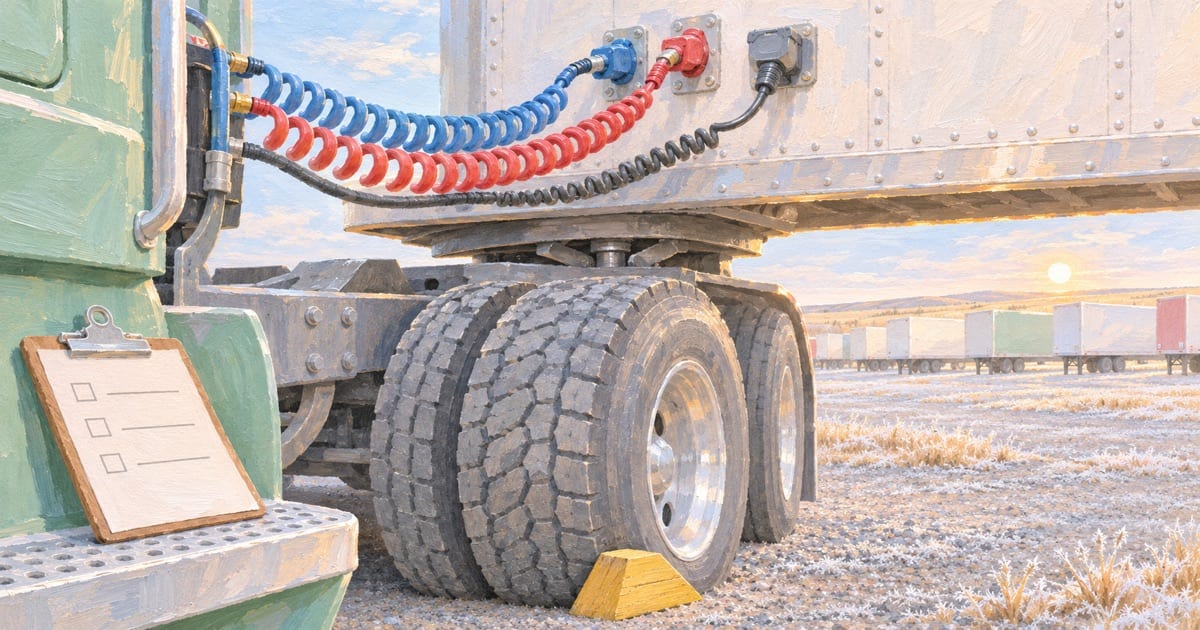
| 4 | Chock the wheels, making sure the chocks will hold the vehicle when the air brakes are released later; square blocks at least 15 by 15 centimetres |
Then walk a complete circle. The guide’s order starts under the hood, then the front, then down the driver’s side from front to back, the rear, and back up the passenger side, returning to the cab as needed to switch the lights on and off. Any order works if you check everything and complete the circle.
The Class 1 pre-trip checklist, area by area
The 53 items below follow the Commercial Driver’s Guide’s checklist for all vehicles plus its “additional items for Class 1 and Class 3 vehicles”. Tick each one as you say it out loud, the way you will for the examiner. The tool counts your ticks; nothing is saved.
Practice checklist: tick each item as you say it out loud
0 of 53 checked
Under the hood
Front of the tractor
Driver’s side of the tractor
Drive axles and coupling
Trailer: front and driver’s side
Trailer axles
Rear, then the passenger side
Inside the cab and start-up
Equipment and documents
Our arrangement of the Commercial Driver’s Guide trip inspection items (Spring 2025, pages 30 to 34). Your road test and your carrier’s schedule may need items this list does not show. On the road test you may not use notes.
The same items, as tables (for printing or for readers without scripts):
| Under the hood |
|---|
| 1. Radiator: no leaks, coolant level adequate, proper cap |
| 2. Fan: no bent, cracked or missing blades, mountings tight |
| 3. Belts: correct tension, no wear |
| 4. Oil: above “add”, not over “full” on the dipstick; other fluid levels adequate |
| 5. Air filter condition |
| 6. Battery: no cracks, heavy corrosion or leaks; terminals and mounting secure |
| 7. Steering mechanism: nothing bent, broken or missing; power steering pump and hose not leaking, fluid adequate; no excessive play |
| 8. Hoses: secure, no leaks, kinks, cuts, abrasions or cracks; wiring tight, none exposed |
| 9. Shocks and leaf springs (if visible): not loose, leaking, cracked or missing; U-bolts not loose, broken or missing |
| 10. Air brakes: compressor mounted securely; brake chambers; slack adjuster angle, pushrod travel and wear; air lines |
| Front of the tractor |
|---|
| 1. No fluid leaks on the ground |
| 2. Headlights (high and low), hazards, turn signals, clearance and marker lights work; lenses clean and not cracked |
| 3. Windshield clean and free of major cracks |
| 4. Licence plate valid, clean and secure |
| Driver’s side of the tractor |
|---|
| 1. Steer tire: tread not less than 3.2 mm, proper inflation, no bulges, separation, cuts or uneven wear |
| 2. Steer rim: no cracks, missing pieces, bends or rust streaks; wheel fasteners secure |
| 3. Steer axle wheel bearing oil level (if equipped); inspection decal valid |
| 4. Mirrors secure and not cracked; door works; windows clean |
| 5. Handrail and steps secure |
| 6. Fuel tank and lines: no leaks, tank secure, vent clear, proper cap |
| 7. Exhaust: no leaks, muffler and heat shield secure |
| 8. Storage compartments close properly, contents secure |
| Drive axles and coupling |
|---|
| 1. Each drive axle: tread not less than 1.6 mm, proper inflation, no damage; duals not touching, nothing trapped between them |
| 2. Each drive axle rim: no cracks, bends or rust streaks; fasteners secure |
| 3. Fifth wheel: coupler bolts secure, slider locked, plate undamaged and flush to the apron (no daylight) |
| 4. Fifth wheel jaws closed, plate flat under the trailer, kingpin enclosed |
| 5. Kingpin (and pintle eye if fitted) not worn, cracked or broken; safety chains or cables sound |
| 6. Drive shaft in good condition |
| 7. Suspension: no cracked or broken springs, U-bolts, torsion bars or walking beams; air bags not damaged |
| 8. Brake chambers secure; slack adjusters checked for travel, condition and wear; air lines secure |
| 9. Signal, brake and backing lights work; mud flaps do not rub; body sound |
| Trailer: front and driver’s side |
|---|
| 1. Inspection decal present and valid |
| 2. Body, frame and cross members: no holes, bends, cracks, weld separations or broken parts |
| 3. Landing gear raised, handle secure, no cracks |
| 4. Air lines secure, no leaks or damage |
| 5. Clearance and marker lights work; reflectors and reflective tape clean |
| 6. Load securement devices and anchor points sound |
| Trailer axles |
|---|
| 1. Each trailer axle: tread not less than 1.6 mm, proper inflation, duals not touching |
| 2. Rims and fasteners: no cracks, bends or rust streaks; fasteners secure |
| 3. Sliding tandem locking pins locked and secure |
| 4. Brake chambers and all slack adjusters checked; suspension and air bags sound; axles not cracked |
| Rear, then the passenger side |
|---|
| 1. Turn signals, hazards, brake lights, clearance and marker lights work; lenses clean (have someone press the brakes if you can) |
| 2. Licence plate and plate light; doors or gates closed and secure; mud flaps |
| 3. Walk back up the passenger side checking the same items as on the driver’s side |
| Inside the cab and start-up |
|---|
| 1. Seat and mirrors adjusted; seat belt adjusted and fastened |
| 2. Brake pedal and clutch feel right; steering has no excessive play |
| 3. All gauges and warning lights work; fuel adequate |
| 4. Wipers, washer, defroster and heater work; horn works; backing alarm works if fitted |
| 5. No unusual engine or clutch noise |
| 6. Air pressure build-up adequate and pressure drop acceptable when the brakes are applied; service brakes tested by moving forward slowly and stopping |
| Equipment and documents |
|---|
| 1. Fire extinguisher fully charged and in date; approved warning device; first aid kit fully equipped |
| 2. Registration, insurance, inspection certificate, trip inspection schedule and report, permits, logbook |
| 3. Required personal protective equipment; tools secured; spare bulbs, fuses and belts |
Numbers worth knowing for the pre-trip
| Item | Figure | Source |
|---|---|---|
| Steer axle tire tread | Not less than 3.2 mm | Commercial Driver’s Guide p31 |
| Drive and trailer axle tire tread | Not less than 1.6 mm | Commercial Driver’s Guide p32, p34 |
| Wheel chocks (square blocks) | At least 15 by 15 cm | Commercial Driver’s Guide p29 |
| Fifth wheel plate to trailer apron | Flush: no daylight between them | Commercial Driver’s Guide p33 |
| Trip inspection validity | 24 hours | Commercial Driver’s Guide p26, p27 |
| Air brake test pressures and leak limits | See the air brake guide linked below | Commercial Driver’s Guide p36 |
Halfway: 3 free practice questions
The same three questions as above, in the same player. They show how it works; three questions cannot tell you whether you are ready for the 30-question knowledge test.
FreeTests: Ch. 2: National Safety Code and hours of service · Ch. 4: Having a safe trip · Ch. 5: Basic commercial vehicle operations
Alberta Class 1 Knowledge Test Practice: free sample
Answer 3 questions against the clock, like the real exam. You then see the right answer, the reason and your time on each. About 4 minutes · free · no sign-in.
3 questions to answer
Start nowabout 5 minThis one is free · no sign-in needed
Your result shows how long each question took you.
The air brake inspection has six steps in the guide: a visual check with the wheels chocked, the tractor protection system, the park control valve, the supply circuit (compressor build-up and governor), air system leaks, and service brake response. The pressures for each step, how they differ by province and how to measure pushrod stroke are in our air brake pre-trip inspection and brake adjustment guide. Getting the Q endorsement itself is covered in our Alberta air brake test guide.
Still need the Q endorsement?
A Class 1 licence requires the air brake (Q) endorsement first, and the air brake check is part of the Class 1 pre-trip. Our Alberta Class 1 and air brake bundle has the Class 1 knowledge test practice and the air brake practice test together, each answer explained.
Uncoupling and coupling: the steps to show
The road test asks for the uncouple and couple procedure for Class 1 vehicles. The Commercial Driver’s Guide lists these basic steps for a tractor and semi-trailer:
| Step | Coupling | Uncoupling |
|---|---|---|
| 1 | Chock the trailer wheels (one chock: behind the wheel; two: in front and behind) | Park tractor and trailer in a straight line; set the park brakes |
| 2 | Check the fifth wheel jaws are open (unlocked) | Chock the trailer wheels (one chock: in front of the wheel; two: in front and behind) |
| 3 | Check the trailer apron, kingpin and collar for wear or cracks | Lower the landing gear |
| 4 | Back in line and stop before the fifth wheel touches the apron; check the heights match | If the trailer has no spring brakes on at least one axle: fill its air tanks and set its brakes (see the note below) |
| 5 | If the trailer has no spring brakes on at least one axle, connect the air lines and fill the trailer tanks. Then set the trailer brakes | Disconnect the electrical and air lines; unlock the fifth wheel |
| 6 | Back until the connection is made; do a firm tug test and correct any slack | Secure the electrical and air lines to the tractor |
| 7 | Look to confirm the jaws are locked around the kingpin | Pull ahead slowly until the fifth wheel just clears the trailer, and stop |
| 8 | Raise the landing gear and hook up the electrical line | Check the ground and landing gear support the trailer |
| 9 | Remove the wheel chocks | Pull ahead slowly until the tractor frame fully clears the trailer |
Note on uncoupling: the guide lists the no-spring-brake step (fill the trailer tanks, set its brakes) as a separate bullet after “disconnect the electrical and air lines”; we put it before the disconnection because the trailer tanks fill through the air lines. That order is ours. The guide also gives pintle hitch steps for trailers coupled that way. For either hitch it says the most important task is to physically and visually check every connection.
The daily trip inspection: what the law requires
Under Alberta’s trip inspection rules, as the Commercial Driver’s Guide sets them out, a driver may not drive a truck or bus, or tow a trailer, that needs trip inspections (see the weights below) unless the driver or another person inspected it within the previous 24 hours. Someone else (yard or maintenance staff) may do the inspection and sign the report, and you may rely on it and produce it to an officer, unless you have reason to believe the inspection and report do not meet the requirements, or you are aware or ought to be aware that the vehicle has a defect. You must also keep watching the vehicle for defects while en route.
| Carrier | Trucks that need trip inspections |
|---|---|
| Provincially regulated (operates only within Alberta) | Registered for 11,794 kg or more |
| Federally regulated (one or more vehicles outside Alberta) | Registered for 4,500 kg or more |
| Either | Also commercial passenger vehicles designed to seat 11 or more, driver included |
A truck, tractor and towed trailer are inspected using Schedule 1 of NSC Standard 13; a converter dolly is inspected as part of the trailer it carries, and again when it carries a different trailer. Carriers must give drivers the schedule, and drivers must carry it and produce it, with the report, when an officer asks. A schedule and report can be the same document.
What goes on the trip inspection report
| Field | What to record |
|---|---|
| Vehicle | Licence plate number, commercial vehicle identification number, or unit number |
| Odometer | The odometer or hubometer reading at the time of the inspection |
| Carrier | The name of the carrier operating the vehicle |
| Place | The municipality or highway location of the inspection |
| Inspector | Name of the person who inspected, with a signed statement that it was inspected as required |
| Result | That no defect was found, or each defect found on the scheduled items |
| Modified schedule | Any parts deleted from the NSC schedule and any items added |
| When and who | Time and date of the report; name and signature of the person making it |
Defects and major defects
Schedule 1 lists 23 systems. Each names defects, major defects or both: defects (you may keep driving once the defect is entered on the report and reported to the carrier; report it no later than the next daily inspection) and major defects (report without delay; no one may drive the vehicle on a highway while a major defect is present). A summary, in our words:
| System | Defect | Major defect (do not drive) |
|---|---|---|
| Air brake system | Audible air leak; slow pressure build-up | Pushrod stroke past the adjustment limit; air loss over the limit; tractor protection system inoperative; low air warning fails or is activated; service, parking or emergency brake inoperative |
| Cab | Occupant door fails to open | A cab or sleeper door fails to close securely |
| Cargo securement | Insecure or improper load covering (for example the wrong type, or flapping in the wind) | Insecure cargo; a required securement device or load covering absent, failed, malfunctioning or deteriorated |
| Coupling devices | Loose or missing fastener on the coupler or mounting | Coupler insecure or moving past the limit; coupling or locking mechanism damaged or fails to lock; safety chain or cable defective, wrong or missing |
| Dangerous goods | – | Dangerous goods requirements not met |
| Driver controls | Accelerator, clutch, gauges or indicators fail to work properly | – |
| Driver seat | Seat damaged or will not stay in position | Seat belt or tether belt insecure, missing or faulty |
| Electric brake system | Loose or insecure wiring or electrical connection | Breakaway device or brake inoperative |
| Emergency equipment and safety devices | Missing, damaged or defective | – |
| Exhaust system | Exhaust leak | Leak that lets exhaust into the cab |
| Frame and cargo body | Damaged frame or body | Frame member visibly shifted, cracked, collapsing or sagging |
| Fuel system | Missing fuel cap | Insecure tank; dripping fuel leak |
| General | – | Serious, noticeable damage or deterioration that may affect safe operation |
| Glass and mirrors | Required mirror or glass cracked, broken, damaged, missing or maladjusted so it fails to give the required view; broken or damaged attachments | – |
| Heater and defroster | Control or system failure | Defroster fails to give a clear view through the windshield |
| Horn | No working horn | – |
| Hydraulic brake system | Fluid below the minimum mark | Parking brake or brake boost / power assist inoperative; fluid leak; pedal fade or insufficient pedal reserve; warning device activated (other than ABS); reservoir less than a quarter full |
| Lamps and reflectors | A required lamp not working as intended; a required reflector missing or partly missing | When lamps are required: both low-beam headlamps or both rearmost tail lamps out. At all times: a rearmost turn signal or both rearmost brake lamps out |
| Steering | More free play than normal | Steering wheel insecure or not responding normally; free play past the limit |
| Suspension system | Air leak in air suspension; broken spring leaf; suspension fastener loose, missing or broken | Damaged or deflated air bag; cracked or broken main leaf, or more than one broken leaf in any spring assembly; a leaf or suspension part missing, shifted out of place or touching another vehicle component; loose U-bolt |
| Tires | Damaged tread or sidewall; a leak (one you can feel or hear counts as flat) | Flat; tread below the wear limit; touching another tire or any vehicle part other than the mud flap; marked “Not for highway use”; exposed cords in the tread or outer sidewall |
| Wheels, hubs and fasteners | Hub oil low (sight glass); leaking wheel seal | Loose, missing or ineffective fastener; damaged, cracked or broken wheel, rim or attaching part; signs of imminent wheel, hub or bearing failure |
| Windshield wiper and washer | Control or system malfunction; blade damaged, missing or not clearing | When needed for the weather: the driver’s-side wiper or washer fails to clear the view |
Summarised from NSC Standard 13 Schedule 1 (Truck, Tractor and Trailer), which applies to trucks, tractors and trailers over 4,500 kg registered gross vehicle weight. Read your carrier’s schedule for the exact wording and limits. Inspectors can put a vehicle out of service until repairs are made.
En route and after the trip
At rest and check stops the guide suggests checking that lights are clean and working, there are no air leaks, wheels are secure and tires inflated and not hot, nothing is broken or loose, the load and any dangerous goods placards are secure, the trailer locking mechanisms are secure and the brakes are properly adjusted.
While driving, watch for brakes pulling or grabbing, odd transmission or engine noises, steering play and suspension sway. At the end of a shift the guide recommends a post-trip inspection, so repairs can be arranged before the next trip.
Mistakes to avoid on the road-test pre-trip
Avoid these
- Skipping part of the circle. If you do not complete the pre-trip, the road test does not proceed.
- Checking silently. The guide asks you to point to each item and tell the examiner what you are looking at and what condition it should be in.
- Bringing a truck that fails. If the vehicle does not pass the pre-trip, the road test does not proceed; if the examiner refuses it as not safe or legal, you also lose the $217 fee.
- Forgetting the coupling check. Tug test, then look at the jaws around the kingpin.
- Relying on notes. Notes are not allowed during the pre-trip; practise from memory with the checklist above.
- Chocks that will not hold. Chock before the air brake checks release the brakes.
For the whole route to the road test (Entry Program, Core Learning, the knowledge test and the restricted licence), see our Class 1 Learning Pathway guide; for the knowledge test format, our Alberta Class 1 knowledge test guide. Class 3 road tests have a pre-trip too: see our Class 3 licence guide.
Before your test: 3 free practice questions
Same three questions as above. The full practice has timed 30-question Class 1 mocks in the same player.
FreeTests: Ch. 2: National Safety Code and hours of service · Ch. 4: Having a safe trip · Ch. 5: Basic commercial vehicle operations
Alberta Class 1 Knowledge Test Practice: free sample
Answer 3 questions against the clock, like the real exam. You then see the right answer, the reason and your time on each. About 4 minutes · free · no sign-in.
3 questions to answer
Start nowabout 5 minThis one is free · no sign-in needed
Your result shows how long each question took you.
The other half of Class 1: the knowledge test
The pre-trip is part of the road test; before that you must pass the Class 1 knowledge test, and the Commercial Driver’s Guide’s trip inspection chapter is part of what it covers. Our Alberta Class 1 Knowledge Test Practice has timed 30-question Class 1 mocks and chapter sets written from the Commercial Driver’s Guide, plus two air brake mocks, with an explanation for every answer. It does not cover the Driver’s Guide for cars and light trucks or the Class 1 Learning Pathway coursework.
See the Alberta Class 1 knowledge test practice, or the Class 1 and air brake bundle if you still need the Q endorsement. Independent practice; not made or endorsed by the Government of Alberta.
Frequently asked questions
What is on the Class 1 pre-trip inspection in Alberta?
On the road test you communicate and demonstrate a pre-trip inspection of the tractor-trailer, the uncoupling and coupling procedure, and an air brake inspection. The walk-around covers under the hood, lights, tires, wheels, the fifth wheel and kingpin, suspension, brakes and air lines on tractor and trailer, the cab and start-up, and emergency equipment and documents.
Can I use notes during the Alberta pre-trip inspection?
No. The Commercial Driver’s Guide says you may not refer to any notes during the pre-trip.
How long is the pre-trip inspection on the Class 1 road test?
Alberta says each pre-trip inspection and road test is allowed a certain amount of time but does not publish the figure on the pages we read. Practise until you can do the full routine smoothly.
What happens if I fail the pre-trip?
If the vehicle does not pass the pre-trip inspection, or you do not successfully complete it, the road test does not proceed. An examiner can also refuse a vehicle that is not safe or legal, and you lose the road test fee.
How often is a trip inspection required?
Within the previous 24 hours. A completed trip inspection and report are valid for a maximum of 24 hours, and you must carry the schedule and report in the vehicle.
Which trucks need a daily trip inspection in Alberta?
For carriers operating only within Alberta, trucks registered for 11,794 kg or more; for federally regulated carriers (any vehicle outside Alberta), trucks registered for 4,500 kg or more.
What is a major defect?
A defect listed as major on the inspection schedule, for example an inoperative service, parking or emergency brake, insecure cargo, a coupler that fails to lock, a flat tire or a dripping fuel leak. It must be reported without delay, and the vehicle may not be driven on a highway while it is present.
Can I drive with a minor defect?
Yes, if it is a minor defect on the schedule, you have entered it on the daily inspection report straight away and reported it to the carrier. Report it no later than the next daily trip inspection.
What is NSC Schedule 1?
The trip inspection schedule in National Safety Code Standard 13 for trucks, tractors and trailers. It lists 23 systems, each with defects, major defects or both. Alberta accepts Schedules 1 to 4 of NSC Standard 13.
What is the minimum tire tread depth on the pre-trip checklist?
The Commercial Driver’s Guide checklist says not less than 3.2 mm on the steering axle tires and not less than 1.6 mm on the drive and trailer axle tires.
More in this series
- Alberta Class 1 knowledge test 2026: format, cost, MELT and how to pass
- Alberta Class 1 Learning Pathway: steps, cost, grants
- Class 3 licence in Alberta: test, air brakes, cost and Class 3 vs Class 1
- Alberta Class 1 knowledge test questions: worked examples
- Alberta Class 1 knowledge test PDF: official handbooks
- Air brake pre-trip inspection and brake adjustment checklist
- Alberta air brake (Q endorsement) test: format, pass mark and practice
Sources
- official — Government of Alberta: Commercial Driver’s Guide, Spring 2025 edition (chapter 3 Trip Inspections; chapter 6 coupling; road test, pages 14 and 15)
- official — CCMTA: National Safety Code Standard 13, Trip Inspections (March 2009 edition; Schedule 1 updated September 2008)
- official — Government of Alberta: Driver’s road test (Class 1 road test $217; read 22 Nov 2026)
- official — Government of Alberta: Obtaining a commercial licence (read 22 Nov 2026)
- official — Government of Alberta: Air Brake Program (read 22 Nov 2026)
official = a document published by the conducting body. reported = a news or coaching site we could not check against an original. Where sources disagree this page says so rather than picking one.