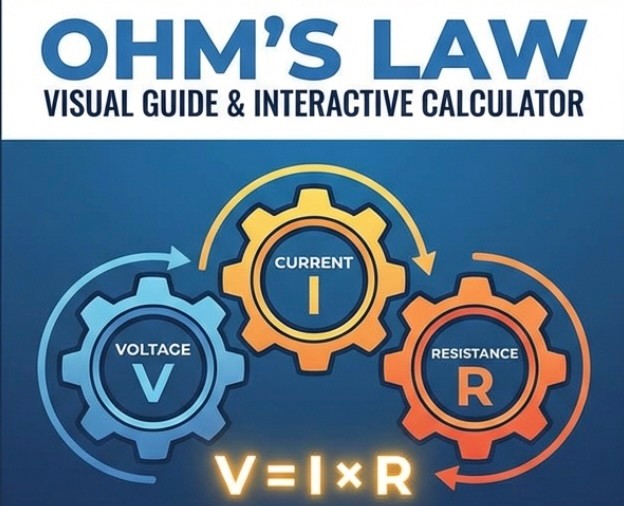
OHM'S LAW
V = I × R · The Foundation of Electrical Theory
V
I
R
VOLTAGEV = I × R
CURRENTI = V ÷ R
RESISTANCER = V ÷ I
> INTERACTIVE CALCULATOR // SOLVE FOR:
RESULT
— V
V = I × R
> POWER FORMULAS // P = V × I (Watts)
BASICP = V × I
FROM V & RP = V² ÷ R
FROM I & RP = I² × R
ENERGY (1 hr)E = P × t
VOLTAGE (V)
Electrical potential difference between two points. Measured in Volts (V). The "pressure" that drives current through a circuit. Named after Alessandro Volta.
CURRENT (I)
Rate of flow of electric charge. Measured in Amperes (A). The symbol I comes from the French intensité de courant. Represents coulombs per second.
RESISTANCE (R)
Opposition to current flow. Measured in Ohms (Ω). Depends on material, length, and cross-sectional area. Increases with temperature in most metals.
> REAL-WORLD EXAMPLES
💡
60W LIGHT BULB
120V · 0.5A · 240Ω
A standard incandescent draws 0.5A from 120V mains — resistance ~240Ω when hot.
📱
USB-C CHARGER
5V · 3A · ~1.67Ω
Fast charging delivers 3A at 5V. The cable resistance must stay very low.
🔋
AA BATTERY
1.5V · ~1A · 1.5Ω
Internal resistance of ~0.1–0.3Ω limits how much current the cell can safely deliver.
🚗
CAR STARTER
12V · 200A · 0.06Ω
Starter motors need hundreds of amps — ultra-low resistance cables are essential.
> FREQUENTLY ASKED QUESTIONS
Ohm's Law states that the current flowing through a conductor is directly proportional to the voltage across it and inversely proportional to its resistance. Double the voltage → double the current. Double the resistance → half the current.
No. Ohm's Law applies to ohmic conductors — materials where resistance stays constant regardless of voltage (e.g. most metals at constant temperature). Non-ohmic devices like diodes, transistors, and LEDs have non-linear V/I relationships.
In metals, atoms vibrate more at higher temperatures, increasing collisions with free electrons and impeding their flow — raising resistance. Semiconductors behave oppositely: resistance often decreases with temperature.
For pure resistors, Ohm's Law applies equally to DC and AC. For AC circuits with capacitors or inductors, resistance is replaced by impedance (Z), which also accounts for reactance. The law becomes V = I × Z.
Cover the variable you want to find. What's left shows the formula. Cover V → see I × R. Cover I → see V ÷ R. Cover R → see V ÷ I. It's a memory aid used in electronics education worldwide.
Voltage in Volts (V), current in Amperes (A), resistance in Ohms (Ω). Power is in Watts (W). Always keep units consistent — mixing mA with Ω and V causes calculation errors.
Not at all. When Ohm published in 1827, the German scientific establishment largely rejected his work. It took over a decade to gain international acceptance. He was eventually awarded the Copley Medal in 1841.
1827
GEORG SIMON OHM · THE GALVANIC CIRCUIT
Born in Erlangen, Bavaria in 1789, Georg Simon Ohm was a self-taught physicist who derived his law through careful experimental work using the newly invented electrochemical cell as a voltage source and a torsion balance to measure current.
He published his findings in Die galvanische Kette, mathematisch bearbeitet ("The Galvanic Circuit Investigated Mathematically"). The unit of electrical resistance, the Ohm (Ω), was named in his honour by the International Electrical Congress in 1881.
Ohm received the Copley Medal from the Royal Society in 1841, finally achieving the recognition he deserved.