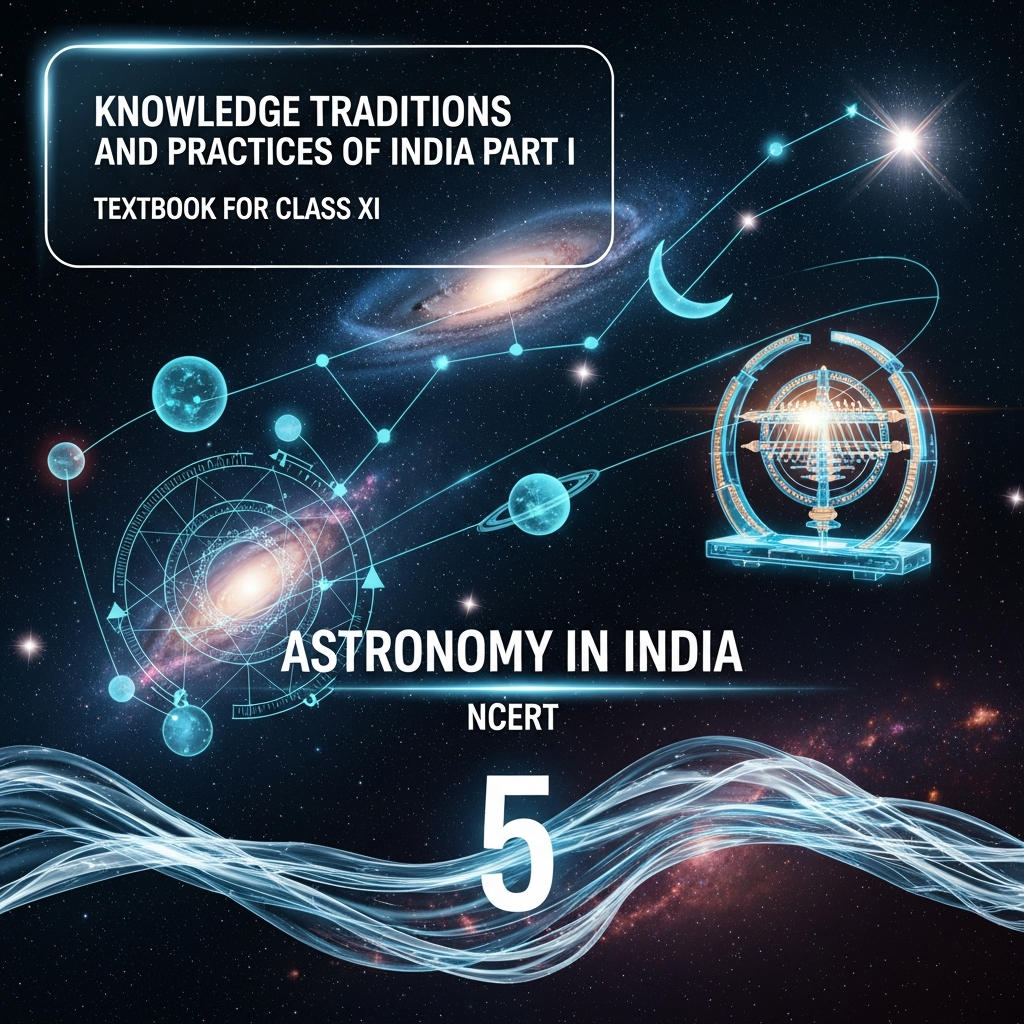
Knowledge Traditions and Practices of India Part I – Astronomy in India (Chapter 5)
Detailed study of ancient and modern astronomy in India from NCERT Class XI textbook, covering Indian calendars, astronomical phenomena like eclipses, contributions of renowned astronomers, observatories, and current advancements in the field included in Chapter 5.
Updated: 2 months ago
Categories: NCERT, Class XI, Knowledge Traditions and Practices of India, Chapter 5, Astronomy, Indian Astronomy, Ancient Sciences, Modern Astronomy, Education, Science, Culture
Tags: Astronomy in India, NCERT Class 11, Hindu Calendar, Eclipses, Indian Astronomers, Aryabhatta, Varahamihira, Bhaskara, Kerala School, Jantar Mantar, Indian Observatories, Modern Indian Astronomy, Radio Telescopes, Solar System, Indian Scientific Heritage, Chapter 5
Astronomy in India - Class 11 Knowledge Traditions Ultimate Study Guide 2025
Astronomy in India
Chapter 5: Knowledge Traditions and Practices of India - Ultimate Study Guide | NCERT Class 11 Notes, Questions, Examples & Quiz 2025
Full Chapter Summary & Detailed Notes - Astronomy in India Class 11 NCERT
Overview & Key Concepts
Chapter Goal: Trace ancient Indian astronomy from Vedic times to modern observatories, emphasizing calendars, eclipses, and astronomers like Āryabhaṭṭa. Exam Focus: Luni-solar calendar, tithi, eclipses (Rahu/Ketu), Uttarāyaṇa, ancient figures (Āryabhaṭṭa, Brahmagupta), modern sites (GMRT, IIA). 2025 Updates: SKA project progress, TMT contributions. Fun Fact: Āryabhaṭṭa calculated π ≈ 3.1416 at age 23.
Expanded Content: Include global comparisons (e.g., Kerala School vs. Newton); point-wise for recall; add 2025 relevance like gravitational wave detections.
Introduction to Indian Astronomy
Ancient Roots: Wonder at sky phenomena (moon phases, eclipses); myths/religions; Vedic cosmology (universe origin).
Practical Needs: Calendars for agriculture/festivals; eclipse predictions for rulers; astrology's influence.
Main Tasks: Calendars/time-keeping, eclipse predictions, star observations, distances/calculations.
Example: Kings appointed astronomers for comets/shooting stars as omens.
Expanded: Evidence: Mathematical advancements; debates: Credit to Indian vs. Western; real: Overlooked contributions in history.
12 Rāśis along ecliptic; Sun's monthly transit (e.g., Pisces in March); visualizes solar year.
Why This Guide Stands Out
Comprehensive: All astronomers/observatories point-wise, diagram integrations; 2025 with API updates (e.g., TMT imaging), analyzed for scientific legacy.
Indian Calendar System
Luni-Solar Hybrid: Lunar for festivals (phases), solar for daily life; sidereal month 27.3 days, synodic 29.5 days.
Pakṣas & Tithis: Kṛṣṇapakṣa (dark half from full moon), Śuklapakṣa (bright from new); tithi: 12° Sun-Moon separation (19-26 hrs variable).
Solar Elements: Rāśis (zodiac), Saṅkrānti (Sun entry, e.g., Makara); months named after Nakṣatras (e.g., Caitra from Citrā).
Harmonization: Adhika māsā every ~3 years (extra lunar month); avoids seasonal drift unlike Hijri.
Think & Reflect: Tithi variations cause festival overlaps; schools differ on sunrise vs. change timing.
Group: Model Jantar Mantar yantra; individual: Timeline of astronomers.
Debate: Indian vs. Western credit in astronomy.
Ethical role-play: Astrology vs. science.
Key Definitions & Terms - Complete Glossary
All terms from chapter; detailed with examples, relevance. Expanded: 30+ terms grouped by subtopic; added advanced like "Adhikamāsa", "Precession" for depth/easy flashcards. Table overflow fixed with word-break.
Luni-Solar Calendar
Hybrid lunar-solar system. Ex: Festivals by moon, daily by sun. Relevance: Seasonal harmony.
Sidereal Period
Moon's orbit vs. stars (27.3 days). Ex: Basis for Nakṣatras. Relevance: Fixed reference.
Tithi
Lunar date (12° Sun-Moon sep.). Ex: Variable 19-26 hrs. Relevance: Festival timing.
Rāśi Cakra
Zodiac belt (12 constellations). Ex: Sun's monthly transit. Relevance: Solar months.
Nakṣatra
27/28 stars for Moon position. Ex: Month naming (Citrā for Caitra). Relevance: Lunar tracking.
Saṅkrānti
Sun enters Rāśi. Ex: Makara Saṅkrānti. Relevance: Solar new year.
Adhikamāsa
Extra lunar month (~3 yrs). Ex: Malamāsa without Saṅkrānti. Relevance: Drift prevention.
Pakṣa
Half-month (Kṛṣṇa/Śukla). Ex: Dark/bright phases. Relevance: Day counting.
Solar Eclipse
Moon blocks Sun. Ex: New moon alignment. Relevance: Precautions needed.
Lunar Eclipse
Earth shadows Moon. Ex: Full moon nodes. Relevance: No contact, myths debunked.
Line of Nodes
Orbital intersection. Ex: Rahu/Ketu ends. Relevance: Eclipse condition.
Sun's max declination. Ex: Summer/winter markers. Relevance: Seasons.
Tip: Group by era/site; examples for recall. Depth: Debates (e.g., heliocentrism credit). Errors: Confuse tithi/pakṣa. Interlinks: To math chapters. Advanced: Precession math. Real-Life: Apps like Stellarium. Graphs: Astronomer timelines. Coherent: Evidence → Impact. For easy learning: Flashcard per term with example.
Text Book Questions & Answers - NCERT Exercises
Direct from chapter exercises (page 95). Answers based on chapter content, point-wise for exams.
Discussion Questions
1. Write a few sentences on the development of astronomy in India.
Answer:
Ancient: Vedic myths to practical calendars/eclipses; Āryabhaṭṭa (Earth rotation).
Medieval: Kerala heliocentrism, Jantar Mantar.
Modern: GMRT/Chandrayaan, global projects (TMT/LIGO).
2. Briefly describe the contribution of Āryabhaṭṭa to astronomy.
Detects Einstein-predicted waves; studies universe evolution (e.g., black holes); India joining for cosmic tools.
11. It is said that astronomy is the study of the past. Comment.
Answer:
Light from distant objects shows ancient states (e.g., TMT for early universe).
Reveals evolution/history via redshift/faint sources.
12. Name the city where Sawai Jai Singh observatory is built.
Answer:
Jaipur (main); also Delhi, Ujjain, Mathura, Varanasi.
13. Match the following:
Answer:
Sūryasiddhānta - Varāhamihira
Lunar Year - 354 days
Nakṣatras - Moon
Nilkantha - Heliocentric solar system
Rāśi - Ecliptic
GONG - Udaipur
Jai Singh - Jantar Mantar observatories
Tip: Practice matching (Q13); timelines (Q1). Full marks: Point-wise, diagram refs.
Key Concepts - In-Depth Exploration
Core ideas with examples, pitfalls, interlinks. Expanded: All concepts with steps/examples/pitfalls for easy learning. Depth: Debates, analysis. Table overflow fixed.
Advanced: Orbital math, series derivations. Pitfalls: Era mix. Interlinks: To physics. Real: Apps for tithi. Depth: 14 concepts details. Examples: Real diagrams. Graphs: Timeline. Errors: Eclipse myths. Tips: Steps evidence; compare tables (astronomers/observatories).
Historical Perspectives - Detailed Guide
Evolution of discoveries/practices; expanded with points; links to pioneers/debates. Added global context, Indian milestones.
Vedic Era (Prehistoric)
Cosmology questions; myths/eclipses.
Practical: Rain/festivals.
Depth: Philosophical roots.
Classical Period (5th-7th CE)
Āryabhaṭṭa rotation; Brahmagupta zero.
Varāhamihira precession.
Depth: Math integration.
Medieval Advances (11th-16th CE)
Bhāskara II infinity; Kerala heliocentrism.
Trig series pre-Newton.
Depth: Credit controversies.
Colonial to Independence (18th-20th CE)
Jantar Mantar; Kodaikanal 1889.
Post-1947: IIA/NCRA.
Depth: Tech revival.
Modern Era (21st CE)
Chandrayaan; GMRT/TMT.
2025: SKA/LIGO full ops.
Depth: Global leadership.
Global Comparisons
India pre-Europe (heliocentric 1500 vs. 1543).
Calculus series 100 yrs early.
Depth: Overlooked innovations.
Tip: Link to timelines. Depth: Reflexive myths to science. Examples: Āryabhaṭṭa. Graphs: Era chronology. Advanced: 2025 missions. Easy: Bullets milestones.
Diagram & Explanation Examples - From Text with Simple Explanations
Expanded with evidence, interpretations; focus on analysis, breakdowns for diagrams/figures.
Example 1: Zodiac Constellations Analysis
Simple Explanation: Solar path mapping.
Step 1: Ecliptic belt (8° wide).
Step 2: 12 Rāśis (e.g., Pisces March).
Step 3: Sun monthly transit.
Step 4: Calendar basis.
Simple Way: Sun → Rāśi → Month cycle.
Example 2: Eclipse Nodes Appreciation
Simple Explanation: Alignment geometry.
Step 1: Orbital planes intersect.
Step 2: Nodes (Rahu/Ketu) ends.
Step 3: New/full moon only.
Step 4: No straight line otherwise.
Simple Way: Planes → Cross → Eclipse trigger.
Example 3: Uttarāyaṇa Sunrise Shift
Simple Explanation: Seasonal drift.
Step 1: Northward post-Dec solstice.
Step 2: Precession backward (2000 yrs).
Step 3: Auspicious journey.
Step 4: Bhīṣma wait.
Simple Way: South max → North turn → Summer herald.
Example 4: Tithi Calculation
Simple Explanation: Lunar dates.
Step 1: Sun-Moon angular sep.
Step 2: 12° = 1 tithi (30 total).
Step 3: Elliptic speed varies duration.
Step 4: Sunrise school vs. change.
Simple Way: Angle → Tithi → Festival day.
Example 5: Adhikamāsa Rule
Simple Explanation: Sync mechanism.
Step 1: 11-day lunar-solar gap.
Step 2: Every ~3 yrs extra month.
Step 3: No Saṅkrānti = adhika.
Step 4: Festivals oscillate ~1 month.
Simple Way: Short year → Add month → Balance seasons.
Example 6: Kerala Trig Series
Simple Explanation: Math for skies.
Step 1: Infinite power expansions.
Step 2: Sine/cos/arctan proofs.
Step 3: Astronomical calcs.
Step 4: Pre-Europe calculus.
Simple Way: Series → Function → Orbit predict.
Tip: Practice diagram sketches; troubleshoot (e.g., node alignment). Added for figures, explanations.
Interactive Quiz - Master Astronomy in India
10 MCQs in full sentences; 80%+ goal. Covers calendars, eclipses, astronomers, modern.
Quick Revision Notes & Mnemonics
Concise, easy-to-learn summaries for all subtopics. Structured in tables for quick scan: Key points, examples, mnemonics. Covers calendars, astronomers, modern. Bold key terms; short phrases for fast reading. Overflow fixed.
Subtopic
Key Points
Examples
Mnemonics/Tips
Calendar
Luni-Solar: Lunar fest, solar daily; adhika ~3 yrs.