Checked 10 November 2026. Exercise dates change. On 10 November 2026 the JAC vacancy page gave the Deputy District Judge qualifying test as 24 November 2026, and the Future applications tab listed a fee-paid Immigration and Asylum Chamber exercise launching in December 2026 with no test date yet. Check your own exercise page and the instructions the JAC emails you.
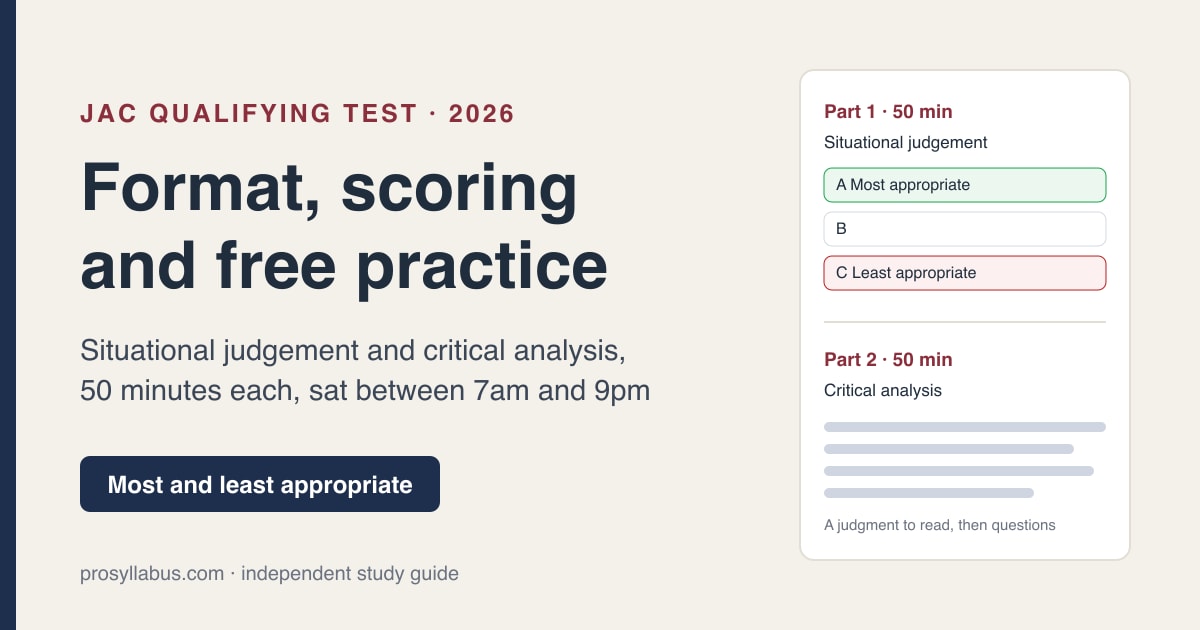
The JAC qualifying test is the online, multiple-choice test the Judicial Appointments Commission uses to help shortlist candidates, usually in its larger courts and tribunals exercises, such as Deputy District Judge, Recorder and fee-paid tribunal judge. It usually has two parts, with a standard 50 minutes each: a situational judgement test, where you choose the most and the least appropriate of five actions, and a critical analysis test, where you answer questions on a written document such as a speech or a judgment. You choose which to sit first; you must start after 7am and finish before 9pm on the test day.
This guide sets out the format and the scoring from the JAC's own pages and reports, with links, then adds our practice advice, clearly marked as ours. Independent practice. Not affiliated with the Judicial Appointments Commission. ProSyllabus is an independent study site; the JAC did not write and does not endorse our questions.
JAC pages "Qualifying test" and "About online tests", read 10 November 2026.
Key facts: the JAC qualifying test
| Item | Detail |
|---|---|
| Parts | Usually a situational judgement test and a critical analysis test, both multiple choice. For non-legal exercises the test usually includes only situational judgement |
| Time | 50 minutes a part, with any agreed extra time shown in the timer; answers are submitted automatically when the time runs out, and those answers are still marked |
| Order | You choose which part to take first |
| Window | Start after 7am and finish before 9pm on the test day |
| Questions per part | The JAC's general pages give no number. Its evaluation reports for the 2026 Recorder exercise and the 2025 fee-paid Immigration and Asylum Chamber exercise both describe 20 situational judgement and 20 critical analysis questions |
| Situational judgement | Situations like those in the role, five possible actions each: choose the most and the least appropriate. One mark for each correct choice. Assesses at least Communication Skills, Personal Qualities and Effective Working; does not test legal rules or procedures |
| Critical analysis | A written document, such as a speech or a judgment, sent to you before the test day; questions with four options and one correct answer. Assesses at least Legal Skills and Dealing with Information |
| Scoring | At least 30% in both parts; then candidates are ranked by a composite of standard scores, 60% situational judgement and 40% critical analysis; cut-off set by the places at the next stage |
| Before the test | An email at least a week before with the instructions, any pre-reading, the links and the test times |
| Device | The JAC lists a laptop, desktop or tablet with an up-to-date browser and a stable connection, and advises against a mobile phone because the screen may be too small. It says CPS laptops are not compatible and advises against government devices |
| AI | Not allowed in any qualifying test, and no selection material may be entered into an AI tool |
Sources: the JAC pages Qualifying test, About online tests, Practice qualifying test tool and Accessing online tests, and the evaluation reports for the Recorder (2026) and fee-paid Immigration and Asylum Chamber (2025) exercises. Your own exercise instructions are the final word on your test.
FreeTests: Communication Skills · Personal Qualities · Effective Working
JAC Qualifying Test Practice · Free sample: 3 situational judgement questions: free sample
Answer 3 questions against the clock, like the real exam. You then see the right answer, the reason and your time on each. About 8 minutes · free · no sign-in.
3 questions to answer
Start nowabout 8 minThis one is free · no sign-in needed
Your result shows how long each question took you.
The current exercises and their dates
| Exercise | What the JAC says (read 10 November 2026) |
|---|---|
| Deputy District Judge (JAC00356) | Registration ran from 13 to 27 October 2026 and is closed. 130 candidates sought (80 immediate, 50 future). Qualifying test on 24 November 2026, 7am to 9pm; instructions by email by 17 November 2026 (contact the team if nothing has arrived by noon on 18 November); results hoped by 16 December 2026; full applications 16 December 2026 to 6 January 2027; selection days remotely between 17 March and 6 April 2027 |
| Fee-paid Judge of the First-tier Tribunal, Immigration and Asylum Chamber | Listed under Future applications: 70 candidates, launch December 2026. No test date published yet |
Both rows are from the JAC vacancies pages. The JAC evaluation report for the 2023 Deputy District Judge test (ref 184) records 2,267 candidates taking it, at 40 minutes a part; the JAC qualifying test page now gives 50 minutes a part (ref 184 report, Qualifying test page).
Part 1: the situational judgement test
Each question describes a situation a judge in the role might face and gives five possible actions. You pick one as the most appropriate and one as the least appropriate. The JAC practice tool page says you get one mark for each correct choice, so two marks a question, and no marks for any other answer. It also says you are not tested on legal rules or procedures: you are judged on how appropriate each action is. The JAC points candidates to the Guide to Judicial Conduct and the Equal Treatment Bench Book as background reading for this part (Preparing for online tests).
Our advice: the two choices are marked separately, so decide the most and the least appropriate action separately. Judge each action in its context: is it fair to both parties, open, proportionate, and does it keep each party's chance to be heard? For practice, consider how each action would affect the parties' chance to take part and respond.
Worked example 1: situational judgement (written by us, not a JAC question)
- Situation: You are hearing a small claim. Shortly before the hearing, the usher hands you an envelope that the claimant left at the counter, marked "for the judge only". Inside is a letter setting out new points about the defendant.
- A. Read the letter carefully before the hearing so that you are fully prepared.
- B. Return the letter unread and tell the claimant you will not look at it.
- C. At the start of the hearing, tell both parties a letter was handed in, give the defendant a copy, and hear from both about whether it can be relied on.
- D. Read the letter, and mention it only if the defendant asks whether you have seen anything else.
- E. Give the letter to the defendant afterwards so they know what was said about them.
- Our key: most appropriate C, least appropriate D. C keeps everything open: both parties see what was sent and can say whether it should count. D is least appropriate because it conceals a one-sided communication unless the defendant happens to ask, so neither party can address it openly. B is cautious but leaves the defendant unaware of a one-sided approach to the judge. A starts you on material the other side has not seen. E is too late to be fair.
Our own illustration in the JAC format. It does not represent any JAC test question.
Part 2: the critical analysis test
You get a written document, for example a speech or a judgment, and questions with four possible answers, one of them correct. The JAC practice tool page says that in a real qualifying test you receive the text before the test day as part of your preparation; for its practice version, it says all the information you need to answer is in the text. Recent evaluation reports describe the text being sent one week before the test; for the 2026 Recorder exercise it was a 2007 speech by Lord Phillips on judicial independence (Recorder report, IAC report).
Our advice: use the preparation time you are given. Read the text carefully, and note in a line what each paragraph does: states the facts, sets out a test, rejects an argument, limits the decision. During practice, use those notes to check how each answer option relates to the text. In the real test, follow your exercise instructions on what you may have with you, answer from the text rather than from what you know about the law, and watch for options that are true in general but not what the text says.
Worked example 2: critical analysis (our own short passage and question)
- Passage: "The tribunal must give reasons that allow the losing party to understand why they lost. That does not mean every argument must be answered. It means the principal issues must be identified and the tribunal's conclusion on each explained, so that the parties, and any appeal court, can see the basis of the decision."
- Question: Which statement is best supported by the passage?
- A. A tribunal must answer every argument a party raises. B. Reasons are written mainly for the benefit of an appeal court. C. Reasons must deal with the principal issues and explain the conclusion on each. D. A losing party is entitled to a full transcript of the hearing.
- Answer: C. It restates the test in the passage. A is what the passage says is not required. B misreads "and any appeal court" as the main purpose. D is not mentioned.
Our own passage and question in the JAC format.
FreeTests: Communication Skills · Personal Qualities · Effective Working
JAC Qualifying Test Practice · Free sample: 3 situational judgement questions: free sample
Answer 3 questions against the clock, like the real exam. You then see the right answer, the reason and your time on each. About 8 minutes · free · no sign-in.
3 questions to answer
Start nowabout 8 minThis one is free · no sign-in needed
Your result shows how long each question took you.
How the JAC scores the qualifying test
The JAC marks both parts automatically. You need at least 30% in both parts to be considered further. It then converts your mark in each part into a standard score, which shows how far above or below the average of the field you were, and combines the two into a composite score: 60% situational judgement, 40% critical analysis. Candidates are ranked by composite score and a cut-off is set by the number of places at the next stage (About online tests, Scoring the online test). The JAC says there is no pre-determined pass mark (Recorder report).
| Step | What happens |
|---|---|
| 1. Mark each part | Situational judgement: one mark for each correct most and least choice. Critical analysis: one mark for each correct answer |
| 2. Apply the floor | Candidates below 30% in either part do not proceed |
| 3. Standardise | Standard score = (your mark minus the mean) divided by the standard deviation, for each part |
| 4. Combine | Composite = 60% of the situational judgement standard score + 40% of the critical analysis standard score (equal weights before July 2023) |
| 5. Rank and cut | Candidates are ranked by composite score, and a cut-off is set by the places at the next stage |
JAC 00326 Recorder online qualifying test evaluation and feedback report (2026): average score per part.
What that means for you (our reading): situational judgement carries 60% of the composite against 40% for critical analysis, and in the 2026 Recorder report it had the lower average mark (63.7%, against 88.4%). The averages alone do not show how much an extra mark changes a standard score or how you should divide your preparation time. Our advice: use your practice results to find the areas that need most attention. Because ranking is against the field, a practice percentage, ours included, cannot tell you whether you will pass.
On the day: how the platform works
The JAC's Accessing online tests page describes the screen: questions appear one at a time, you press "Save and continue" after answering, you can skip a question and return to it if time allows, and a "Review your answers" page comes before "Submit answers". The timer shows in a green bar. If time runs out, what you have completed is submitted and marked. Use a laptop, desktop or tablet with a stable connection, not a phone, in a quiet place; the JAC also warns against taking the test abroad.
The AI rule. The JAC's AI guidance says you must not use AI in any qualifying test, selection day or other live assessment, and you must not enter any selection material into an AI tool. A breach is treated as an integrity issue and may lead to disqualification. Our advice: do all your practice before the test day.
How to prepare: a plan for the last two weeks
Our preparation plan
- Take the JAC practice tool first. It has 5 situational judgement and 5 critical analysis questions, 10 minutes each, on the JAC's own software. You can take it as often as you like.
- Sit timed parts against the clock. Recent JAC evaluation reports describe 20 questions in 50 minutes, which is 2.5 minutes a question (our arithmetic). Practise the pace before the day, not on it.
- Read the Guide to Judicial Conduct and the Equal Treatment Bench Book as background. The JAC highlights both as helpful preparation for the situational judgement part.
- Review each wrong choice separately. Check whether you missed the most or the least appropriate action, and read the explanation for each.
- Rehearse the pre-reading. Practise reading a judgment, noting each paragraph's job and answering from the text alone.
- Set up your test day. A suitable device, a quiet room, the instructions email to hand, and both parts finished before 9pm.
Practise both parts, timed
Our JAC qualifying test practice has three mocks, each with both parts: original situational judgement questions (most and least appropriate), 20 in Mock 1, 19 in Mock 2 and 20 in Mock 3, and 20 critical analysis questions in each on an invented text (a judgment, a speech, then an appeal judgment), in any order. The 2026 Recorder and 2025 fee-paid Immigration and Asylum Chamber evaluation reports describe 20 questions a part in 50 minutes, and Mocks 1 and 2 use that time; the report on the 2023 Deputy District Judge test describes 40 minutes a part, and Mock 3 runs at that pace. Mock 2's situational judgement part has one fewer question. It is marked with our own answer keys on the scheme the JAC practice tool page describes, with the reason for every answer and your marks grouped by our reading of the JAC skill areas. Try 3 situational judgement questions free below; the free sample can be taken once. Independent practice. Not affiliated with the Judicial Appointments Commission. ProSyllabus is an independent study site; the JAC did not write and does not endorse our questions.
FreeTests: Communication Skills · Personal Qualities · Effective Working
JAC Qualifying Test Practice · Free sample: 3 situational judgement questions: free sample
Answer 3 questions against the clock, like the real exam. You then see the right answer, the reason and your time on each. About 8 minutes · free · no sign-in.
3 questions to answer
Start nowabout 8 minThis one is free · no sign-in needed
Your result shows how long each question took you.
Frequently asked questions
What is the JAC qualifying test?
It is the online multiple-choice test the Judicial Appointments Commission uses to help shortlist candidates, usually in its larger courts and tribunals exercises. It usually has a situational judgement part and a critical analysis part, with a standard 50 minutes each, taken in either order, started after 7am and finished before 9pm on the test day.
How many questions are in the JAC qualifying test?
The JAC's general pages give no number. Its evaluation reports for the 2026 Recorder exercise and the 2025 fee-paid Immigration and Asylum Chamber exercise both describe 20 situational judgement and 20 critical analysis questions, 50 minutes each. Your exercise instructions are the final word.
What is the pass mark for the JAC qualifying test?
There is no fixed pass mark. You need at least 30% in both parts; candidates are then ranked by a composite of standard scores (60% situational judgement, 40% critical analysis), and the cut-off depends on the number of places at the next stage.
How is the situational judgement test marked?
You choose the most and the least appropriate of five actions. The JAC practice tool page says you get one mark for each correct choice, two marks a question, and no marks for any other answer.
Do I get the critical analysis text in advance?
Yes. The JAC practice tool page says that in a real qualifying test you receive the text before the test day as part of your preparation. Recent evaluation reports say it was sent one week before the test.
Can I use AI in the qualifying test?
No. The JAC says you must not use AI in any qualifying test, selection day or other live assessment, and must not enter any selection material into an AI tool. Breaching the policy is treated as an integrity issue and may lead to disqualification. Its separate guidance on using AI to improve your own written application is on the same page.
When is the Deputy District Judge qualifying test?
The JAC vacancy page (read 10 November 2026) gives 24 November 2026, from 7am to 9pm, with instructions emailed by 17 November 2026 and results hoped by 16 December 2026.
Is there an official practice test?
Yes. The JAC practice qualifying test tool has 5 situational judgement and 5 critical analysis questions, 10 minutes each. Your score is shown at the end and is not recorded, and you can take it as many times as you like.
Can I take the qualifying test on my phone?
The JAC advises against it: it lists a laptop, desktop computer or tablet with an up-to-date browser and a stable connection, and says not to use a mobile phone because the screen may be too small to view the test properly.
Are your practice questions real JAC questions?
No. JAC test material is confidential. Our situations and judgments are our own, written to the JAC description of the format; our keys and reasons are our own judgement.
More in this series
Sources
- official — JAC: Qualifying test
- official — JAC: About online tests (scoring, the 30% minimum, the email before the test)
- official — JAC: Scoring the online test (standard and composite scores)
- official — JAC: Practice qualifying test tool
- official — JAC: Accessing online tests
- official — JAC: Preparing for online tests
- official — JAC: Using artificial intelligence (AI), updated August 2026
- official — JAC: 00326 Recorder online qualifying test evaluation and feedback report (2026)
- official — JAC: 289 Fee-paid Judge of the First-tier Tribunal (Immigration and Asylum Chamber) online qualifying test evaluation and feedback report (October 2025)
- official — JAC: Deputy District Judge qualifying test evaluation and feedback report (ref 184)
- official — JAC vacancies (Deputy District Judge JAC00356 and Future applications)
official = a document published by the conducting body. reported = a news or coaching site we could not check against an original. Where sources disagree this page says so rather than picking one.