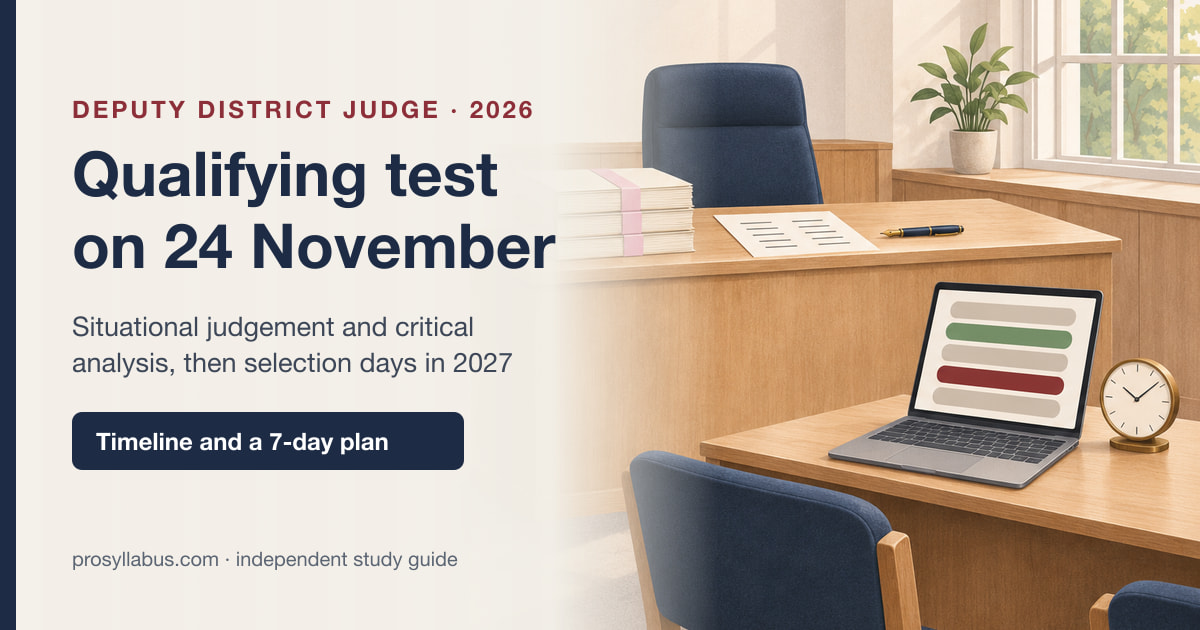
Checked 11 November 2026. Qualifying test arrangements vary by exercise; check the instructions for yours. On 10 November 2026 the JAC vacancy page said Deputy District Judge candidates would get their qualifying test instructions by email by 17 November 2026, for a test on 24 November 2026. What your own email says overrides this page.
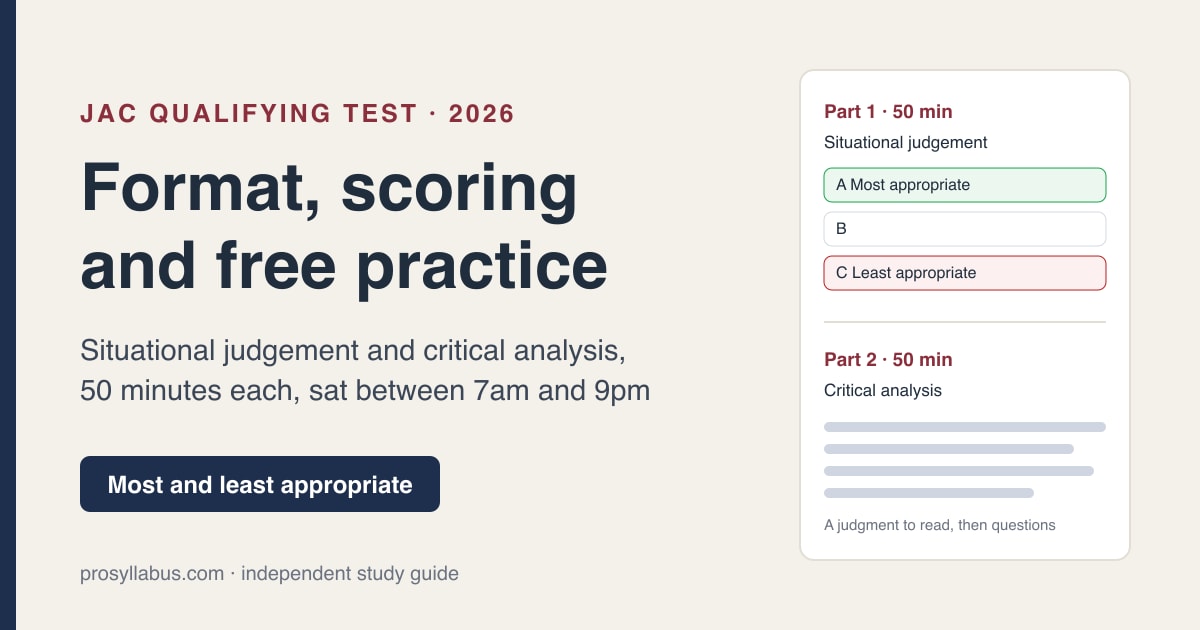
The JAC qualifying test usually has two parts. The critical analysis test is the part where you answer multiple-choice questions on a written document, such as a speech or a judgment, and it carries 40% of the composite score. You get the document before the test day: the JAC says it emails you at least one week before the test with the instructions, any pre-reading, the links and the test times. In the three JAC evaluation reports we read (2023, 2025 and 2026), the text was sent one week before the test.
Our approach splits your preparation into two stages: close reading during the pre-reading period, then the timed questions (50 minutes in the 2025 and 2026 reports, 40 minutes in 2023). This guide covers the first stage: what arrives, what past texts and questions looked like, a reading plan for each day of the week, and two worked questions on a short extract we wrote. The format and the scoring of the whole test are in our JAC qualifying test guide. Independent practice. Not affiliated with the Judicial Appointments Commission. ProSyllabus is an independent study site; the JAC did not write and does not endorse our questions.
JAC About online tests and Practice qualifying test tool pages; evaluation reports ref 184 (2023), 289 (2025) and 00326 (2026). Read 11 November 2026.
What the JAC releases at least a week ahead
The JAC's About online tests page says you will get an email at least one week before your online test, with the instructions for the test, any pre-reading material, the links you need and the test times; if it does not arrive by the expected date, contact the selection exercise team. Its Accessing online tests page adds that the situational judgement test and the critical analysis test then appear separately in your account in the days leading up to the test date. The Qualifying test page describes the critical analysis document as, for example, a speech or a judgment.
The JAC evaluation reports name the text each time. Here are the three we read:
| Exercise | Text sent one week before | Type | Time and questions | Average mark |
|---|---|---|---|---|
| Deputy District Judge (2023, ref 184) | A speech by Mr Justice Fordham, given on 9 November 2023, surveying leading cases on how the Human Rights Act 1998 has operated in the courts after 25 years | Speech | 40 minutes, 20 questions | 81% |
| Fee-paid Judge of the First-tier Tribunal, Immigration and Asylum Chamber (2025, ref 289) | Maleci (Non-admission of late evidence) [2024] UKUT 00028, an Upper Tribunal decision | Judgment | 50 minutes, 20 questions | 79% |
| Recorder (2026, ref 00326) | Lord Phillips of Worth Matravers, former Lord Chief Justice of England and Wales, "Judicial Independence", Commonwealth Law Conference, Nairobi, 12 September 2007 | Speech | 50 minutes, 20 questions | 88.4% |
Sources: the JAC reports for Deputy District Judge (ref 184), the Immigration and Asylum Chamber (289) and Recorder (00326). Each says the questions and answer options were based on the content of that text. Two points stand out (our reading). First, the text fits the role: a tribunal decision on late evidence for tribunal judges, a speech on judicial independence for Recorders. Second, a text can be very recent: the 2023 Deputy District Judge speech was given on 9 November 2023 and, by the report's account, sent one week before the test, so you cannot expect to have read it already.
JAC evaluation reports ref 184 (2,267 took the test), 289 (665) and 00326 (1,112): average critical analysis score. Lowest scores were 10% to 15% and highest 100% in all three.
What the averages mean for you (our reading): the average critical analysis score ranged from 79% to 88.4% in these three exercises, and each report picks out easier and harder questions. Candidates are ranked on a 60/40 composite of standard scores. These averages alone do not show how strong the field was or how many places one mark is worth. Our aim for the week: make the harder questions more manageable and cut avoidable errors on the easier ones.
FreeTests: Communication Skills · Personal Qualities · Effective Working
JAC Qualifying Test Practice · Free sample: 3 situational judgement questions: free sample
Answer 3 questions against the clock, like the real exam. You then see the right answer, the reason and your time on each. About 8 minutes · free · no sign-in.
3 questions to answer
Start nowabout 8 minThis one is free · no sign-in needed
Your result shows how long each question took you.
How the questions test the passage
Live test material is confidential (the JAC practice tool has its own practice questions). But each evaluation report describes some of its easier and harder critical analysis questions by topic:
| Exercise | Easier questions (per the report) | Harder questions (per the report) |
|---|---|---|
| Deputy District Judge 2023 | What Mr Justice Fordham stated when considering all the cases together: 98% correct | What he meant when he said that the case of Smith and Grady v Ministry of Defence "failed at home": 32% correct |
| Immigration and Asylum Chamber 2025 | Two questions answered correctly by 93% or more: the appropriate response when a party fails to comply with judicial directions issued by an Assistant Resident Judge, and the source of the First-tier Tribunal's authority to issue directions | Two questions the report classes as harder: the principles applied when deciding whether to grant permission to appeal, and how the Upper Tribunal should respond on the application of rule 17(2) of the Tribunal Procedure Rules |
| Recorder 2026 | Six questions answered correctly by 98% or more, on the safeguards for judicial independence the speech covers, such as judicial pay and tenure and protection from political interference | Two questions the report classes as harder, on where judicial independence comes from in the constitution and the changes made by the Constitutional Reform Act 2005 |
What we take from this (our reading): the summaries give topics and difficulty, not the questions themselves, so they cannot show exactly what reasoning each question needed. The Deputy District Judge report describes the question on what a phrase ("failed at home") meant as apparently the hardest, and the tribunal report names harder questions on permission to appeal and on rule 17(2). Our reading is that interpreting phrases and applying principles are useful areas to practise. Our advice is to anchor every answer in the text. The JAC practice tool page says, of its practice version, that all the information you need to answer the questions is in the text.
From that, these are the question types we prepare for in our own practice. The labels are ours, not the JAC's:
| Question type (our label) | What it asks you to do | How the week helps |
|---|---|---|
| What the text says | Find a point the text states; in our practice questions this can mean combining points from several paragraphs | A one-line map of each paragraph is meant to help you find any point quickly |
| What the author means | Explain a phrase, metaphor or label as the author uses it in context, whether literal or figurative | List every quoted phrase, image and term of art, and write what it means in this text |
| Best supported by the text | Pick the statement the text gives the strongest support for, when several sound plausible | Know each claim and the reason the author gives for it |
| Applying a principle | Say how a rule or test set out in the text works at a given step or on a given fact | Write each test in the text as numbered steps, with any exceptions |
| Goes further than the text | Spot the option that overstates, reverses or generalises what the text says | Mark every limit: "not every", "in principle", "unless", "rightly" |
A day-by-day plan for the pre-reading week
This is our plan for the seven days between the email and the test, written for the critical analysis text only (the qualifying test guide has the preparation for the whole test). It assumes the text arrives a full week before the test and takes about an hour a day; if yours arrives later, keep the order and merge days. Do all of it yourself: the JAC's AI guidance says you must not enter any selection material into an AI tool, so do not paste the pre-reading into one to summarise it or to generate questions on it.
| Day | What to do | Output |
|---|---|---|
| Day 1 (email arrives) | Check the email: which tests you must take, the test window, the links. Read the text once, straight through, without notes, to see what it is for: what question it answers and what its conclusion is | Two sentences: what the text is about and where it ends up |
| Day 2 | Read it again slowly. Number the paragraphs. For each, write one line on what it does: sets out facts, states a test, reports a view, rejects an argument, limits the point, concludes | A paragraph map, one line each |
| Day 3 | Go through the language. List every quoted phrase, image, label and term of art, and write what it means in this text. Note every case, statute or rule the text names and what the author uses it for, in one line, from the text itself | A glossary of phrases and a list of authorities, each with its job in the argument |
| Day 4 | Rebuild the argument. Write each test or principle as numbered steps. Mark every limit and exception (unless, not every, in principle, save where). Note where the author reports someone else's view and whether they agree with it | The argument on one page: claims, reasons, limits, whose view |
| Day 5 | Change texts to practise the questions: sit a timed critical analysis set on a text you have not seen, at the pace reported for 2025 and 2026 (20 questions in 50 minutes, 2.5 minutes each by our arithmetic; use your own instructions if they differ). Then re-read your own text's map | Your pace, and the question types you got wrong |
| Day 6 | For each paragraph, write one statement the text supports and one that goes a step too far (a dropped limit, a reversed point, a general rule made out of one example). Re-read the text in full one last time | A list of "says" against "does not say", in your own words |
| Day 7 (the day before) | Keep it light: read your paragraph map and glossary once. Check the test links work on the device you will use and that the two tests appear in your account | Notes ready, device and links checked |
| Test day | Skim your paragraph map and glossary only. Follow the instructions on what you may have with you. Start after 7am and finish both parts before 9pm. The JAC says you can choose which part to do first; our advice is to take critical analysis when you are fresh | Map and glossary skimmed, nothing new read |
Pre-reading week tracker
Tick each step as you finish it. Use it beside your own notes; it does not hold or read your text.
0 of 13 done
Ticks are saved only in this browser on this device.
Two worked questions on an extract we wrote
The extract below is our own, invented for practice; it is not from any JAC text. The two questions practise two of our types: "what the author means" and "goes further than the text". These are our practice choices; the reports do not say which question types best separate candidates. Try them before reading the answers.
Our extract: from an invented speech on remote hearings
- [1] Open justice is not a decoration on the work of the courts; it is part of how that work is checked.
- [2] When a hearing moves to a video link, the question is not whether the public could, in principle, be admitted, but whether anyone who wished to watch would in practice be able to.
- [3] A link that is available only on request, through an email address published nowhere, keeps the door shut while saying it is open.
- [4] That is not to say every public hearing must be streamed live: a published link that anyone can use, or a room where the public can watch the screen, may be enough.
- [5] Some hearings are rightly private, and the reasons for privacy do not weaken because the hearing is remote.
- [6] But where a hearing would be public in a courtroom, the move to a screen should not quietly change that.
Written by ProSyllabus for this guide. Not a JAC text, and not a statement of the law.
Worked question 1: what the author means
- Question: In sentence [3], what does the speaker mean by a link that "keeps the door shut while saying it is open"?
- A. Remote hearings should never be held in private.
- B. Access can exist on paper but not in practice.
- C. Court buildings should stay open during remote hearings.
- D. Video links are less secure than courtrooms.
- Answer: B. Sentence [2] sets the test, whether people could watch in practice, and sentence [3] gives an example that fails it: access exists on paper, but the way to get it is not made public. A contradicts sentence [5], which accepts that some hearings are rightly private. C reads the image literally; the door is a figure of speech for access. D raises security, which the extract never discusses.
Our own question. The trap is the literal reading (C) and the option that sounds principled but contradicts another sentence (A).
Worked question 2: goes further than the text
- Question: Which statement goes further than the extract supports?
- A. Some hearings may properly be held in private.
- B. The speaker separates access in principle from access in practice.
- C. Being remote should not by itself make a hearing private.
- D. A public hearing held remotely must be streamed live.
- Answer: D. Sentence [4] says a public hearing need not be streamed live: a published link or a public viewing room may be enough. D turns one way of giving access into a requirement. A restates sentence [5]. B paraphrases sentence [2]. C restates sentence [6]: moving to a screen should not by itself change a public hearing into a private one.
Our own question. In this question the decisive limit is in sentence [4].
What these show: both answers came from a sentence-by-sentence map of the extract (for a real text, your paragraph map), not from knowledge of the law on open justice. A candidate who knew the law well but had not mapped the limit in sentence [4] could read D in question 2 as a fair summary and pick another option instead. Our recommendation: spend the week mostly on close reading and mapping, and add background research only if it helps you understand the text.
FreeTests: Communication Skills · Personal Qualities · Effective Working
JAC Qualifying Test Practice · Free sample: 3 situational judgement questions: free sample
Answer 3 questions against the clock, like the real exam. You then see the right answer, the reason and your time on each. About 8 minutes · free · no sign-in.
3 questions to answer
Start nowabout 8 minThis one is free · no sign-in needed
Your result shows how long each question took you.
Common traps in the answer options
Our list. None of it is JAC guidance:
| Trap | What it looks like | Your check |
|---|---|---|
| True in law, not in the text | An option that states a correct legal rule the text does not state or rely on | Can you point to the sentence that supports it? |
| The right words, the wrong voice | A view the author reports, or argues against, presented as the author's own view | Who holds this view in the text, and does the author agree? |
| The dropped limit | The author's point with its "unless", "in principle" or "not every" removed | Is the option stronger than the sentence it comes from? |
| One example made a rule | A conclusion drawn from one case or illustration and stated as general | Does the author generalise, or only illustrate? |
| The literal reading | A figure of speech read literally when the context rules that reading out | What does the phrase do in the argument at that point? |
| The right point, the wrong place | A correct statement about a different case, step or paragraph from the one the question asks about | Does it answer this question, about this part of the text? |
On the day: using the text in the test
The JAC practice tool page says that in its practice version you get the text just before the questions, can take as much time as you need to read it, can keep a copy with you during the practice test, and the timer starts only when you move on to the questions. The JAC pages we read do not say what you may have with you in a real qualifying test, so follow the instructions in your own email on that point (Practice qualifying test tool).
In the three evaluation reports, each critical analysis question had one correct answer. The JAC's Accessing online tests page says you choose one answer, and that you can skip questions and return to them at the end if you have time left. Our advice: answer the questions you can locate quickly first and skip the "what does the author mean" questions. Consult the text or your notes only if your exercise instructions allow it; otherwise rely on what you remember from your week of preparation. For the scoring, the 30% minimum and the 60/40 composite, see the qualifying test guide.
Practise on a text you have not seen
The week of reading prepares you for one text. Practice on other texts prepares you for the questions. Our JAC qualifying test practice has full mocks in which the critical analysis part is 20 questions on its own invented text (a judgment or a speech) in 50 minutes, with our answer key and the reason for every option, alongside a situational judgement part. The free sample below is 3 situational judgement questions, which can be taken once; the critical analysis parts are in the full mocks. Independent practice. Not affiliated with the Judicial Appointments Commission. ProSyllabus is an independent study site; the JAC did not write and does not endorse our questions.
FreeTests: Communication Skills · Personal Qualities · Effective Working
JAC Qualifying Test Practice · Free sample: 3 situational judgement questions: free sample
Answer 3 questions against the clock, like the real exam. You then see the right answer, the reason and your time on each. About 8 minutes · free · no sign-in.
3 questions to answer
Start nowabout 8 minThis one is free · no sign-in needed
Your result shows how long each question took you.
Frequently asked questions
When do I get the critical analysis text?
The JAC says you will get an email at least one week before your online test with the instructions, any pre-reading, the links and the test times. In the three evaluation reports we read (2023, 2025, 2026), the critical analysis text was sent one week before the test.
What kind of text is it?
The JAC describes it as a written document, for example a speech or a judgment. Recent texts were a 2023 speech on the Human Rights Act at 25, a 2024 Upper Tribunal decision on late evidence, and a 2007 speech on judicial independence.
Do I need to know the law on the topic of the text?
The reports say the questions and answer options were based on the content of the text, and the JAC practice tool page says, of its practice version, that all the information you need is in the text. Our advice: answer from the text; background reading helps you understand it but is no substitute for knowing exactly what it says.
How many critical analysis questions are there?
The JAC general pages give no number. The 2025 Immigration and Asylum Chamber and 2026 Recorder reports describe 20 questions in 50 minutes; the 2023 Deputy District Judge report describes 20 in 40 minutes. In all three reports each question had four options and one correct answer. Your exercise instructions are the final word.
How much does the critical analysis test count?
You need at least 30% in both parts to be considered. Candidates are then ranked on a composite of standard scores in which critical analysis carries 40% and situational judgement 60%.
Can I use AI to summarise the pre-reading?
No. The JAC says you must not enter any selection material into an AI tool, and must not use AI in any qualifying test. A breach is treated as an integrity issue and may lead to disqualification.
Can I have the text open during the real test?
For its practice tool, the JAC says you can keep a copy with you. The JAC pages we read do not say what is allowed in a real qualifying test, so follow the instructions in the email for your exercise.
Should I read the cases the text mentions?
The JAC pages we read do not mention reading the cases a text cites. Our advice is to study the text first, including how the author uses any case it cites. The reports say the questions and answer options were based on the content of the text.
Are your worked questions real JAC questions?
No. JAC test material is confidential. Our extract and questions are our own, written to the JAC description of the format.
More in this series
Sources
- official — JAC: About online tests (the email at least one week before, scoring)
- official — JAC: Qualifying test
- official — JAC: Practice qualifying test tool
- official — JAC: Accessing online tests
- official — JAC: Using artificial intelligence (AI), updated August 2026
- official — JAC: Deputy District Judge qualifying test evaluation and feedback report (ref 184)
- official — JAC: 289 Fee-paid Judge of the First-tier Tribunal (Immigration and Asylum Chamber) qualifying test evaluation and feedback report (October 2025)
- official — JAC: 00326 Recorder online qualifying test evaluation and feedback report (2026)
- official — JAC vacancies: Deputy District Judge (JAC00356)
official = a document published by the conducting body. reported = a news or coaching site we could not check against an original. Where sources disagree this page says so rather than picking one.