Checked 11 November 2026. The format is from the Local Government Association's Impact pages for Cohort 29, read 11 November 2026. The LGA does not publish its interview questions, the thinking or answer time per question, its scoring scale or a pass mark; this guide says so wherever that matters. The practice prompts, the structure and the worked answers are ours.
The Impact video interview is Stage 2 of the Cohort 29 application, from January 2027. If you pass the situational judgement test, the LGA invites you to record answers to three questions, shown one at a time, each linked to its key skills and behaviours. It expects the interview to take 20 to 30 minutes and suggests leaving an hour so you can try the platform's practice function first. It is timed, you get one re-record per question, and professional assessors mark it as audio only (LGA timeline, read 11 November 2026).
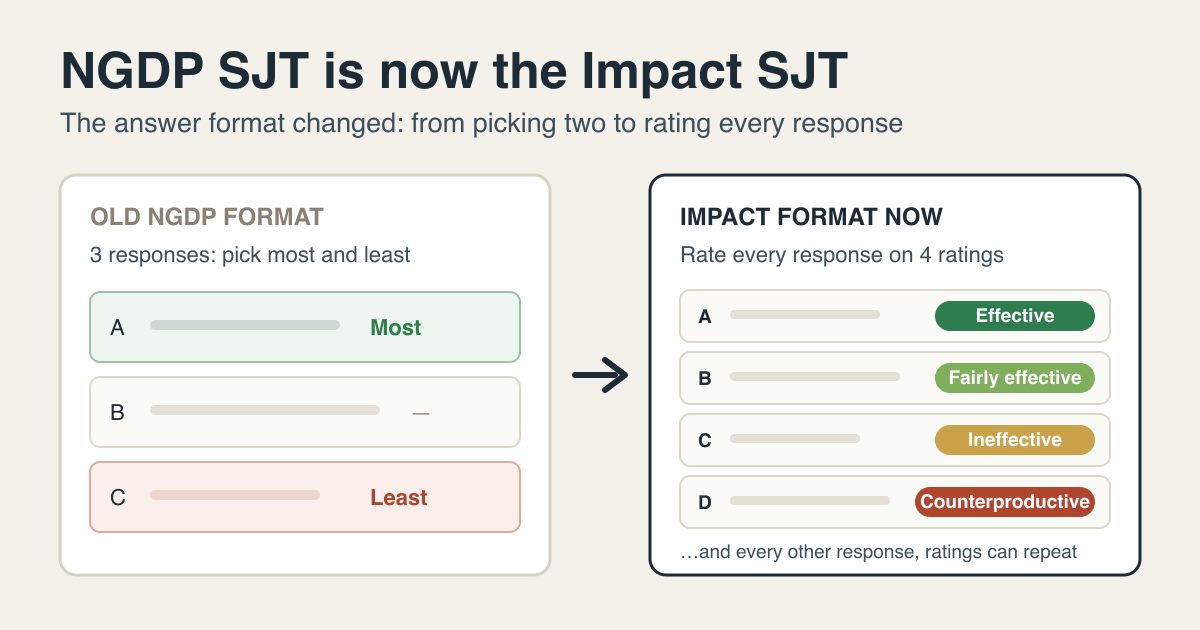
Impact: The Local Government Graduate Programme is the new name, launched in June 2024, for the programme previously known as the National Graduate Development Programme (NGDP), (LGA FAQs). Older material, including the LGA's own recorded workshops, still uses the NGDP name. The LGA does not publish its questions. This guide shows what it does publish, what the interview looks for, and how to practise: ten original prompts sorted by key skill, a 60-second answer structure, two worked answers and a timed drill.
Independent practice. Not affiliated with the Local Government Association. ProSyllabus is an independent study site; nothing here is made or endorsed by the LGA or by any council, and the practice prompts are ours, not the LGA's questions.
LGA Impact timeline and accessibility pages, read 11 November 2026.
Impact video interview format (Cohort 29)
| Rule | What the LGA says | What it means for practice (our suggestion) |
|---|---|---|
| When | From January 2027, after you pass the Stage 1 situational judgement test | Stage 1 closes at 12:00 midday on 6 January 2027. Our suggestion: prepare your examples while you finish Stage 1, not after |
| Questions | Three, asked one at a time, relating to the key skills and behaviours | Prepare real examples across all 8 key skills, then choose an example that answers the question asked |
| Length | About 20 to 30 minutes; leave an hour to use the practice function and get used to the platform | Book a quiet hour, not a gap between lectures or shifts |
| Timing | The assessment is timed | Practise against a clock. The LGA does not publish the thinking or answer time per question; read your interview instructions and ask the Impact team before starting if the timings are unclear |
| Re-records | One chance to re-record each question if you are not satisfied with your first answer | Decide in advance what would make you use it (see below) |
| Marking | Professional assessors mark the interviews as audio files only, to prevent unconscious bias. Only the answers you speak are assessed | Content and clarity matter most. Your clothes and visual background are not marked, but use a quiet room and do the interview on your own: only the audio is marked, and the video is spot-checked for independence. Practise out loud |
| Video checks | The team spot-checks video to make sure candidates complete interviews independently, and checks video where there were technical problems | Do it on your own, in your own words |
| Experience | Draw on any relevant experiences; you are not expected to have worked in a related area | Study, part-time work, volunteering, sport, caring and society roles all count |
| Adjustments | Ask the team before you begin; extra time or other adjustments cannot be given afterwards. A telephone interview with the same questions can be arranged if a visual impairment or another disability would make a video interview difficult | If you had adjustments at university, ask before you open the interview |
Sources: the LGA's Impact timeline and accessibility page, read 11 November 2026. Not published on any LGA page we read: the questions, the thinking and answer time per question, the scoring scale and a pass mark. Do not treat unofficial timings as confirmed; follow the instructions supplied for your interview. The LGA also links a recorded workshop, "ACE IT: Video interview tips", on its events page (it notes its recordings still use the old NGDP name). For every stage and date in one place, see our Impact application process guide.
Stage 1 comes first: the situational judgement test
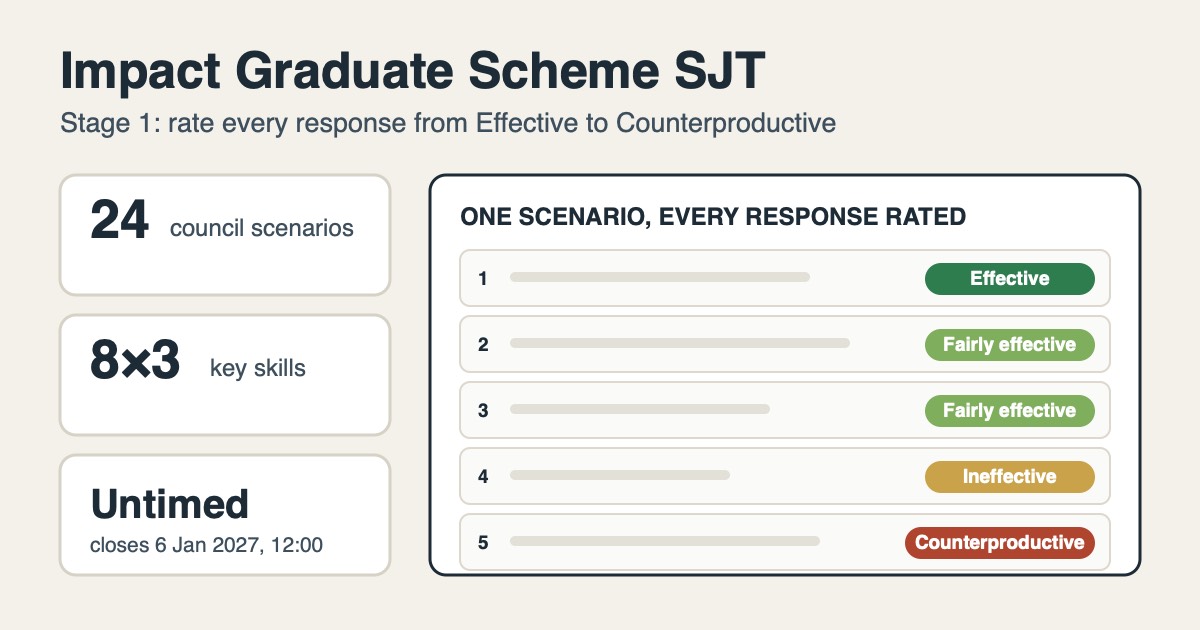
You only reach the video interview if you pass the situational judgement test, which you must finish before you can submit your application. For Cohort 29 the LGA's application page says you give an effectiveness rating for each response option, and its practice questions use four ratings: Effective, Fairly effective, Ineffective and Counterproductive. If you have not sat it yet, practise that first. Try a free scenario of our independent practice:
FreeTests: Effective Communication
Questions at the recycling stall
Read the situation, then rate each of its 5 responses from Effective to Counterproductive, as the real test asks. You then see the rating and the reason for each. The first 3 of 43 scenarios are free.
What the video interview looks for
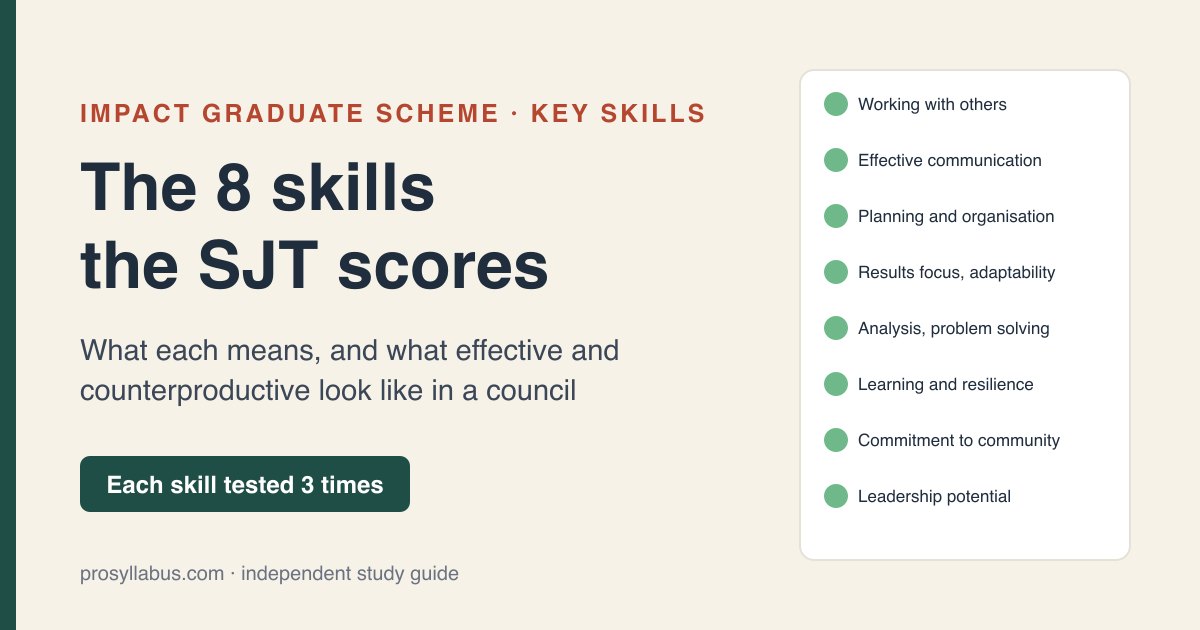
The LGA says the three questions relate to its key skills and behaviours: the same eight that the SJT measures (application page) and that the assessment centre assesses (timeline page). It does not say which skills the three questions cover, so our suggestion is a genuine example for each. The skills and our paraphrases of the LGA's definitions are in our Impact key skills guide; below is where an example for each might come from, and which of our practice prompts fit it.
| Key skill | Where your example might come from (our suggestions) | Practise with our prompts |
|---|---|---|
| Working with others | Group project, team at work, society committee | 1, 10 |
| Effective communication | Tutoring, customer service, presenting, writing for a society | 2 |
| Planning and organisation | Exams with a job, event organising, dissertation | 3 |
| Results focused and adaptability | A cancelled venue, a lost team member, a changed brief | 4 |
| Analysis and problem solving | Research, a sales or rota problem, a survey you ran | 5 |
| Motivation for learning and personal resilience | A failed module or bid, tough feedback, a new skill you taught yourself | 6 |
| Commitment to local government and the wider community | Volunteering, local news, your own council's website, a service you used | 7, 9 |
| Leadership potential | Captaincy, a shift lead, starting something new | 8 |
The LGA's approach to AI page is the clearest official statement of what its assessors want. It says they look for "authenticity, depth and lived experiences", that it is assessing your personal expression of the key skills, "not the output of an AI tool", and that it is "not looking for flawless answers". It lists what AI-written answers tend to do: sound "polished but generic", mirror competency frameworks without real-world examples, and lack personal reflection on what you did, thought or learned. Where it has reasonable grounds to believe AI was used, it may ask you to repeat the exercise under supervision or withdraw your application. It also says AI is not used to assess candidates at any stage.
| The LGA warns against | Do this instead (our suggestion) |
|---|---|
| Polished but generic wording | Say what you actually did, with one detail only you would know |
| Mirroring the competency framework without a real example | Name the skill once at most; spend the time on the example |
| No personal reflection | End every answer with what you learned or would do differently |
| AI-written answers (assessed as your own expression) | Plan from bullet points in your own words, never a script you did not write |
A 60-second answer structure
The LGA does not publish the answer limit. Our suggestion is to use a minute as a practice unit for one concise example. It is a familiar situation, action, result shape with two changes. Start with a direct answer to the question, so a listener knows where you are going. And end with what you learned, because the LGA's AI page says its assessors look for reflection and lived experience; add a link to council work where it helps answer the question. This is our suggested structure, not an LGA requirement.
- Answer (0 to 10 seconds): Answer the question in one sentence and name the example you will use.
- Situation (10 to 20 seconds): Where, when, who, and what your own role was. Two sentences at most.
- Actions (20 to 42 seconds): Two or three things you did, in order, each with "I". This is the heart of the answer.
- Result (42 to 50 seconds): What changed. Use a real number only if you know it.
- Reflect and link (50 to 60 seconds): What you learned, and how you would use it as a trainee in a council.
Our suggested practice split. Follow the actual answer limit in your interview instructions: shorten or expand the structure to fit, keeping your actions clear and answering the question asked.
Three habits make the structure work on audio. Say "I", not "we", for the actions, so the assessor hears your part. Signpost aloud ("Two things I did. First…"), because a listener cannot see your paragraphs. And stop when you have made the link: a clean finish sounds more confident than a trailing "so, yeah". If your instructions allow more than a minute, keep the same order and add detail to the actions and the reflection; if less, cut the situation first.
Ten practice prompts by key skill
These are our own prompts, written to cover all eight key skills (two skills appear twice). They are not the LGA's questions, which it does not publish. Practise each one aloud with the structure above, then use the drill below to get one at random.
| # | Key skill | Practice prompt (ours) | A strong answer includes |
|---|---|---|---|
| 1 | Working with others | Tell us about a time you worked with someone whose views or way of working were very different from yours. What did you do to make it work? | A real disagreement, what you asked or listened to, what you changed, and what you kept and why |
| 2 | Effective communication | Describe a time you had to explain something complicated to people who did not know the subject. How did you make sure they understood? | Who the audience was, how you adapted the message, and how you checked it landed |
| 3 | Planning and organisation | Tell us about a time you had several deadlines at once. How did you decide what to do first? | The competing demands, how you prioritised them, the method you used, and how you met or renegotiated deadlines |
| 4 | Results focused and adaptability | Describe a time a plan changed at short notice. What did you do, and what was the outcome? | What changed, how quickly you adjusted, staying positive, and a clear result |
| 5 | Analysis and problem solving | Tell us about a problem you solved by looking at information or figures. How did you reach your conclusion? | More than one source, a link or trend you spotted, and a decision based on the evidence |
| 6 | Motivation for learning and personal resilience | Tell us about a setback or piece of critical feedback. What did you learn, and what did you do differently afterwards? | An honest setback, what you did next, a change you can point to, and how you looked after yourself |
| 7 | Commitment to local government and the wider community | Why do you want to work in local government, and what issue facing councils interests you most? | A personal reason, one real local issue you have read about, and what a trainee could contribute |
| 8 | Leadership potential | Describe a time you took ownership of a task nobody else was leading. How did you bring others with you? | Why you stepped in, how you set an example, how you supported others, and the result |
| 9 | Commitment to local government and the wider community | Tell us about something you have done that made a difference to a community, group or neighbourhood. | Who benefited, what you did yourself, and what it taught you about serving the public |
| 10 | Working with others | Tell us about a time you had to win the support of someone who was not keen on your idea. | Their concern, the evidence or compromise you offered, and how the working relationship ended up |
Practice drill: one prompt, 30 seconds to plan, 60 seconds to speak
Press Start for a random prompt from our ten above. Plan for 30 seconds, then answer out loud while the clock runs and the beat of our structure lights up. Nothing is recorded and nothing leaves this page: it is a timer, so speak to the room, a friend or your own phone's voice memo if you want to listen back.
Our drill and our prompts, not the LGA's. The LGA does not publish its questions or the thinking and answer time per question. Our timings are practice settings; follow the instructions supplied for your interview.
Two worked answers
Read these to see the structure working, not to copy. Each is about a minute aloud. Both use invented but ordinary graduate experiences; yours should be your own, which is exactly what the LGA says it is looking for.
Worked answer 1: working with others
Our practice prompt: Tell us about a time you worked with someone whose views or way of working were very different from yours. What did you do to make it work?
Answer (0 to 10 seconds). I made it work by asking what Sam was worried about first. This was my final-year group project.
Situation (10 to 20 seconds). Four of us wrote a report on bus use for a transport charity. I wanted a survey; Sam preferred the published figures.
Actions (20 to 42 seconds). First, I asked Sam to explain the figures, and saw they covered most of what we needed. Second, I suggested a short survey on the one gap: why older residents had stopped using one route. Third, I set out both plans' timings, and we agreed a combined approach.
Result (42 to 50 seconds). We finished a week early, and the charity used our survey findings in its letter to the council.
Reflect and link (50 to 60 seconds). I learned that asking first saves time. In a council team, I would start the same way when views differ.
Why it works
- It answers the question in the first sentence, so the assessor knows where it is going.
- It shows the skill through actions (asking, compromising, letting the group decide) rather than naming it.
- It ends with a reflection and a council link, both short.
Our worked answer to our own prompt. The project and names are invented. About 125 words; read it aloud against the drill clock to find your pace.
Worked answer 2: commitment to local government and the wider community
Our practice prompt: Why do you want to work in local government, and what issue facing councils interests you most?
Answer (0 to 10 seconds). I want to work in local government because councils run services people use every day. The issue I follow most is temporary accommodation.
Situation (10 to 20 seconds). For a year I volunteered at a Saturday food bank. Many families I met lived in temporary accommodation far from their children's schools.
Actions (20 to 42 seconds). I read my council's housing pages and the local paper's coverage, then went to a public meeting on the issue. I helped make a one-page list of council services families could ask about, checked it with the council's advice line, and kept it updated.
Result (42 to 50 seconds). Volunteers used the list every week to help families find the right council contact.
Reflect and link (50 to 60 seconds). I learned that one family's situation can involve several council services. I want to help make that support easier to find and join up.
Why it works
- The motivation is personal and backed by something the speaker actually did, not a general statement about public service.
- It names one real kind of local issue and shows the speaker read about it, following the LGA's own tip to read your council's website and local news.
- It ends on what the speaker learned and what they want to do in a council, without repeating the LGA's wording back.
Our worked answer to our own prompt. The volunteering is an invented example. Pick a local issue you have genuinely read about, and explain in your own words what you learned.
The situational judgement test measures each of the same key skills three times, and you have to pass it before any of this. Our suggestion: use SJT practice to explore the key skills, then practise explaining your own experiences aloud for the interview. Our scenario explanations are our judgements, not the LGA's marking. Try another free scenario:
FreeTests: Effective Communication
Questions at the recycling stall
Read the situation, then rate each of its 5 responses from Effective to Counterproductive, as the real test asks. You then see the rating and the reason for each. The first 3 of 43 scenarios are free.
Using your one re-record
The LGA gives one chance to re-record each question. Check the platform's instructions for how a re-record is treated. Our suggestion is to decide your rule before you start, so you are not deciding under pressure:
- Re-record if you misunderstood the question, ran out of time before your result, or lost your place and never recovered.
- Keep an otherwise clear answer after a small stumble, pause or filler word. Consider a re-record if the mistake changes your meaning or stops you answering the question.
- If you re-record, correct the problem and answer the question directly. Keep the same example only if it fits the question.
- Use the practice function first (the LGA suggests leaving time for it), so your first real recording is not your first time on the platform.
These are our suggestions. The LGA allows one re-record per question; follow the platform's instructions about using it.
Getting ready for an audio-marked interview
Because only the audio is marked, the things that matter most are what you say and whether it can be heard. Our checklist for the hour you book:
| Check | Our suggestion |
|---|---|
| Room | Quiet, door shut, phone on silent. Background noise competes with your voice on an audio file |
| Microphone | Test it in the practice function; a headset or earphones with a microphone often sounds clearer than a laptop |
| Connection | A stable connection. The LGA says it checks video where there were technical problems, so report any at once |
| Notes | Check your interview instructions for any rule on notes, and ask the Impact team before starting if it is unclear. The LGA spot-checks the video to make sure candidates complete the interview independently, so use your own words |
| Pace | Speak clearly at a comfortable pace, with brief pauses between points. Practise finishing within the time allowed |
| Adjustments | Ask before you begin; the LGA cannot give extra time or other adjustments afterwards. A telephone interview with the same questions can be arranged if a visual impairment or another disability would make a video interview difficult |
Your example bank: one real example per key skill
Tick each key skill once you have a real example ready and have said it aloud in about a minute. Our suggestion: prepare examples across all eight skills, then choose what fits each question.
0 of 13 done
Ticks are saved only in this browser on this device.
Common mistakes
- Memorising a script. The LGA says it is not looking for flawless answers and warns that AI-generated responses can sound "polished but generic". Our suggestion: practise from brief bullet points, not memorised wording.
- Using AI to write answers. The LGA assesses your personal expression of the key skills. Where it has reasonable grounds to believe AI was used, it may ask you to repeat the exercise under supervised conditions or withdraw your application.
- Describing what "we" did. The assessor needs to hear your own actions.
- Spending half the answer on background. Keep the situation to two sentences.
- Forcing a prepared example into a question it does not answer. Prepare a range of real examples across the key skills, then choose one that fits the question asked.
- A general answer to "why local government". Name a real local issue you have read about.
- Asking for adjustments after the interview. The LGA says it cannot provide them retrospectively.
- Treating unofficial timings as confirmed. The LGA does not publish thinking or answer time per question; follow your interview instructions and ask the Impact team if anything is unclear.
Pass Stage 1 first
The video interview is only for candidates who pass the situational judgement test, which closes at 12:00 midday on Wednesday 6 January 2027. Our independent Impact Graduate Scheme Situational Judgement Test Practice asks you to rate each response with the four labels in the LGA's practice questions, from Effective to Counterproductive. You then see our reason for each rating and our score for each key skill: our judgements and scoring, not the LGA's. The first scenarios are free.
See the Impact SJT practice. Independent practice. Not affiliated with the Local Government Association.
FreeTests: Effective Communication
Questions at the recycling stall
Read the situation, then rate each of its 5 responses from Effective to Counterproductive, as the real test asks. You then see the rating and the reason for each. The first 3 of 43 scenarios are free.
Frequently asked questions
What questions are asked in the NGDP (Impact) video interview?
The LGA does not publish them. It says you will be asked three questions, one at a time, which relate to its key skills and behaviours: working with others; effective communication; planning and organisation; results focused and adaptability; analysis and problem solving; motivation for learning and personal resilience; commitment to local government and the wider community; and leadership potential. Practise with one real example for each skill.
How many questions are in the Impact video interview?
Three, shown one at a time. The LGA expects the interview to take 20 to 30 minutes and suggests leaving an hour so you can use the practice function first.
When is the Impact video interview?
From January 2027 for Cohort 29, for candidates who pass the Stage 1 situational judgement test. Stage 1 closes at 12:00 midday on 6 January 2027.
Can I re-record my answers?
Yes, once per question, if you are not satisfied with your first answer. The interview is timed.
Is the Impact video interview marked on how I look?
No. The LGA says professional assessors mark the interviews as audio files only, to prevent unconscious bias. Its team spot-checks the video to make sure candidates are completing the interview independently, and checks video where there were technical problems.
How long should each answer be?
The LGA does not publish the thinking or answer time per question. Follow your interview instructions. Our one-minute, five-beat structure is a practice exercise: shorten or expand it to fit the actual limit.
Do I need local government experience?
No. The LGA encourages you to draw on any relevant experiences and examples, and says it does not expect you to have worked in a related area.
Can I do the interview by phone instead?
The LGA's accessibility page says that if a visual impairment or another disability makes a video interview difficult, it can run a telephone interview with the same questions. Ask the team before you begin; it cannot give extra time or other adjustments afterwards.
Can I use AI to prepare my answers?
The LGA says it is assessing your personal expression of the key skills, not the output of an AI tool, and that where it has reasonable grounds to believe AI was used, it may ask you to repeat the exercise under supervised conditions or withdraw your application. It also says AI is not used to assess candidates at any stage.
How do I pass a video interview?
Our suggestion: have one real example per key skill, answer the question in your first sentence, describe your own actions, end with what you learned, and practise aloud against a clock. For Impact, also read about a real issue facing councils.
What comes after the Impact video interview?
If you pass, a half-day virtual assessment centre in February to March 2027 with a written task, a group discussion and a presentation, then council interviews in May to June 2027. Our application process guide sets out every stage.
More in this series
Sources
- official — Local Government Association: Impact, the Local Government Graduate Programme timeline (Stage 2: Complete your video interview), read 11 November 2026
- official — Local Government Association: Impact, the Local Government Graduate Programme accessibility (Stage 2: Video interview), read 11 November 2026
- official — Local Government Association: Impact, the Local Government Graduate Programme, our approach to AI, read 11 November 2026
- official — Local Government Association: Impact, the Local Government Graduate Programme application (key skills and behaviours, hints and tips), read 11 November 2026
- official — Local Government Association: Impact, the Local Government Graduate Programme FAQs (Impact is the new name, launched June 2024; previously the National Graduate Development Programme), read 10 November 2026
- official — Local Government Association: Impact, the Local Government Graduate Programme events (recorded workshop "ACE IT: Video interview tips"), read 11 November 2026
official = a document published by the conducting body. reported = a news or coaching site we could not check against an original. Where sources disagree this page says so rather than picking one.
Practise the Impact SJT: 43 council scenarios, rate every response
Original council scenarios in the format the LGA uses now: rate every response Effective, Fairly effective, Ineffective or Counterproductive, then see the reason behind each rating. The first three are free.
- 43scenarios
- 229responses to rate
- 8key skills
- 3free to try
Every rating comes with its reason, written against the LGA's own definitions of the four ratings.
FreeTests: Effective Communication
Questions at the recycling stall
You are helping on a council stall at a community centre about a change to bin collections: general waste moves from weekly to fortnightly next month. An older resident tells you the leaflet has confused her, she does not know her new collection days, and she is worried she will be fined if she puts the wrong bin out. You have a printed calendar of collection days for every street in the area. You know there are no fines for wrong bins in the first two months.
Response 1 of 5
Find her street on the calendar, write her new collection days on the back of her leaflet, and check she is clear about them.
Rate this response. 5 responses, about 3 minutes, no sign-in.
Opens when you unlock all
- Criticised in front of others · Motivation for Learning and Personal Resilience
- A resident rings about a broken streetlight · Commitment to Local Government and the Wider Community
- Your project group has gone quiet · Leadership Potential
- A briefing for a councillor · Effective Communication
- Your manager is off sick · Planning and Organisation
- The brief changes halfway · Results Focused and Adaptability
- The survey with a gap · Analysis and Problem Solving
- Too much on, and tired · Motivation for Learning and Personal Resilience
- A consultation nobody came to · Commitment to Local Government and the Wider Community
- A colleague takes credit · Working with Others
- A difficult email from a business owner · Effective Communication
- An event in four weeks · Planning and Organisation
- The pilot is not working · Results Focused and Adaptability
- Two reports, two numbers · Analysis and Problem Solving
- An unfamiliar task · Motivation for Learning and Personal Resilience
- A complaint about a new cycle lane · Commitment to Local Government and the Wider Community
- The figures you need from Housing · Working with Others
- More missed-bin complaints · Analysis and Problem Solving
- Two teams, one event · Working with Others
- A mistake in your team's figures · Leadership Potential
- A new trainee joins · Leadership Potential
- Two ways to write one summary · Working with Others
- Calls a colleague cannot make · Working with Others
- The food bank's storage boxes · Working with Others
- Fewer swimmers at one pool · Analysis and Problem Solving
- Two quotes for one job · Analysis and Problem Solving
- A survey about market day · Analysis and Problem Solving
- Short of volunteers · Leadership Potential
- A quiet member of your group · Leadership Potential
- The room without a lift · Leadership Potential
- Telling tenants the lift repair is late · Effective Communication
- A drainage report for residents · Effective Communication
- Going on leave with work in progress · Planning and Organisation
- The room is double-booked · Planning and Organisation
- An emergency comes first · Results Focused and Adaptability
- Your contact at the school leaves · Results Focused and Adaptability
- The wrong date went out · Motivation for Learning and Personal Resilience
- Not chosen for a secondment · Motivation for Learning and Personal Resilience
- A cold home · Commitment to Local Government and the Wider Community
- A renewal he cannot do online · Commitment to Local Government and the Wider Community
- 40 more council scenarios, 214 responses to rate on the LGA's four ratings
- All 8 key skills, in council scenarios like the real test
- The reason behind every rating, so you learn the scale, not the answers
- A score for each key skill, and whether you rate too harshly or too kindly (our scoring)
- Untimed, like the real test. Pause any time and come back
Independent practice. Not affiliated with the Local Government Association. The scenarios are original; ratings are our reading of the LGA's published definitions of the four ratings. Beyond its two practice questions, the LGA pages we read publish no answers and no scoring rule.