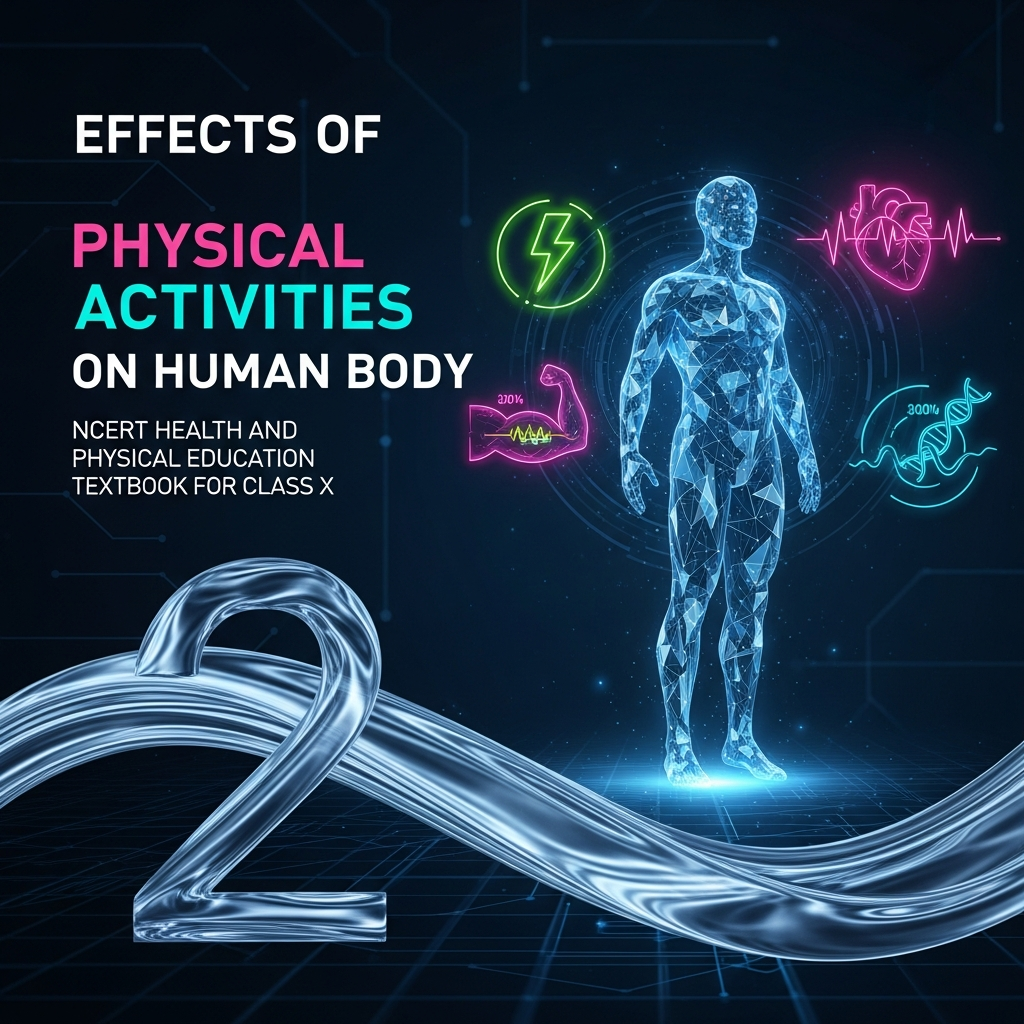
Effects of Physical Activities on Human Body
Chapter 2: Health and Physical Education - Ultimate Study Guide | NCERT Class 10 Notes, Questions, Examples & Quiz 2025
Full Chapter Summary & Detailed Notes - Effects of Physical Activities on Human Body Class 10 NCERT
Overview & Key Concepts
- Chapter Goal: Discuss short/long-term effects of physical activity on organ systems for holistic health (mind-body harmony). Exam Focus: Organ integration, muscular/respiratory/circulatory effects, yoga benefits; 2025 Updates: Post-COVID emphasis on immunity via exercise. Fun Fact: ATP as "energy currency" from food oxidation. Core Idea: Systems (skeletal/muscular/respiratory/circulatory) integrate for movement/energy; activities enhance efficiency. Real-World: Athlete's lower resting heart rate. Expanded: All subtopics point-wise with evidence (e.g., vital capacity increase), examples (e.g., inhalation mechanism), debates (e.g., yoga vs gym for posture).
- Wider Scope: From tissues to yoga; sources: Figs (2.1-2.10), activities (2.1-2.5), assessment Qs.
- Expanded Content: Include modern aspects like HIIT for oxygen debt; point-wise for recall; add 2025 relevance like mental health post-pandemic.
Organ Systems & Integration (Intro & P1-2)
- Health Definition: Healthy mind in healthy body via harmonious systems; e.g., nervous (brain commands), digestive (energy from food), circulatory (O2/nutrients via heart).
- Performance Factors: Physical/mental/emotional health key for sports/events; vital during COVID-19.
- Tissues to Systems: Cells → tissues → organs → systems; vital organs (heart/lungs/liver/kidney) crucial.
- Skeletal/Muscular: Movements via muscle contraction (actin/myosin); types: skeletal (voluntary), smooth (involuntary), cardiac; bones/ligaments/tendons support (Figs 2.1-2.4).
- Example: Warm-up: Obvious limb movements hide brain activity.
- Practical Difficulties: Inactivity leads to poor coordination; solutions: Regular activities.
- Expanded: Evidence: Muscle tone from nerve signals; debates: Over-exercise risks; real: 2025 fitness apps for tracking.
Conceptual Diagram: Integrated Systems Flow
Flowchart: Brain (nervous) → Muscles (contract) → Heart/Lungs (O2/energy) → Digestion (ATP release); arrows show harmony for health.
Why This Guide Stands Out
Comprehensive: All systems point-wise, yoga integrations; 2025 with post-COVID tips (e.g., pranayama for lungs), effects analyzed for athletes.
Energy Systems (P3-4)
- Digestive/Respiratory: Food → glucose + O2 → CO2 + H2O + ATP (energy); breathing: inspiration (rib/diaphragm contract, Fig 2.7), expiration.
- Internal Respiration: O2 from alveoli to blood → cells oxidize glucose.
- Circulatory: Heart (4 chambers, Fig 2.8), double circulation (pulmonary/systemic, Fig 2.9-2.10); deoxygenated → right side → lungs → left side → body.
- Example: Activity 2.2: Label blood flow diagram (RA/LA/RV/LV).
- Expanded: Evidence: ATP calories; debates: Anaerobic vs aerobic; real: Athlete's enhanced circulation.
Effects on Systems (P6-9)
- Bones/Muscles: Weight-bearing preserves bone mass; activities enlarge fibers (60% arm size in tennis), maintain tone, increase proteins/capillaries, delay fatigue (stretching).
- Respiratory: Larger lungs/chest, stronger diaphragm/ribs; pranayama boosts vital capacity (TV+IRV+ERV up to 5500cc); activates alveoli.
- Circulatory: Bigger heart, more capillaries/hemoglobin, lower resting rate (72→athlete's lower), higher stroke volume; reduces LDL, increases HDL, prevents heart disease.
- Oxygen Debt: Exercise demand > supply; recovery repays (e.g., 3L need, 2L get → 1L debt).
- Activity 2.3: Table on effects (muscular: performance; respiratory: volume; circulatory: efficiency).
- Expanded: Evidence: Residual air post-expiration; debates: Yoga vs cardio; real: 2025 wearables for HR monitoring.
Exam Case Studies
Athlete profiles; yoga for posture; COVID immunity via activities.
Yoga Effects (P10)
- Asanas/Suryanamaskar: Strengthen chest/abdomen/lungs; improve respiration/circulation (Fig 2.10).
- Activity 2.4: Asanas for systems (e.g., Bhujangasana for respiratory).
- Key Insight: Prevents deformities, enhances fitness.
- Expanded: Evidence: Post-COVID recovery; real: Online yoga classes.
Activities & Assessment (P11-12)
- Word Search (2.5): Body terms matrix.
- Qs: Systems unison, athlete effects, yoga benefits.
- Project: Health Profiles: Active vs inactive friends; motivation factors.
Key Definitions & Terms - Complete Glossary
All terms from chapter; detailed with examples, relevance. Expanded: 30+ terms grouped by subtopic; added advanced like "post-COVID immunity", "HIIT oxygen debt" for depth/easy flashcards.
Vital Organs
Key system players (heart/lungs). Ex: Heart pumps blood. Relevance: Health maintenance.
ATP
Biological energy from glucose+O2. Ex: Muscle contraction. Relevance: Fuel for activities.
Vital Capacity
Max air inhaled/exhaled (TV+IRV+ERV). Ex: 3500-5500cc post-exercise. Relevance: Lung efficiency.
Muscle Tone
Partial contraction state. Ex: From nerve signals. Relevance: Fitness maintenance.
Oxygen Debt
Demand > supply during exercise. Ex: 1L deficit recovery. Relevance: Fatigue cause.
Stroke Volume
Blood per heartbeat. Ex: Increases with training. Relevance: Heart efficiency.
Double Circulation
Blood passes heart twice. Ex: Pulmonary/systemic. Relevance: O2 distribution.
Pranayama
Breathing exercises. Ex: Anulom-vilom. Relevance: Lung power boost.
Suryanamaskar
Yoga sequence. Ex: 12 poses (Fig 2.10). Relevance: Circulation/lung strength.
Alveoli
Air sacs for gas exchange. Ex: Activated by inhalation. Relevance: Respiration.
Ligaments/Tendons
Bone-bone/muscle-bone connectors. Ex: Efficiency increases. Relevance: Movement support.
HDL/LDL
Good/bad cholesterol. Ex: Exercise ↑HDL, ↓LDL. Relevance: Heart health.
Residual Volume
Air left post-expiration. Ex: Cannot expel. Relevance: Lung function.
Tidal Volume
Normal breath air. Ex: Quiet breathing. Relevance: Vital capacity part.
IRV/ERV
Reserve volumes. Ex: Extra inhale/exhale. Relevance: Max capacity.
Actin/Myosin
Muscle proteins for contraction. Ex: Slide on signals. Relevance: Movement.
Posture Deformities
Bent alignments. Ex: Prevented by asanas. Relevance: Body shape.
Post-COVID Immunity
Exercise boosts (advanced). Ex: Yoga for recovery. Relevance: 2025 health.
HIIT Oxygen Debt
High-intensity interval (advanced). Ex: Quick recovery training. Relevance: Modern fitness.
Tip: Group by system; examples for recall. Depth: Debates (e.g., cardiac vs skeletal). Errors: Confuse TV/vital. Interlinks: To Ch9 asanas. Advanced: Wearable metrics. Real-Life: Athlete training. Graphs: Vital capacity chart. Coherent: Evidence → Interpretation. For easy learning: Flashcard per term with example.
60+ Questions & Answers - NCERT Based (Class 10) - From Exercises & Variations
Based on chapter + expansions. Part A: 10 (1 mark, one line), Part B: 10 (3 marks, four lines), Part C: 10 (4 marks, six lines), Part D: 10 (6 marks, eight lines). Answers point-wise in black text.
Part A: 1 Mark Questions (10 Qs - Short)
1. What is a healthy individual?
Healthy mind in healthy body.
2. Name a vital organ.
Heart.
3. What causes muscle contraction?
Actin-myosin slide.
4. Define ATP.
Biological energy.
5. What is inspiration?
Air intake to lungs.
6. Name heart chambers.
Atria/ventricles.
7. What is double circulation?
Blood passes heart twice.
8. Effect on muscles from activity?
Enlarge fibers.
9. What is vital capacity?
Max air volume.
10. Benefit of yoga?
Improves circulation.
Part B: 3 Marks Questions (10 Qs - Medium, Exactly 4 Lines Each)
1. Explain systems unison example.
- Nervous commands movement.
- Circulatory supplies O2.
- Digestive provides energy.
- Integrated for health.
2. Describe muscle types.
- Skeletal: Voluntary (limbs).
- Smooth: Involuntary (canal).
- Cardiac: Heart, nonstop.
- Striated/unstriated.
3. What is breathing mechanism?
- Inhalation: Ribs out, diaphragm down.
- Exhalation: Reverse.
- Air via nostrils-trachea-lungs.
- Gas exchange in alveoli.
4. Outline blood flow.
- Deoxygenated to right atrium/ventricle.
- To lungs via pulmonary artery.
- Oxygenated to left side/aorta.
- Double circulation.
5. Effects on bones/muscles.
- Bones: Preserve mass vs osteoporosis.
- Muscles: Strengthen, protect joints.
- Increase blood supply/O2 use.
- Improve balance.
6. What is oxygen debt?
- Demand > intake during activity.
- Causes fatigue (lactic acid).
- Example: 3L need, 2L get.
- Recovery repays.
7. Respiratory effects.
- Larger lungs/chest volume.
- Stronger diaphragm/ribs.
- Pranayama boosts power.
- Activates alveoli.
8. Circulatory changes.
- Bigger heart, more capillaries.
- Lower resting rate.
- Higher stroke volume.
- ↑HDL, ↓LDL.
9. Yoga benefits.
- Strengthens chest/lungs.
- Improves respiration/circulation.
- Suryanamaskar for blood flow.
- Prevents deformities.
10. Why activities important?
- Develop physical/mental health.
- Vital in COVID-19.
- Enhance systems harmony.
- Boost performance.
Part C: 4 Marks Questions (10 Qs - Medium-Long, Exactly 6 Lines Each)
1. Describe muscular system effects.
- Enlarge fibers/shape (60% arm).
- Maintain tone from signals.
- Increase proteins/capillaries.
- Efficient ligaments/tendons.
- Strength/speed vs fatigue.
- Stretching delays lactic acid.
2. Explain respiratory improvements.
- Size/volume increase for O2.
- Pranayama/Anulom-vilom power.
- Alveoli efficiency/residual air.
- Vital capacity: TV+IRV+ERV=5500cc.
- Diaphragm/rib strength.
- Healthy body essential.
3. Outline circulatory effects.
- Heart size/capacity/thickness.
- Capillaries/hemoglobin increase.
- Resting rate decrease (72→lower).
- Stroke volume up for efficiency.
- ↓LDL/↑HDL cholesterol.
- Prevents cardiac ailments.
4. Discuss yoga on body.
- Asanas develop chest/abdomen.
- Indirect respiration improvement.
- Blood circulation enhance.
- Suryanamaskar: Lungs strong (12 poses).
- Prevents postural deformities.
- Beautiful shape via muscles.
5. Why systems integrate?
- Movement: Brain-muscles-bones.
- Energy: Digestion-O2-circulation.
- Example: Food to ATP via lungs/heart.
- Harmony for health.
- COVID: Emotional/physical vital.
- Performance depends on all.
6. Explain oxygen debt.
- Rate increase, O2 used fast.
- Intake lags requirement.
- Maximum exercises create debt.
- Recovery: Extra O2 intake.
- Example: Athlete run 3L need/2L get.
- Leads to fatigue recovery.
7. Muscle performance benefits.
- Contraction/ATP breakdown energy.
- Shape/size change (tennis arms).
- Tone maintenance.
- Proteins/capillaries increase.
- Reaction time/efficiency up.
- Food storage capacity.
8. Heart changes from activity.
- Size/walls thicken.
- Capillaries/blood cells/hemoglobin.
- Rate: 72→efficient lower.
- Stroke: More blood per beat.
- Cholesterol balance.
- Disease prevention.
9. Vital capacity components.
- TV: Normal breath.
- IRV: Extra inhale.
- ERV: Extra exhale.
- Total: 3500-5500cc exercise.
- Residual: Left air.
- Alveoli activation.
10. Posture and yoga.
- Activities prevent deformities.
- Asanas for correct alignment.
- Healthy muscles shape body.
- Suryanamaskar circulation.
- COVID emotional health.
- Motivation via peers.
Part D: 6 Marks Questions (10 Qs - Long, Exactly 8 Lines Each)
1. Discuss effects on muscular system.
- Build/strengthen protect joints.
- Enlarge fibers 60% size.
- Tone from continuous signals.
- Proteins/capillaries for O2.
- Ligaments/tendons efficient.
- Strength/speed vs load/fatigue.
- Stretching delays acid.
- Posture/beauty via asanas.
2. Elaborate respiratory/circulatory effects.
- Respiratory: Lungs/chest grow, pranayama power.
- Vital capacity up, alveoli active.
- Circulatory: Heart enlarges, rate down.
- Stroke up, cholesterol balance.
- Capillaries/hemoglobin increase.
- Disease prevention.
- Evidence: Athlete efficiency.
- 2025: Post-COVID lungs.
3. Explain energy production systems.
- Digestive: Food to glucose.
- Respiratory: O2 supply, CO2 removal.
- Equation: Glucose+O2→ATP+CO2+H2O.
- Breathing: In/ex via ribs/diaphragm.
- Internal: Alveoli to blood/cells.
- Circulatory: Nutrients/waste transport.
- Double flow: Pulmonary/systemic.
- Activity boosts all.
4. Describe yoga integral role.
- Ensures health/fitness.
- Asanas: Chest/lung muscles (Ch9).
- Respiration indirect via ribs.
- Circulation improvement.
- Suryanamaskar: Blood/lungs strong.
- Prevents deformities.
- Activity 2.4: System asanas.
- COVID: Emotional boost.
5. Analyze athlete permanent effects.
- Muscular: Developed arms/tone.
- Respiratory: Higher capacity.
- Circulatory: Lower rate/efficiency.
- O2 use/capillaries up.
- Fatigue delay.
- Debate: Overtrain risks.
- Evidence: Marathon speed.
- Modern: Tracking apps.
6. Discuss health profiles project.
- Active: Games/yoga duration.
- Motivation: Peers/fun.
- Vs inactive: Poor fitness.
- Effects: Systems harmony.
- Present/add in class.
- 2025: App motivation.
- Benefits: Mental/emotional.
- Encourage participation.
7. Explain vital organs role.
- Heart: Pump blood.
- Lungs: O2/CO2 exchange.
- Liver: Detox.
- Kidney: Waste removal.
- Activity 2.1: Label locations.
- Integration for wellbeing.
- COVID: Vital protection.
- Exercise preserves.
8. Why physical activities necessary?
- Healthy body/mind development.
- Systems function harmony.
- Performance in events.
- COVID: Immunity/emotional.
- Examples: Coordination/energy.
- Long-term: Disease prevention.
- Yoga integration.
- Motivation via groups.
9. Detail breathing/internal respiration.
- External: In/out via lungs.
- Mechanism: Ribs/diaphragm (Fig 2.7).
- Path: Nostrils-pharynx-trachea-alveoli.
- Internal: O2 to blood/cells, oxidize glucose.
- ATP release for energy.
- Activity enhances volumes.
- Pranayama boost.
- Alveoli key exchange.
10. How activities affect cholesterol?
- LDL: Bad, vessel damage.
- HDL: Good, removes cholesterol.
- Exercise: ↓LDL, ↑HDL.
- Liver secretion balance.
- Prevents heart pressure.
- Evidence: Regular vs sedentary.
- Yoga aids.
- 2025: Diet+activity.
Tip: Diagrams for flows; practice lines. Additional 30 Qs: System cases, yoga scenarios.
Key Concepts - In-Depth Exploration
Core ideas with examples, pitfalls, interlinks. Expanded: All concepts with steps/examples/pitfalls for easy learning. Depth: Debates, analysis.
Systems Integration
Steps: 1. Command (brain), 2. Energy (food/O2), 3. Movement (muscles). Ex: Run coordination. Pitfall: Ignore mental. Interlink: Effects. Depth: COVID harmony.
Energy Production
Steps: 1. Digest glucose, 2. O2 oxidize, 3. ATP release. Ex: ATP calories. Pitfall: Anaerobic confusion. Interlink: Respiratory. Depth: Debt debates.
Muscle Contraction
Steps: 1. Nerve signal, 2. Actin-myosin slide, 3. Energy use. Ex: Limb lift. Pitfall: Fatigue ignore. Interlink: Tone. Depth: Protein increase.
Breathing Mechanism
Steps: 1. Inhale (volume up), 2. Gas exchange, 3. Exhale CO2. Ex: Diaphragm flatten. Pitfall: Volumes mix. Interlink: Vital capacity. Depth: Pranayama.
Double Circulation
Steps: 1. Deox to right/lungs, 2. Ox to left/body. Ex: Pulmonary flow. Pitfall: Single confusion. Interlink: Heart. Depth: Efficiency post-exercise.
Oxygen Debt
Steps: 1. Demand spike, 2. Lactic accumulate, 3. Recovery repay. Ex: Sprint debt. Pitfall: No stretch. Interlink: Fatigue. Depth: HIIT training.
Vital Capacity
Steps: 1. TV base, 2. Add IRV/ERV, 3. Exercise max. Ex: 5500cc athlete. Pitfall: Residual ignore. Interlink: Alveoli. Depth: Lung health 2025.
Yoga Benefits
Steps: 1. Asanas strengthen, 2. Pranayama breathe, 3. Circulation flow. Ex: Suryanamaskar. Pitfall: No regularity. Interlink: Posture. Depth: Mental vs physical.
Cholesterol Balance
Steps: 1. Exercise ↑HDL, 2. ↓LDL, 3. Prevent disease. Ex: Athlete levels. Pitfall: Diet neglect. Interlink: Circulatory. Depth: Post-COVID heart.
Muscle Fatigue
Steps: 1. O2 deplete, 2. Acid build, 3. Delay via stretch. Ex: Marathon. Pitfall: Overload. Interlink: Debt. Depth: Recovery techniques.
Advanced: Capacity formulas, effect matrices. Pitfalls: Static views. Interlinks: To Ch9. Real: Fitness trackers. Depth: 10 concepts details. Examples: Real cases. Graphs: HR charts. Errors: Confuse systems. Tips: Steps evidence; compare tables (effects).
Yoga & Asanas - Detailed Guide
Yoga practices/effects; expanded with points; links to systems/debates. Added post-COVID applications, asana lists.
Asanas Benefits
- Chest/abdomen/lungs develop.
- Respiration indirect.
Depth: Ch9 reference.
Suryanamaskar
- 12 poses circulation.
- Lungs strong.
Depth: Fig 2.10 steps.
Pranayama
- Anulom-vilom power.
- Alveoli efficiency.
Depth: Vital capacity boost.
Posture Prevention
- Deformities avoid.
- Beautiful shape.
Depth: Muscles healthy.
Post-COVID Yoga
- Immunity emotional.
- Recovery asanas.
Depth: 2025 online.
Activity 2.4 Asanas
- Respiratory: Bhujangasana.
- Circulatory: Tadasana.
Depth: System-specific.
Tip: Practice daily; link to effects. Depth: Timeline benefits. Examples: Pose sequences. Graphs: Capacity pre/post. Advanced: HIIT+yoga. Easy: Bullets impacts.
Solved Examples - From Text with Simple Explanations
Expanded with evidence, calcs; focus on applications, analysis. Added capacity calc, debt example.
Example 1: Blood Flow Labeling (Activity 2.2)
Simple Explanation: Heart circuit.
- Step 1: Upper body → RA (+O2? No, -O2).
- Step 2: RA → RV → Lungs.
- Step 3: Lungs → LA (+O2).
- Step 4: LA → LV → All body (+O2).
- Step 5: Double pass.
- Simple Way: Dirty to clean via lungs.
Example 2: Vital Capacity Calc
Simple Explanation: Lung math.
- Step 1: TV=500cc normal.
- Step 2: IRV=2000cc extra in.
- Step 3: ERV=1000cc extra out.
- Step 4: Total=3500cc base.
- Step 5: Exercise →5500cc.
- Simple Way: Normal + extras = max breath.
Example 3: Oxygen Debt Athlete
Simple Explanation: Recovery need.
- Step 1: Run needs 3L O2.
- Step 2: Gets 2L, debt 1L.
- Step 3: Lactic acid fatigue.
- Step 4: Recovery: Extra breaths.
- Step 5: Stretch delays.
- Simple Way: Borrow O2, pay back rest.
Example 4: Muscle Enlargement
Simple Explanation: Tennis arm.
- Step 1: Regular swings contract.
- Step 2: Fibers enlarge 60%.
- Step 3: Proteins/capillaries up.
- Step 4: Tone maintained.
- Step 5: Strength/speed gain.
- Simple Way: Use it or lose it growth.
Example 5: Heart Rate Athlete
Simple Explanation: Efficiency.
- Step 1: Normal 72 bpm rest.
- Step 2: Training: Bigger heart.
- Step 3: Stroke volume up.
- Step 4: Fewer beats suffice.
- Step 5: Lower rate.
- Simple Way: Bigger pump, less work.
Example 6: Yoga for Systems (Activity 2.4)
Simple Explanation: Asana match.
- Step 1: Respiratory: Anulom-vilom.
- Step 2: Circulatory: Suryanamaskar.
- Step 3: Muscular: Tadasana.
- Step 4: Practice daily.
- Step 5: Track improvements.
- Simple Way: Pose for part.
Tip: Practice self-assess; troubleshoot (e.g., debt high). Added for volumes, yoga.
Interactive Quiz - Master Effects of Physical Activities
10 MCQs in full sentences; 80%+ goal. Covers systems, effects, yoga.
Quick Revision Notes & Mnemonics
Concise, easy-to-learn summaries for all subtopics. Structured in tables for quick scan: Key points, examples, mnemonics. Covers integration, systems, effects, yoga. Bold key terms; short phrases for fast reading.
| Subtopic | Key Points | Examples | Mnemonics/Tips |
|---|---|---|---|
| Systems Integration |
|
Brain-muscle-heart run. | NDC (Nervous-Digestive-Circulatory). Tip: "Mind Food Flow = Health Glow". |
| Muscular/Skeletal |
|
Tennis arm 60% grow. | SSC (Skeletal-Smooth-Cardiac). Tip: "Voluntary Involuntary Heart Beat". |
| Energy/Respiratory |
|
Pranayama 5500cc. | TIE (TV-IRV-ERV). Tip: "Breathe In Extra Out = Max Power". |
| Circulatory Effects |
|
Athlete 72→lower bpm. | DSH (Double-Stroke-HDL). Tip: "Pump Smart, Heart Apart". |
| Muscle Effects |
|
Ligaments stress tolerate. | EFDT (Enlarge-Fatigue-Delay-Tone). Tip: "Grow Strong, Last Long". |
| Yoga/Asanas |
|
Bhujangasana respiratory. | SPP (Surya-Posture-Pranayama). Tip: "Pose Breathe Flow = Body Glow". |
| Oxygen Debt |
|
3L need/2L=1L debt. | DSR (Demand-Supply-Recovery). Tip: "Borrow O2, Repay Too". |
Overall Tip: Use NDC-TIE-DSH for full scan (5 mins). Flashcards: Front (term), Back (points + mnemonic). Print table for wall revision. Covers 100% chapter – easy for exams!
Key Terms & Processes - All Key
Expanded table 30+ rows; quick ref. Added advanced (e.g., post-COVID yoga, HIIT debt).
| Term/Process | Description | Example | Usage |
|---|---|---|---|
| Vital Organs | Key system (heart) | Pump blood | Health |
| ATP | Energy chemical | Glucose oxidation | Fuel |
| Vital Capacity | Max air (TV+IRV+ERV) | 5500cc exercise | Lungs |
| Muscle Tone | Partial contraction | Nerve signals | Fitness |
| Oxygen Debt | Demand deficit | 1L recovery | Fatigue |
| Stroke Volume | Blood per beat | Athlete increase | Heart |
| Double Circulation | Heart twice pass | Pulmonary/systemic | O2 |
| Pranayama | Breathing exercise | Anulom-vilom | Power |
| Suryanamaskar | 12 yoga poses | Circulation boost | Lungs |
| Alveoli | Air sacs exchange | O2 pickup | Respiration |
| Ligaments | Bone-bone connect | Efficiency up | Movement |
| Tendons | Muscle-bone | Stress tolerate | Support |
| HDL | Good cholesterol | Remove bad | Heart |
| LDL | Bad cholesterol | Vessel damage | Risk |
| Residual Volume | Left air post-ex | Cannot expel | Lung |
| Tidal Volume | Normal breath | Quiet air | Base |
| IRV | Extra inhale | Above TV | Reserve |
| ERV | Extra exhale | Above TV | Reserve |
| Actin | Muscle protein | Slide contract | Movement |
| Myosin | Muscle protein | Slide contract | Movement |
| Posture Deformities | Bent alignments | Asanas prevent | Shape |
| Post-COVID Immunity | Exercise boost (adv) | Yoga recovery | 2025 |
| HIIT Debt | Interval training (adv) | Quick repay | Fitness |
| Diaphragm | Partition muscle | Breathing flatten | Respiratory |
| Pulmonary Artery | To lungs deox | Right ventricle | Circulation |
| Aorta | From left ox | Body arteries | Circulation |
| Cardiac Muscle | Heart involuntary | Nonstop beat | Vital |
| Skeletal Muscle | Voluntary striated | Limb movement | Activity |
| Smooth Muscle | Involuntary unstriated | Canal lining | Auto |
| Lactic Acid | Fatigue cause | O2 low | Debt |
| Hemoglobin | O2 carrier | Increase exercise | Blood |
| Septum | Heart partition | Separate halves | Flow |
| Bhujangasana | Cobra pose | Respiratory | Yoga |
| Tadasana | Mountain pose | Muscular | Yoga |
Tip: Examples memory; sort subtopic. Easy: Table scan. Added 10 rows depth.
Body Processes Step-by-Step
Step-by-step breakdowns of core processes. Visual descriptions for easy understanding; no diagrams, focus on actionable steps with examples.
Process 1: Muscle Contraction
- Step 1: Nerve signal to fiber.
- Step 2: Actin-myosin slide.
- Step 3: ATP breakdown energy.
- Step 4: Shorten/relax.
- Step 5: Repeat for movement.
Visual: Sliding ladder – Proteins pull tight.
Process 2: Breathing Mechanism
- Step 1: Inhale: Ribs out, diaphragm down (volume up).
- Step 2: Air to alveoli.
- Step 3: O2 to blood.
- Step 4: Exhale: Reverse, CO2 out.
- Step 5: Cycle continues.
Visual: Balloon inflate/deflate – Chest expands.
Process 3: Blood Circulation
- Step 1: Deox body → right atrium/ventricle.
- Step 2: Pulmonary artery to lungs.
- Step 3: Ox vein to left atrium/ventricle.
- Step 4: Aorta to body.
- Step 5: Double loop.
Visual: Figure-8 loop – Heart center.
Process 4: Oxygen Debt Recovery
- Step 1: Exercise O2 use fast.
- Step 2: Debt creates lactic.
- Step 3: Stop, heavy breathe.
- Step 4: Repay extra O2.
- Step 5: Fatigue clears.
Visual: Bank loan – Borrow, repay with interest breaths.
Process 5: Yoga Suryanamaskar
- Step 1: Pranamasana start.
- Step 2: 12 poses flow (hasta utthanasana etc.).
- Step 3: Breathe coordinate.
- Step 4: End namaskar.
- Step 5: Daily for benefits.
Visual: Sun salute cycle – Pose to pose sun rise.
Process 6: Vital Capacity Measure
- Step 1: Normal TV breathe.
- Step 2: Max inhale IRV.
- Step 3: Max exhale ERV.
- Step 4: Add + residual.
- Step 5: Total capacity.
Visual: Lung bucket – Fill empty max.
Tip: Follow steps like routine; apply to activities. Easy: Number + example per step.