Checked 25 September 2026. Counts are from the three official DA papers and keys and will not change. They describe past papers — GATE publishes no official weightage, and the 2027 paper can differ.
GATE Data Science and Artificial Intelligence (DA) has only been held three times — 2024, 2025 and 2026 — and GATE publishes no official weightage. So every "GATE DA weightage" table online is an estimate, and most of them do not say how they were made.
We made ours the slow way. We took the three official question papers and answer keys, placed every one of the 165 subject questions into one of the seven sections of the official syllabus, and added up the marks from the key. This page shows the result, the handful of questions that could reasonably go in two sections, and what the pattern means for the 2027 paper.
Where other pages get this wrong
Programming and DBMS carry far more marks than most weightage tables admit.
Commonly published instead: Weightage tables — including an older page on this site — that put Programming at 10–12% and leave DBMS & Warehousing out altogether.
In the official papers, Programming, Data Structures and Algorithms carried 20, 14 and 14 of the 85 subject marks (16–24%). DBMS & Warehousing rose from 7 marks in 2024 to 11 in 2025 and 18 in 2026 — more than Machine Learning that year. A plan that treats DBMS as a minor topic is planning for a paper that no longer exists.
The paper, before the weightage
Every GATE DA paper has 65 questions for 100 marks in 3 hours. The first 10 questions are General Aptitude (15 marks: five 1-mark and five 2-mark MCQs). The remaining 55 are the DA subject, for 85 marks. There is no separate engineering-mathematics part — probability, linear algebra and calculus are sections of the DA syllabus itself.
| Subject part | 1-mark MCQ / MSQ / NAT | 2-mark MCQ / MSQ / NAT | Total MCQ / MSQ / NAT |
|---|---|---|---|
| 2024 | 17 / 2 / 6 | 10 / 10 / 10 | 27 / 12 / 16 |
| 2025 | 13 / 7 / 5 | 12 / 11 / 7 | 25 / 18 / 12 |
| 2026 | 12 / 6 / 7 | 11 / 8 / 11 | 23 / 14 / 18 |
Inside the subject part, MCQs fell every year (27, 25, 23) while numerical-answer questions went 16, 12, 18. MSQ and NAT questions carry no negative marking, so in 2026 32 of the 55 subject questions could be attempted without losing marks for a wrong answer — though an MSQ scores only with exactly the right set of options and a NAT only with a value in the accepted range, so a wrong attempt still earns nothing and costs time.
Marks per section, year by year
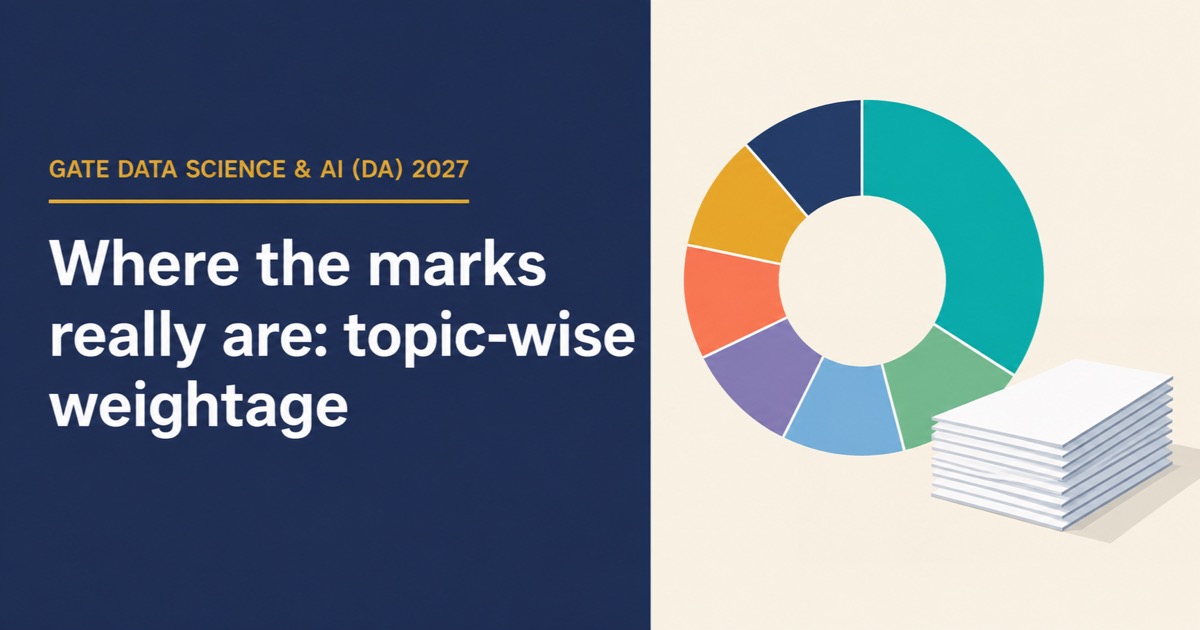
| Section | 2024 (Q / marks) | 2025 (Q / marks) | 2026 (Q / marks) | Three-year marks | Share of 255 |
|---|---|---|---|---|---|
| Probability & Statistics | 9 / 15 | 12 / 19 | 13 / 21 | 55 | 21.6% |
| Programming, DS & Algorithms | 13 / 20 | 9 / 14 | 9 / 14 | 48 | 18.8% |
| Machine Learning | 10 / 15 | 8 / 12 | 8 / 13 | 40 | 15.7% |
| DBMS & Warehousing | 5 / 7 | 7 / 11 | 11 / 18 | 36 | 14.1% |
| Linear Algebra | 6 / 10 | 8 / 12 | 5 / 8 | 30 | 11.8% |
| AI (search, logic, uncertainty) | 7 / 10 | 4 / 6 | 6 / 8 | 24 | 9.4% |
| Calculus & Optimization | 5 / 8 | 7 / 11 | 3 / 3 | 22 | 8.6% |
Marks from the official answer keys, classified by us question by question. Each bar is 85 marks.
What the numbers say
Four patterns worth planning around
- Probability & Statistics is the largest section and growing: 15 → 19 → 21 marks. It is also the section that feeds Machine Learning and AI (Bayes, conditional independence), so its effective weight is higher still.
- DBMS & Warehousing is the fastest riser: 7 → 11 → 18 marks. SQL output, relational algebra, functional dependencies and normal forms, B+ trees and OLAP cubes all appeared.
- Programming is big and steady: 20 → 14 → 14 marks, most of it Python output-tracing, sorting, binary search and graph traversal — very learnable.
- Calculus is the most volatile: 8 → 11 → 3 marks. Do not skip it, but do not over-invest either.
Three papers is a small sample. These are tendencies, not promises about 2027.
Where other pages get this wrong
Linear Algebra is not a fixed 15% of the paper.
Commonly published instead: "Linear Algebra: 15%" as a standing rule.
It carried 10, 12 and 8 of 85 marks — between 9% and 14%. And several linear-algebra ideas were examined inside Machine Learning questions (PCA, principal components, least squares), which we counted as ML. Learn eigenvalues, SVD and projections thoroughly; their marks show up under more than one heading.
The questions that keep coming back
These are themes we saw in more than one paper. The year and question number are given so you can find each one in the official PDFs.
| Section | Recurring themes (paper · question) |
|---|---|
| Probability & Statistics | Bayes theorem (24 Q58, 25 Q31, 26 Q57); exponential distribution and memorylessness (24 Q57; 25 Q21, Q41; 26 Q34); conditional expectation (24 Q59, 25 Q11); CDFs (25 Q19, Q39; 26 Q54); covariance/correlation (24 Q65, 26 Q63); CLT (25 Q40, 26 Q45) |
| Linear Algebra | Eigenvalues (24 Q13; 26 Q46, Q65); singular values (24 Q61, 25 Q50); projection matrices (24 Q49, 25 Q50, 26 Q52); subspaces (24 Q47, 26 Q22); rank and solutions (24 Q48, 25 Q13); matrix powers (25 Q37, 26 Q21) |
| Calculus & Optimization | Local/global maxima and minima (24 Q50, 25 Q49, 26 Q27); second-derivative tests (24 Q15, 25 Q51); limits (24 Q60, 25 Q32); continuity and differentiability (24 Q37; 25 Q24, Q48) |
| Programming, DS & Algorithms | Python output tracing (24 Q38, Q41; 25 Q23, Q47, Q63; 26 Q16, Q50, Q58); sorting (24 Q30, Q45; 25 Q29; 26 Q15, Q49); binary search (24 Q40, 25 Q27, 26 Q31); DFS/BFS (24 Q14, 25 Q65, 26 Q40); tree traversals (24 Q28, 26 Q25); stacks, queues, deques (24 Q16, Q32; 25 Q64); hashing (24 Q21, 25 Q18) |
| DBMS & Warehousing | SQL query output (24 Q31; 25 Q33; 26 Q51, Q60); relational algebra (24 Q26; 25 Q17, Q62; 26 Q42); FDs, keys and normal forms (24 Q46; 25 Q16, Q57; 26 Q17); OLAP cube/cuboids (25 Q46; 26 Q18, Q43); B+ trees and indexing (24 Q55; 26 Q32, Q41) |
| Machine Learning | Naive Bayes (24 Q18, Q20; 25 Q35; 26 Q23); SVM margin/support vectors (24 Q17, 25 Q53); neural-network parameter counts, ReLU (24 Q43, 25 Q42, 26 Q56); hierarchical-clustering linkage (24 Q42, 25 Q30, 26 Q36); PCA (24 Q18, 25 Q60, 26 Q11); linear and ridge regression (25 Q34; 26 Q37, Q55). Seen once: k-means (24 Q19), kNN (24 Q63). |
| AI | Minimax/alpha–beta (24 Q25, 25 Q43, 26 Q30); A* and heuristics (24 Q23, 25 Q44, 26 Q13); propositional logic (24 Q29; 25 Q15; 26 Q24, Q38); first-order logic (24 Q54; 26 Q14, Q48); Bayesian networks (24 Q24, Q64; 25 Q26) |
GATE DA recurring-themes checklist
Tick a theme once you can solve its past questions without looking at the key. Saved in this browser.
0 of 37 done
Ticks are saved only in this browser on this device.
How we classified — and where it was a judgement call
Each question was placed in the one section whose syllabus text best describes what it tests. Most were unambiguous. The ones below could be argued either way; we list our choice so you can re-count if you disagree. Moving all of them would change no section by more than a few marks.
| Paper | Questions and our choice |
|---|---|
| 2024 | Q22 Fisher LDA → ML; Q24 conditional independence → AI; Q27 z-score normalisation → DBMS (data transformation); Q33 sigmoid derivative → Calculus; Q64 Bayesian-network joint probability → AI. Q59 was marks-to-all; counted under P&S. |
| 2025 | Q15 propositional equivalence → AI; Q34 least-squares fit → ML; Q48 ReLU continuity → Calculus; Q60 PCA variance → ML |
| 2026 | Q11 angle between principal components → ML; Q22 ball meeting a 2-D subspace → LA; Q29 SGD update → Calculus & Optimization; Q33 counting bijections → P&S; Q35 double geometric series → Calculus; Q45 Poisson/CLT limit → P&S; Q65 max xᵀAx on the unit sphere → LA |
What this means for your 2027 plan
| Priority | Section | Why |
|---|---|---|
| 1 | Probability & Statistics | Largest and rising; feeds ML and AI |
| 2 | Programming, DS & Algorithms | Big, steady, and very learnable by practice |
| 3 | DBMS & Warehousing | Fastest riser; 18 marks in 2026 |
| 4 | Machine Learning | Steady 12–15 marks; leans on probability and linear algebra |
| 5 | Linear Algebra | 8–12 marks directly, more inside ML questions |
| 6 | AI | Compact syllabus; 6–10 marks |
| 7 | Calculus & Optimization | Smallest syllabus; volatile 3–11 marks |
Priority here means the order in which to make a section solid, not permission to skip the bottom of the list. On our classification every section carried at least three marks in every paper — Calculus in 2026 only just (Q27, Q29, Q35; if the SGD question Q29 were filed under ML, it would be two). The cheapest marks are often in the smallest sections, because their syllabus is short.
Practise it, don't just read it
Weightage tells you where the marks are. A topic quiz tells you whether they are yours yet.
The ProSyllabus GATE DA library currently has three topic quizzes: Matrix Rank and Inverse (Section 2, Linear Algebra), Backpropagation in Neural Networks (Section 6, multi-layer perceptrons) and Gradient Descent Variants (optimisation practice for Machine Learning — the syllabus names no gradient methods, though a 2026 question applied an SGD update). Each has ten questions and a worked explanation for every option. Probability, programming and DBMS have no quizzes yet — drill those from the section index of the official papers.
Which topic has the highest weightage in GATE DA?
Probability and Statistics. In our count of the official 2024, 2025 and 2026 papers it carried 15, 19 and 21 of the 85 subject marks — 55 of 255 marks over three years, about 22%.
Is DBMS important for GATE DA?
Yes, increasingly. Database Management and Warehousing carried 7 marks in 2024, 11 in 2025 and 18 in 2026 — more than Machine Learning in 2026. SQL output, relational algebra, normal forms, indexing and OLAP cubes all appeared.
Does GATE publish official weightage for DA?
No. GATE publishes the syllabus and the papers but no weightage. Any weightage table, including this one, is a count or estimate made from past papers. Ours is a question-by-question count of the three official DA papers.
Has the GATE DA syllabus changed for 2027?
No. Comparing the official 2026 and 2027 syllabus PDFs, the content is word for word the same; the only change is that the seven topic headings are now numbered Section 1 to Section 7.
How many questions are in GATE DA?
Sixty-five questions for 100 marks in 3 hours: 10 General Aptitude questions for 15 marks and 55 Data Science and AI questions for 85 marks.
More in this series
- GATE DA marks vs score vs rank, with calculator
- GATE DA previous year papers 2024–2026, with answer keys
- GATE DA or GATE CS — which paper, and writing both
- GATE DA 2027 week-by-week plan, October to February
- GATE DA without a CS degree
- Probability & Statistics for GATE DA — the heaviest section
- GATE DA cutoffs, rank vs IIT and placements
- GATE DA notice board — official updates
Sources
- official — GATE 2024 DA question paper (IISc)
- official — GATE 2024 DA final answer key
- official — GATE 2025 DA question paper (IIT Roorkee)
- official — GATE 2025 DA answer key
- official — GATE 2026 DA question paper (IIT Guwahati)
- official — GATE 2026 DA answer key
- official — GATE 2027 DA syllabus (IIT Madras)
- official — GATE 2026 DA syllabus (IIT Guwahati)
official = a document published by the conducting body. reported = a news or coaching site we could not check against an original. Where sources disagree this page says so rather than picking one.