Checked 8 November 2026. Frontline’s guidance for the 2027 cohort (applications opened 28 September 2026; assessment centres usually October to May in the help centre, October to April on the applicants page). Frontline sends invited applicants their own instructions for the interview before the day: follow those if they differ from this guide.
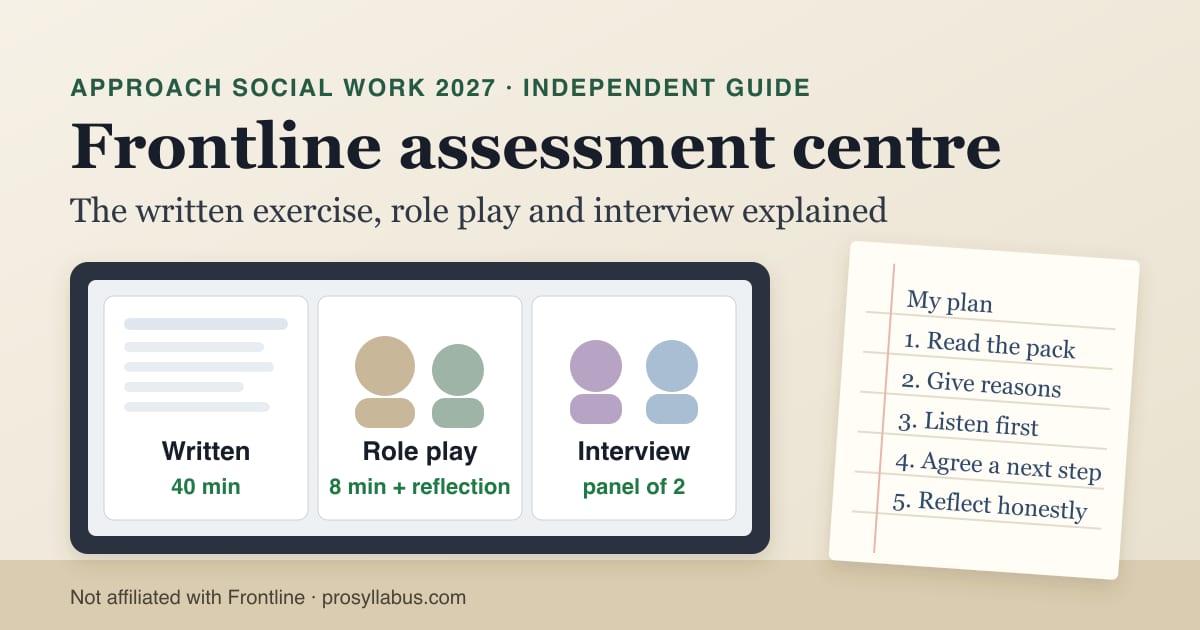
The Frontline interview is one of three activities at the Approach Social Work virtual assessment centre. Frontline describes it as a competency-based panel interview with a social worker and a person with care experience, who ask about your past experiences and why you want to become a social worker. The questions are linked to Frontline’s published competencies. Frontline recommends that you do not script your answers, and suggests the STAR method (Situation, Task, Action, Result) to structure them.
Frontline’s published guidance does not give its interview questions. This guide sets out what it does say, then gives 34 practice questions of our own grouped by its competencies, our suggested follow-up probes, two worked answers, a story bank and a mock-interview script. The full assessment-centre day, including the written exercise and the role play, is in our Frontline assessment centre guide.
ProSyllabus is an independent study site. It is not part of Frontline or Approach Social Work, and every question on this page is our own independent practice: not made, endorsed or checked by Frontline, not taken from real or past Frontline interviews, and not a prediction of what you will be asked.
Frontline: assessment centre tips, applicants page and application process.
Key facts: the Frontline interview
| Item | Detail |
|---|---|
| Programme | Approach Social Work (formerly the Frontline programme): a three-year route into children’s social work in England, with a master’s degree |
| Stage | Part of the virtual assessment centre (stage 4 of 5), after the online test and the screening of your application form |
| Format | Panel interview by video call, one of three activities at a half-day virtual assessment centre |
| Panel | A social worker and a person with care experience (Frontline’s process page: a care-experienced young person) |
| What they ask | Questions about your experiences and why you want to pursue a career as a social worker, linked to the competencies |
| Style | Competency-based: examples from your past; prompt questions follow your answers |
| Frontline’s advice | Prepare examples for each competency; do not script; STAR can help structure answers |
| Before the day | An information pack 1 to 3 days before, with instructions for the interview and the role play and case information for the written exercise; Frontline suggests allowing about an hour to read it |
| Not in Frontline’s guidance | The questions, how long the interview lasts, how many questions are asked, and how answers are scored |
| Adjustments | Disclosing a disability is your choice; Frontline strongly recommends doing it early (for example on the application form) so it can make reasonable adjustments. Its assessment-centre examples include extra time, a BSL interpreter, a scribe and dyslexia-friendly resources |
| Outcome | Within 10 working days of the assessment centre; a decision on the whole day, not the interview alone |
Where the interview sits in the application
Frontline’s five stages are registration, the application form (two competency questions of 350 words each), the online test, the virtual assessment centre and pre-employment checks. If you pass the online test, a screener trained in social work reviews your application form without seeing your personal details or work experience; to be considered for an assessment centre you then upload the required eligibility documents and fill in Frontline’s career-experience form. Frontline says assessment centres run from October and invites candidates on a rolling basis, depending on location and the needs of its local authority partners.
On the day, a different assessor observes each of the three activities, and each competency is assessed in more than one of them. Frontline tells applicants not to be discouraged if one activity feels weaker, because there is still a chance to show the required competencies in another. The interview is the activity where you talk about yourself; the written exercise and the role play are covered in our Frontline assessment centre guide.
If you are still at the online-test stage, Frontline gives you 7 days from the link to complete it: verbal reasoning and social-work scenarios, not timed, in one sitting, with about 30 minutes recommended. The full stage is explained in our online test guide.
The free try below is one moment from our assessment centre practice: a short role-play brief of our own, in which a parent who feels judged opens the door, and you type what you would say first. It is not an interview question; it lets you practise how you would respond to a parent. It is our own practice item, not Frontline’s, and you get one free try.
Free: one role-play moment, with feedback and a model response
Read the short brief, then type what you would say in your first minute, as you would say it aloud. One free try, no sign-up.
Question 1 10 marks
Practice role-play brief (our own, fictional). You are a newly qualified social worker making a first home visit to Mrs Karen Lowe. Her son Josh (11) has arrived at school hungry several times this term, and staff think he has lost weight. The school told Mrs Lowe they would contact children's services. Your objectives: explain why you are there, hear her side, find out how Josh is, and agree a next step.
Mrs Lowe opens the door and says: "I know why you're here. I'm not a bad mum. I'm doing everything on my own and nobody helps me."
Type what you would say in your first minute, as you would say it aloud.
0 words · at least 50 needed for feedback. Answer as fully as you would on the day.
What Frontline says the interviewers are looking for
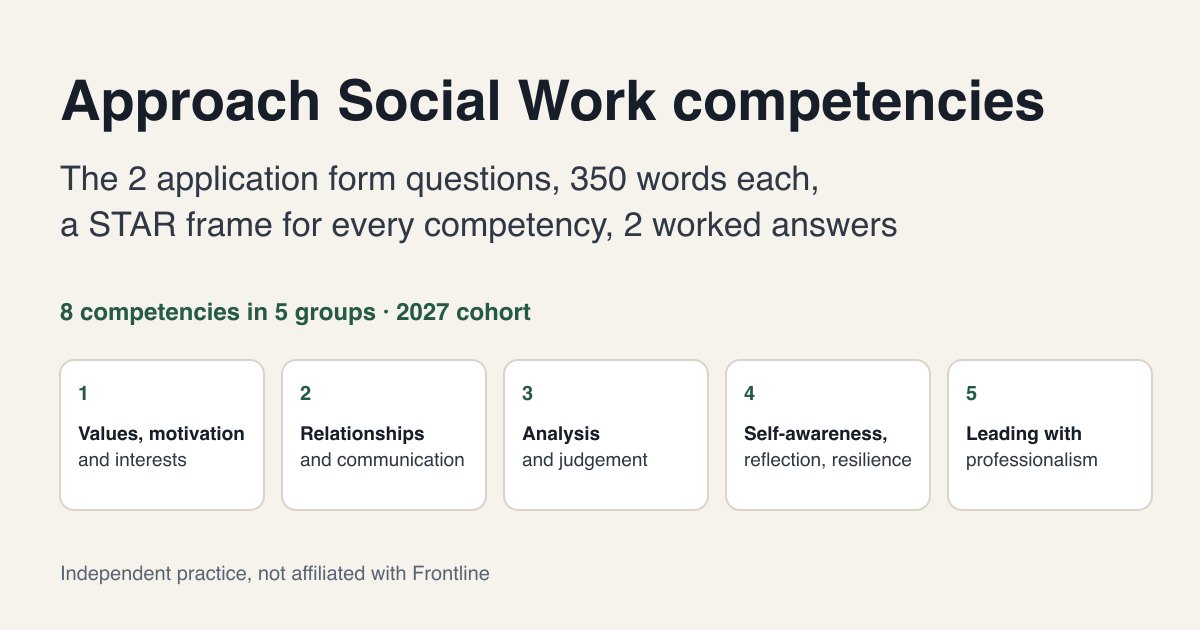
Frontline uses its published competencies throughout the application process: eight competencies within five groups. For the interview, it tells applicants to prepare examples of when they have shown them. In summary, and in Frontline’s terms:
| Competency group | Competencies |
|---|---|
| Values, motivation and interests | Values, motivation and interests: a realistic understanding of children’s social care; motivation to help children and families with fairness and dignity; curiosity about people and systems and a belief that they can change; commitment to learning and study |
| Relationships and communication | Empathy with professional boundaries; clear, respectful and adaptive communication |
| Analysis and judgement | Analytical thinking and curiosity; judgement and decision making under uncertainty and pressure |
| Self-awareness, reflection and resilience | Self-awareness and reflexivity; emotional resilience and seeking help |
| Leading with professionalism | Leadership: following through, challenging bias or unfairness respectfully, promoting fairness, safety and dignity, collaborating well |
Frontline adds two things it looks for all day, on top of the competencies: how you manage your time, and your professional conduct, including professionalism in your presentation, your communication and how you relate to others. In an interview, that means arriving on the call on time, listening to the whole question and answering it. What each competency means in practice is in our competencies guide and on Frontline’s competencies page.
Frontline interview questions by competency
Frontline’s own description of the interview is short: questions about your experiences and why you aspire to be a social worker. The questions below are ours, written to practise against each competency in that style. They are not Frontline questions and not an indication of the real questions, their number or their grouping. When you answer, protect other people’s confidentiality and share only the personal experiences you are comfortable discussing.
Values, motivation and interests
| Practice question (ours) | What a strong answer could show (our view) |
|---|---|
| Why do you want to become a children’s social worker? | A specific reason rooted in something you saw or did, and a realistic picture of the work, including its hard parts |
| Why Approach Social Work, rather than another route into social work? | You know the programme: learning on the job in a practice hub, supervision from a consultant social worker, the master’s, the relationship-based models it teaches |
| What do you think a children’s social worker does in a normal week? | Research, in Frontline’s terms: building relationships, working with other professionals, advocating for children and making complex decisions to keep them safe; not only “helping children” |
| Tell us about a social issue, such as inequality, that has shaped your decision to apply. | How the issue affects families, why it matters to you, and that you see people inside systems, not only individual choices |
| Tell us about a time you saw someone change something about their life. What made the difference? | A belief that people can change, and curiosity about what helped |
| What is the hardest part of social work, in your view, and how do you feel about it? | Honesty about distress, conflict and caseloads, without either drama or false calm |
| Tell us about something you learned recently that changed your mind. | Commitment to learning and study: what you read or heard, and what you now think differently |
Relationships and communication
| Practice question (ours) | What a strong answer could show (our view) |
|---|---|
| Tell us about a time you supported someone who was upset or angry. | Empathy: you noticed their emotional state and responded to it, and stayed objective |
| Tell us about a time you had to keep a professional boundary with someone you cared about helping. | You understand why boundaries protect the other person, not just you; what you said and how they took it |
| Describe a time you had to explain something difficult to someone who did not want to hear it. | Clear, honest words, said kindly; how you checked they understood |
| Tell us about a time you changed how you communicated for a particular person. | Adaptive communication: age, language, disability, mood; what you changed and why |
| Tell us about a time someone challenged you, and you stayed calm. | You stayed non-judgemental and purposeful, and kept the conversation going |
| How would you start building trust with a young person who does not want to speak to you? | Patience, honesty about your role, and doing what you said you would |
| Tell us about a time you listened and realised you had misunderstood someone. | Respect for other people’s perspectives; what you asked and what you learned |
Analysis and judgement
| Practice question (ours) | What a strong answer could show (our view) |
|---|---|
| Tell us about a time you had to make a decision without all the information you wanted. | You gathered what you could, named what was missing, decided in time and explained your reasoning |
| Describe a time you noticed something did not add up. What did you do? | You spot inconsistencies and missing information, and ask questions before concluding |
| Tell us about a time you were worried about someone’s safety or wellbeing. | You recognised the limits of your role and escalated the concern to the right person, promptly |
| Tell us about a time you had to choose between two options that both had risks. | Balancing competing risks, and naming what you would watch afterwards |
| Tell us about a time a first explanation for someone’s behaviour turned out to be wrong. | Curiosity about context and alternative explanations |
| Tell us about a decision you made under time pressure. Would you make it again? | Judgement under pressure, and honest review afterwards |
| When have you said “I don’t know” and asked for advice? What happened? | You know the limits of your knowledge and treat asking as good practice, not failure |
Self-awareness, reflection and resilience
| Practice question (ours) | What a strong answer could show (our view) |
|---|---|
| How might your own background or experiences shape how you see the families you work with? | Reflexivity: a specific way your identity or experience could help and could mislead you |
| Tell us about a time you noticed an assumption or bias of your own. | You caught it, examined it and changed what you did |
| Tell us about feedback that was hard to hear. What did you do with it? | You adjusted your behaviour, and can show the change |
| Tell us about a time something you were involved in affected you emotionally. How did you cope? | Regulating emotions without pretending to be untouched; what you did to recover |
| Tell us about a time you asked for help rather than struggling alone. | You recognise when you need support and ask for it appropriately and in time |
| Social work involves uncertainty and pressure. What tells you that you are ready for that? | A realistic view of the emotional demands, with evidence from your past, not only optimism |
| Tell us about a time you kept going with something difficult. What kept you going? | Perseverance through difficulty, and the support you used |
Leading with professionalism
| Practice question (ours) | What a strong answer could show (our view) |
|---|---|
| Tell us about a time you showed leadership by speaking up to improve a situation. | What you personally did, the impact it had, and how it relates to advocating for children and families |
| Tell us about a time you challenged an assumption, unfairness or bias in someone else. | You challenged it respectfully, thought about power and safety, and sought a fair outcome, escalating if needed |
| Tell us about a time you could not keep a commitment. What did you do? | Accountability: you told people early, took responsibility and repaired it |
| Tell us about a time you persuaded others to work together towards a better outcome. | Collaboration and influence, and responsible use of any authority you held |
| Tell us about a time you made a mistake that affected other people. | Ownership in the first sentence, then what you did and what changed in how you work |
| How do you manage your time when several people need something from you at once? | Time management and respect for people’s time, with an example of how you prioritised |
Our advice: prepare flexible stories, not answers to these exact questions. One example can illustrate several competencies; answer the question actually asked and adapt to the prompts. Frontline’s two application-form questions, on motivation and on leadership, show the kind of wording it uses, but they do not tell you the interview questions. Frontline’s guidance does not say whether the panel has read your form, so it helps to have an example ready that you did not use there.
Follow-up questions to practise
Frontline warns that scripted answers make it hard to adjust to the prompt questions. These are probes of our own to practise with, after any of the questions above; Frontline’s guidance does not give its prompt questions:
| Probe (ours) | Why we suggest it |
|---|---|
| What exactly did you say? | To hear your communication, not a summary of it |
| What was your part, rather than the team’s? | To separate “I” from “we”, which Frontline also asks for in written answers |
| How do you think the other person felt? | Empathy and perspective-taking |
| What would you do differently now? | Reflection, and whether you can name a real weakness |
| How does that relate to working with children and families? | Whether you can carry the lesson into social work |
| Who else could you have involved? | Judgement: seeking help, escalating, working with others |
| What if the situation had got worse? | Thinking under uncertainty; your limits and when you would pass a concern on |
Answering a panel that includes a person with care experience
One of your two interviewers has experience of the care system. Frontline’s guidance does not say how the panel divides the questions, so give both interviewers your full attention and respect. Our advice for the way you talk:
- Talk about children and families with dignity, as people rather than cases or problems. Do not assume your interviewer identifies with any particular story, or speaks for everyone with care experience.
- Describe working with children and families: listening to what they want, explaining your role honestly. Recognise too that keeping a child safe can mean decisions a family disagrees with, explained respectfully.
- Use plain, respectful language and avoid unnecessary acronyms such as “LAC”. Use terms accurately (“children in care” are in care now; “care-experienced people” is broader), respect people’s own terminology, and if you use a term such as “safeguarding”, explain what it means in practice.
- Be honest about the limits of your understanding of care, and stay open to perspectives different from your own.
- Do not ask your interviewer about their own experience of care, and do not guess at it.
- Explain why you want to do this job in a way you would be comfortable saying to a child, young person or parent who has a social worker.
Our advice, not Frontline guidance.
Using STAR without scripting
Frontline suggests STAR for structure and also recommends not scripting. The two fit together if you prepare points, not paragraphs: for each story, four lines of notes you could speak from in any order the conversation needs.
| Part | What to say | Our rule of thumb |
|---|---|---|
| Situation | Where you were and what was going on, in one or two sentences | About 15% |
| Task | What you had to do, or the problem you faced | About 10% |
| Action | What you did and said, step by step, with “I”; why you chose it | About 50% |
| Result | What happened, what you learned, and what it means for social work | About 25% |
The shares are ours, not Frontline’s. In the Result, say what happened and what you learned and, where it fits the question, how that learning could carry into work with children and families: Frontline asks for exactly that link in its application-form leadership question.
Worked answer 1: why social work, and why Approach Social Work
Frontline says the interviewers ask why you aspire to a career as a social worker. The example below is invented, for a recent graduate; use your own story.
Worked answer 1 · Values, motivation and interests
“Why do you want to become a children’s social worker, and why through Approach Social Work?”
Situation: For two years at university I volunteered at an after-school homework club in a part of the city with high child poverty. One boy, about ten, stopped coming for three weeks. When he came back he told me his family had been moved into temporary accommodation an hour away and he was getting up at six to get to school.
Task: I was a volunteer, so my job was to pass what he had told me to the club coordinator, through the club’s procedure, and I did. But it made me want to understand what happens after that point: who works with families in that position, and how.
Action: I asked the coordinator, and she introduced me to the school’s family support worker, who explained in general terms, without discussing any family, how her service works with families facing housing problems and with the council. I then read about how housing, poverty and family stress connect, and I took Frontline’s quiz and read participants’ stories to begin exploring the demands of the job as well as its rewards.
Result: It challenged an assumption I might have made, that missed sessions meant a lack of commitment: I could see how housing pressures his family could not control might affect him, while knowing I did not have the full picture. Further research helped me see what makes children’s social work different from housing advice or family support: building relationships with children and parents, understanding a child’s needs and safety, working with other professionals and making difficult decisions. That combination is what I want to do: work alongside children and families, hear what matters to them and challenge barriers to support. Approach Social Work suits how I learn: in practice from the first year, in a hub with a consultant social worker, with a master’s and models like motivational interviewing that put the relationship first.
What it shows: Motivation from a specific experience; curiosity about people and systems, without blaming the family; research on the role and the programme (the hub, the consultant social worker, the models it teaches); and the volunteer passing information on through the agreed route, without sharing it more widely.
The weak version: “I have always wanted to help people, and Frontline is the best programme.” It gives the panel little specific evidence of your motivation, of what children’s social care involves, or of why Approach in particular.
Our own invented example, written for this guide. It is not a Frontline answer, a model Frontline has approved or a prediction of what a panel will ask. Frontline recommends not scripting answers: use the shape, not the words.
Worked answer 2: a decision without all the information
Frontline’s analysis and judgement competencies include seeking relevant information, spotting risks and missing information, deciding under uncertainty, knowing the limits of your knowledge and escalating concerns appropriately. Our example shows a safeguarding concern handled within your role; other examples could show other parts of the competency. Again, it is invented.
Worked answer 2 · Analysis and judgement
“Tell us about a time you had to make a decision without all the information you wanted.”
Situation: I worked weekends as a swimming teacher at a leisure centre. During a Saturday class I noticed bruising on the upper arms of a girl of about eight, and she flinched and pulled away when I moved closer to demonstrate a stroke.
Task: I did not know how she got the bruises, and there could have been an ordinary explanation. I had to look after her in the lesson and raise the concern promptly under our safeguarding procedure, without investigating or assuming what had happened.
Action: I checked quietly that she was all right and gave her space; I was ready to listen if she wanted to talk, without leading questions or promises of secrecy. I did not investigate or confront her parent, because that was not my role. I raised the concern with the centre’s safeguarding lead without avoidable delay, asking a colleague to cover the pool so the class stayed supervised, and then wrote down exactly what I had seen and when, kept separate from any interpretation. I told the lead I might be wrong and that I was reporting what I saw, not a conclusion. If the lead had been unavailable, I would have used the other reporting route in our procedure; immediate danger would have needed immediate protective action.
Result: The lead thanked me and said she would take it forward; I understood that further information would be shared with me only if my role needed it. I learned that raising a concern does not need certainty: my part was to look after her immediate safety, report promptly through the right route and record accurately. As a social worker I would be receiving that kind of information, so I know how much depends on someone choosing to share it promptly.
What it shows: Recognising the limits of your knowledge and role, recording relevant information, a timely decision under uncertainty, escalating appropriately on the first observation, care for the child in the moment, and objectivity: a factual record, not a judgement about the family.
The weak version: Waiting for certainty before raising it, investigating it yourself (questioning the child closely or confronting the parent), promising the child secrecy, or sharing the details with people who do not need them.
Our own invented example, written for this guide. It is not a Frontline answer, a model Frontline has approved or a prediction of what a panel will ask. Frontline recommends not scripting answers: use the shape, not the words.
The card below takes you to the same free role-play moment from our assessment centre practice and starts it, if you have not tried it yet. After you answer, the feedback shows which points of our practice checklist your words covered, with a model response to compare.
FreeAssessment centre role play
Try one role-play moment: what would you say first?
A short practice brief of our own: a parent who feels judged opens the door. Type what you would say in your first minute, then see what your answer showed and a model response. One free try.
Your story bank: experiences that cover every competency
Frontline says you do not need any particular experience to apply. The panel wants evidence of the competencies, and that can come from paid work, volunteering, study, caring for a relative or your own life. Aim for six to eight stories you can tell well. Anonymise them and leave out identifying or unnecessary sensitive details about other people. Choose experiences you are comfortable discussing: you do not need to disclose your own trauma or care history to give a strong answer. Our suggested types:
| Story type | Likely competencies |
|---|---|
| Someone you supported through a hard time | Empathy with boundaries; communication; emotional resilience |
| A concern you raised or passed on | Judgement under uncertainty; leadership; seeking help |
| A time you spoke up about something unfair | Leadership; values; communication when challenged |
| A mistake you made and put right | Self-awareness; leadership (accountability) |
| Feedback that changed what you do | Self-awareness and reflexivity; commitment to learning |
| A problem where the first explanation was wrong | Analytical thinking and curiosity |
| A time you were stretched thin and asked for help | Emotional resilience and seeking help; time management |
| What brought you to children’s social work | Values, motivation and interests |
Frontline interview preparation checklist
Tick each step as you go. It combines Frontline’s advice with our suggestions.
0 of 14 done
Ticks are saved only in this browser on this device.
A 25-minute mock interview to run with a friend
The interview is online, so practise on a video call. Give your friend this page and ask them to play both interviewers. Timings are ours; Frontline’s guidance does not say how long its interview lasts.
| Minutes | What happens |
|---|---|
| 0 to 3 | Introductions; one warm-up question: “Tell us a little about yourself and why you are here today.” |
| 3 to 9 | One values question from the list, then two probes from the follow-up table |
| 9 to 15 | One relationships or analysis question, then two probes |
| 15 to 21 | One self-awareness or leadership question, then two probes, including “What would you do differently now?” |
| 21 to 25 | Your questions for the panel, then feedback: which competencies your friend heard, and where you said “we” |
Afterwards, note which stories ran long and which probes caught you out. Change the questions for the second run so you are not rehearsing words.
Questions you could ask the panel
Frontline’s guidance does not say whether there is time for your own questions. If you are offered it, one thoughtful question is better than three; prioritise something that matters to you and that Frontline’s website does not already answer. Some of ours:
- What do new participants usually find hardest in their first months in a practice hub?
- What helps a trainee build trust with a family that did not ask for a social worker?
- How does the programme help participants bring children’s own views and wishes into their day-to-day work?
- How do participants usually look after themselves in the first year?
Our suggestions.
Common mistakes
- Reciting a script. Frontline recommends against it: it says scripted answers can make it harder to adjust to prompt questions and to show your natural communication style.
- Saying “we” throughout. The panel needs to hear what you did.
- Answering a different question from the one asked, because it matches a prepared story. Listen to the whole question first.
- Talking about “saving” children or “fixing” families. Frontline looks for people who believe families can change and work with them with fairness and dignity.
- Presenting yourself as never stressed. Frontline wants a realistic understanding of the emotional challenge and evidence that you ask for help.
- Knowing nothing specific about Approach Social Work. “Why this route?” needs facts: the hub, the consultant social worker, the master’s, the local authority placement.
- Treating a weak first activity as the end. Each competency is assessed in more than one activity.
After the interview, feedback and applicant support
Frontline says you will hear within 10 working days of your assessment centre. If you are successful and Frontline has verified your qualifications and right to work, you receive a conditional offer (the help centre says you read and sign a conditional offer letter); the offer is conditional on eligibility checks (references and verification of documents), suitability checks (including a DBS check, health and conduct checks and a self-declaration form), Frontline finding you a suitable local authority placement, and two days of shadowing in your allocated local authority. Frontline says it can give feedback only to applicants who reach the assessment-centre stage, so ask for it if you are unsuccessful; you can apply only once per recruitment cycle, so the next chance is when applications reopen the following autumn.
If you have a disability, Frontline says disclosing it is not obligatory but strongly recommends doing so early, so it can make reasonable adjustments; its help centre lists BSL interpreter support and live captioning at events, and assessment-centre examples such as extra time, a BSL interpreter, a scribe and dyslexia-friendly resources. Frontline also runs lunchtime and evening drop-in sessions with its recruitment team for applicants with questions; the booking links are on its applicants page. For the whole programme, see our Approach Social Work programme guide.
Not sat the online test yet?
The interview comes only after the online test and the screening of your application form, and Frontline reviews your form only after a successful test result. Our Approach Social Work Online Test Practice covers that earlier stage: three practice tests of 20 questions with verbal reasoning passages and social-work scenarios asked as most likely and least likely, every answer explained, and a result grouped by our own mapping to the competency areas (not Frontline’s scoring). It does not cover the interview.
See the Approach Social Work Online Test Practice. Independent practice, written by us; not made or endorsed by Frontline.
FreeAssessment centre role play
Try one role-play moment: what would you say first?
A short practice brief of our own: a parent who feels judged opens the door. Type what you would say in your first minute, then see what your answer showed and a model response. One free try.
Frequently asked questions
What questions are asked in the Frontline interview?
Frontline says the panel asks about your experiences and why you want to become a social worker, and that the questions are linked to its competencies: values, motivation and interests; relationships and communication; analysis and judgement; self-awareness, reflection and resilience; and leading with professionalism. Its guidance does not give the questions. The practice questions on this page are ours.
Who interviews you at the Frontline assessment centre?
A panel of a social worker and a person with care experience. Frontline says its assessors include people with experience of the care system and social workers who have completed one of its programmes.
What is the Frontline interview process?
The interview is one of three activities at a half-day virtual assessment centre, with a written exercise and a role play. You reach it after the application form, the online test and a review of your form. You hear the outcome within 10 working days.
Is the Approach Social Work interview competency-based?
Yes. Frontline calls it a competency-based interview and asks about your past experiences. It suggests the STAR method (Situation, Task, Action, Result) to structure answers, and recommends not scripting them.
How should I answer “Why do you want to be a social worker?”
Through your values, your research and, where it helps, a specific experience, rather than a general wish to help: what you saw or did, what it taught you about children, families and the systems around them, and why that leads you to children’s social work. Add why Approach Social Work in particular, with facts about the programme. Worked answer 1 on this page shows the shape.
How do I prepare for a social work interview with Frontline?
Read Frontline’s competencies, research the programme and the role, prepare six to eight real stories with STAR points rather than scripts, practise answering follow-up questions out loud on a video call, and read the information pack Frontline sends 1 to 3 days before the assessment centre.
Do I need social work experience for the Frontline interview?
No. Frontline says you do not need any particular experience to apply. Your examples can come from work, volunteering, study, caring or your own life, as long as they show the competencies.
How long is the Frontline interview?
Frontline’s guidance does not give the length of the interview or how many questions it asks. The whole assessment centre lasts half a day.
What questions should I ask at the end of a social work interview?
If you are offered the chance, ask one thoughtful question that Frontline’s website does not already answer, for example about what new participants find hardest in a practice hub. Do not ask an interviewer about their own experience of care.
Can I get feedback if I am unsuccessful at the Frontline interview?
Frontline says it can give feedback only to applicants who reach the assessment-centre stage, so you can ask. You can apply once per recruitment cycle, so the next chance is the following autumn.
More in this series
Sources
- official — Frontline: Approach Social Work assessment centre tips (the interview, written exercise and role play; read 8 Nov 2026)
- official — Frontline: Approach Social Work applicants (application form questions, assessment centre activities and assessors, outcome, drop-in sessions)
- official — Frontline: Approach Social Work, Application process (the five stages; the interview with a social worker and a care-experienced young person)
- official — Frontline: Approach Social Work, What we’re looking for (competencies, time management and professional conduct)
- official — Frontline: Approach Social Work competencies (full descriptions)
- official — Frontline: Approach Social Work help centre (assessment centre dates and outcome, feedback, reapplying, reasonable adjustments, practice hubs, curriculum)
- official — Frontline: Approach Social Work programme page (three-year programme, master’s degree, bursary and pay)
- official — Frontline: Is social work right for you? (Frontline’s free quiz)
- official — Frontline: Stories (participants and social workers)
official = a document published by the conducting body. reported = a news or coaching site we could not check against an original. Where sources disagree this page says so rather than picking one.