Checked 12 November 2026. Read from the JAC vacancies page (Future applications tab), the JAC00289 vacancy page and the JAC 289 and 287 test reports on 12 November 2026. The JAC says the new Immigration and Asylum Chamber exercise launches in December 2026; its closing date, test dates and fee are not yet published. The vacancy page, once live, and the instructions the JAC emails you are the final word.
If you are searching for the fee-paid tribunal judge qualifying test, the fee-paid tribunal judge exercise now on the JAC list is for Fee-paid Judge of the First-tier Tribunal, Immigration and Asylum Chamber. The Judicial Appointments Commission says it has been asked to identify 70 candidates and that the exercise launches in December 2026, open to solicitors, barristers and Fellows of CILEX (JAC vacancies, Future applications tab, read 12 November 2026). The JAC has not yet published the closing date, how it will shortlist, the test dates or the fee. When it last ran this exercise, in 2025, shortlisting began with an online qualifying test.
This guide sets out what is published about the new exercise, how the last Immigration and Asylum Chamber exercise ran in 2025 (JAC00289), what its qualifying test contained and how candidates did, and a 7-day plan for the week before your test. Facts are linked to JAC pages; our own estimates and advice are marked as ours. Independent practice. Not affiliated with the Judicial Appointments Commission. ProSyllabus is an independent study site; the JAC did not write and does not endorse our questions.
JAC vacancies, Future applications tab (read 12 November 2026); JAC 289 qualifying test report (October 2025); JAC 289 scenario test report (December 2025).
FreeTests: Communication Skills · Personal Qualities · Effective Working
JAC Qualifying Test Practice · Free sample: 3 situational judgement questions: free sample
Answer 3 questions against the clock, like the real exam. You then see the right answer, the reason and your time on each. About 8 minutes · free · no sign-in.
3 questions to answer
Start nowabout 8 minThis one is free · no sign-in needed
Your result shows how long each question took you.
The December 2026 exercise: what is published
This table summarises the main details on the JAC Future applications tab on 12 November 2026. The full entry also covers deployment and cross-assignment for existing judges, and offers an email alert for this exercise.
| Item | What the JAC says (read 12 Nov 2026) |
|---|---|
| Role | Fee-paid Judge of the First-tier Tribunal, Immigration and Asylum Chamber (IAC) |
| Candidates | 70 |
| Open to | Solicitors, barristers and Fellows of CILEX. A solicitor (or a salaried judicial office holder who was formerly a solicitor) must appear on the Roll |
| Locations | London, Birmingham, the North East (Bradford and Newcastle), Manchester, Scotland (Glasgow), Northern Ireland (Belfast) and Wales (Newport) |
| Launch | December 2026. No closing date, test date or fee published yet |
| Existing First-tier Tribunal judges | Do not need to apply solely to seek further or other assignments, but are not prevented from applying |
How the last Immigration and Asylum Chamber exercise ran (2025)
The JAC last recruited fee-paid judges for this chamber in 2025, also for 70 posts (JAC00289). Its vacancy page said that if applications far exceeded the vacancies, shortlisting would be an online qualifying test followed by a scenario test; if fewer were received and a qualifying test was not needed, a scenario test only. Both tests were used (JAC00289 vacancy page):
Dates from the JAC vacancy page for JAC00289 and the JAC 289 post selection day report, read 12 November 2026; the December 2026 launch is from the JAC Future applications tab. The recommendation date is not published, so that point sits at the date the JAC published the post selection day report. The JAC has not yet published a test date for the new exercise. Placement on the line is by date.
| Step | JAC00289 (2025) |
|---|---|
| Applications | 1pm 16 September to 1pm 30 September 2025 |
| Test instructions | By email on 14 October 2025 (if nothing had arrived by 15 October, check junk mail, then contact the exercise team at once) |
| Qualifying test | 21 October 2025, online. Results hoped by mid-November |
| Scenario test | 2 December 2025, online, instructions on 25 November. Results hoped by mid-March 2026 |
| Selection days | Remotely on Microsoft Teams, 5 to 20 May 2026: a roleplay and a competency-based interview |
| Outcome | 67 candidates recommended to the Senior President of Tribunals |
Sources: the JAC00289 vacancy page and the JAC 289 post selection day report, read 12 November 2026.
What that means for you (our estimate): in 2025 applications were open for 14 days and the qualifying test came 21 days after they closed, 35 days after launch. Repeating both gaps after a December 2026 launch would put a qualifying test in about January or early February 2027. That is our illustration, not a JAC timetable. The vacancy page will give the real arrangements when the exercise opens; the JAC says it publishes the dates of any online tests on that page.
What the qualifying test contains
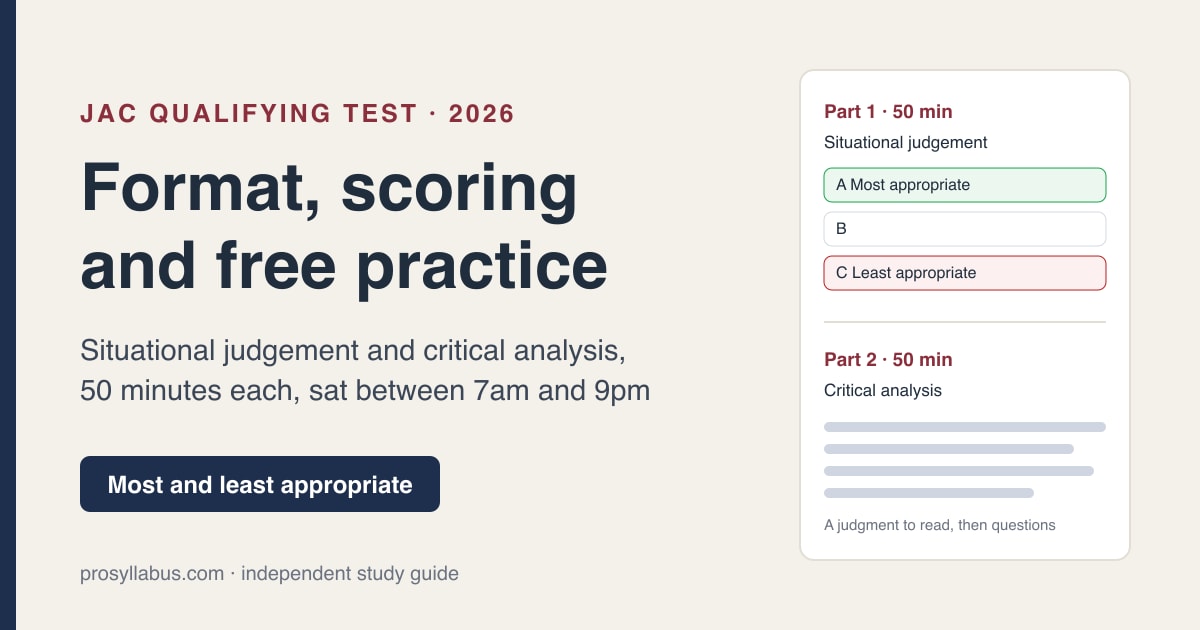
The JAC qualifying test is an online multiple-choice test, usually in two parts: a situational judgement test and a critical analysis test. Both were used in the 2025 Immigration and Asylum Chamber exercise; the new vacancy page and your instructions will confirm this time. You start after 7am on the test day, finish before 9pm, have 50 minutes for each part and choose which part to take first (JAC qualifying test page). In the 2025 Immigration and Asylum Chamber test each part had 20 questions in 50 minutes (JAC 289 report).
| Part | What you do | Marking | 2025 IAC test |
|---|---|---|---|
| Situational judgement | Read a situation and pick the most appropriate and the least appropriate of five actions | 1 mark for each correct choice, 2 a question | 20 questions, 50 minutes. Questions came from the JAC's bank, written by judges from a range of jurisdictions |
| Critical analysis | Answer questions on a written text sent to you about a week before | 1 mark a question, one correct answer of four | 20 questions, 50 minutes, on Maleci (Non-admission of late evidence) [2024] UKUT 00028, with questions written by a Resident Judge of the chamber |
Sources: JAC 289 report, JAC practice tool page. The practice tool page says the situational judgement questions do not test legal rules or procedure, and that all the information you need for the critical analysis questions is in the text.
Scoring. There is no fixed pass mark. Anyone under 30% in either part is removed; the rest are ranked by a composite of standard scores, 60% situational judgement and 40% critical analysis, and the cut-off is set by the places at the next stage. In 2025 that line fell at a composite score of 0.19 (JAC 289 report, About online tests). We explain how most and least answers are judged in our JAC situational judgement test guide, and how to use the reading week in our JAC critical analysis test guide.
Worked example 1: situational judgement (written by us, not a JAC question)
- Situation: You are hearing an appeal. Twenty minutes into the appellant's evidence, the appellant says quietly that they do not understand some of what the interpreter is saying. The interpreter says the appellant is just nervous. The Home Office presenting officer asks you to carry on, as the list is long.
- A. Carry on, since the interpreter is the expert and has said there is no problem.
- B. Pause the evidence, find out what the difficulty is (for example the language or dialect), check whether the appellant can understand and be understood, hear both parties briefly, then decide whether to continue, arrange another interpreter or adjourn, recording your reasons.
- C. Adjourn the appeal at once to a later date without asking either of them any questions.
- D. Ask the presenting officer whether they think the interpretation is good enough.
- E. Tell the appellant that if they wanted a different interpreter they should have said so before the hearing began, and carry on.
- Our key: most appropriate B, least appropriate E. B investigates the concern and makes the appellant's ability to take part properly the condition for carrying on, without running on while a real interpretation problem may remain. E is least appropriate because it brushes aside a concern about whether the appellant can take part at all, and blames them for raising it, which is unfair and could undermine the decision. A accepts one side of the disagreement without checking. C may be the right result in the end, but it decides to adjourn before checking whether the problem can be put right fairly. D seeks one party's view, which can inform the decision, but does nothing to find out or resolve the appellant's concern.
Our own illustration in the JAC format. It does not represent any JAC test question.
What the 2025 results showed
The JAC regularly publishes evaluation and feedback reports on its online tests. These are the figures for the last Immigration and Asylum Chamber exercise. They are history, not a forecast: if online tests are used again, the cut-offs will depend on how candidates perform against each other and the places at the next stage.
JAC 289 qualifying test, scenario test and post selection day reports. 51 candidates withdrew or did not sit the qualifying test. The equal merit provision was applied at both shortlisting stages.
Try the format. The box below runs 3 situational judgement questions in our practice player, with the reason for every answer, so you can check your most and least choices against a key.
FreeTests: Communication Skills · Personal Qualities · Effective Working
JAC Qualifying Test Practice · Free sample: 3 situational judgement questions: free sample
Answer 3 questions against the clock, like the real exam. You then see the right answer, the reason and your time on each. About 8 minutes · free · no sign-in.
3 questions to answer
Start nowabout 8 minThis one is free · no sign-in needed
Your result shows how long each question took you.
JAC 289 qualifying test report: the lowest, highest and average candidate score in each part.
The report names the topics of the easiest and hardest questions. In situational judgement, 75% or more got both choices right on a conflict of interest and on managing time under pressure outside your control; fewer than 8% got both right on procedural fairness and enforcing the rules, and on how to respond when a litigant does not follow the expected formalities. In critical analysis, 93% or more were right on how to respond when a party fails to comply with directions issued by an Assistant Resident Judge and on where the tribunal's power to give directions comes from; the hardest questions were on the principles for granting permission to appeal and how the Upper Tribunal should respond on the application of rule 17(2) (JAC 289 report).
What that means for you (our advice): about 45% of those who sat the 2025 test were invited to the next stage (300 of 665, our arithmetic), and about one in ten (67 of 665) was recommended. In 2025 candidates averaged 57% in situational judgement against 79% in critical analysis, and situational judgement carries 60% of the composite. The hardest items were about fairness when a party does not follow the rules or the expected formalities, so practise those situations and check each wrong answer against a key.
After the qualifying test: scenario test and selection day
In 2025, 300 candidates from the qualifying test were invited to an 80-minute written scenario test, and 295 took it: one scenario, an appeal in a private membership organisation, with three questions worth 15, 24 and 36 marks and word limits of 250, 500 and 700 words. Judges marked the answers without seeing names; the line for selection day fell at 55.3%, and the average was 54.6% (JAC 289 scenario test report). The JAC scenario test page has example questions and pre-reading.
Selection day had two parts. In the roleplay, candidates acted as a fee-paid judge in a fictional appeals tribunal, with its rules sent in advance, and had to run the hearing, give reasoned rulings and a final reasoned judgment. A competency-based interview followed (JAC 289 post selection day report). Our practice covers the qualifying test only, not the written scenario test or selection day.
How this differs from the Deputy District Judge exercise: the 2026 Deputy District Judge exercise lists a qualifying test, then a selection day of a roleplay and follow-up questions, with no scenario test and no skills and abilities-based interview; our Deputy District Judge qualifying test guide covers it. The 2025 Immigration and Asylum Chamber exercise had both shortlisting tests and an interview.
The other fee-paid First-tier Tribunal exercise
A separate Fee-paid Judge of the First-tier Tribunal exercise, JAC00287, held its qualifying test in 2025. It was for 150 posts: 1,431 candidates sat it, the averages were 62.7% in situational judgement and 73.5% in critical analysis, the cut-off was a composite score of 0.21, and 596 went on to the scenario test. Its critical analysis text was an abridged Upper Tribunal decision from January 2024 (JAC 287 report). It is not on the JAC list of future exercises on 12 November 2026.
Worked example 2: critical analysis (our own short passage and question)
- Passage: "A tribunal that refuses every late document is not being strict; it is being careless. The rules allow late evidence where it is fair to admit it. The question is never only whether the deadline was missed, but why, how much the evidence matters, and whether the other side can deal with it. A refusal that asks only the first question has answered none of them."
- Question: Which statement best describes the writer's view?
- A. Deadlines for evidence should be removed. B. Late evidence should always be admitted if it is relevant. C. Deciding whether to admit late evidence means weighing several factors, not just the missed deadline. D. Tribunals are usually too lenient about late evidence.
- Answer: C. The passage says the question is "never only" the missed deadline, and lists the reason, the importance of the evidence and fairness to the other side. A and B go further than the writer, who accepts that the rules set a test. D makes a claim about how tribunals usually behave that the passage does not make.
Our own passage and question in the JAC format, not taken from any JAC test text.
Who can apply and what the role involves
Judges of the First-tier Tribunal are appointed by the Senior President of Tribunals. The 2025 vacancy page listed the judicial-appointment eligibility condition on a five-year basis, five-year routes for Scottish and Northern Irish lawyers, and a route for those whose experience in law makes them, in the Senior President of Tribunals' opinion, as suitable. It also stated the retirement age of 75 and that a reasonable length of service is usually four years. The fee was £633.96 a day, or £652.14 in London. The 2026 vacancy page will confirm the terms (JAC00289 vacancy page).
The chamber decides appeals against decisions of the Secretary of State: asylum and humanitarian protection; family and private life; Withdrawal Agreement and EU Settlement Scheme rights; and bail. A judge usually sits alone, face to face or remotely. The vacancy page says many cases involve interpreters, some appellants represent themselves, and some have suffered torture or trauma, so the judge may need to guide a vulnerable person through the appeal. New judges attend a residential induction of up to five days (JAC00289 vacancy page).
A 7-day plan for the week before your test
Our plan for the seven days before the test. Read your instructions as soon as they arrive; the JAC says it sends them at least one week before (About online tests). Day 1 is seven days before the test and the last row is test day.
| Day | Focus | What to do (our advice) |
|---|---|---|
| Day 1 | Instructions | Read the instructions email in full. Note what you may have with you, when the pre-reading arrives and the test hours. In 2025 Government lawyers and Crown Prosecution Service candidates were told not to use work devices or work email; check whether your instructions say the same |
| Day 2 | Baseline | Take the JAC practice tool (5 + 5 questions, 10 minutes each) to see the platform, then one timed situational judgement part |
| Day 3 | Pre-reading | Read the critical analysis text slowly once. Write one line on what each paragraph does and list the tests or rules it applies |
| Day 4 | Fairness situations | Review every wrong most and every wrong least. Focus on procedural fairness, enforcing the rules and litigants who do not follow the expected formalities, the hardest situational judgement themes in the 2025 report. Add interpreters and litigants in person, which the role description stresses |
| Day 5 | Critical analysis, timed | One timed critical analysis part on a different practice text, to train the question types. Check each wrong answer against the words of the text |
| Day 6 | Second timed set | A second full timed situational judgement part. Re-read the pre-reading text and your notes |
| Day 7 | Rest and set up | No new practice. Choose your time slot and which part to sit first, and test your room and connection |
| Test day | Test day | Follow your instructions. Under the JAC's general guidance you start after 7am and finish before 9pm, and each part is timed and submits automatically when the time runs out |
The AI rule. The JAC says you must not use AI in any qualifying test, selection day or other live assessment, and you must not enter any selection material into an AI tool (JAC AI guidance). A pre-reading text sent to you for the test is selection material, so do not put it into an AI tool, including while you prepare. Our advice is to finish your practice before test day.
Practise both parts before the test
Our JAC qualifying test practice has three mocks, each with both parts: original judicial situations where you pick the most and the least appropriate action (20 questions in Mock 1, 19 in Mock 2 and 20 in Mock 3), and 20 critical analysis questions on an invented text in each (a judgment, a speech, then an appeal judgment). Mocks 1 and 2 give the standard 50 minutes a part; Mock 3 gives 40 minutes a part. It is marked with our own answer keys on the scheme the JAC practice tool page describes, with the reason for every answer and your marks grouped by our reading of the JAC skill areas. Our marks are not the JAC's standard or composite scores and do not predict progression. It covers the qualifying test only, not the scenario test or selection day. Try 3 situational judgement questions free below; the free sample can be taken once. For the format across all JAC exercises, see our JAC qualifying test guide. Independent practice. Not affiliated with the Judicial Appointments Commission. ProSyllabus is an independent study site; the JAC did not write and does not endorse our questions.
FreeTests: Communication Skills · Personal Qualities · Effective Working
JAC Qualifying Test Practice · Free sample: 3 situational judgement questions: free sample
Answer 3 questions against the clock, like the real exam. You then see the right answer, the reason and your time on each. About 8 minutes · free · no sign-in.
3 questions to answer
Start nowabout 8 minThis one is free · no sign-in needed
Your result shows how long each question took you.
Frequently asked questions
When is the next fee-paid tribunal judge qualifying test?
The JAC lists Fee-paid Judge of the First-tier Tribunal, Immigration and Asylum Chamber as launching in December 2026, for 70 candidates. It has not yet confirmed that a qualifying test will be used, or published a closing date or test date. In 2025 the qualifying test came 21 days after applications closed and 35 days after launch; repeating both gaps after a December launch would put a qualifying test in about January or early February 2027, which is our illustration, not a JAC date.
What is in the fee-paid tribunal judge qualifying test?
The JAC qualifying test usually has two multiple-choice parts: a situational judgement test, where you choose the most and the least appropriate of five actions, and a critical analysis test on a written text sent to you about a week before, with four options and one correct answer. Both were used in the 2025 Immigration and Asylum Chamber exercise, with 20 questions in 50 minutes a part. The JAC has not yet confirmed the arrangements for the new exercise.
What is the pass mark?
There is no fixed pass mark. You need at least 30% in both parts; candidates are then ranked by a composite of standard scores, 60% situational judgement and 40% critical analysis, and the cut-off depends on the places at the next stage. In the 2025 Immigration and Asylum Chamber test the cut-off was a composite score of 0.19.
How many people pass?
In 2025, 665 sat the Immigration and Asylum Chamber qualifying test and 300 were invited to the scenario test, about 45% (our arithmetic from the JAC report); 295 sat it. 155 were invited to selection day, and 67 were recommended for appointment.
Is there a scenario test as well?
In 2025 there was: 300 candidates were invited to an 80-minute written scenario test with three questions, and 295 took it. The 2025 vacancy page said both tests would be used if applications far exceeded the vacancies. The 2026 vacancy page will say which tests apply this time.
Who can apply?
The JAC says the December 2026 exercise is open to solicitors, barristers and Fellows of CILEX. In 2025 the eligibility condition was on a five-year basis; the 2026 vacancy page will confirm.
How much does a fee-paid Immigration and Asylum Chamber judge earn?
In 2025 the fee was £633.96 a day, or £652.14 in London. The JAC has not yet published the fee for the 2026 exercise.
Can I use AI to prepare for or during the test?
Not during it: the JAC says you must not use AI in any qualifying test, selection day or other live assessment, and you must not enter any selection material into an AI tool. Do not enter the JAC's pre-reading text into an AI tool, including during preparation.
Are your practice questions real JAC questions?
No. Our situations and texts are our own original practice material, written to the JAC's published description of the format. Our keys and reasons are our own judgement.
More in this series
Sources
- official — JAC vacancies, Future applications: Fee-Paid Judge of the First-tier Tribunal, Immigration and Asylum Chamber, read 12 November 2026
- official — JAC vacancy: Fee-Paid Judge of the First-tier Tribunal, Immigration and Asylum Chamber (JAC00289, 2025), read 12 November 2026
- official — JAC: 289 Fee-paid Judge of the First-tier Tribunal, Immigration and Asylum Chamber online qualifying test evaluation and feedback report (October 2025)
- official — JAC: 289 Fee-paid Judge of the First-tier Tribunal, Immigration and Asylum Chamber online scenario test evaluation and feedback report (December 2025)
- official — JAC: 289 Fee-paid Judge of the First-tier Tribunal, Immigration and Asylum Chamber post selection day evaluation and feedback report (May 2026)
- official — JAC: 287 Fee-paid Judge of the First-tier Tribunal online qualifying test evaluation and feedback report (November 2025)
- official — JAC: Qualifying test
- official — JAC: About online tests (the email at least one week before, the 30% minimum, ranking)
- official — JAC: Scenario test
- official — JAC: Practice qualifying test tool
- official — JAC: Using artificial intelligence (AI), updated August 2026
official = a document published by the conducting body. reported = a news or coaching site we could not check against an original. Where sources disagree this page says so rather than picking one.