Checked 26 October 2026. The format and pass-mark rules were read on csmls.org and in the October 2026 General MLT handbook on 26 October 2026. The blueprint is in the General MLT Competency Profile (2016 profile, effective with the June 2019 exam) linked from the CSMLS Competency Profiles page.
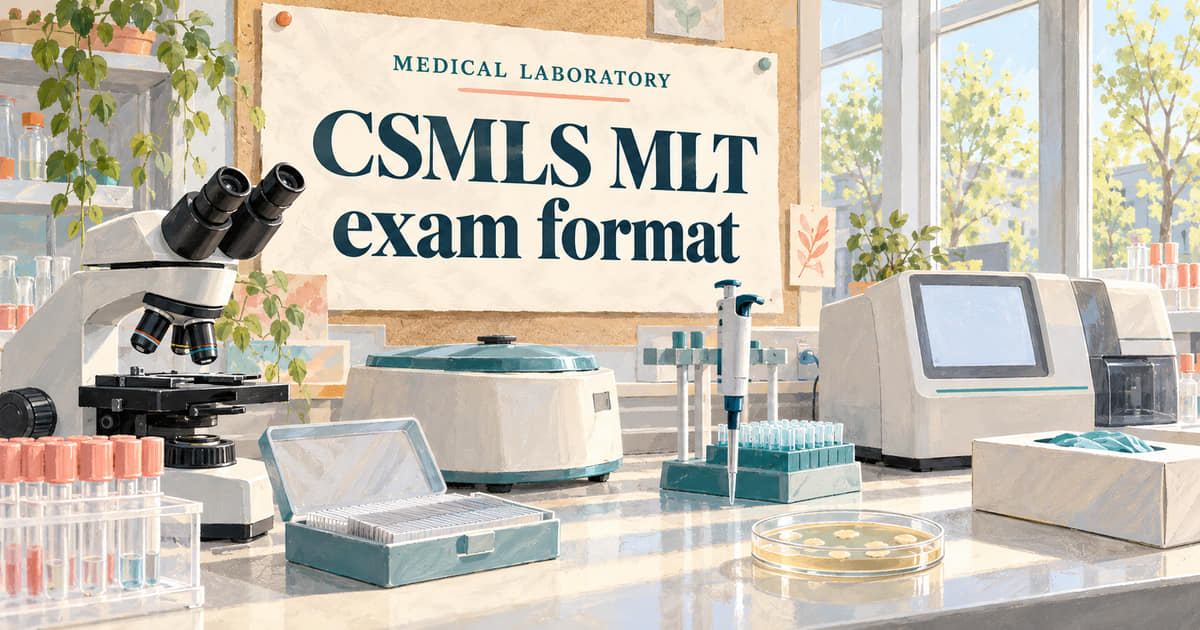
The CSMLS General Medical Laboratory Technologist (MLT) certification exam is a computer-based exam of 210 multiple-choice questions in 3.5 hours, inside a 4-hour appointment. It covers Clinical Chemistry, Clinical Microbiology, Hematology, Histotechnology and Transfusion Science, and every question is written to a competency in the CSMLS General MLT Competency Profile. CSMLS says that as of 1 March 2026 it is written only in Alberta, and the handbook names October 2028 as the last session.
ProSyllabus is an independent study site. It is not part of CSMLS (the Canadian Society for Medical Laboratory Science), CMLTA or CAMLPR, and nothing here is the official exam. Every date, fee and rule on this page is taken from the official pages listed at the foot of the page.
CSMLS Exam Structure and the General MLT Exam Handbook (version October 2026), read 26 Oct 2026.
FreeTests: 4. Interpretation and Reporting of Results (20-25% of the exam) · 3. Analytical Processes (30-35% of the exam)
CSMLS MLT Practice Exam: free sample
Answer 3 questions against the clock, like the real exam. You then see the right answer, the reason and your time on each. About 4 minutes · free · no sign-in.
3 questions to answer
Start nowThis one is free · no sign-in needed
Your result shows how long each question took you.
The format, rule by rule
| Rule | What CSMLS says |
|---|---|
| Questions | 210 multiple-choice questions; some may include images; no case studies |
| Time | 3.5 hours of exam time in a 4-hour appointment |
| Answers | One answer is acceptable: choose the best one. One mark for each correct answer. |
| Option styles | No choices such as "a and b", "c and d", "all of the above" or "none of the above" |
| New questions | All exams may include validation questions; up to 20% may be new and are statistically validated before they are scored |
| On screen | You can move back and forth through all the questions and change answers until you submit the exam section |
| Question levels | Recall, application and critical thinking; most questions test the application of knowledge |
There is no negative marking in the rules CSMLS publishes: each correct answer earns one mark, so leave nothing blank.
The blueprint: eight competency categories
CSMLS says the exam blueprint is inside each competency profile and gives the exam weighting of each category. The General MLT profile sets these ranges (mark %):
| Category | Share of the exam marks |
|---|---|
| 1. Safe Work Practices | 5-7% |
| 2. Data and Specimen Collection and Handling | 5-7% |
| 3. Analytical Processes | 30-35% |
| 4. Interpretation and Reporting of Results | 20-25% |
| 5. Quality Management | 20-25% |
| 6. Critical Thinking | 5-10% |
| 7. Communication and Interaction | 3-5% |
| 8. Professional Practice | 5-7% |
General MLT Competency Profile, Examination Blueprint. Bars show the midpoint of each published range; the labels give the range.
The categories cut across the five disciplines. Analytical Processes, for example, covers microscopy, staining, spectrophotometry, ion-selective electrodes, immunoassays, cell counting, coagulation testing, red cell antibody work, blood products, culture and susceptibility testing, molecular methods and tissue preparation. Interpretation and Reporting covers judging results against reference and critical values, delta checks and method limits, and acting on implausible results before they are reported. Quality Management covers quality control data, statistics, maintenance and proficiency testing.
What the categories ask you to do: two competencies from each
Each category lists numbered competencies, and every exam question is written to one of them. Two examples from each category, quoted from the General MLT Competency Profile, show the kind of task the questions test:
| Category | Example competencies |
|---|---|
| 1. Safe Work Practices | 1.03 "Applies laboratory hygiene and infection control practices"; 1.12 "Applies spill containment and clean up procedures for biological and other hazardous materials" |
| 2. Data and Specimen Collection and Handling | 2.07 "Assesses suitability of the specimen for testing"; 2.12 "Identifies, documents and initiates corrective action for pre-examination (pre-analytical) errors" |
| 3. Analytical Processes | 3.14 "Identifies and evaluates the morphology of cellular and non-cellular elements in microscopic preparations"; 3.16.03 "Performs compatibility analyses" |
| 4. Interpretation and Reporting of Results | 4.03 "Identifies unexpected or implausible results and takes appropriate action prior to reporting"; 4.04 "Recognizes and acts on critical values" |
| 5. Quality Management | 5.03 "Assesses quality control data and calibration data"; 5.04 "Uses statistics to monitor and track the acceptability of quality control results" |
| 6. Critical Thinking | 6.04 "Organizes work to accommodate priorities"; 6.06 "Demonstrates effective problem solving/trouble-shooting strategies and initiates appropriate follow up" |
| 7. Communication and Interaction | 7.02 "Demonstrates effective teamwork skills"; 7.04 "Demonstrates adaptive skills when interacting with patients/clients" |
| 8. Professional Practice | 8.01 "Maintains confidentiality of healthcare information"; 8.03 "Recognizes limitations of own competence and seeks action to resolve" |
Read the verbs. Most competencies ask you to assess, identify, interpret or act, not to recite a fact, which is why CSMLS says the majority of questions test the application of knowledge. When you revise a topic, practise the decision it leads to: what you would do next with that result, that specimen or that QC run.
What this means for your study plan
Analytical Processes, Interpretation and Reporting, and Quality Management make up most of the marks between them (70 to 85% by the published ranges). A question about a chemistry result is often really a question about interpretation or quality control. Practise reading a result in context: the specimen, the reference interval, the QC run and the patient.
FreeTests: 4. Interpretation and Reporting of Results (20-25% of the exam) · 3. Analytical Processes (30-35% of the exam)
CSMLS MLT Practice Exam: free sample
Answer 3 questions against the clock, like the real exam. You then see the right answer, the reason and your time on each. About 4 minutes · free · no sign-in.
3 questions to answer
Start nowThis one is free · no sign-in needed
Your result shows how long each question took you.
How the pass mark is set
There is no fixed pass percentage. CSMLS sets the pass mark for each exam with a double modified Angoff method: subject matter experts predict how many minimally competent candidates would answer each question correctly, and the average becomes the pass point. A harder exam gets a lower pass point and an easier one a higher pass point. CSMLS says Angoff scores usually fall between 60 and 80 per cent, and that there is no bell curve: everyone who reaches the pass mark passes.
If you are unsuccessful, the results dashboard shows your overall score next to the pass mark and your performance in each category of the Competency Profile, with guidance on next steps.
A worked example
Here is one practice question in the style the blueprint rewards: a short lab scenario where you must interpret values, not recall a fact. Pick an answer before you open it.
Worked example · Clinical Chemistry · 4. Interpretation and Reporting of Results (20-25% of the exam)
An outpatient, 58 years old, has no symptoms. Serum results: potassium 9.4 mmol/L (3.5-5.0), calcium 0.61 mmol/L (2.10-2.60), alkaline phosphatase 14 U/L (40-130), sodium 140 mmol/L (135-145). The hemolysis index is normal, and last week potassium was 4.2 mmol/L. What is the best action?
- (A) Repeat potassium on the same tube after recentrifuging
- (B) Suspect K2EDTA contamination and request a recollection
- (C) Report all results with a comment that hemolysis is absent
- (D) Phone the potassium and calcium as critical values now
Show the answer
Answer: (B) Suspect K2EDTA contamination and request a recollection. Very high potassium with very low calcium and low ALP, in a sample that is not hemolysed, is the pattern of K2EDTA contamination: EDTA adds potassium, chelates calcium so measured calcium falls, and chelates the magnesium and zinc that ALP needs as cofactors. The large change from 4.2 mmol/L in a well patient supports an artifact. Phoning these as critical values would report a spurious result; a correctly drawn recollection is needed. CSMLS competency 4.03: Identifies unexpected or implausible results and takes appropriate action prior to reporting
An original ProSyllabus question written to a competency of the CSMLS General MLT Competency Profile. Not a question from a CSMLS exam.
How to prepare, following the blueprint
| Step | What to do |
|---|---|
| 1. Read the handbook | CSMLS asks candidates to read the General MLT Exam Handbook carefully before registering; it holds the attempt rules, testing rules and the format. |
| 2. Map your gaps to the eight categories | Take a timed set early and score it by category, not only by discipline, so you know where marks are leaking. |
| 3. Use the reference textbooks | CSMLS says every exam answer is referenced to its reference textbook list; you are not expected to buy them all, and loan libraries in Toronto, Hamilton, Vancouver, Calgary and Winnipeg hold some titles. |
| 4. Practise at the exam pace | 210 questions in 3.5 hours is one minute a question. Practise long timed blocks so the pace feels normal. |
| 5. Review the reasoning, not just the key | For every miss, write down which value, reaction or rule pointed to the right answer. |
Practice tests
CSMLS sells its own practice test: 210 questions in 3.5 hours covering all MLT competencies, CAD 185 for members and CAD 245 for non-members, with a summary of results by competency. It says it does not endorse any practice test calling itself a "CSMLS practice test" outside its website.
| Fact | CSMLS exam | ProSyllabus practice exam |
|---|---|---|
| Questions | 210, one best answer | A 100-question full mock plus six discipline sets, our own questions |
| Time | 3.5 hours | The mock runs 100 minutes, the exam pace of one minute a question |
| Weighting | The eight-category blueprint | The mock is split across the eight categories inside the published ranges |
| Feedback | Pass or fail; category performance for unsuccessful candidates | Score by category, time per question, and the lab reasoning behind every answer |
Want timed practice?
The ProSyllabus CSMLS MLT practice exam tags every question to a CSMLS competency, so your result shows your score in each category next to its exam weight. Three questions are free to try. It is independent practice: our own questions, not the CSMLS exam or the CSMLS practice test, and a practice score does not predict your exam result.
FreeTests: 4. Interpretation and Reporting of Results (20-25% of the exam) · 3. Analytical Processes (30-35% of the exam)
CSMLS MLT Practice Exam: free sample
Answer 3 questions against the clock, like the real exam. You then see the right answer, the reason and your time on each. About 4 minutes · free · no sign-in.
3 questions to answer
Start nowThis one is free · no sign-in needed
Your result shows how long each question took you.
Frequently asked questions
How many questions are on the CSMLS MLT exam?
210 multiple-choice questions in 3.5 hours, in a 4-hour appointment. Some may include images; there are no case studies.
What is the CSMLS pass mark?
It is set for each exam with the Angoff method, so it changes from exam to exam. CSMLS says Angoff scores usually fall between 60 and 80 per cent.
Is there negative marking?
No negative marking appears in the CSMLS rules: one mark is given for each correct answer, and one answer is acceptable per question.
Which subjects are on the General MLT exam?
Clinical Chemistry, Clinical Microbiology, Hematology, Histotechnology and Transfusion Science, weighted by the eight categories of the General MLT Competency Profile rather than by subject.
Where do I find the CSMLS exam blueprint?
In the General MLT Competency Profile, linked from the CSMLS Competency Profiles page. The blueprint gives the share of marks for each of the eight categories.
Are ProSyllabus questions real CSMLS questions?
No. They are our own questions written to the competencies in the profile. CSMLS exam content is confidential, and candidates agree not to copy or share it.
More in this series
Sources
- official — CSMLS: Exam Structure (question format, length, pass mark, results)
- official — CSMLS: General MLT Certification Examination Handbook, Alberta Residents ONLY (CEXM-043-H1, version October 2026)
- official — CSMLS: On Exam Day
- official — CSMLS: Competency Profiles (the General MLT profile holds the exam blueprint)
- official — CSMLS: Practice Test for CSMLS Certification Exam
- official — CSMLS: Reference Textbooks
- official — CSMLS: Dates and Fees (2026 and 2027 exam sessions, registration windows, results dates, 2027 fees, service fees)
official = a document published by the conducting body. reported = a news or coaching site we could not check against an original. Where sources disagree this page says so rather than picking one.