Checked 8 November 2026. Frontline’s pages for the 2027 cohort (applications opened 28 September 2026; rolling, and locations close as they fill). Dates, regions, pay and rules can change from one cohort to the next; check Frontline’s pages before you rely on any of them.
Approach Social Work is the new name of the Frontline programme: a fully funded, three-year route into children’s social work in England, run by the charity Frontline. You train inside a local authority children’s services team from your first year, qualify as a social worker after year one, work as a paid social worker in years two and three, and finish with a master’s degree awarded by Lancaster University. Frontline pays the tuition; in year one you get a tax-free bursary of £18,000 (£20,000 in London).
This page explains how the programme works year by year for the 2027 cohort, who can apply, where you could be placed, the dates from application to qualification, and the trade-offs that Frontline itself and the Department for Education (DfE) have published. Each stage of the application has its own guide, linked where it comes up.
ProSyllabus is an independent study site: independent practice, not affiliated with Frontline or Approach Social Work. Every programme fact below is taken from Frontline’s or the Department for Education’s own pages, linked, as read on 8 November 2026.
Frontline: programme page, programme overview, pay and help centre (read 8 Nov 2026).
Approach Social Work at a glance
| Item | Detail |
|---|---|
| What it is | A fast-track, work-based route to qualify as a children’s social worker in England (formerly called the Frontline programme) |
| Run by | Frontline, a charity; funded through the Department for Education; Lancaster University awards the qualifications |
| Length | Three years: for the 2027 cohort, 12 July 2027 to September 2030 |
| Where you work | One partner local authority in England, in children’s services, for all three years |
| Qualifications | Postgraduate Diploma in Social Work at the end of year one (then registration with Social Work England); MA in Advanced Relationship Based Social Work Practice with Children and Families at the end of year three |
| Money | Year one: tax-free bursary of £18,000 (£20,000 in London). Years two and three: a social worker’s salary from your local authority. No tuition fees |
| Who can apply | At least a 2:2 honours degree (predicted or obtained), GCSE English Language grade C/4 or equivalent, right to work and study in the UK (with access to public funds) until September 2030, resident in England, not already qualified or part-qualified in social work; outside London, a driving licence when you apply. No age limit |
| Application | Registration, application form, online test, virtual assessment centre, then pre-employment checks. Rolling; locations close as they fill |
| Official pages | thefrontline.org.uk: Approach Social Work and its help centre |
Sources: programme page · programme overview · help centre · eligibility.
Is Approach Social Work the same as Frontline?
Yes, as a programme. Frontline’s own pages call it “Approach Social Work (formerly known as the Frontline programme)”, and the Department for Education’s May 2026 research report describes “Frontline (now known as Approach Social Work)”. The organisation that runs it is still called Frontline, which is why you will see both names: Frontline is the charity, Approach Social Work is its graduate training programme. Older articles, forum threads and the DfE research on earlier cohorts use the old name.
One structural change matters if you read older material. The DfE report notes that its 2022 cohort took a master’s degree after two years, and adds in a footnote that under the new contract the programme is delivered over three years, with the master’s in year three. Older material describes a different structure and may give different dates or salary figures, so use the current cohort’s pages for dates and pay.
Who can apply for Approach Social Work 2027
Frontline is strict about eligibility: it says it cannot accept anyone who does not meet all the criteria, will not consider mitigating circumstances, and will not accept work experience in place of a requirement.
| Requirement | What Frontline asks for | Evidence |
|---|---|---|
| Degree | At least a 2:2 in an undergraduate honours degree, predicted or obtained (or an international equivalent confirmed by UK ENIC). Other level 6 qualifications do not count | UK degrees: the official final degree certificate. International qualifications: original certificates or transcripts (not translations). Final-year students: a tutor reference on the predicted grade; the 2:2 must be confirmed by 30 June 2027 |
| English | GCSE English Language grade C/4 or above, or an accepted equivalent; international qualifications only where English was studied as a first language | Usually your UK degree certificate; otherwise the GCSE certificate or a certified statement of results |
| Right to work | Right to work and study in the UK, with access to public funds, until September 2030. Frontline cannot sponsor visas and cannot accept student-route visas | Passport and, where relevant, visa or EU Settlement Scheme status. Visa holders must already show permission to September 2030 when they apply |
| Residence | Resident in England by July 2027 and for the whole programme | Part of the checks |
| Suitability | DBS (paid for by Frontline), health and reference checks after the assessment centre. A criminal record or past disciplinary action does not automatically rule you out, but you must declare it; each case is considered individually | Self-declaration and checks |
| Not a social worker | Not already fully or partially qualified in social work (a social work bachelor’s degree rules you out) | Self-declaration |
| Driving (outside London) | A full valid UK driving licence (manual or automatic) at the point of application, and access to a car by the start of the placement, for every location outside London. Medical exemptions are handled case by case | Licence |
Three points people often miss. There is no age limit, and you need no specific social work experience: Frontline assesses applicants against its competencies. Frontline asks you to have your eligibility documents before you submit an application, because you cannot book an assessment centre without them; the exception is a degree you are still studying for: after a successful assessment centre Frontline asks your academic tutor to confirm a predicted 2:2, and the result itself must be confirmed by 30 June 2027. And the funding rule behind the England residence requirement is legal, not a preference: the help centre explains that DfE can only fund training for people resident in England, so the programme is not open to people living in Wales, Scotland or Northern Ireland during it. Read Frontline’s eligibility page in full before you register. Frontline also says it uses contextual recruitment and offers extra support, including 1:1 coaching and webinars, to applicants from under-represented groups (it names the global majority, people from lower socio-economic backgrounds and men).
FreeTests: Verbal reasoning · Relationships and communication
Approach Social Work Online Test Practice: free sample
Answer 4 questions against the clock, like the real exam. You then see the right answer, the reason and your time on each. About 8 minutes · free · no sign-in.
4 questions to answer
Start nowabout 8 minThis one is free · no sign-in needed
Your result shows how long each question took you.
How the programme works, year by year
Frontline’s programme overview sets out three years. Here is each one for the 2027 cohort, with the dates Frontline gives.
Year one: train in a hub and qualify
The programme starts with readiness for practice (formerly called the Summer Institute), from 12 July to 13 August 2027: five weeks of study, mostly online, with three consecutive residential days for the whole cohort and two in-person regional teaching days. After a summer break (14 August to 5 September), your year-long placement in a local authority social work team starts on 6 September 2027.
You work in a practice hub of typically five participants, managed and supervised by an experienced consultant social worker, with a Frontline practice tutor who visits to teach, tutor and assess you. You take on direct work with children and families gradually. Frontline says year one is over 200 days of on-the-job training and nearly 50 days of academic teaching, including a contrasting placement in adults’ social care. Year one is in the office: Frontline says opportunities for remote work are “extremely limited”. In years two and three, working from home depends on your local authority’s policy.
At the end of year one you receive a Postgraduate Diploma in Social Work, which makes you eligible to apply for registration with Social Work England as a qualified social worker. You also join the Frontline Fellowship. For the 2027 cohort, the end of year one falls in 2028.
Year two: newly qualified social worker
In year two you are an employee of your local authority, on a newly qualified social worker’s salary, managing your own caseload. All newly qualified social workers in England complete the national two-year Early Career Development Programme, which Frontline says replaces the Assessed and Supported Year in Employment in autumn 2027 and is provided through your local authority. Frontline keeps training you alongside it, your practice tutor continues to support you, and your hub keeps meeting.
Year three: finish the master’s
In year three you complete the remaining credits of the MA in Advanced Relationship Based Social Work Practice with Children and Families, with a literature review as your dissertation, supervised by your practice tutor. You also finish the two-year Early Career Development Programme. Frontline adds four coaching sessions (leadership coaching) for the move from newly qualified to experienced practitioner. The programme ends in September 2030, which is why the right-to-work rule runs to that date.
| Year | Your status | What you do | You come out with | Money |
|---|---|---|---|---|
| Year one (Jul 2027 to the end of year one, 2028) | Full-time student of Lancaster University on placement | Readiness for practice, then a year in a local authority hub with a consultant social worker; teaching days and assignments | Postgraduate Diploma in Social Work; registration with Social Work England | Tax-free bursary £18,000 (£20,000 London) |
| Year two (2028 to 2029) | Employed social worker at your local authority | Your own caseload as a newly qualified social worker; Early Career Development Programme; Frontline training and hub | A year of qualified practice | Salary set by your local authority |
| Year three (2029 to Sep 2030) | Employed social worker at your local authority | Practice plus the final master’s credits and a literature-review dissertation; the rest of the Early Career Development Programme; coaching | MA in Advanced Relationship Based Social Work Practice with Children and Families | Salary set by your local authority |
What you learn, and what a week looks like
Frontline designs and teaches the course and Lancaster University awards it. The curriculum is built around three evidence-informed approaches: systemically informed practice, motivational interviewing and trauma-informed parenting interventions (based on attachment, trauma and mentalisation), alongside law, social policy, ethics, risk assessment and anti-racist, anti-oppressive practice. The year-one modules Frontline lists are:
| Module | Credits | What it covers |
|---|---|---|
| FLSW921 Readiness for practice | 10 | Foundation skills, values and knowledge before direct practice; two days shadowing a social worker |
| FLSW922 Principles of relational social work practice | 30 | The Frontline model: systemic and relationship-based practice, trauma-informed work, motivational interviewing, assessment and risk |
| FLSW923 The legal context of social work practice | 30 | Law, ethics and social policy, and how families experience the legal system |
| FLSW924 Advanced relational social work practice | 30 | Advanced systemic and trauma-informed practice, risk, extra-familial harm, wellbeing and burnout |
| FLSW925 Practice learning experience one | 10 | Typically at least 70 days: 60 in your placement, 10 in a contrasting setting |
| FLSW926 Practice learning experience two | 10 | Typically at least 100 days: 80 in your placement, 20 in a contrasting setting |
Frontline’s typical week for a year-one participant mixes a hub meeting, home visits with the consultant social worker, a Child in Need meeting, a child protection conference to observe, a teaching day, supervision, and time to write up records and plans. Evenings include teaching-day preparation. It combines a full-time placement with postgraduate study.
Where you could work: 2027 locations
You are placed with one partner local authority and stay there for all three years. For 2027, Frontline says it expects to partner with local authorities in these regions; each list is Frontline’s “may include” list, and locations close through the season as they fill:
| Region | Local authorities Frontline lists |
|---|---|
| North East | Darlington, Durham, Hartlepool, Newcastle upon Tyne, South Tyneside |
| Yorkshire and the Humber | Bradford, Calderdale, Kirklees, Leeds, North East Lincolnshire, North Lincolnshire, North Yorkshire (Knaresborough, Richmond, Scarborough), Sheffield, Wakefield, York |
| North West | Bolton, Cheshire West and Chester, Halton, Lancashire, Manchester, Oldham, Rochdale, St Helens, Stockport, Tameside, Trafford, Warrington, Wirral |
| East Midlands | Derbyshire, Leicester city, Northamptonshire, Nottinghamshire |
| West Midlands | Birmingham, Coventry, Sandwell, Solihull, Staffordshire, Walsall, Warwickshire, Wolverhampton, Worcestershire |
| London | Bromley, Croydon, Hounslow, Merton, Southwark, Sutton, Wandsworth |
| East of England | Central Bedfordshire, Essex, Hertfordshire, Luton, Thurrock |
| South East | Kent, Oxfordshire, Slough, Surrey, West Berkshire, Wokingham |
| South West | Bath and North East Somerset, Bristol, Devon, North Somerset, Plymouth, Somerset, South Gloucestershire, Swindon, Wiltshire |
How placement decisions work matters as much as the list:
- Commute limit. Frontline will not consider applicants whose rush-hour commute would be longer than 45 minutes for most locations; some allow 60 minutes, and these are made clear when you register.
- No guaranteed preference. You tell Frontline about your circumstances after a successful assessment centre, and it aims to take them into account, but it cannot guarantee your preferred area. It says it rarely places people where they have no existing support network.
- Driving. Every location outside London needs a full valid UK driving licence (manual or automatic) when you apply and access to a car by September 2027, unless you are medically exempt (handled case by case). If you are learning to drive, apply for a non-London location only after you pass. Frontline expects some locations to stay open until December and some to reopen in February.
- Three-year commitment. Accepting a placement means committing to that local authority for the whole programme. Frontline says it does not charge exit fees to people who leave early.
Source: Frontline, Where you’ll work and the help centre’s “Locations” section.
2027 timeline: from application to qualification
Frontline recruits on a rolling basis rather than to one deadline, so the dates below are the fixed points it has published. Places and assessment-centre dates fill as the season goes on.
| When | What happens |
|---|---|
| 28 September 2026 | Applications for the 2027 cohort opened |
| Rolling, from autumn 2026 | Register, then the application form, the online test (7 days to complete it) and, if successful, an assessment centre invitation. Locations close as they reach capacity |
| Usually October to May | Virtual assessment centres; outcome within 10 working days of your date. Frontline may cancel later dates once it has recruited enough candidates |
| After a successful assessment centre | Conditional offer, then references, document checks, DBS and health checks, placement allocation and two days shadowing in your local authority |
| By 30 June 2027 | Final-year students confirm the 2:2 |
| By July 2027 | You must be living in England |
| 12 July to 13 August 2027 | Readiness for practice: five weeks, mostly online, plus three residential days and two regional teaching days in person |
| August 2027 to August 2028 | Bursary paid in 13 monthly instalments on the first working day of each month |
| 6 September 2027 | Year-long placement in your local authority starts |
| End of year one (2028) | Postgraduate Diploma, registration with Social Work England; first local authority salary usually arrives 15 to 30 September 2028 |
| September 2030 | Programme ends with the master’s degree |
Sources: help centre · programme overview · pay and financial support · eligibility.
The application, in five stages
Each stage has its own guide on this site, so this is the short version. You can apply only once per recruitment cycle; if you are unsuccessful, you wait until applications open again the following autumn. Frontline gives individual feedback only to applicants who reach the assessment centre. Register only once: Frontline withdraws duplicate applications.
| Stage | What it is | Our guide |
|---|---|---|
| 1. Registration | About 10 to 15 minutes; confirms eligibility and opens the applicant portal with guidance and tips | This page (eligibility above) |
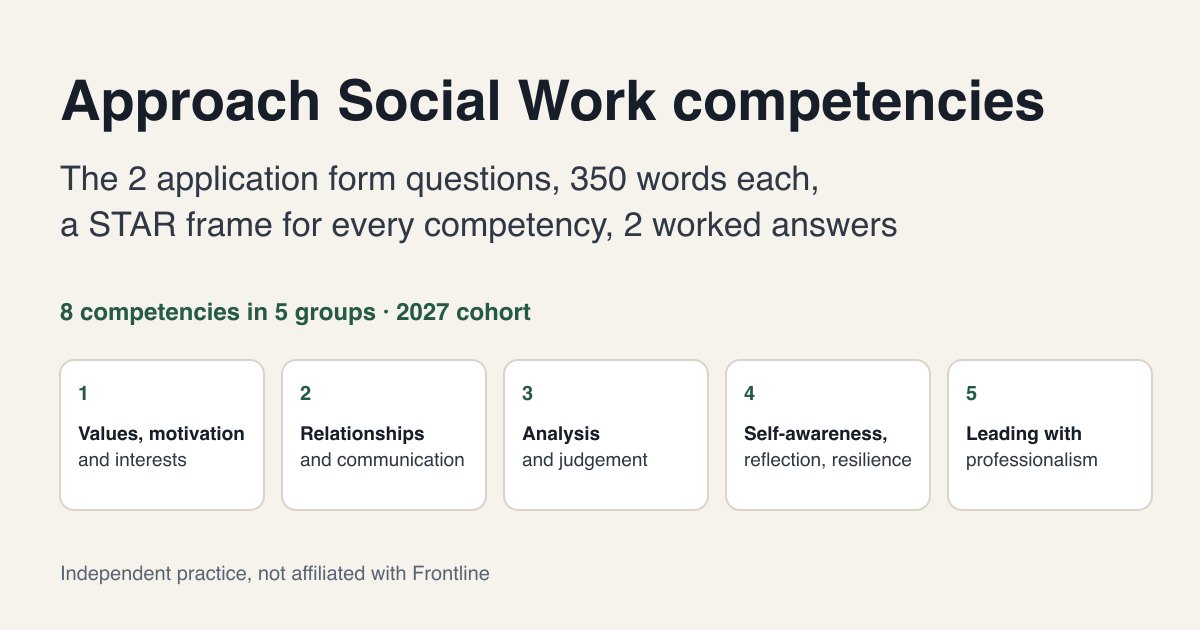
| 2. Application form | Two competency-based questions, plus personal and academic details | The competencies with examples |
| 3. Online test | Verbal reasoning and situational judgement in social-work scenarios; 7 days to complete; about 30 minutes, not timed | The online test guide and free practice |
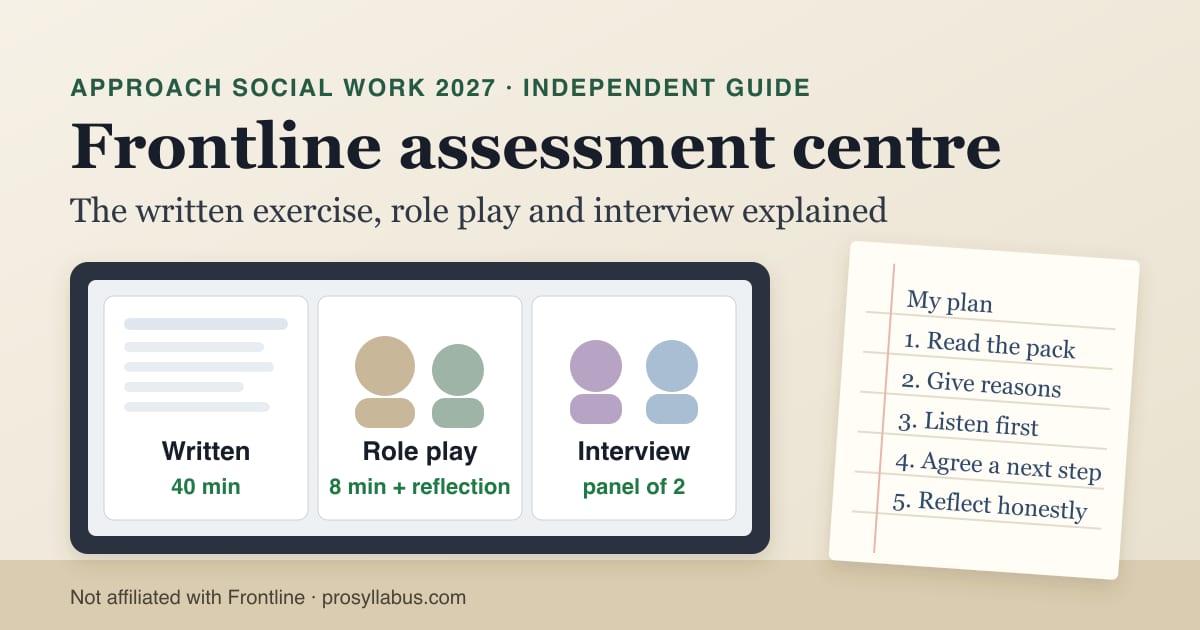
| 4. Virtual assessment centre | Half a day: a written exercise, a role play and an interview with a social worker and a care-experienced young person | Assessment centre; interview questions |
| 5. Offer and checks | Conditional offer, references, documents, DBS and health checks, placement, shadowing days | This page (timeline above) |
Read more: our guide to the application form competencies, our guide to the online test, our assessment centre guide and Frontline interview questions. Frontline’s own description is on its application process page.
Bursary, salary and costs: the short version
Frontline’s own figures, in one table; our bursary and salary guide covers each year in detail.
| Year | What you receive | Frontline’s note |
|---|---|---|
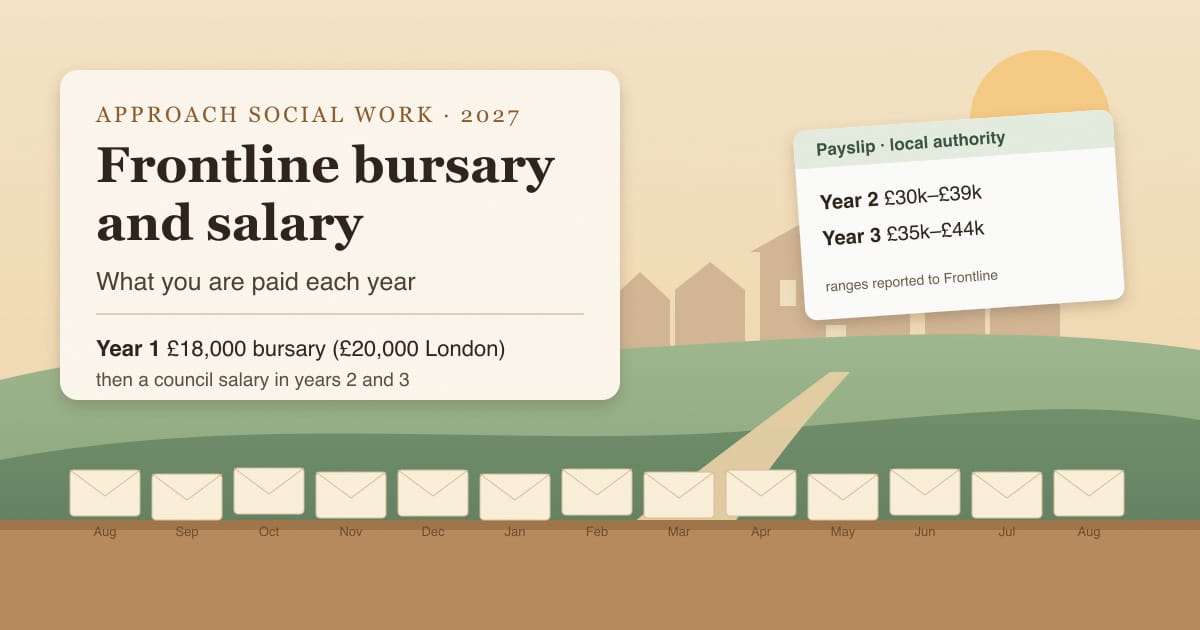
| Year one | Tax-free, non-repayable bursary of £18,000 outside London or £20,000 in London, paid instead of a student maintenance loan | Roughly the take-home pay of a £20,600 salary outside London or £23,500 in London |
| Year two | Newly qualified social worker’s salary, set by your local authority | Participants reported £30,000 to £39,000 (median £35,000), 2024 and 2025; London authorities may pay more |
| Year three | Social worker’s salary | Participants reported £35,000 to £44,000 (median £40,000), 2024 and 2025 |
| Fees | Diploma and master’s fully paid by Frontline | Social work master’s fees typically cost £9,000 a year |
What you pay yourself: travel to programme days, including readiness for practice, the residential (where Frontline covers accommodation and food) and teaching days; any GP fee for the health form; overseas police checks and replacement certificates. Travel for home visits and other visits to families is typically reimbursed by your local authority, under its own process. In year one you are a full-time Lancaster University student, so you get student discounts and may get a council tax exemption or discount; Frontline warns that most participants no longer receive Universal Credit and/or are no longer eligible for 30 hours of free childcare once they have the bursary, so check your own circumstances. Holiday is 25 days in year one and should avoid skills days, and study leave is limited, so assignments fit around your placement. Source: Frontline, Pay, progression and financial support.
Two cash-flow points to plan for: the programme starts on 12 July 2027 but the first bursary payment arrives on the first working day of August 2027, and the last bursary payment (August 2028) comes before the first salary (usually 15 to 30 September 2028). Frontline runs a small, discretionary bursary advance and grant scheme for the readiness for practice period (an advance means smaller payments later in the year). Disabled participants may be eligible, on application, for Disabled Students’ Allowance in year one and Access to Work in years two and three; Frontline also pays £160 towards a specific learning difficulty (SpLD) assessment and makes reasonable adjustments during the application. All participants can use an employee assistance programme, including a 24-hour helpline and, where appropriate, up to six counselling sessions a year.
Pros and cons: what the official evidence says
The official evidence is what Frontline publishes about the programme and what DfE found when it surveyed a recent cohort. DfE’s May 2026 report surveyed applicants to the 2022 cohort and the people who qualified from it, at 6 and 18 months after their diploma. 409 people started that cohort and 346 completed the diploma; the satisfaction figures do not cover people who left. The figures below are from survey respondents, not every qualifier: applicants responded at 15%; of the 346 people who completed the diploma, the qualifier surveys went to the 314 active programme participants, with 127 responses at 6 months (40%) and 86 at 18 months (27%). DfE did not run significance tests on the qualifier surveys and says the findings are not necessarily representative, so read them as indications, not guarantees.
DfE, Frontline 2022 cohort: surveys of applicants and qualifiers (May 2026). Respondents only: 127 at 6 months, 86 at 18 months. The first four bars are positives; the last three are costs to plan for.
The strengths
- Qualify after the first programme year, then earn a salary. You register as a social worker at the end of year one and move into a salaried local authority post; Frontline calls it a guaranteed role.
- No fees and a funded first year. The bursary is tax-free and non-repayable, and the diploma and master’s cost you nothing.
- Close support. A hub of typically five trainees, managed by a consultant social worker, plus a practice tutor. DfE’s survey quotes show experiences vary, with one respondent crediting “the quality of my consultant social worker”.
- Real practice in year one. After readiness for practice, over 200 days of on-the-job training, mostly in statutory children’s services with a contrasting spell in adults’ social care, alongside postgraduate study.
- No experience requirement, no age limit. Career changers and recent graduates can both apply without specified prior experience, as long as they meet the eligibility rules.
- Outcomes so far. In DfE’s 2022-cohort survey, 97% of respondents were in work or study 18 months after qualifying, most of them as children’s social workers, and 84% of those in social work said they were very or moderately likely to still be in it a year later.
The trade-offs
- Money is tight in year one. Frontline says you will probably need other sources of money, and 77% of DfE’s 6-month respondents did (most often savings or family). Plan for the gap between the last bursary payment in August 2028 and the first salary in mid to late September 2028.
- Little choice of place. One local authority for three years, a 45-minute commute limit for most locations, and no guarantee of your preferred area.
- A car outside London. A full valid UK driving licence (manual or automatic) when you apply and access to a car by September, unless medically exempt.
- Intensive. Full-time placement plus postgraduate study, in the office in year one. At 6 months, only 55% of DfE’s respondents agreed the academic workload was manageable; 39% disagreed.
- The job itself is demanding. At 18 months, 66% agreed their workload was too high, and the hours were what most were dissatisfied with. An earlier DfE study (2021) reported a sense of disappointment among some Frontline graduates in the reality of local authority practice compared with the training model.
- One try per year, no deferral at application. Deferral is considered only after a conditional offer, in extreme extenuating circumstances, and is not guaranteed. If you are not ready, applying in a later cycle may serve you better.
- Children’s social work in England. The qualification lets you register with Social Work England; Frontline notes you may need extra training to practise elsewhere in the UK, and Scotland requires further steps before working with adults.
On retention, the older DfE tracking study (2021) estimated, mainly from the professional register, that 8% to 16% of graduates from Frontline’s early cohorts were not in a statutory social work role in England 18 months after qualifying. Comparing that with 18% for social work graduates from all routes at 15 months (a different survey, not directly comparable), it found no evidence that fast-track attrition was higher at that point. Later figures for the earliest cohorts were higher and moved up and down (cohort 1: 36% after three years, 32% after four, 36% after five), suggesting people move in and out of the profession, and DfE says it is not known how they compare with other routes. Being on the register does not prove someone is practising, and these cohorts qualified between 2015 and 2019 (cohort 1 in 2015, each later cohort a year after). Sources: DfE 2022 cohort report · DfE fast track tracking study.
How competitive is it?
Frontline’s pages do not give an acceptance rate for the 2027 cohort. The official numbers we found are in DfE’s May 2026 report: 4,333 people applied to the 2022 cohort and 409 started it, so roughly one applicant in ten started the programme. That is an indication only: some applicants withdraw or are not eligible, and cohort sizes change. Frontline’s own advice is to apply as soon as you are ready, because locations and assessment-centre dates fill.
The selection is built on Frontline’s competencies at every stage. After the application form comes the online test, which combines verbal reasoning and situational judgement; you receive its result, and only if it is successful does Frontline review your application form and consider you for an assessment centre. You can try the format with the free questions below. These are our own questions, written for practice, not Frontline’s.
FreeTests: Verbal reasoning · Relationships and communication
Approach Social Work Online Test Practice: free sample
Answer 4 questions against the clock, like the real exam. You then see the right answer, the reason and your time on each. About 8 minutes · free · no sign-in.
4 questions to answer
Start nowabout 8 minThis one is free · no sign-in needed
Your result shows how long each question took you.
Approach Social Work or another route?
Approach Social Work is one of several ways to qualify. The obvious comparison is the government’s Step up to social work, also an intensive, funded route into child and family social work. Its facts below are from GOV.UK; check there for the next intake.
| Feature | Approach Social Work | Step up to social work |
|---|---|---|
| Length | Three years (qualify after year one) | 14 months, full time |
| Money | £18,000 / £20,000 bursary in year one; salary in years two and three | Tax-free DfE bursary of £21,995, the same everywhere |
| You come out with | Postgraduate Diploma, then an MA | Postgraduate Diploma |
| Experience needed | None specified | 6 months’ full-time (or equivalent) direct experience, paid or voluntary, with vulnerable children, young people, families, carers or vulnerable adults |
| Intake | Every year; 2027 applications open now | Every two years; GOV.UK listed applications as closed when we checked |
| Delivered by | Frontline, with Lancaster University | Regional partnerships of local authorities and universities |
Mainstream undergraduate and postgraduate social work degrees and apprenticeships are the other routes; Frontline points applicants to the professional association BASW for an overview. Sources: GOV.UK, Step up to social work · Frontline help centre (other routes).
Before you register: a readiness checklist
Approach Social Work 2027: before you register
Tick each item as you check it. It follows Frontline’s eligibility and location rules; the order is our suggestion.
0 of 12 done
Ticks are saved only in this browser on this device.
Frontline’s free quiz, “Is social work right for you?”, is a good first step if you are still deciding. When you are ready, registration is on Frontline’s apply page.
Getting ready for the online test
After the application form comes Frontline’s online test: verbal reasoning plus situational judgement in social-work scenarios. Our Approach Social Work Online Test Practice has three full practice tests in those two formats, every answer explained, with your result by verbal reasoning and by competency area.
Independent practice, written by us; not made or endorsed by Frontline. Use Frontline’s own practice questions at the start of the real test too. The free questions just below are a few from it.
FreeTests: Verbal reasoning · Relationships and communication
Approach Social Work Online Test Practice: free sample
Answer 4 questions against the clock, like the real exam. You then see the right answer, the reason and your time on each. About 8 minutes · free · no sign-in.
4 questions to answer
Start nowabout 8 minThis one is free · no sign-in needed
Your result shows how long each question took you.
Frequently asked questions
What is Approach Social Work?
Approach Social Work is Frontline’s fully funded three-year training programme for becoming a children’s social worker in England. You train in a local authority children’s services team, qualify with a Postgraduate Diploma in Social Work after year one, work as a paid social worker in years two and three, and finish with a master’s degree awarded by Lancaster University.
Is Approach Social Work the same as the Frontline programme?
Yes. Frontline’s pages describe it as Approach Social Work, formerly known as the Frontline programme. Frontline is the charity that runs it. The 2027 programme runs over three years, while older cohorts finished the master’s after two.
When does Approach Social Work 2027 start?
On 12 July 2027, with five weeks of readiness for practice until 13 August. After a summer break, the local authority placement starts on 6 September 2027.
When do Approach Social Work applications open and close?
Applications for the 2027 cohort opened on 28 September 2026. There is no single closing date: recruitment is rolling, locations close as they fill, and assessment centres usually run from October to May. Frontline expects some locations to stay open until December and some to reopen in February, and recommends applying as soon as you are ready.
What are the Approach Social Work entry requirements?
At least a 2:2 in an undergraduate honours degree (predicted or obtained, or an international equivalent), GCSE English Language at grade C/4 or an accepted equivalent, the right to work and study in the UK with access to public funds until September 2030, residence in England by the start, and not already being fully or partially qualified in social work. Outside London you also need a full valid UK driving licence (manual or automatic) when you apply and access to a car by September 2027, unless medically exempt.
Where are the Approach Social Work locations for 2027?
Frontline expects to partner with local authorities in the North East, Yorkshire and the Humber, the North West, the East and West Midlands, London, the East of England, the South East and the South West. Its list includes, for example, Leeds, Manchester, Birmingham, Southwark, Essex, Kent and Bristol. Locations close as they fill, and most have a 45-minute rush-hour commute limit.
Can I do Approach Social Work in London?
Yes. Frontline lists Bromley, Croydon, Hounslow, Merton, Southwark, Sutton and Wandsworth for 2027. London placements do not need a driving licence, and the year-one bursary is £20,000 instead of £18,000.
Can I do Approach Social Work in Wales or Scotland?
No. You must live in England by July 2027 and for the whole programme, because the Department for Education can only fund training for people resident in England. After qualifying you register with Social Work England; Frontline says you can practise elsewhere in the UK but may need additional training, and Scotland has further requirements before you can work with adults.
How much do you get paid on Approach Social Work?
In year one, a tax-free bursary of £18,000, or £20,000 in London. In year two participants reported salaries of £30,000 to £39,000 (median £35,000), and in year three £35,000 to £44,000 (median £40,000), according to Frontline’s 2024 and 2025 figures. Your local authority sets the salary, and London local authorities may offer more.
How competitive is Approach Social Work?
Frontline’s pages do not give an acceptance rate. Department for Education research shows 4,333 people applied to the 2022 cohort and 409 started it, about one in ten. Cohort sizes change from year to year.
Is Approach Social Work good? What do reviews say?
In the Department for Education’s survey of the 2022 cohort, 93% of respondents were satisfied with the programme six months after qualifying and 90% would recommend it. At the same point 77% said they had needed money beyond the bursary in year one, and at 18 months 66% agreed their workload was too high. These are survey respondents (127 and 86 people), not every qualifier. It suits people who want statutory children’s social work and can manage a tight first-year budget and an intensive schedule.
What is the readiness for practice residential?
Readiness for practice is the first five weeks of the programme (12 July to 13 August 2027). Most days are online, but there are three consecutive residential days for the whole cohort and two in-person regional teaching days. Frontline covers accommodation and food on the residential; you pay your travel. Attendance is expected on every planned day.
What is the role of Lancaster University?
Lancaster University awards the Postgraduate Diploma and the MA in Advanced Relationship Based Social Work Practice with Children and Families; Frontline designs and delivers the teaching. In year one you are a full-time Lancaster student, which brings student discounts and possible council tax relief.
Do I need experience to apply?
No. Frontline says you do not need specific experience. It assesses applicants against its competencies, so think of examples from work, volunteering or life that show them.
Can I reapply if I am unsuccessful?
You can apply only once per recruitment cycle, so you would wait until applications open again the following autumn. Frontline gives individual feedback only to applicants who reach the assessment centre. Deferral is not offered at the point of application; after a conditional offer it is considered only in extreme extenuating circumstances.
How do I contact Approach Social Work or log in to the applicant portal?
Frontline says the quickest route is its Approach Social Work help centre, with a query form if your answer is not there. The applicant portal opens once you complete the registration form on Frontline’s apply page.
More in this series
- Approach Social Work online test 2027: format and free practice
- Approach Social Work application form: the competencies with examples
- Frontline assessment centre: written exercise, role play and interview explained
- Frontline interview questions and answers
- Frontline bursary and salary 2027: what you are paid each year
Sources
- official — Frontline: Approach Social Work programme page (programme overview, pay summary, eligibility summary, stages)
- official — Frontline: Approach Social Work programme overview (year one, two and three; 2027 dates)
- official — Frontline: Approach Social Work curriculum (postgraduate diploma, modules, practice days)
- official — Frontline: A typical week on year one of Approach Social Work
- official — Frontline: Where you’ll work (2027 regions and local authorities, commute limits, driving)
- official — Frontline: Pay, progression and financial support (bursary, salary, costs, holiday, flexible working)
- official — Frontline: Approach Social Work application process
- official — Frontline: What we’re looking for (eligibility and competencies)
- official — Frontline: Approach Social Work eligibility (degree, GCSE English, right to work, residence, evidence)
- official — Frontline: Why join the programme
- official — Frontline: Approach Social Work help centre (structure, dates, locations, finance, eligibility, reapplying, deferrals)
- official — Frontline: Apply to Approach Social Work (2027 registration form)
- official — Frontline: Is social work right for you? (Frontline’s free quiz)
- official — Department for Education: Frontline 2022 cohort, surveys of applicants and qualifiers (research report, May 2026)
- official — Department for Education: Social work fast track programmes, tracking retention and progression (final report, 2021)
- official — GOV.UK: Step up to social work (Department for Education)
official = a document published by the conducting body. reported = a news or coaching site we could not check against an original. Where sources disagree this page says so rather than picking one.