Checked 21 October 2026. What the exercise asks for is read from the Army officer selection page and the candidate answer sheet, 21 Oct 2026. The worked examples are our own and are not taken from any AOSB paper.
The Army's officer selection page describes the written part of the planning exercise and links to an example answer sheet. The written submission includes "a short set of focused questions" with the scenario map, and the answer sheet asks for a plan with "routes to specific locations, actions or decisions of personnel, timings and where your specific aims are met". The sheet's own example of a resource is a hovercraft, described as "It crosses marshes. Speed 20 mph. Need a skilled pilot." Our reading: a timed plan with routes needs speeds, distances and clock times. This guide covers that arithmetic.
Our summary of the arithmetic. The quoted requirements are from the Army's officer selection page and the AOSB candidate answer sheet, read 21 Oct 2026.
1. Time from distance and speed
Time = distance ÷ speed. Keep the units together: miles with miles per hour gives hours. Then convert to minutes by multiplying by 60. Worked example (ours): 18 miles at 12 mph is 18 ÷ 12 = 1.5 hours = 90 minutes.
| Speed (mph) | Minutes per mile | Minutes for 15 miles |
|---|---|---|
| 10 | 6 | 90 |
| 12 | 5 | 75 |
| 15 | 4 | 60 |
| 20 | 3 | 45 |
| 30 | 2 | 30 |
| 60 | 1 | 15 |
The middle column is the quick trick: minutes per mile = 60 ÷ speed. It is worth knowing these six by heart.
2. Back-planning from a deadline
If an aim has a deadline, work backwards from it: deadline, minus travel time, minus any loading, briefing or handover time, gives the latest start. Worked example (ours): a party must be at a bridge by 1630; the walk is 4 miles at 3 mph (80 minutes) and they need 10 minutes to get ready. 1630 minus 90 minutes = 1500 latest start. Write the latest start for every aim before you choose between options; it shows at once which aims are under pressure.
3. Shuttles and round trips
If one vehicle carries a group in parts, it must come back for the rest. Count the legs: carrying 9 people in a vehicle with room for 4 passengers (its driver is not one of the 9) needs 3 loads, so 3 trips out and 2 trips back, which is 5 one-way legs. Worked example (ours): each leg is 6 miles at 24 mph (15 minutes), plus 5 minutes to load each trip. Five legs of 15 minutes = 75 minutes, plus three loads of 5 minutes = 15 minutes: the last person arrives 90 minutes after the first load starts. Our check: count the return trips, and do not add a return after the last load.
4. Two things moving at once
When two parties move towards each other on one route, use the closing speed. Two parties starting together at the ends of a 20-mile road and moving towards each other at 4 mph and 6 mph close the gap at 10 mph, so they meet after 20 ÷ 10 = 2 hours, 8 miles from the first party's start. Worked out this way (closing speed), it is one division, not a table of positions.
5. The 24-hour clock
Our advice: keep every time in the 24-hour clock, and add minutes in two steps: to the next full hour, then the rest. Worked example (ours): 1345 plus 95 minutes is 1345 + 15 = 1400, then + 80 = 1520. Crossing midnight: 2330 plus 50 minutes is 0020 the next day; write "next day" in your plan.
6. Miles and kilometres
The Army's example answer sheet gives a speed in mph, but practise both units in case a scenario uses kilometres. Our assumption for the kilometre examples on this page (not taken from the Army's sources): the international mile, 1 mile = 1.609344 km (about 1.609 km), so roughly 8 km is 5 miles. Never mix the two in one calculation: convert first. A useful rule is to convert the speed rather than every distance, if most distances are in one unit.
| Miles | Kilometres | Speed: mph | Speed: km/h |
|---|---|---|---|
| 1 | 1.6 | 10 | 16 |
| 5 | 8.0 | 20 | 32 |
| 10 | 16.1 | 30 | 48 |
| 20 | 32.2 | 40 | 64 |
| 25 | 40.2 | 50 | 80 |
- The six parts of the Army's answer sheet
- Four original scenarios, each with a map
- 20 focused questions with working
- Two options compared for every exercise
- A timed plan, a contingency and a justification
- Briefing and Main Board on one page
The kilometre and km/h figures are rounded to one decimal place or to the nearest whole number, so they are approximations: 20 miles at 10 mph is 120 minutes, but 32.2 km at 16 km/h works out at about 121. Convert once, keep the full figure until the end, and round only the final time.
7. Mixed terrain and average speed
A route that is part road, part track, is two calculations, not one. Worked example (ours): 12 miles of road at 30 mph (24 minutes) and then 3 miles of track at 6 mph (30 minutes) take 54 minutes. Averaging the two speeds is the trap here: (30 + 6) ÷ 2 = 18 mph would give 15 ÷ 18 hours = 50 minutes, which is wrong because the vehicle spends 30 minutes on the slow stretch and only 24 on the fast one. (The plain average of two different speeds is right only when equal times are spent at each.) Average speed is total distance ÷ total time: 15 miles in 54 minutes is about 16.7 mph.
8. Fuel, range and endurance
If a scenario gives a vehicle's range or fuel, check every leg of the plan against it before you commit, including the return. Worked example (ours): a boat with fuel for 40 miles making three round trips of 7 miles each way covers 42 miles and runs dry on the last return, while three trips out and two back (35 miles) fit, if the boat may stay at the far side. The same check applies to people: if the scenario gives a slower speed for a party carrying a stretcher or a heavy load, use it for that leg.
Enter a deadline, a distance and a speed, plus any minutes for loading or preparation. It works out the travel time and the latest time you can start. It runs only in your browser.
Travel 90 min. Latest start 1215.
Same sum as section 2: deadline minus travel time minus extra minutes. Travel time is shown rounded up to the whole minute, and the latest start is rounded down to the whole minute, so it is never late. The sums are done exactly on the numbers as typed, so there is no rounding error from how computers store decimals; enter plain numbers such as 4.5. A start before 0000 is labelled "previous day", or with the number of days earlier when it falls more than one day before.
- The six parts of the Army's answer sheet
- Four original scenarios, each with a map
- 20 focused questions with working
- Two options compared for every exercise
- A timed plan, a contingency and a justification
- Briefing and Main Board on one page
9. Using the map copy
The Army says the focused questions come with "a copy of the map from the scenario for you to add information to". Our way to use it: write each leg's distance on the route, write the travel time beside it in minutes for each vehicle that can use it, and put each deadline as a clock time beside its place. Once the map carries the minutes, comparing options is reading, not calculating, and the focused questions go faster.
A practice routine
Speed in this arithmetic comes from repetition. Our suggestion for the weeks before a board: ten minutes a day of mental time, speed and distance sums with no calculator, plus one full practice planning exercise a week against the clock, written out on the six boxes of the answer sheet. After each exercise, check every time in your plan against the scenario before you look at any model answer: the errors you find yourself are the ones you stop making. Keep a list of every slip (a missed return leg, minutes not divided by 60, a vehicle in two places) and read it before each new exercise.
A note on our labels: the Army's sheet prints six unnumbered prompts, each followed by a space to write in; "box" is our word for those spaces.
Checks before you hand in
- Every time in the plan is in the same clock.
- Every leg has a distance, a speed and a time, and the three agree.
- Every vehicle is in one place at a time: no vehicle on two jobs at once.
- Each aim's deadline is met with the time to spare written beside it.
- Loading, briefing and handover times are in, not just driving time.
Our checklist, not the Army's.
Try one question
A group of four is 6 miles from a road junction. They can walk there at 3 mph, or wait 40 minutes for a minibus that will take them by a 10-mile road route at 30 mph. Which gets them to the junction first, and by how much?
- A. Walking, by 20 minutes
- B. The minibus, by 60 minutes
- C. The minibus, by 20 minutes
- D. Both arrive at the same time
Show the answer
B. The minibus, by 60 minutes. Walking: 6 ÷ 3 = 2 hours = 120 minutes. Minibus driving: (10 ÷ 30) × 60 = 20 minutes, so the minibus takes 40 minutes waiting + 20 minutes driving = 60 minutes in all. The minibus arrives 120 − 60 = 60 minutes earlier.
Our own question, made up for practice. It is not taken from an AOSB planning exercise.
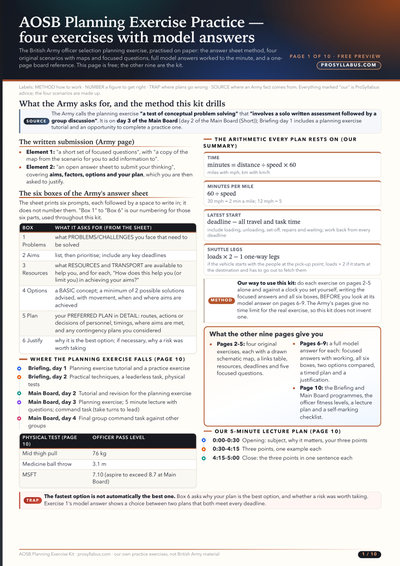
Arithmetic is only part of the exercise: the answer sheet also asks you to identify the problems, prioritise your aims, weigh your resources and options, and justify a preferred plan. See the answer sheet, box by box.
Frequently asked questions
Is there maths in the AOSB planning exercise?
The Army says the written part includes a short set of focused questions with the scenario map, and the answer sheet asks for a plan with routes, actions and timings. Our advice: practise time, speed and distance arithmetic, and keep every time in one clock (we use the 24-hour clock).
Can I use a calculator in the AOSB planning exercise?
The Army's officer selection page does not say. Practise without one, so it does not matter.
How do I work out time from speed and distance?
Time = distance ÷ speed. In miles and miles per hour the answer is in hours; multiply by 60 for minutes. Minutes per mile = 60 ÷ speed.
How do I avoid mistakes with mixed speeds?
Work out each stretch separately (distance ÷ speed for each) and add the times. Do not take the plain average of two different speeds unless equal times are spent at each; the true average speed is total distance ÷ total time.
Should I use miles or kilometres?
Whatever the scenario uses. The Army's example answer sheet gives a speed in mph. If a scenario mixes units, convert before you calculate (our examples assume 1 mile = about 1.609 km, the international mile).
What is back-planning?
Working backwards from a deadline: deadline minus travel time minus any loading or preparation time gives the latest time you can start.
ProSyllabus is an independent study site, not part of the British Army or the Ministry of Defence. The description of the planning exercise is taken from the Army's own recruitment pages; the arithmetic, worked examples and checklist are ProSyllabus's own. Check anything that matters to you with your recruiter and the joining instructions for your board.
Sources
- official — British Army Jobs: "Army officer selection" (no date on the page; read 21 Oct 2026): Briefing, Main Board, Main Board (Short), Army Scholarship Board
- official — British Army: "AOSB PLANNING EXERCISE - CANDIDATE ANSWER SHEET" (PDF; its pages are marked "AOSB Plan Ex Answer Sheet Dec 23"; read 21 Oct 2026), linked from the officer selection page
official = a document published by the conducting body. reported = a news or coaching site we could not check against an original. Where sources disagree this page says so rather than picking one.