Checked 21 October 2026. Read from the Army officer selection page and the candidate answer sheet it links ("AOSB Plan Ex Answer Sheet Dec 23"), 21 Oct 2026. Neither gives how long each part of the exercise lasts; ask your recruiter, and check your joining instructions.
Our suggestion: practise the planning exercise on paper at home, because the Army publishes its answer sheet. The Army describes it as "a test of conceptual problem solving" that "involves a solo written assessment followed by a group discussion." It sits on day 3 of the Main Board. Candidates who attend Briefing are introduced to it there: Briefing day 1 includes a "Planning Exercise tutorial presentation and an opportunity to complete a practice planning exercise." Professionally qualified officers, who do not normally attend Briefing, have a planning exercise tutorial on day 1 of their Main Board (Short). This guide goes through the answer sheet box by box.
A note on our labels: the Army's sheet prints six unnumbered prompts, each followed by a space to write in; "Box 1" to "Box 6" is our numbering.
British Army Jobs, Army officer selection page, and the AOSB candidate answer sheet, read 21 Oct 2026.
What you hand in
The officer selection page splits the written submission into two parts, in these words:
"1) a short set of focused questions, this will also include a copy of the map from the scenario for you to add information to, and 2) an open answer sheet to submit your thinking. This covers four areas: aims, factors, options, and your plan. You are then asked to justify your plan."
Our reading: these are two different tasks. The focused questions, with the map, call for accurate reading of the scenario: what is where, how far, how fast, by when. The open answer sheet calls for judgement: what matters most, what could work, and why your choice is the best of them. After the written part comes a group discussion with the other candidates.
The answer sheet, box by box
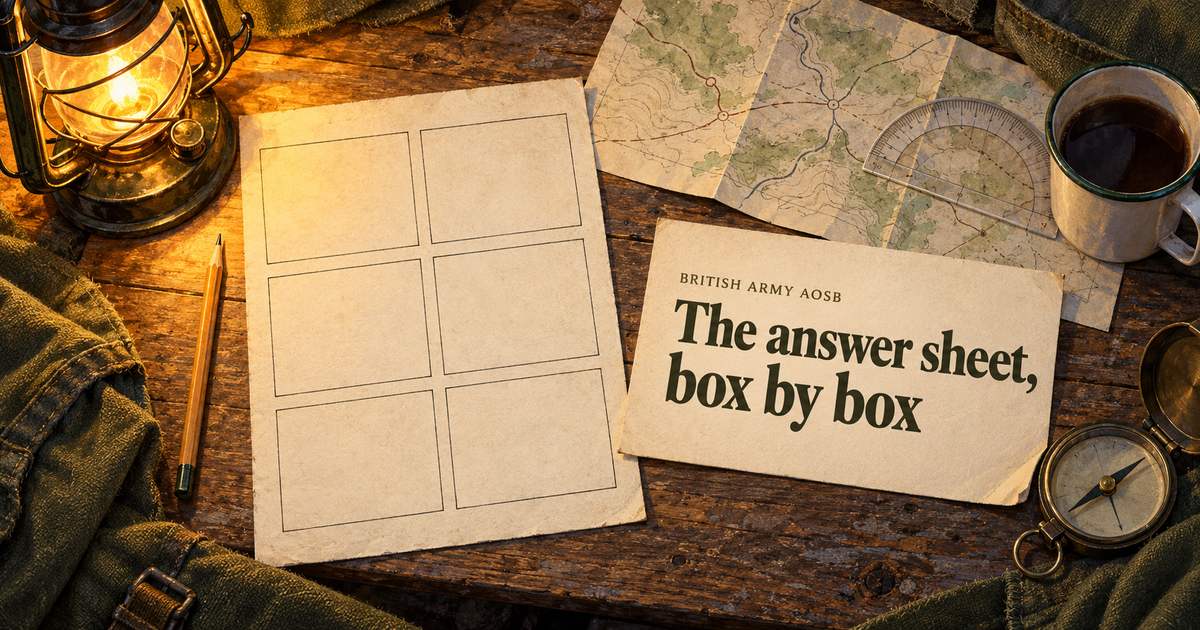
The Army's example sheet is headed "AOSB PLANNING EXERCISE - CANDIDATE ANSWER SHEET" and has a box for your candidate number. Its prompts, in order, with what each one is really asking you for:
| Box | The sheet asks (quoted) | What to write (our advice) |
|---|---|---|
| 1. Problems / challenges | "From your understanding of the scenario, list what PROBLEMS/CHALLENGES you are facing that need to be solved?" | One line per problem, in your own words. Include the hidden ones: a deadline, a vehicle that cannot cross terrain, a person who cannot be moved fast. |
| 2. Aims | "Define your AIMS (list and then prioritise what you need to achieve, include any key deadlines)." | Numbered, most important first, each with its deadline as a clock time. The order comes from the scenario: what it says matters most, and what happens if an aim is missed. |
| 3. Resources and transport | "What RESOURCES and TRANSPORT are available to help you?" with two columns: "Resource/Transport" and "How does this help you (or limit you) in achieving your aims?" | Every vehicle and item, with its speed, capacity and limits. The sheet's own example: "E.g. Hovercraft" / "E.g. It crosses marshes. Speed 20 mph. Need a skilled pilot." |
| 4. Possible solutions | "Options of how you could solve it. Written as a BASIC concept. You are advised to create minimum of 2 possible solutions, with details of: movement, when and where your aims are achieved." | At least two real options, a few lines each: who goes where, by what, and the time each aim is met. Not a full timetable yet. |
| 5. Preferred plan | "From your options above, select your PREFERRED PLAN and write it out in DETAIL below (including routes to specific locations, actions or decisions of personnel, timings and where your specific aims are met, if you considered any contingency plans - include these too)." | A timed sequence: clock times, routes, who does what. Mark the moment each aim is met. Add one contingency. |
| 6. Justify | "JUSTIFY your plan. Why is this the best option. If necessary, explain why a risk was worth taking." | Compare against your other option: which aims it meets, how much spare time it leaves, what risk it carries and why that risk is acceptable. |
The sheet ends: "(Please use the reverse side of the sheet if you need more space for any part of your submission)". The selection page names the open sheet's four areas as aims, factors, options and plan, while the printed sheet itself has no box headed "factors". Our reading: the problems box and the resources table are where your factors go, so write each factor with what it means for your plan, as the resources table asks.
Our suggested order, not an Army rule. The Army's programme includes a planning exercise tutorial presentation at Briefing and a reminder and revision period on Main Board day 2, before the exercise on day 3; follow what you are taught there.
Common weaknesses on paper (our advice)
- Unprioritised aims. The sheet says list and then prioritise. A list in the order you read the scenario is not a priority.
- No deadlines. The aims box asks you to include key deadlines. Write them as clock times, and keep to one clock (the 24-hour clock is the safest).
- One option dressed up as two. The sheet advises a minimum of 2 possible solutions. If your second option only swaps a vehicle and changes nothing about timings, routes or risk, it is not really a choice; a different vehicle that changes those is.
- A plan with no times. The plan box asks for timings and where your specific aims are met. A plan without times cannot be checked, by you or by the board.
- A justification that repeats the plan. The last box asks why it is the best option. Say what the other option would have cost.
Our advice, drawn from what each box asks for. Neither the officer selection page nor the answer sheet gives a marking scheme.
Try one question
A vehicle must reach a village 45 miles away by 1400. It travels at 30 mph and needs 15 minutes to load before it leaves. What is the latest time loading can start?
- A. 1215
- B. 1230
- C. 1245
- D. 1300
Show the answer
A. 45 miles at 30 mph takes 1.5 hours, which is 90 minutes. Add 15 minutes of loading: 105 minutes in all. 1400 minus 105 minutes is 1215. Answer B (1230) forgets the loading time; C and D take off only 75 and 60 minutes.
Our own question, made up for practice. It is not taken from an AOSB planning exercise.
A filled answer sheet, on a small scenario of our own
Reading the boxes is one thing; seeing them filled is another. Below is a short practice scenario we made up, with the answer sheet filled in the way the boxes ask. Every distance and speed is invented, and every time is worked out in full so you can check it.
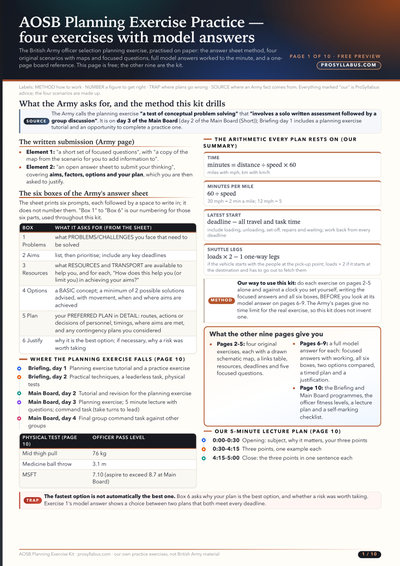
- The six parts of the Army's answer sheet
- Four original scenarios, each with a map
- 20 focused questions with working
- Two options compared for every exercise
- A timed plan, a contingency and a justification
- Briefing and Main Board on one page
The scenario (ours)
- It is 1300. You and three others are at a farm. A hiker with an injured ankle, who cannot walk, is at a hut 6 miles north, up a hill track. A storm will make the track impassable to vehicles from 1600.
- The medical centre is in the village, 9 miles south of the farm by road. It closes at 1700.
- A shepherd at a cottage 4 miles east of the farm, reached only by footpath, needs a parcel of medicine by 1500.
- At the farm: a Land Rover (30 mph on the road, 12 mph on the track, room for the hiker lying across the back seat) and a quad bike (18 mph on the track, rider plus one passenger sitting behind).
- Allow 5 minutes to set off, 10 minutes to load the hiker at the hut and 5 minutes for any change of vehicle. Walking speed is 3 mph.
A made-up scenario for practice. It is not taken from any AOSB planning exercise.
Box 1, problems. An injured hiker who cannot walk out; a track that closes to vehicles at 1600; a medical centre that closes at 1700; a parcel that must reach a cottage with no road by 1500; four people and two vehicles to cover all of it.
Box 2, aims, in priority. (1) Get the hiker off the track before 1600 and to the medical centre before 1700. (2) Get the medicine to the shepherd by 1500. The hiker comes first: an injured person on a hill with a storm coming is the problem with the worst outcome if it fails.
Box 3, resources and transport.
| Resource/Transport | How it helps (or limits) you |
|---|---|
| Land Rover | Road 30 mph, track 12 mph. The hiker can lie across the back seat. Track closes at 1600. |
| Quad bike | Track 18 mph, faster than the Land Rover there. Only one passenger, sitting behind the rider: hard for someone with an injured ankle. |
| Four people | Enough to send two with the hiker and one with the medicine, with one left at the farm. |
| Footpath to the cottage | No vehicle can use it: 4 miles at 3 mph takes 80 minutes on foot. |
Box 4, possible solutions. Option A: two people take the Land Rover up the track for the hiker and drive on to the medical centre; one person walks the medicine to the cottage. Option B: one person takes the quad bike up the track, brings the hiker back to the farm on the pillion, and they change to the Land Rover for the road; one person walks the medicine. The timings:
| Step | Option A (Land Rover) | Option B (quad, then Land Rover) |
|---|---|---|
| Set off from the farm | 1305 | 1305 |
| Reach the hut (6 miles of track) | 1335 (30 min at 12 mph) | 1325 (20 min at 18 mph) |
| Hiker loaded, leave the hut | 1345 | 1335 |
| Back at the farm, off the track | 1415 | 1355, then 5 min to change: 1400 |
| Medical centre (9 miles of road at 30 mph, 18 min) | 1433 | 1418 |
| Medicine at the cottage (walker leaves 1305, 80 min) | 1425 | 1425 |
Box 5, preferred plan: Option A. 1305: two people leave in the Land Rover by the track; at the same time a third leaves on foot with the medicine; the fourth stays at the farm with the quad bike. 1335: Land Rover at the hut; load the hiker across the back seat. 1345: hiker loaded, leave the hut. 1415: back at the farm, off the track 105 minutes before it closes. 1433: at the medical centre, 147 minutes before it closes (aim 1 met). 1425: medicine at the cottage, 35 minutes before the deadline (aim 2 met). Contingency (assuming a Land Rover that cannot climb the track turns back at once and is at the farm by 1330): the fourth person takes the quad bike up at 1335; the quad reaches the hut at 1355, has the hiker loaded by 1405 and is back at the farm at 1425 (95 minutes before the track closes); after 5 minutes to change to the Land Rover, the hiker reaches the medical centre at 1448, before 1700.
Box 6, justify. Option B reaches the medical centre 15 minutes sooner, but it puts an injured person on the back of a quad bike on a hill track. Both options meet every deadline with time to spare, so those 15 minutes buy nothing that matters and add a real risk. Option A meets both aims with a margin of at least 35 minutes and keeps a vehicle in reserve for the contingency.
Notice what made the choice: not which option was fastest, but which one met every aim with acceptable risk. That is exactly what the justify box asks: "Why is this the best option. If necessary, explain why a risk was worth taking."
Then the group discussion
After the written part you discuss the scenario as a group. The Army's page does not describe how that discussion is assessed, so we will not guess. What is safe to say from the page is that the discussion follows the written assessment; our reading is that a candidate who has the facts and timings straight on paper has something exact to offer the group. The Army's general tip applies here too: "Every aspect will be assessed and no single activity will lead to non-selection."
For the arithmetic behind the focused questions, see our guide to planning exercise maths. For where the exercise sits in the board, see the Main Board day by day and what happens at Briefing.
Frequently asked questions
What is the AOSB planning exercise?
The Army calls it a test of conceptual problem solving: a solo written assessment followed by a group discussion. It is on day 3 of the Main Board, after a tutorial on day 2, and Briefing day 1 includes an opportunity to complete a practice planning exercise.
What is on the AOSB planning exercise answer sheet?
The Army's example sheet has boxes for problems and challenges, aims (listed, prioritised, with key deadlines), resources and transport (and how each helps or limits you), possible solutions (at least two advised), your preferred plan in detail, and a justification of the plan.
Is there a map in the AOSB planning exercise?
Yes. The Army says the written submission includes a short set of focused questions with a copy of the map from the scenario for you to add information to.
How long is the AOSB planning exercise?
The Army's officer selection page does not give timings for the planning exercise. The programme includes a planning exercise tutorial presentation at Briefing and a tutorial with a revision period on Main Board day 2; ask your recruiter if you need timings before then.
Do I need to be good at maths for the planning exercise?
The answer sheet asks for a plan with routes and timings, and its example resource gives a speed in mph. Our advice: be quick and reliable with time, speed and distance arithmetic, and keep every time in one clock (we use the 24-hour clock).
ProSyllabus is an independent study site, not part of the British Army or the Ministry of Defence. The programme and rules here are taken from the Army's own recruitment pages; check anything that matters to you with your recruiter and the joining instructions for your board.
Sources
- official — British Army Jobs: "Army officer selection" (no date on the page; read 21 Oct 2026): Briefing, Main Board, Main Board (Short), Army Scholarship Board
- official — British Army: "AOSB Planning Exercise - Candidate Answer Sheet" (PDF; its pages are marked "AOSB Plan Ex Answer Sheet Dec 23"; read 21 Oct 2026), linked from the officer selection page
official = a document published by the conducting body. reported = a news or coaching site we could not check against an original. Where sources disagree this page says so rather than picking one.