Checked 21 October 2026. Programme read from the Army officer selection page and the officer and reserve officer application pages, 21 Oct 2026. Check timings and kit in your own joining instructions.
Briefing is the first of the two stages of the Army Officer Selection Board. The Army's description: "Your first stage is a 2 day trip to the selection centre in Westbury, Wiltshire, for your Briefing. Here, you'll be taught how to prepare for your next visit, the Main Board, and assessed during physical and practical exercises." It is a teaching visit and a look at you at the same time, and the outcome decides whether you are put forward for a Main Board place.
British Army Jobs: Army officer selection, Officer Application Process and Reserve Officer Application Process pages, read 21 Oct 2026.
How you get there
For a regular officer, the Army lists the stages as an online application with a medical history form, an online video interview with a recruiter, a medical check, and then AOSB: "Once your recruiter thinks that you're ready, you'll be sent to briefing." Army Reserve officer candidates are normally invited to meet their chosen unit, and go through medical checks and a face-to-face medical first; for them the Army describes Briefing as "a 24 hour session to assess your officer potential, and to teach you the skills you'll need to pass the Main Board."
To join as a regular officer the Army says you must "Be between 18 and 29", with higher limits for specialists such as doctors and over-30s considered only by exception. Reserve officers can apply from 17 years and 9 months.
If you applied for a Professionally Qualified Officer (PQO) commission, the Army says you "will not normally attend Briefing"; the preparation is built into the three-day Main Board (Short) instead (see our Main Board guide).
The programme, day by day
| Day | Activity | What it involves (Army page) |
|---|---|---|
| Day 1 | Welcome Address and Introduction Brief | Listed by name only; the page gives no more detail. |
| Day 1 | Psychometric testing | "similar to the practice sessions offered on line (a link to the practice site is provided by email when booked onto the Briefing event)" |
| Day 1 | Group Discussion | "including a short 2 minute introduction by each candidate" |
| Day 1 | Planning Exercise | "tutorial presentation and an opportunity to complete a practice planning exercise" |
| Day 1 | Interview | "a short interview with the group leader" |
| Day 2 | Practical Techniques | "on completing practical tasks and undertake a leaderless tasks in the group" |
| Day 2 | Physical Tests | "practice the Multi-stage Fitness Test (MSFT), throwing a medicine ball and a measured weight lift, and complete a small course of individual tasks" |
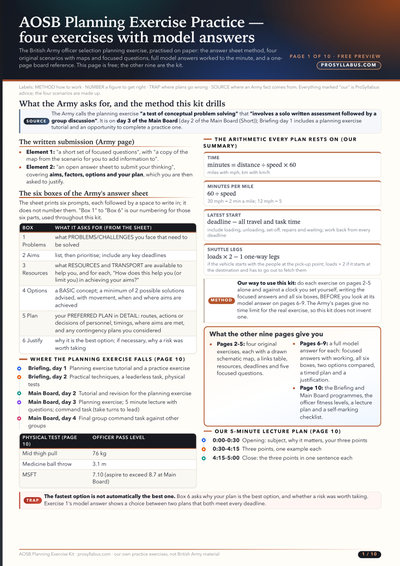
Two things on that list reward preparation at home more than anything else: the two-minute introduction (you know you will give one, so have it ready) and the planning exercise (the tutorial teaches the method, and a candidate who already knows the answer sheet gets more from it; see our separate guide, the answer sheet, box by box).
The fitness standards
The Army's officer selection page gives the levels an officer needs to pass:
| Test | Officer pass level |
|---|---|
| Mid Thigh Pull | 76 kg |
| Medicine Ball Throw | 3.1 m |
| MSFT (beep test) | level 7.10 |
At Briefing the Army lists practice of the MSFT, throwing a medicine ball and "a measured weight lift"; it does not say whether that lift is the mid thigh pull. At the Main Board the page says "candidates should aspire to exceed level 8.7" on the MSFT, and the activity is run up to level 11.6. Its tip list says it plainly: "Make sure you can easily meet the fitness standards required". The Army's assessment preparation page adds that candidates are screened for Sickle Cell Trait, starting with a family origin questionnaire, and that anyone at risk should wait to hear from the Army before starting fitness training.
A two-minute introduction that works
Our structure for the 2 minutes
- Who you are in one sentence: name, where you are from, what you do now.
- One thing you have done that shows responsibility, with a result.
- Why the Army, and which part of it interests you. The Army's own tip: "Research and understand which part of the Army you want to serve in".
- One interest outside work or study, briefly.
- Practise it aloud with a timer until it fits in 2 minutes without rushing.
Our advice. The Army's page says only that each candidate gives a short 2 minute introduction in the group discussion.
- The six parts of the Army's answer sheet
- Four original scenarios, each with a map
- 20 focused questions with working
- Two options compared for every exercise
- A timed plan, a contingency and a justification
- Briefing and Main Board on one page
Briefing and Main Board side by side
Several Briefing activities are rehearsals of things you will be assessed on at Main Board. Seen side by side, the Army's two programmes show where your preparation time goes furthest:
| Activity | At Briefing (day) | At Main Board (day) |
|---|---|---|
| Psychometric tests | Day 1, similar to the online practice | Day 1, "a measure of your cognitive and personality profile" |
| Planning exercise | Day 1, tutorial and a practice exercise | Day 2 tutorial, the exercise on day 3 |
| Group problem-solving tasks | Day 2, practical techniques and a leaderless task | Day 2 outdoor tasks, "group exercises in practical problem solving that you saw at Briefing" |
| Command tasks | Not on the Army's Briefing list | Day 3 command task, where you take turns to lead the group; day 4 final group command task, a series of minor command tasks the group completes against other groups |
| Fitness | Day 2, practise the MSFT, medicine ball throw and weight lift | Day 1 MSFT, aspire to exceed level 8.7 |
| Interview | Day 1, a short interview with the group leader | Day 2, your experiences, interests and why you are applying |
| Group discussion | Day 1, with a 2 minute introduction each | Part of the day 3 planning exercise: a solo written assessment, then a group discussion |
Several Main Board activities are not on the Army's Briefing list: the essay on current affairs, the five-minute lecture and the command tasks (on day 3 you take turns to lead the group). (Briefing day 2 does include a small course of individual tasks; the Main Board list has an individual task course on day 3.) Our advice: the essay and the lecture are the two you can practise alone, at home, with a timer and a notebook, so start on them straight after Briefing (see our separate guide, the Main Board day by day).
Getting the most from the teaching
Briefing includes teaching: the Army says you will be taught how to prepare for the Main Board. Our advice on using that:
- Arrive knowing the formats. If you already know what the planning exercise answer sheet asks for, the tutorial can teach you how the Army wants it done instead of what it is.
- Treat the practice planning exercise as real. Work to the clock, write in full, and if you are shown a solution, compare your timings with it.
- In the group discussion, contribute early. Have your two-minute introduction ready, and in the discussion itself a short, relevant point early on is easier than breaking in late.
- In the leaderless task, be useful. With no appointed leader, ideas, effort and support for other people's good ideas all count. Watching from the side does not.
- Ask what to work on. The Army says the Briefing tests are designed to help it understand your development needs; leave knowing what they are.
Our advice. The Army's page lists the activities but does not publish how each is marked.
What happens after Briefing
The Army: "If your performance at Briefing shows that you're ready for the Main Board you'll be put forward for a place." It also says you "may be advised to wait between Briefing and Main Board, so you come prepared to perform at your best." Our advice: if you are advised to wait, ask what to work on; the Army says the Briefing tests are designed "to help us understand your development needs before you attend the Main Board."
Briefing preparation tracker
Our own checklist, built from the Briefing programme, the officer fitness standards and the Army's assessment tips. Tick each item when it is done.
0 of 10 done
Ticks are saved only in this browser on this device.
The last item is the Army's own advice on its assessment preparation page: "Work on getting seven to eight hours a night in the weeks before you go to Assessment."
Frequently asked questions
How long is AOSB Briefing?
For regular officer candidates the Army describes it as a 2 day trip to the selection centre in Westbury, Wiltshire. For Army Reserve officer candidates it describes a 24 hour session.
What happens at AOSB Briefing?
Day 1: welcome brief, psychometric testing, a group discussion with a 2 minute introduction by each candidate, a planning exercise tutorial with a practice exercise, and a short interview with the group leader. Day 2: practical techniques and leaderless tasks, and physical tests.
What fitness level do I need for AOSB?
The Army's officer pass levels are mid thigh pull 76 kg, medicine ball throw 3.1 m and MSFT (beep test) level 7.10. At Main Board candidates should aspire to exceed MSFT level 8.7.
Do professionally qualified officers attend Briefing?
Not normally. The Army says PQO applicants do the Main Board (Short) programme, which includes the preparation covered at Briefing.
Is there a planning exercise at AOSB Briefing?
Yes, as practice. Day 1 includes a planning exercise tutorial presentation and an opportunity to complete a practice planning exercise. The assessed planning exercise is on day 3 of the Main Board.
Can I fail AOSB Briefing?
The Army says that if your performance at Briefing shows you are ready, you are put forward for a Main Board place, and that you may be advised to wait between Briefing and Main Board. It describes the tests as designed to understand your development needs.
ProSyllabus is an independent study site, not part of the British Army or the Ministry of Defence. The programme and rules here are taken from the Army's own recruitment pages; check anything that matters to you with your recruiter and the joining instructions for your board.
Sources
- official — British Army Jobs: "Army officer selection" (no date on the page; read 21 Oct 2026): Briefing, Main Board, Main Board (Short), Army Scholarship Board
- official — British Army Jobs: "Officer Application Process" (no date on the page; read 21 Oct 2026)
- official — British Army Jobs: "Reserve Officer Application Process" (no date on the page; read 21 Oct 2026)
- official — British Army Jobs: "How old do I need to be to join the Army?" (no date on the page; read 21 Oct 2026)
- official — British Army Jobs: "Preparing for Army Assessment" (no date on the page; read 21 Oct 2026)
official = a document published by the conducting body. reported = a news or coaching site we could not check against an original. Where sources disagree this page says so rather than picking one.