

Checked 20 October 2026. From the Grand-Ducal regulation of 22 July 2019, guichet.lu (EN page last updated 23.05.2025) and INLL’s Sproochentest page and FAQ, all read 20 October 2026. INLL can change practical arrangements (tablet, duration, places) without a new regulation.
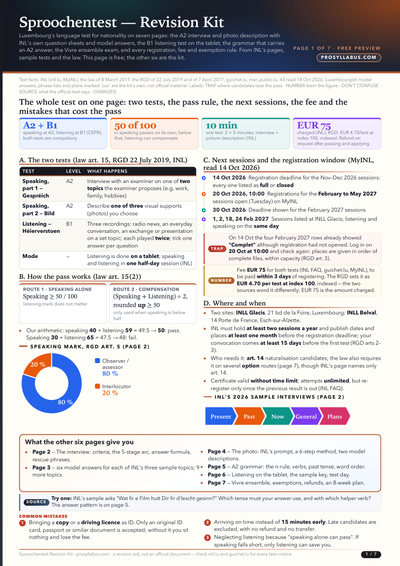
The Sproochentest (in full, the Sproochentest Lëtzebuergesch) is the Luxembourgish language test you pass to become Luxembourgish by naturalisation and in several option cases. It is organised by the INLL, the Institut national des langues Luxembourg, under a Grand-Ducal regulation of 22 July 2019. It has two parts: a short speaking test at level A2 with two examiners, and a listening test at level B1 taken on a tablet. There is no reading or writing. You pass with half the points in speaking, or, if speaking falls short, through an average with your listening mark. This guide sets out who needs it, both tests in detail, the exact pass rule with worked examples and a checker, what preparing takes, and who is exempt. ProSyllabus is an independent study site, not affiliated with the INLL (Institut national des langues Luxembourg), the Ministry of Education or the Ministry of Justice; the rules below are summarised from their published pages and the 2019 regulation, and they decide every case.
INLL Sproochentest page and FAQ; guichet.lu prerequisites page.
Who needs the Sproochentest
For naturalisation, lifelong-learning.lu, the state’s adult-learning portal, says your knowledge of Luxembourgish is documented by the certificate awarded on passing the assessment examination, which is the Sproochentest. guichet.lu’s general sentence also names a certificate of participation in a Luxembourgish course; that is the route for 20-year residents applying by option (below). For option, lifelong-learning.lu says the Vivre ensemble certificate and the assessment of your Luxembourgish are required as the parent of a Luxembourgish minor, after marriage to a Luxembourger, as an adult who fulfilled the Welcome and Integration Contract or the introductory modules of the citizens’ pact, as an adult who settled in Luxembourg before 18, or as an adult with stateless, refugee or subsidiary protection status; guichet.lu gives the same list. INLL’s page says the test concerns only people covered by Article 14 of the law of 8 March 2017 on Luxembourg nationality.
The same people also need the Vivre ensemble au Grand-Duché de Luxembourg certificate (see the last section). One group is treated differently: an adult who has lived in Luxembourg for at least 20 years and applies by option needs only 24 hours of Luxembourgish lessons, and is exempt from the Sproochentest and from the Vivre ensemble course or exam (guichet.lu, lifelong-learning.lu).
| Your route | Sproochentest | Vivre ensemble certificate |
|---|---|---|
| Naturalisation | Yes | Yes |
| Option: parent of a Luxembourgish minor | Yes | Yes |
| Option: marriage to a Luxembourger | Yes | Yes |
| Option: Welcome and Integration Contract or citizens’ pact modules fulfilled | Yes | Yes |
| Option: settled in Luxembourg before 18 | Yes | Yes |
| Option: stateless, refugee or subsidiary protection status | Yes | Yes |
| Option: adult resident for at least 20 years | No — 24 hours of Luxembourgish lessons instead | No |
Source: guichet.lu prerequisites page (EN, last update 23.05.2025) and lifelong-learning.lu. Other option cases exist; the Ministry of Justice’s Nationality Office decides which rules apply to you.
- Cheatsheet + revision sheet: key concepts in 2 lines each
- The two parts and how compensation works
- The assessor's grid and the interview stages
- INL's three sample topics with model answers
- A six-step method for the picture
- The A2 grammar you need, with the n-rule
Test 1: speaking at level A2
The speaking test is pitched at A2 of the Common European Framework of Reference (CEFR) for spoken production and interaction. INLL and guichet.lu describe it the same way: you can introduce yourself and talk in simple terms about your family, other people, your living conditions, your education or your job, and you can describe and compare people, things and activities simply.
It has two parts. First, an interview with an examiner on an A2 topic; INLL gives work, family and leisure as examples, and you choose between two themes the examiner proposes. Second, the description of a visual (INLL’s sample page calls it a photo): you choose one of three. INLL gives the duration as 10 minutes (2 × 5 minutes).
Two examiners, two marks: 20% and 80%
The regulation (art. 5) puts two examiners in the room. The interlocutor leads the conversation and gives you one global mark. The observer marks you on repertoire, use of basic grammatical structures, fluency and clarity, completion of the tasks, coherence, the ability to make yourself understood, and interaction. Your final speaking mark is out of 100 points: the interlocutor’s mark counts for 20% and the observer’s for 80%.
Règlement grand-ducal du 22 juillet 2019, art. 5(2).
What that means in practice is our reading: the person talking to you is not the one who gives most of your mark. The observer is listening for the criteria, all the way through, including the part where you describe the picture. An illustration with numbers we made up: if each examiner’s mark were expressed out of 100, a global mark of 60 and an observer mark of 45 would give 0.2 × 60 + 0.8 × 45 = 12 + 36 = 48, just under half. The regulation does not say on what scale each examiner marks; only the weights are fixed.
Test 2: listening at level B1, on a tablet
The listening test is at B1. INLL’s description: you understand the main points of clear standard speech on familiar matters such as work, school and leisure. guichet.lu adds the main points of radio or TV programmes on current affairs or on topics of personal or professional interest.
You hear three recordings: a radio news item, an everyday conversation, and an exchange or presentation on a set topic. The regulation (art. 6) says each recording is played twice and that you answer a questionnaire with binary or multiple-choice questions, ticking one answer per question; the answer sheets are marked out of 100. INLL’s page says the listening test is done on a tablet, and that speaking and listening take place in half a day.
On duration the two official texts differ. The regulation gives the listening test a total of 25 minutes; INLL’s page prints 35 minutes next to the tablet line. We print both and cannot tell you which is current; your convocation email gives the timing for your session.
| Part | Level | Your choice | Duration (INLL) | Marked by |
|---|---|---|---|---|
| Speaking: interview | A2 | 1 of 2 themes | About 5 minutes | Interlocutor (20%) and observer (80%), out of 100 |
| Speaking: picture | A2 | 1 of 3 visuals | About 5 minutes | Same two examiners, same mark |
| Listening: 3 recordings, each played twice | B1 | None | 35 minutes (the 2019 regulation says 25) | Answer sheet, out of 100 |
How the pass works: speaking first, then compensation
guichet.lu states the rule in full. You pass if you score at least 50% in the speaking test. If your speaking mark is below 50%, it can be offset by your listening mark: you still pass if the arithmetic average of the two marks, rounded up to the next whole number if applicable, is 50% or more. INLL’s own page gives the same rule but without the words about rounding.
Three consequences follow, by our arithmetic on that rule. Speaking at 50 or more meets the rule without any need for compensation. Below 50, what counts is the total: with whole marks you pass when speaking plus listening reaches 99 (an average of 49.5 rounds up to 50). And the rounding only ever matters at exactly 99: there the guichet.lu wording passes you and INLL’s shorter wording would not. None of the official pages we read sets a separate minimum for either test.
| Speaking (out of 100) | Listening (out of 100) | Result under guichet.lu’s rule | Why |
|---|---|---|---|
| 62 | 20 | Pass | Speaking is 50 or more: passed on speaking alone |
| 50 | 0 | Pass | Speaking is 50 or more: passed on speaking alone |
| 49 | 50 | Pass | Compensation: average 49.5, rounded up to 50 |
| 45 | 54 | Pass | Compensation: average 49.5, rounded up to 50 |
| 45 | 53 | Not passed | Average 49, rounded up to 49: below 50 |
| 40 | 60 | Pass | Compensation: average 50, rounded up to 50 |
| 40 | 58 | Not passed | Average 49, rounded up to 49: below 50 |
| 30 | 70 | Pass | Compensation: average 50, rounded up to 50 |
| 30 | 68 | Not passed | Average 49, rounded up to 49: below 50 |
| 48 | 40 | Not passed | Average 44, rounded up to 44: below 50 |
Worked examples are ours, computed with the rule as guichet.lu words it. They assume whole marks. The examination commission deliberates on every result (regulation, art. 11).
The practical lesson: listening is not a side test. A candidate who is nervous in the interview and lands at 45 in speaking needs 54 in listening to pass; at 40 in speaking, 59. Because the listening test is multiple choice and the recordings are played twice, it is the part many people can push up most with practice. The rule still starts from speaking: 50 or more there meets it without compensation.
Results, certificate and retakes
The pass certificate is issued as a single original and sent to you by registered letter; a failure is also notified by registered letter (regulation, art. 12). INLL’s FAQ says the certificate has no expiry date, and that the number of registrations is not limited, but you can register again only once the results of your previous test are out. On written request you may consult, at the INLL, the recording of your speaking test and the questionnaire you filled in (art. 11(4)). Registration, dates, the EUR 75 fee and its refund are covered in detail in our registration guide.
- Cheatsheet + revision sheet: key concepts in 2 lines each
- The two parts and how compensation works
- The assessor's grid and the interview stages
- INL's three sample topics with model answers
- A six-step method for the picture
- The A2 grammar you need, with the n-rule
How to prepare
Start with the descriptors above, because they are what the examiners mark against, and with INLL’s own sample materials, which are free on its Sproochentest page: three example interviews, two example photos, the assessment grid, and for listening the tablet instructions, an mp3 file (3.2 MB), an answer sheet and the key. Open INLL’s sample tests. Our speaking guide walks through each of them.
How long it takes depends on where you start. lifelong-learning.lu, the state’s adult-learning portal, says someone with no knowledge of Luxembourgish needs an average of 400 hours of lessons to reach the required levels. Courses run at the INLL, in classes organised by communes, and by other bodies and private schools; the Ministry of Education says preparatory courses are organised by the INLL, the Service de la formation des adultes and its partners. guichet.lu also links llo.lu, a platform for learning Luxembourgish.
Course fees can be partly reimbursed later. The 2019 regulation (art. 15) refunds registration fees for Luxembourgish courses up to EUR 750 (up to EUR 1,500 for courses with reasonable accommodation), (art. 15(2)). Two kinds of course qualify: the Article 28 introductory course, and other Luxembourgish courses organised by the INLL or with a programme approved by the Minister of Education, provided you attended them before filing for nationality. Keep every receipt.
| Starting point | What the official pages say | Our suggestion |
|---|---|---|
| No Luxembourgish | Average of 400 hours of lessons to reach the required levels (lifelong-learning.lu) | Book a course first and register for the test once your teacher thinks A2 speaking is close |
| Some Luxembourgish from work or family | No figure published | Do INLL’s listening sample under timed conditions and rehearse the three sample interviews aloud |
| A Luxembourgish certificate already held | Some certificates exempt you on request (regulation, art. 13) | Check the exemption list below before paying the fee |
Exemptions
There are three ways out of the test. Medical: if your physical or mental state does not allow you to learn Luxembourgish, you can ask the Minister of Justice for an exemption, with a certificate from a specialist doctor (guichet.lu). Twenty years of residence: the 24-hour course replaces the test for an adult resident of at least 20 years applying by option. Certificates: under art. 13(2) of the regulation, holders of certain Luxembourgish certificates are exempt on request, and INLL then issues the pass certificate. The list includes the Zertifikat Lëtzebuerger Sprooch a Kultur, the Master in Luxembourgish language and literature, and the Lëtzebuergesch als Friemsprooch (LaF) diplomas at A2, B1, B2 and C1 in speaking and listening, among others. A pass certificate from the earlier test under the 2008 nationality law counts as equivalent.
One point is contradictory in the official texts. The regulation’s list also exempts a person who passed the preliminary Luxembourgish test for recruitment to the State administration, provided A2 speaking was reached. INLL’s FAQ says that passing the State’s Luxembourgish test before entering the civil service does not exempt you. If this is your case, ask INLL (nationalite@inll.lu) in writing before you rely on either.
How it fits with Vivre ensemble
For naturalisation and the option cases above you need both the Sproochentest pass certificate and the Vivre ensemble au Grand-Duché de Luxembourg certificate. The second covers fundamental rights, state and communal institutions, and history and European integration. You get it by attending a 24-hour course or by passing an exam without the course, and registration for either is free (guichet.lu). It is run by the Ministry of Education’s adult-education department, not by the INLL, so it has its own registration. Read our guide to the Vivre ensemble exam or 24-hour course. There is no official question bank for that exam; we wrote 15 free practice questions of our own on its three subjects.
Everything about this exam on ProSyllabus is on the Sproochentest exam page.
What we could not confirm
- Pass rates: the regulation (art. 14) says the minister publishes a yearly statistical analysis; we did not read one, so this page gives no pass rate.
- The listening duration: 25 minutes in the regulation, 35 minutes on INLL’s page.
- The number of listening questions: the regulation does not fix it. INLL’s sample answer key has 16, which is a sample, not a rule.
- The State-recruitment language test exemption: the regulation and INLL’s FAQ disagree (above).
Checked 20 October 2026. Ask INLL (nationalite@inll.lu, +352 26 44 30 1) before relying on any of these.
Frequently asked questions
What is the Sproochentest?
The Luxembourgish language test for people acquiring Luxembourg nationality, organised by the INLL. It has a speaking test at level A2 and a listening test at level B1. There is no reading or writing.
What is the pass mark for the Sproochentest?
At least 50% in speaking. Below that, you still pass if the average of your speaking and listening marks, rounded up to the next whole number, is at least 50% (guichet.lu). With whole marks, that means speaking plus listening of 99 or more.
Can a good listening score make up for a weak speaking score?
Yes. A speaking mark under 50% can be offset by the listening mark through the average. For example, 45 in speaking and 54 in listening averages 49.5, rounded up to 50: a pass.
How long is the speaking test?
INLL gives 10 minutes, two parts of about five minutes: an interview on one of two themes, and the description of one of three pictures.
Is the listening test on paper or on a tablet?
INLL’s page says it is done on a tablet. You hear three recordings, each played twice, and answer multiple-choice questions.
Does the Sproochentest certificate expire?
No. INLL’s FAQ says the certificate is valid without time limit.
How many times can I take the Sproochentest?
As many times as you need; INLL does not limit registrations. You can register again only after the results of your previous attempt are out.
Who does not need the Sproochentest?
Adults resident for at least 20 years applying by option (they take 24 hours of lessons instead), people granted a medical exemption by the Minister of Justice, and holders of the certificates listed in art. 13 of the 2019 regulation who ask INLL for an exemption.
More in this series
- Sproochentest speaking test: topics, picture task and INLL’s examples
- Sproochentest registration, dates, fee and refund
- Sproochentest : inscription, dates, frais et remboursement
- Sproochentest : épreuves, réussite et compensation (vérificateur)
- Vivre ensemble exam or 24-hour course: the 40 questions
- Vivre ensemble : examen ou cours de 24 heures
Sources
- official — Règlement grand-ducal du 22 juillet 2019 on the Luxembourgish language evaluation test (Mémorial A 547)
- official — guichet.public.lu — Prerequisites for acquiring Luxembourg nationality (language test, Vivre ensemble, costs, refund)
- official — INLL — Sproochentest: obtaining Luxembourg nationality (format, pass rule, sample tests)
- official — INLL — Sproochentest : obtenir la nationalité luxembourgeoise (format, réussite, exemples d’épreuves)
- official — INLL — FAQ, Sproochentest section (fee, places, validity, attempts, absence)
- official — lifelong-learning.lu — Acquiring Luxembourgish nationality (last update 23.07.2026)
- official — Ministry of Education (men.public.lu) — Courses and exams to obtain Luxembourg citizenship
official = a document published by the conducting body. reported = a news or coaching site we could not check against an original. Where sources disagree this page says so rather than picking one.


