
Checked 8 November 2026. Interview dates, admissions statistics and the scoring description change from year to year. Dates follow Oxford's 2026 interview timetable for PPE; the scoring and shortlisting figures come from the PPE department's 2025-26 information for applicants. Read on 8 November 2026.
Oxford PPE interview questions are short, open problems in philosophy, politics or economics that you think through aloud, typically with two tutors; Oxford says you may be given a text, a graph or an object to discuss. Oxford says PPE tutors are "less concerned with what you know than with how you think and use your knowledge", so the way to prepare is to practise a few reliable moves (define, test with a counter-example, draw a distinction, put a number on it, revise openly) on questions you have never seen.
Below: the 2026 dates and format, the four things the PPE department says interviewers look for, how interviews are scored, 18 original practice questions (six per subject) each with a model line of argument, and two worked in full. Independent practice, not affiliated with the University of Oxford. The questions were written for this page as practice; they are not presented as real, leaked or past Oxford interview content, and nobody can tell you what a college will ask. For the interview process across all subjects, see our Oxford interview questions hub.
Sources: the Oxford PPE course page and the 2026 interview timetable, read 8 November 2026.
- 25 original questions: number, proof, sequences, graphs, calculus, geometry, probability, logic
- For each: what to say first, the approach step by step, and the trap
- Where a tutor may take the conversation next, for every question
- What to say when you are stuck, and how to use a hint
- Writing maths on the shared whiteboard
- A 25-minute mock-interview script a parent or friend can run
The Oxford PPE interview in 2026: key facts
| What | What Oxford says |
|---|---|
| Format | Online, on Microsoft Teams. An academic conversation "similar to a short tutorial". PPE is a tier 2 subject: video plus an interactive virtual whiteboard, and you should have paper and pens to hand. |
| First-college interviews | Most on Monday 7 and Tuesday 8 December 2026; some for overseas candidates in the week of Monday 30 November; some on the morning of Wednesday 9 December. |
| Second college | Decisions about second-college interviews by 4pm on Thursday 10 December; those interviews on Friday 11, Monday 14, Tuesday 15 and Wednesday 16 December. |
| Invitation | Usually between the middle of November and early December, by letter or email, sometimes with only a week's notice. Interviews cannot be rearranged, but if there are technical issues during an interview you will be offered another time. |
| How many and who | Typically two tutors per interview. The PPE department says applicants normally have at least two interviews at their first college, and colleges normally try to involve tutors from all three subjects. |
| Admissions test | TARA, 12-16 October 2026, all three modules (Critical Thinking, Problem Solving, Writing Task). No written work. |
| Subjects needed | None of philosophy, politics or economics is required. Maths is recommended: you should be "comfortable articulating ideas in an equation as well as in a diagram or a written statement". |
| Decision | 12 January 2027 via UCAS; colleges follow up later that day. |
Oxford's interviews page adds a code of conduct: you agree not to share interview content in any form, not to record the interview, and not to use assistive technology, including AI and automatic transcription, unless explicitly permitted (for example as a reasonable adjustment). Breaking it puts any offer at serious risk. That is also why you should be wary of anyone selling "real" questions.
What PPE interviewers are looking for: the four official areas
The PPE department's interviews page says the interview "is not primarily a test of existing knowledge" and names four areas in which interviewers look for your potential. The middle column is the department's own examples; the right-hand column is our suggestion for how each one sounds when you are thinking aloud.
| Area | The department's examples | How it can sound (ours) |
|---|---|---|
| Understanding | Listening carefully, analysing problems, identifying the premises and conclusions of arguments, putting someone else's ideas in your own words. | "So the claim is that X, and the reason given is Y. Have I got that right?" |
| Intellectual flexibility | Willingness to consider alternative views; readiness to respond to problems and criticisms. | "That case breaks my first answer. I'd now say…, because…" |
| Critical thinking and problem-solving | Logical and critical approaches, assessing arguments, telling good from bad reasons for a claim, assessing relevance, thinking independently. | "That is a reason to think it is popular, not a reason to think it is right." |
| Communication | Expressing ideas clearly, giving considered responses, addressing the point instead of veering off topic. | "My short answer is no. Here are the two reasons, the stronger one first." |
Two points from Oxford's own pages shape how to use the questions below. First, there "may well be more than one right way to answer a question", and tutors are then "more interested in exploring your thought process". Second, interviewers "are not trying to make you feel ignorant or catch you out, but to stretch you". If a tutor pushes back, that is the interview working, not going wrong.
FreeTests: Interview warm-up
Oxford PPE interview warm-up: free sample
Answer 4 questions against the clock, like the real exam. You then see the right answer, the reason and your time on each. About 6 minutes · free · no sign-in.
4 questions to answer▶ Start nowThis one is free · no sign-in neededYour result shows how long each question took you.How PPE interviews are scored and who gets shortlisted
The PPE department's 2025-26 information for applicants gives overall interview bands rather than question-by-question marking guidance. It describes the round it reports, and the arrangements may change. Colleges give candidates up to three interview scores, which do not have to be subject-specific, on a 1 to 100 scale:
| Score | Band | What the department says |
|---|---|---|
| 70-100 | Excellent | A mark above 70 is a strong indicator for admission. |
| 65-69 | Positive | Most candidates admitted will have interview scores above 65. |
| 60-64 | Neutral | No comment beyond the band. |
| 50-59 | Weak | A candidate with interview and test marks consistently below 60 is in a weak position. |
| 49 or less | Very poor | Interview strongly suggests that the candidate is not suitable. |
Source: PPE department, PPE admissions 2025-26, Information for applicants (preliminary statistics, February 2026). The course page's 3-year average (2023-25) is 38% interviewed and 12% successful.
For shortlisting, the same document gives the admissions test, the GCSE (or equivalent) profile and predicted or actual A-level (or equivalent) results high weight, the UCAS teacher's reference medium, and the personal statement and AS-level module grades low. In that round, after first interviews, candidates were ranked on a score built from interview scores, scores in the admissions test then used (the TSA, which TARA has since replaced for PPE) and contextualised GCSE information where available, and colleges chose second-interview candidates using all the information they had (13 candidates that year). Final decisions use the full range of evidence, so the interview matters a lot but is never the only thing. Because the test carries high weight at shortlisting, Oxford also suggests thinking back over your admissions test answers before the interview: our TARA guide explains the three modules.
How a PPE interview question unfolds
Oxford says the discussion "develops in response to your answers". In practice that can look like this: you are given a case, a claim, a short passage or a few numbers; you give a first answer; the tutor offers a point that strains it; you refine. The table shows starting material you could practise with in each subject and the move that often helps. The material types follow Oxford's guide (you "may be given a text, a poem, a graph, or an object"); the pairing with subjects and the moves are our suggestion.
| Subject | Practice material (ours) | What tends to move it forward (ours) |
|---|---|---|
| Philosophy | A puzzle, a thought experiment or a one-line claim | Define the key word, then find a counter-example to the first answer and draw a distinction that saves what was right. |
| Politics | A claim about institutions, a short passage, a table or poll | Ask who decides, who gains and what evidence would tell two explanations apart. |
| Economics | An everyday market, a policy, a graph or a few numbers | State your assumption, use a small worked number, then ask what changes if the assumption fails. Sketch on the whiteboard as you talk. |
- 9 Philosophy (one worked in full on page 1), 8 Politics and 8 Economics questions
- Each question: how to think it through aloud and follow-ups to practise; most also give one line of argument (not the only one)
- Eight thinking moves to practise, and eight traps
- Economics with worked numbers: a price rise taken to its break-even, comparative advantage, expected value
- Two data questions on invented charts: turnout and a minimum wage
- A 30-minute mock interview script with follow-up cards, so a parent or friend can push you without knowing PPE
Oxford PPE philosophy interview questions
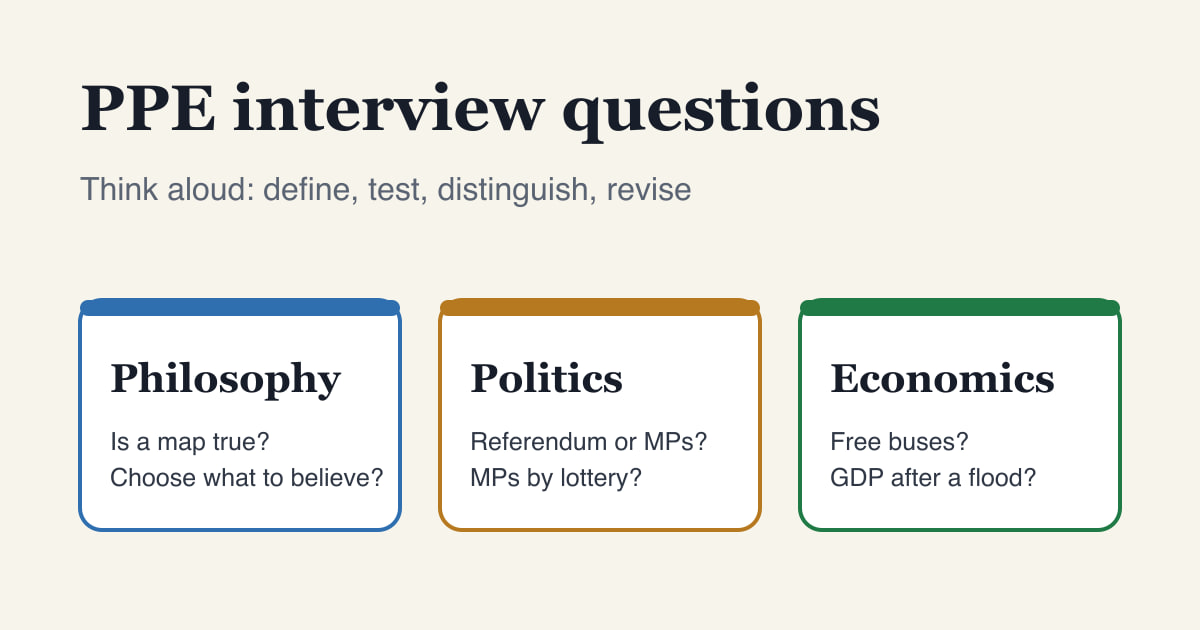
You do not need to have studied philosophy at school, though some introductory reading helps you engage with unfamiliar problems. Philosophy questions test whether you can say precisely what a claim means, test it against cases and change your mind for a good reason. Each line of argument below is one reasonable route, not the answer.
| Question | A model line of argument | A follow-up to practise |
|---|---|---|
| Is it wrong to break a rule if nobody is harmed? (Say, walking across a "keep off the grass" lawn at 3am.) | Separate "this act causes harm" from "the rule is worth having". Rules can be justified by what happens if everyone feels free to make exceptions, so a harmless breach can still be unfair to those who obey. Then test it: does that hold for a pointless rule? | What if nobody will ever know? |
| If everyone in a town thinks a new statue is ugly, is it ugly? | Don't stop at "beauty is subjective". Compare it with "everyone thinks the soup is too salty" (a claim about people's reactions) and "everyone thinks the bridge is safe" (a claim that can be wrong). Ask which one "ugly" is more like, and what would count as getting it wrong. | Could the whole town be mistaken? |
| Should someone who tries to commit a crime and fails be punished as much as someone who succeeds? | Stipulate that both had the same intention and did the same things, and only luck decided the outcome. If blame tracks what you chose, they are equally blameworthy; if it tracks what happened, they differ. Then separate moral blame from legal punishment, and weigh cases that pull each way: dangerous driving is punished even when no one is hurt, yet causing a death is punished more. | So is luck ever relevant to blame? |
| Can you decide to believe something? | Try it: can you believe it is raining, right now, because someone offers you £100? It seems not, which suggests belief responds to evidence, not to will. But you can choose what evidence to look at, so you may control belief indirectly. | Then can you be blamed for a belief? |
| Do you owe more to your own family than to strangers? | Grant the intuition (saving your sister before a stranger seems fine), then ask what explains it: a special relationship, promises implicit in family life, or simply that a world where people look after their own goes better. Test it: does it still hold when the cost to the stranger is huge? | Does the same reasoning justify favouring your own country? |
| Is a map of the London Underground true? | Worked in full below. | Is an economic model with unrealistic assumptions useless? |
Worked question 1 (philosophy): Is a map of the London Underground true?
Thinking aloud, step by step
- Pin down the terms. "One standard starting point is that sentences and beliefs are the things that are true or false. A map is not a sentence, but it does make claims: that this station is on this line, that it comes after that one, that two lines meet here."
- Commit to a first answer. "My first thought is that the Tube map is false, because it is not to scale: lines are straightened, stations are spaced evenly, and distances on it do not match distances on the ground."
- Test it with a case. "But its main job is to show routes and connections. If I use it to get from one station to another, it gets the order of stops and the changes right. If it showed a station on the wrong line, I would say it was wrong, and that feels like a different kind of failure from not being to scale."
- Draw the distinction. "So maybe a map is true or false only in respect of what it claims. The Tube map claims connections and order, and those are accurate; it makes no claim about distance, so leaving distance out is not a falsehood. A map that showed distances, but wrongly, would be false."
- Push the idea further. "This matters beyond maps, but with a twist. Leaving something out is not the same as assuming something false. An economic model that assumes people have full information is not just silent about ignorance; it idealises. So for a model I would ask two questions: are its omissions harmless for the purpose, and do its idealised assumptions distort the answer it gives?"
The line of argument in one breath: truth belongs to the claims a representation makes; a good map leaves things out on purpose, so judge it by whether what it asserts is accurate and whether its omissions mislead for its purpose, and ask separately whether a model's idealised assumptions distort its answers.
A way of thinking to practise, not a script. Tutors follow your answers, so no two conversations go the same way.
Oxford PPE politics interview questions
Politics questions reward the habit of asking how an institution actually works, who it gives power to and what evidence would settle a disagreement. Current affairs help, but only as examples you can reason with: the PPE department recommends a good daily newspaper and news programmes.
| Question | A model line of argument | A follow-up to practise |
|---|---|---|
| Is a referendum more democratic than a vote in Parliament? | Separate two ideas of democracy: every voice counts equally (favours referendums) and decisions are deliberated and accountable (can favour Parliament). Then ask what a referendum does to minorities, to complex trade-offs and to responsibility if things go wrong. | Should a referendum result ever be overturned? |
| Would it be better to choose MPs by lottery from all adults? | Grant the premise and see what follows: random selection, well designed, can make a chamber more like the population and avoids campaigns and party selection, but it raises questions about preparation, safeguards against corruption and how members answer to anyone. Ask whether elections exist to pick the best people or to let people remove them. | Could a lottery work for one chamber and not the other? |
| Should people who pay more tax get more votes? | State the argument at its strongest (those who fund the state have more at stake), then test it: everyone is bound by the laws, not just those who pay for them, and one person, one vote protects people whose interests the rich might ignore. Say what the vote is meant to represent. | Then why are under-18s excluded? |
| Which is freer: a country with a free press but no elections, or one with elections but a state-controlled press? | Elections with a controlled press let voters choose, but with less to choose on; a free press without elections lets people know, but leaves them fewer formal ways to act on what they know; other routes, such as protest, courts or lobbying, may exist depending on the institutions. Ask which freedom tends to protect the other over time, and whether press scrutiny could create public pressure or legal consequences. | Is a free internet a free press? |
| Why might a government keep a policy that is widely judged not to work? | List the candidate explanations (fear of looking weak, a group that benefits and lobbies, the cost of changing course, disagreement about the evidence), then ask what evidence would tell them apart. That last step is what turns opinion into political science. | How would you test your favourite explanation? |
| A poll finds 70% want more money spent on hospitals and 60% oppose higher taxes. Are voters being inconsistent? | Do the arithmetic first: 70% plus 60% is 130%, so at least 30% of people hold both views. They may expect the money to come from cuts elsewhere or borrowing, or may not see the trade-off, and question wording also moves answers. Ask what question would reveal the trade-off people actually accept. | Should a government follow polls at all? |
Notice that the last question is half economics. Questions can cross subjects, and Oxford says PPE tutors look for "evidence of interest in all three subjects". If a politics question has a cost in it, put a rough number on the cost.
FreeTests: Interview warm-up
Oxford PPE interview warm-up: free sample
Answer 4 questions against the clock, like the real exam. You then see the right answer, the reason and your time on each. About 6 minutes · free · no sign-in.
4 questions to answer▶ Start nowThis one is free · no sign-in neededYour result shows how long each question took you.Oxford PPE economics interview questions
Economics questions are where the tier 2 whiteboard is most useful: a quick supply-and-demand sketch or a three-row table helps you and the tutors see the same thing. Oxford recommends Maths because PPE applicants should be comfortable putting ideas in an equation or a diagram, but none of these needs more than arithmetic.
| Question | A model line of argument | A follow-up to practise |
|---|---|---|
| A city makes all its buses free. What happens? | Expect more trips, some from people who used to walk or cycle as well as from drivers; crowding may rise, so service may get worse unless more buses run. Then ask who pays: if the city funds it from taxes, the cost moves from riders to taxpayers. Whether it is worth it depends on how many car trips it actually replaces. | Would cutting fares by half be smarter? |
| Why does a bottle of water cost £1 in a shop and £4 at a festival? Is that unfair? | Possible explanations include limited competition inside the festival, fewer convenient alternatives, buyers who are thirsty now and higher costs on site. "Unfair" needs a definition: unfair to whom, compared with what? Note that capping the price might mean fewer sellers bother. | Should festivals have to provide free water? |
| If every household starts saving more, is the economy better off? | For one household, saving more is often sensible. If everyone does it at once, spending falls, firms sell less and incomes may fall, so total saving may not even rise. Then the counterpoint: savings can fund investment. Which effect dominates depends on things like spare capacity, what interest rates and the central bank do, and demand from abroad. | So should a government ever tell people to spend? |
| An app pays people £5 a week to walk 10,000 steps a day. Will it make people healthier? | The incentive may work on the margin, but think about who signs up: plausibly people who already walk a lot, in which case the app mostly pays for what would have happened anyway. Paying can also crowd out people's own reasons to exercise. Ask how you would test it: randomly assign comparable people to paid and unpaid groups and compare changes in activity and health. | What if the payment stopped after a year? |
| Why would a company give its product away for free? | Look for who is really paying: advertisers buying users' attention, a free version that leads to a paid one, or a network that becomes more valuable as it grows. Then ask what the user gives instead, such as attention or data, and whether that is a price. | Is a free product a bad deal for the user? |
| A town's output rises after a flood, because of rebuilding. Is the town better off? | Worked in full below, with numbers. | Is GDP a good measure of how a country is doing? |
Worked question 2 (economics): A town's output rises after a flood. Is the town better off?
Numbers ours, for the conversation: the town normally produces £400m of goods and services a year. A flood destroys £80m of homes and roads. The following year the town's output is £450m at unchanged prices, and the extra £50m is rebuilding that restores £50m of what was destroyed. Everything else is ignored, to keep the numbers simple.
Thinking aloud, step by step
- Pin down what is measured. "Output here is like GDP: the value of what is produced in a year. That is a flow. The homes and roads are a stock, the town's wealth. The question mixes the two, so I want to keep them apart."
- Commit to a first answer. "On the flow measure the town looks better off: output is up from £400m to £450m, which is 12.5%."
- Test it with the stock. "But the flood destroyed £80m of homes and roads, and the rebuilding so far is £50m. So even after a year the town has £30m less of homes and roads than before the flood (80 minus 50), and people spent a year's extra work just getting part of the way back. On wealth it is clearly worse off."
- Ask where the extra £50m came from. "If the builders would otherwise have been building something new, the town has given that up: the cost is what they would have made instead. If they would otherwise have been out of work, the rebuilding did create jobs that would not have existed. So under these assumptions the town is still worse off, but in a slump the rebuilding costs less than it first looks."
- Revise and generalise. "So my first answer was wrong. Higher measured output does not show the town is better off: on these numbers its homes and roads are still £30m below their value before the flood. GDP counts activity, including activity spent repairing damage, so it can rise when people are worse off."
The line of argument in one breath: separate the flow (output, up 12.5%) from the stock (homes and roads, still £30m down), then ask what the rebuilding resources would otherwise have done; GDP measures activity, not well-being.
A way of thinking to practise, not a script. Tutors follow your answers, so no two conversations go the same way.
When you are given a text, a table or a graph
Oxford's guide says you may be given material in the interview or, normally the day before, as pre-reading, and that you must not research pre-interview material online unless told you may. Whatever the material, these four moves (ours) get you started without a script:
- Say what it claims or shows, in one sentence of your own, before you comment on it. That is the "understanding" area in action.
- Find the weakest link. For a text: which important premise is least well supported? For data: what is being compared with what, and is the comparison fair?
- Offer a second explanation. If a table shows that schools with more homework get better results, ask whether better-resourced schools set more homework. Correlation is where economics and politics questions often turn.
- Say what would change your mind: the extra number, case or comparison you would want. That gives the tutor a clear direction in which to take the discussion.
How to prepare for an Oxford PPE interview in the next four weeks
Oxford's "top tip" is to keep practising explaining what you are thinking "almost as if you are thinking out loud", and it says this need not mean formal mock interviews: chats with teachers, friends or family work. The plan below is our suggestion, fitted to the 2026 PPE timetable.
| When | What to do (our suggestion) |
|---|---|
| Now to mid-November | Re-read your personal statement and think back over your TARA answers (both Oxford's advice). Read a good newspaper daily and pick one story a day to argue both ways aloud for five minutes. |
| Mid-November to early December (invitations) | Check the invitation for your college and times. Test Microsoft Teams and the whiteboard on the device you will use. Read the code of conduct. Do two questions a day, one from a subject you know least. |
| Week of 30 November | Two full practice conversations of about 25 minutes with someone who will push back. Practise sketching a diagram on screen while talking. Overseas candidates: some interviews are this week. |
| 7-9 December | Most first-college interviews are on 7-8 December, some on the morning of 9 December. Do any pre-reading you are sent; have paper, pens and water to hand; ask for a question to be repeated if you need to. |
| 10-16 December | Second-college decisions by 4pm on 10 December; interviews on 11 and 14-16 December. Treat a second college as a fresh start. |
| 12 January 2027 | Decisions via UCAS; colleges follow up later that day. |
Mistakes that make a strong candidate sound weak
- Reciting a prepared answer. The discussion "develops in response to your answers" (Oxford), so a script stops fitting after the first follow-up.
- Refusing the premise. If a tutor says "suppose that's true", argue inside the supposition first; question it afterwards if it matters.
- Going silent. Say what you are weighing, even if it is "I'm stuck between two readings of the question".
- Ending on "it's subjective". Say what the disagreement turns on, then which side you lean to and why.
- Name-dropping. A philosopher's or economist's name adds nothing unless you use the idea correctly. Oxford says being able to talk in depth about one subject resource is more impressive than reeling off a list of books.
- Treating one number as proof. Ask what it is being compared with and what else could explain it.
After the interview, and where TARA fits
Shortlisting for PPE leans heavily on the admissions test, and Oxford suggests reviewing your test answers before the interview. If you are reading this before applying for a future year: under current PPE guidance the admissions test carries high weight at shortlisting, so check the requirements for your application year. Our TARA format guide covers the three modules and our TARA practice tests let you practise them in the real format. For this year's interview, the free warm-up below and the PPE interview pack are the practice.
FreeTests: Interview warm-up
Oxford PPE interview warm-up: free sample
Answer 4 questions against the clock, like the real exam. You then see the right answer, the reason and your time on each. About 6 minutes · free · no sign-in.
4 questions to answer▶ Start nowThis one is free · no sign-in neededYour result shows how long each question took you.Practise 25 more PPE questions before December
Our Oxford Interview Questions: PPE pack is a ten-page PDF: 25 original questions across philosophy, politics and economics (none of them on this page), each worked as thinking aloud with follow-ups to practise; the eight thinking moves and eight traps; a 30-minute mock interview script a parent or friend can run with you; and a self-review checklist for each practice run. Start with the free warm-up above.
See the PPE interview pack. Independent practice, not affiliated with the University of Oxford. Written by us; no Oxford tutor has seen or approved it.
Frequently asked questions
What questions are asked in an Oxford PPE interview?
Short, open problems in philosophy, politics and economics, often starting from a case, a claim, a short text, a graph or a few numbers, after a few simple opening questions such as why you chose the course. Oxford publishes a few sample questions from its tutors, but no list of what will be asked, and every interview develops from your answers.
Are there past Oxford PPE interview questions I can practise?
Oxford publishes sample questions on its own interviews pages. Unofficial collections of "past" questions may contain unverified recollections, so do not assume they are authentic, and candidates now agree under Oxford's code of conduct not to share interview content. Original practice questions, like the ones on this page, train the same thinking.
What is the Oxford PPE interview rate?
Over 2023 to 2025, an average of 38% of PPE applicants were interviewed and 12% were successful, with an average intake of 227. In the PPE department's 2025-26 figures, 681 of 1,885 applicants were shortlisted and 261 were offered places.
When are Oxford PPE interviews in 2026?
Most first-college interviews are on Monday 7 and Tuesday 8 December 2026, with some for overseas candidates in the week of 30 November and some on the morning of 9 December. Second-college decisions come by 4pm on 10 December, and second-college interviews are on 11, 14, 15 and 16 December.
When do Oxford PPE interview invitations come out?
Oxford says invitations usually arrive between the middle of November and early December, by letter or email, and you may only get a week's notice. Interviews cannot be rearranged, although Oxford offers another time if technical issues interrupt an interview.
How many interviews do PPE applicants have?
Oxford says you are quite likely to have more than one interview, possibly at more than one college. The PPE department says applicants normally have at least two interviews at their first college, and most colleges have a minimum of two interviewers per interview.
How are Oxford PPE interviews scored?
The PPE department's 2025-26 information for applicants says colleges give up to three interview scores on a 1 to 100 scale. Above 70 is a strong indicator for admission, and most candidates admitted score above 65.
Do I need to have studied philosophy, politics or economics?
No. Oxford says it is not necessary to have studied any of them. Maths is recommended, because PPE applicants should be comfortable expressing ideas in an equation or a diagram, and most successful applicants study Maths to A-level or equivalent.
What should I read before my PPE interview?
The PPE department suggests introductory books for each subject on its How to Prepare page and says reading a good quality daily newspaper is crucial. Oxford also says talking in depth about one resource is more impressive than reeling off a list of books.
How do I prepare for an Oxford PPE interview?
Practise thinking aloud on questions you have not seen, with someone who will push back. Re-read your personal statement, think back over your TARA answers, test the Teams whiteboard, and read the interview code of conduct. Oxford says practice does not have to mean formal mock interviews: chats with teachers, friends or family count.
Is ProSyllabus connected to the University of Oxford?
No. This is independent practice, not affiliated with the University of Oxford. Our questions are original practice written for this page, not actual Oxford interview content, and we do not know what any college will ask.
More in this series
- Oxford interview questions 2026: what to expect, dates and examples by subject
- Oxford history interview questions and source exercises
- Oxford maths interview questions (with worked approaches)
- Oxford physics interview questions (with worked approaches)
- Oxford chemistry interview questions (with worked approaches)
Sources
- official — University of Oxford: Interviews (guide for applicants), read 8 Nov 2026
- official — University of Oxford: Interview timetables 2026 (Philosophy, Politics and Economics row)
- official — University of Oxford: Interview technology (PPE is a tier 2 subject: video plus a virtual whiteboard)
- official — University of Oxford: Philosophy, Politics and Economics course page (requirements, TARA, interview, admissions statistics 2023-25)
- official — PPE at Oxford (ppe.ox.ac.uk): Admissions Criteria
- official — PPE at Oxford (ppe.ox.ac.uk): Interviews (the four areas interviewers look for)
- official — PPE at Oxford (ppe.ox.ac.uk): How to Prepare (introductory reading, TARA, personal statement)
- official — PPE at Oxford: PPE admissions 2025-26, Information for applicants (preliminary statistics PDF, published February 2026)
- official — University of Oxford: Sample interview questions (the tutors' own examples; not reproduced on this page)
official = a document published by the conducting body. reported = a news or coaching site we could not check against an original. Where sources disagree this page says so rather than picking one.


