

Checked 28 October 2026. Pattern, fee, attempts, languages and exam-day rules are from IIBF Rules & Syllabus 2024 and the IIBF DRA page; IIBF may change them and notifies changes on iibf.org.in. The exam dates are those IIBF had published for October to December 2026. RBI rules are as in the Directions named at the foot of the page.
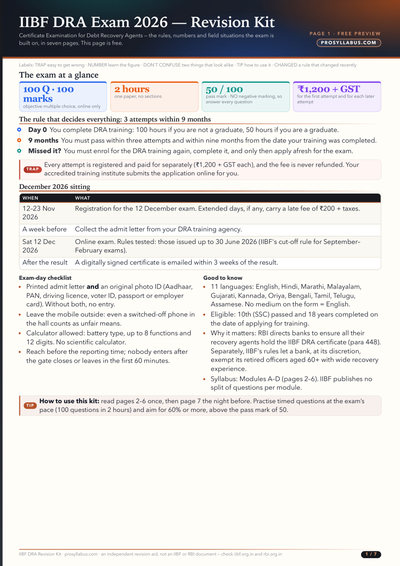
The short answer: the IIBF DRA exam is one online paper of 100 multiple-choice questions for 100 marks in two hours, with no negative marking. You pass with 50. You get three attempts within nine months of finishing your DRA training; if you do not pass within them, you must complete the training again. Each attempt costs ₹1,200 plus GST as applicable (IIBF’s DRA page; the 2024 rules say “Plus Convenience charges and Taxes as applicable”), and your training agency registers you. The next scheduled exam is Saturday 14 November 2026, but its registration closed on 26 October. The next exam with registration still to open is Saturday 12 December 2026, registration 12 to 23 November 2026.
This guide sets out who needs the certificate, who can sit the exam, the pattern and fee, the attempt rule, the dates, the exam-day rules, the four syllabus modules, and which RBI rules fall inside the cut-off for the December 2026 exam.
ProSyllabus is an independent study site. It is not connected with the Indian Institute of Banking & Finance (IIBF), the Reserve Bank of India or any bank, and nothing here is an IIBF document. The rules on this page come from the official documents listed at the foot of the page, with the paragraph or section number where one applies; general banking principles and our own practical advice are not RBI rules.
IIBF Rules & Syllabus 2024; IIBF DRA page, read 28 October 2026.
- 20 questions in 24 minutes: the real exam's pace
- Shorter than the real 100-question paper
- No negative marking, pass mark 50%
- Your score on each syllabus module and your time per question
- Every answer explained, with the RBI rule or Act named where one applies
- A free 5-question sample, no sign-in
Who must pass the DRA exam
The rule comes from the Reserve Bank of India. Para 448 of RBI’s Commercial Banks Responsible Business Conduct Directions, 2025 says a bank shall ensure that all its recovery agents have completed the certificate course for Debt Recovery Agents instituted by IIBF. The service providers a bank engages must also employ only people who have undergone the training and obtained the IIBF certificate. Other institutes and banks’ own training colleges may give the training through a tie-up with IIBF, but every agent has to pass the examination conducted by IIBF (a bank may exempt some retired bank officers: see the exemption below).
IIBF’s Rules & Syllabus 2024 describe the same history: RBI asked the Indian Banks’ Association to design the course with IIBF, and asked banks and NBFCs to ensure that their recovery agents undergo the training and obtain the IIBF certificate. For NBFCs, RBI has now written this into its NBFC Directions as well. The Third Amendment Directions, 2026 (in force from 1 January 2027) add para 100I: an NBFC must ensure its recovery agency engages only agents holding the IIBF certificate, and agents already engaged without it must obtain it within one year of that date.
IIBF’s rules say the exam is for anyone engaged directly or indirectly, for pay or commission, in recovering bank debts or enforcing securities: debt recovery agents, recovery tele-callers, direct selling agents and direct marketing agents, by whatever name they are called. It is also open to anyone who wants a career as a recovery agent for a bank. Checking an agent’s background (due diligence) stays the job of the bank or institution that employs the agent.
Who can sit the exam (IIBF eligibility)
- Education: SSC (10th) passed or above.
- Age: 18 years completed on the date you apply for the training.
- Training: 100 hours if you passed 10th and are not yet a graduate; 50 hours if you are a graduate or above. Graduate employees of BPOs and call centres also need only 50 hours.
- Documents at registration: proof of education and proof of age. Non-members must also attach a copy of one identity document that shows their name, photo and signature: an employer photo ID card, PAN card, driving licence, voter ID card, passport or Aadhaar card. An application without it can be rejected.
- Exemption: a bank may, at its discretion, exempt retired bank officers aged 60 or more with wide recovery experience from the training and certification, for appointment by that bank. This is not a general exemption.
IIBF Rules & Syllabus 2024, "Eligibility", "Exemption" and "Proof of identity".
IIBF Rules & Syllabus 2024, "Training for DRA". For the 50-hour course the rules give 15/20 hours functional and 18-20 hours soft skills. The rules do not assign the remaining hours. Bars drawn at the top of each range.
Exam pattern: what IIBF’s rules say
| Item | IIBF rule |
|---|---|
| Questions | 100 objective multiple-choice questions |
| Marks | 100 marks in all |
| Duration | Two hours |
| Mode | Online only, at IIBF exam centres |
| Negative marking | None for wrong answers |
| Pass mark | 50 out of 100 |
| Sections | One paper; IIBF publishes no per-module split of the 100 questions |
| Languages | English, Hindi, Marathi, Malayalam, Gujarati, Kannada, Oriya, Bengali, Tamil, Telugu, Assamese (11) |
| Centres | Listed on the IIBF website; IIBF holds the exam where there are 20 or more candidates |
IIBF’s rules say it in these words: "Question Paper will contain 100 objective type multiple choice questions for 100 marks" (Rules & Syllabus 2024, "Pattern of examination"). Prepare for 100 questions.
Two hours for 100 questions gives you 72 seconds a question. Because there is no negative marking, a wrong answer and a blank answer both score zero, so a guess can only gain marks: answer every question, and mark the hard ones to come back to if the screen allows it.
Language: the training agency writes your exam medium on the application form. IIBF’s DRA page says that if the medium is not mentioned, it is treated as English. If you want to write in Hindi or another language, check the form before your agency submits it. IIBF’s courseware, the "Hand Book on Debt Recovery" (2024 edition, published by Taxmann), is listed in all 11 languages on the DRA page.
- Hindi and English editions, one purchase
- Calling hours, the never-do list, borrower rights
- SARFAESI, DRT, Lok Adalat and IBC in one table
- 10 field situations with the best response
- Key-numbers sheet and 60 last-day one-liners
Fee and registration
The fee is ₹1,200 for the first attempt and ₹1,200 for each later attempt. The DRA page says "Plus GST as applicable"; the 2024 rules say "Plus Convenience charges and Taxes as applicable". You register separately for every attempt. If IIBF opens extended days of registration after the regular window, a late fee of ₹200 plus taxes is charged on top of the regular fee. The fee is not refunded or adjusted on any account.
You do not apply yourself. IIBF’s rules say the application is made online by the accredited agency that trained you, after you complete the training, during the registration period. The DRA page tells training institutes to verify your certificates, certify your qualification and date of birth on the Training Completion Certificate form, and submit on time: forms received after the last date are rejected and considered for the next exam only.
Three attempts within nine months
This rule decides when a candidate who has not passed must do the training again. In IIBF’s words, candidates must pass "in THREE ATTEMPTS within a period of NINE MONTHS from the date of completion of Training". A candidate who cannot pass within that limit must re-enrol for the DRA training and, after completing it, enrol afresh for the exam.
From the IIBF Rules & Syllabus 2024, "Time limit for passing the examination". The rule counts from the date training is completed, not from the date of the first exam.
Read the rule as two limits that both apply. Three failed attempts end the window even if months are left. Nine months ending also ends it, even if you have used only one or two attempts. IIBF holds DRA exams on pre-announced dates; its April to December 2026 schedule lists one date a month, with two in September. If IIBF keeps a similar pace, nine months holds several dates, so plan your three attempts across them rather than sitting the first date unprepared.
Exam dates, October to December 2026
| Exam date | Registration (by your training agency) | Status on 28 October 2026 |
|---|---|---|
| 10 October 2026 (Saturday) | 15 to 25 September 2026 | Date passed |
| 14 November 2026 (Saturday) | 12 to 26 October 2026 | Registration closed on 26 October; exam still to come |
| 12 December 2026 (Saturday) | 12 to 23 November 2026 | Registration not yet open |
These are the dates on IIBF’s DRA page. The same page lists earlier 2026 dates of 4 April, 2 May, 6 June, 4 July, 8 August, 12 September and 26 September. When we checked, the page listed no dates after 12 December 2026. If you finished training in October 2026, your nine months run to about July 2027, so most of your window falls in dates still to be announced.
Admit letter and result
Your admit letter comes from your DRA training agency, one week before the exam date. At the centre you must show a printed copy of the admit letter and an original photo ID (Aadhaar or e-Aadhaar, employer’s card, PAN card, driving licence, voter card, passport and so on). Without both, you are not allowed to write the exam. The admit letter also carries the password you log in with: keep it to yourself.
After the exam, IIBF hosts your result advice on its website. Candidates who pass receive a digitally signed certificate at the email address registered with IIBF, within three weeks of the result.
Exam-day rules that can cost you the exam
From IIBF’s "Important rules / information for candidates"
- Mobile phone: not allowed in the hall. Merely having a phone or any other electronic or smart gadget with you (except a calculator of the permitted type), even switched off or on silent, is treated as using unfair means. Leave it outside.
- Calculator: a battery-operated calculator of up to 8 functions (addition, subtraction, multiplication, division, percentage, square root, tax plus, tax minus) and 12 digits is allowed. A scientific calculator, or one with more features, counts as unfair means.
- Timing: IIBF advises arriving before the reporting time on your admit letter; no one enters after the gate closing time. No one may leave the venue in the first 60 minutes from the scheduled start.
- Conduct: sign the attendance sheet; sit in the seat shown on the admit letter; complete silence; return any rough-work paper; no books or notes; do not argue with the exam staff.
- Technical delay: if power or a technical problem delays the start, wait for it to be resolved and, if instructed, take the exam at another venue the authority arranges; follow its instructions.
Breaking these rules can attract punishment under IIBF’s rules, and serious misconduct is reported to the candidate’s employer. IIBF publishes its debarment periods for unfair practices on its website.
- Hindi and English editions, one purchase
- Calling hours, the never-do list, borrower rights
- SARFAESI, DRT, Lok Adalat and IBC in one table
- 10 field situations with the best response
- Key-numbers sheet and 60 last-day one-liners
The four syllabus modules
IIBF calls its syllabus indicative and says questions can be asked on anything within the subject, including current developments. The four modules, as listed in the Rules & Syllabus 2024:
| Module | What the IIBF syllabus lists |
|---|---|
| A. Basics of Banking | Features of banking, Indian financial system, structure of Indian banking, functions of banks, recent trends, customer types, banker-customer relationship, duties and rights of bankers, deposit schemes and services, account opening and KYC, prevention of money laundering, Negotiable Instruments Act and payment and collection of cheques |
| B. Brief Outline of Various Products and Legal Aspects of Recovery | Debit and credit cards, principles of lending, credit score, types of loans, priority sector, MUDRA, CGTMSE, securities and creation of charge, loan documents, NPA and asset classification, legal aspects of recovery, SARFAESI Act, Lok Adalat, filing of suits, DRT, Insolvency and Bankruptcy Code, 2016 |
| C. Role in Loan Recovery and Soft Skills | Collection operations, meeting etiquette, anger management, the legal and regulatory framework for DRAs, roles and responsibilities, rights and duties of recovery agents, rights of the defaulter, Integrated Banking Ombudsman Scheme (the 2024 syllabus wording; the scheme now in force is the Reserve Bank – Integrated Ombudsman Scheme, 2026), recovery policy and procedure, code of conduct, soft skills, emotional intelligence, recovery strategy, credit counselling, Fair Practices Code for lenders |
| D. Additional Reading on NBFCs | Types of NBFCs and their framework, loans offered by NBFCs, Fair Practices Code for NBFCs |
IIBF does not publish how many of the 100 questions come from each module, so treat any split you see elsewhere as a guess. Module C covers the agent’s daily work: recovery rules, the agent’s role and responsibilities, and soft skills. A few of RBI’s rules for recovery agents engaged by banks (paras 442-454, and 408-416 for microfinance loans) are worth knowing by heart. Where the current NBFC Directions have the same rule, its paragraph is given too:
RBI recovery-agent rules in force on 30 June 2026
- For overdue loans other than microfinance loans: no calling the borrower before 8:00 a.m. or after 7:00 p.m. (banks para 445, NBFCs para 100; both say they do not apply to microfinance loans). For microfinance loans, persistently calling the borrower or calling before 9:00 a.m. or after 6:00 p.m. is listed as a harsh method (banks para 410, NBFCs para 91).
- For loans other than microfinance loans: no intimidation or harassment of any kind, verbal or physical, against any person: no acts to humiliate publicly, no intrusion into the privacy of the debtor’s family, referees and friends, no inappropriate messages on mobile or social media, no threatening or anonymous calls, no persistent calling, no false and misleading representations (banks para 445, NBFCs para 100). Microfinance loans have their own list of harsh practices (banks para 410, NBFCs para 91).
- When it forwards a case, the bank informs the borrower of the recovery agency’s details. RBI says "it would be appropriate" for the agent also to carry a copy of the bank’s notice, the bank’s authorisation letter and the identity card issued by the bank or agency. If the bank changes the agency, it notifies the borrower, and the new agent "shall carry" the notice, the authorisation letter and an identity card (para 442(3)). In practice, carry all three every time.
- The bank ensures that calls made by recovery agents to customers, and by customers to them, are tape-recorded, and takes reasonable precautions "such as intimating the customer that the conversation is being recorded" (para 442(4)).
- Where the borrower has lodged a grievance or complaint, the bank does not forward the case to a recovery agency until it has finally disposed of it. The exception: the bank is convinced, with appropriate proof, that the borrower is continuously making frivolous or vexatious complaints (para 442(6)).
- The bank, as principal, is responsible for its agents’ actions, and RBI may bar a bank from using recovery agents in an area for a period (paras 452-453).
RBI Commercial Banks Responsible Business Conduct Directions, 2025 (bank paragraphs) and NBFC Responsible Business Conduct Directions, 2025 (NBFC paragraphs 91 and 100).
Which rules can come in the December 2026 exam: the cut-off
IIBF has a fixed cut-off for new regulations. For exams held from September to February, it considers instructions and guidelines issued by regulators up to 30 June of that year. For exams held from March to August, it considers those issued up to 31 December of the previous year.
| Exam held in | Regulator guidelines considered up to |
|---|---|
| September 2026 to February 2027 (includes 12 December 2026) | 30 June 2026 |
| March 2027 to August 2027 | 31 December 2026 |
So for the December 2026 exam, rules issued up to 30 June 2026 can be considered; that does not mean every such rule will be asked. The cut-off counts the date a rule was issued, not the date it came into force. Two recent changes, one on each side of that line:
Two recent changes and the 30 June 2026 cut-off
- Reserve Bank – Integrated Ombudsman Scheme, 2026: issued on 16 January 2026, so inside the cut-off, and in force from 1 July 2026; it repeals the 2021 scheme from that date (clause 20). It covers the banks and NBFCs listed in its clause 1(3), not every entity. The customer first complains to the bank or NBFC, in writing or through any other mode, and keeps proof (clause 10(1)(e)). If there is no reply within 30 days (or a longer period RBI, NPCI or card-network rules allow), or the reply does not satisfy the customer, the complaint can go to the RBI Ombudsman within 90 days from the end of that period or from the entity’s last communication, whichever is later (clause 10(1)(f)-(g)). It can be filed online at cms.rbi.org.in, or by e-mail or on paper (clause 11). For consequential loss the Ombudsman can award up to ₹30 lakh, plus up to ₹3 lakh for the complainant’s time, expenses and harassment (clause 8(3)).
- NBFC recovery rules from 1 January 2027 (Third Amendment Directions, 2026, issued on 6 August 2026, so after the cut-off; they apply to all NBFCs except a few types the circular excludes, such as Mortgage Guarantee Companies, Core Investment Companies and NBFCs with no customer interface): a policy on collection and recovery of loan dues (para 100D); an up-to-date list of recovery agencies on the NBFC’s website, updated within 7 calendar days of a change, and promptly when an agency’s agreement ends (para 100K); where a case goes to an agency for recovery through an in-person visit, the agency’s details to the borrower or guarantor at least one day before the first visit (para 100L); contact and visits to the borrower or guarantor only between 8:00 a.m. and 7:00 p.m., unless that person has expressly requested or authorised another time (para 100Y(4)); a proper acknowledgement or receipt promptly on collection or recovery (para 100Y(9)); call records kept for six months, or until disposal where the case is sub judice (para 100P); and agents already engaged by recovery agencies without the IIBF certificate to obtain it within one year from 1 January 2027, while agencies otherwise engage only certified agents (para 100I).
For exams held from March to August 2027, the cut-off is 31 December 2026, so the August 2026 NBFC amendment becomes eligible for inclusion; IIBF does not say which rules will be asked.
How to prepare in the time you have
Our suggestions, not IIBF’s. Start with Module C, because it is your daily work and the RBI paragraphs above are short. Then learn the numbers in Modules A and B: when a term loan becomes an NPA (interest or instalment overdue for more than 90 days; overdraft and cash credit accounts and farm loans have their own tests), the 60 days of a SARFAESI section 13(2) notice, the cheque bounce time limits in section 138 of the Negotiable Instruments Act, and the ₹20 lakh minimum debt for a bank’s recovery application to a Debts Recovery Tribunal under the RDB Act. Read Module D last; its syllabus list is the shortest. Practise in the same language you will write the exam in, and practise against the clock at the exam’s own pace (two hours for 100 questions is 1.2 minutes a question), so your first IIBF attempt is not your first timed sitting.
For practice in Hindi, see our 30 solved DRA questions in Hindi, grouped by module (written by ProSyllabus for that page; not IIBF questions). For the last week, the DRA revision kit puts the rules and numbers on 7 pages, in Hindi and English editions; page 1 (the exam at a glance, the three-attempt rule and an exam-day checklist) is free to read. We wrote it from the IIBF syllabus and the RBI texts named on this page; it is not IIBF’s book, and no revision can promise a pass.
Frequently asked questions
How many questions are in the IIBF DRA exam?
100 objective multiple-choice questions for 100 marks, in two hours, online, as IIBF’s Rules & Syllabus 2024 say.
What are the passing marks for the DRA exam?
50 out of 100. There is no negative marking for wrong answers.
How many attempts are allowed in the DRA exam?
Three attempts within nine months from the date you completed the DRA training. If you do not pass within that limit, you must re-enrol for the training and then enrol afresh for the exam.
What is the DRA exam fee?
₹1,200 for the first attempt and ₹1,200 for each later attempt, plus GST as applicable (IIBF’s DRA page); the 2024 rules say “Plus Convenience charges and Taxes as applicable”. A late fee of ₹200 plus taxes applies in extended registration days. The fee is not refunded.
Can I register for the DRA exam myself?
No. IIBF’s rules say the accredited agency that trained you applies online for you during the registration period. The admit letter also comes from the agency, one week before the exam.
When is the next DRA exam?
The next scheduled exam is Saturday 14 November 2026, but its registration closed on 26 October. The next exam with registration still to open is Saturday 12 December 2026, registration 12 to 23 November 2026, according to IIBF’s DRA page on 28 October 2026.
Can I write the DRA exam in Hindi?
Yes. The exam is held in English, Hindi, Marathi, Malayalam, Gujarati, Kannada, Oriya, Bengali, Tamil, Telugu and Assamese. Make sure your training agency writes Hindi as the medium on the form; if no medium is written, IIBF treats it as English.
What is the minimum qualification for the DRA certificate?
10th (SSC) pass and 18 years of age on the date you apply for training. The training is 100 hours if you are not a graduate and 50 hours if you are.
Can I keep my phone switched off in the exam hall?
No. IIBF’s rules treat merely having a mobile phone or other electronic or smart gadget in the hall (other than a permitted calculator), even switched off or on silent, as using unfair means.
Which RBI rules can come in the December 2026 DRA exam?
Rules issued up to 30 June 2026 can be considered, under IIBF’s cut-off for exams held from September to February; IIBF does not say which ones will be asked. The Integrated Ombudsman Scheme, 2026 was issued in January 2026, so it falls inside that cut-off even though it started on 1 July 2026; the NBFC recovery amendment was issued in August 2026, after it.
More in this series
Sources
- official — IIBF: Certificate Examination for Debt Recovery Agents (exam schedule, fee, medium, study material)
- official — IIBF: Certificate Examination for Debt Recovery Agents, Rules & Syllabus 2024 (PDF)
- official — RBI: Reserve Bank of India (Commercial Banks – Responsible Business Conduct) Directions, 2025 (28.11.2025, updated 01.10.2026): paras 326-347 Fair Practices Code, 408-416 microfinance, 442-454 recovery agents
- official — RBI: Reserve Bank of India (Non-Banking Financial Companies – Responsible Business Conduct) Directions, 2025 (PDF)
- official — RBI/2026-27/230 of 06.08.2026: NBFC Responsible Business Conduct (Third Amendment) Directions, 2026, in force 01.01.2027 (PDF)
- official — RBI: Reserve Bank – Integrated Ombudsman Scheme, 2026, in force 01.07.2026 (PDF)
- official — RBI: Reserve Bank of India (Commercial Banks – Income Recognition, Asset Classification and Provisioning) Directions, 2025
- official — India Code (Ministry of Law and Justice): Negotiable Instruments Act, 1881; SARFAESI Act, 2002; Recovery of Debts and Bankruptcy Act, 1993; Legal Services Authorities Act, 1987
official = a document published by the conducting body. reported = a news or coaching site we could not check against an original. Where sources disagree this page says so rather than picking one.


