
Checked 11 November 2026. In-basket tests vary by employer and assessment: the length, the number of items and the format can all differ, so read your own exam announcement or preparation guide first. Official facts here come from OPM, the New York State Department of Civil Service, the Canada Revenue Agency and the San Francisco Department of Human Resources, all read 11 November 2026. The plan, the matrix and the delegation rules are ours.
An in-basket test (also called an in-basket assessment, or an in-tray exercise in the UK) is a job simulation: you play someone new in a supervisor's job and work through their inbox of emails, memos, reports and calendar entries against the clock. The US Office of Personnel Management describes the in-basket test as a frequently used assessment center exercise: applicants "play the role of a person new to the job" and "read and react to a pile of memos, messages, reports, and articles" (OPM, Assessment Centers).
Our approach, in one line: follow the test's instructions, find the urgent and risky items before you act, and give every item a clear decision: what happens, who does it, how they are told and by when (in a multiple-choice test, that thinking guides which choices you mark). Learn any rules or references your own preparation guide names, too. This guide gives you a minute-by-minute plan for a 45-minute inbox, the sorting matrix we use, seven delegation rules, what government employers say assessors look for, and common mistakes to check for.
If you want to see a whole inbox answered and scored first, our in-basket exercise examples guide does that. This page is about method. Independent practice. Not affiliated with any government employer, civil service commission or testing agency.
New York State Department of Civil Service sample test material; Canada Revenue Agency assessment page; San Francisco Department of Human Resources preparation manuals; all read 11 November 2026.
FreeTests: Prioritization
The back stairwell exit: free sample
Read the situation, then rate each of its 5 actions, as an in-basket asks. The first 3 of 13 items are free.
3 items free▶ Start nowThis one is free · no sign-in neededUntimed, like the real testWhat an in-basket test is, in its three formats
In-basket tests vary by employer and assessment, so check which one you face in your exam announcement or preparation guide. The official materials we read describe multiple-choice and written in-baskets; we add a third, the rate-the-actions format our simulator uses.
| Format | What you do | Official example | How it is scored (as published) |
|---|---|---|---|
| Pick the best actions (multiple choice) | NY State: read the background and memos, then follow each section's selection instruction (choose only one, or up to two). CRA: for each of 13 situations, answer multiple-choice questions by selecting the most appropriate statement. | New York State Department of Civil Service, "Administrative management of work and resources"; Canada Revenue Agency supervisory in-basket (13 situations, 70 questions, 90 minutes). | NY State: each choice is worth +1 or 0, and if you pick more than allowed, the 0s count first. CRA: a score out of 5 for each competency. |
| Write your response | Sheriff's Captain: for each of seven scenarios, write what you would do, who you would tell, how, and what you would say. EMS Captain: use documents and recorded interviews to complete an investigation and incident documentation, and review completed patient care reports. Follow each item's instructions. | San Francisco Department of Human Resources in-basket exercises (Sheriff's Captain, Fire EMS Captain). | Senior officers build a scoring key; two trained raters score you independently, then confer on a final rating (both manuals). The Sheriff's Captain manual adds that notepaper is not read. |
| Rate the actions | For each item, rate four or five possible actions (handle it now, hand it to someone, schedule it, escalate it, leave it) from Strong to Harmful. | Not in the official materials we read; we include it because our simulator uses it. | Ours: against our model rating, full mark for a match and half a mark one step away, with a reason for every action. Our scoring, not an employer's. |
Our simulator mixes items that matter now, items that can wait, work to hand on or redirect, and items linked to each other; official exercises may instead use independent scenarios or different tasks. The plan below is our method for a written inbox where you choose your own order; adapt it to your assessment's instructions. Some formats prescribe their own order: San Francisco's EMS Captain exercise, for example, sets review periods and recorded interviews, and advises working on each independent item separately. The format notes further down say what changes.
What assessors score: what government employers publish
The four official sources we read give different kinds of evidence: OPM lists what assessment center exercises can measure, New York State publishes a sample key, the CRA names the competencies it scores, and two 2010 San Francisco manuals describe specific public-safety exams (useful on method, not a rule for a general office supervisor exam). The OPM page lists what assessment center exercises can measure: interpersonal skills, oral and written communication, planning and evaluating, and reasoning and problem solving. The Canada Revenue Agency names the competencies its supervisory in-basket scores: Create vision and strategy, Mobilize people, Achieve results and Client-oriented, each out of 5. San Francisco's Sheriff's Captain manual lists abilities that include knowing "when to take action and what type of action is appropriate", setting "an appropriate and efficient course of action for self and/or others", and anticipating problems "to be proactive rather than reactive".
The clearest look inside a key is the New York State sample. Its first question asks which of three memos you would deal with first. The keyed answer is a staff member's complaint about a colleague, with a transfer request threatened, not the colleague's own memos about workload and a training idea: those "will require attention, but are not as critical". In the next section, the keyed first steps are to review the colleague's work records and the unit's workload, before you talk to him; asking around the office scores nothing. In other words, the key rewards spotting the real problem, and checking facts from records before you act.
| OPM | NY State | CRA | San Francisco | |
|---|---|---|---|---|
| Setting priorities and urgency | – | Named | – | Named |
| Getting facts before acting | – | Named | – | Named |
| Delegating and assigning work | – | – | – | Named |
| Written communication | Named | – | – | Named |
| Problem analysis and judgement | Named | Named | – | Named |
| Client orientation | – | – | Named | – |
| Planning ahead | Named | – | – | Named |
"Named" = in our reading, the document states the skill or a clear equivalent. NY State marks come from its sample questions and key; CRA from its named competencies; San Francisco marks may come from either manual (assigning duties and departmental planning appear in the Sheriff's Captain manual); OPM's list is about assessment center exercises in general. A dash means we did not find a clear equivalent in that document, not that the skill is unassessed.
OPM, NY State Department of Civil Service, Canada Revenue Agency and San Francisco Department of Human Resources documents listed under Sources, read 11 November 2026.
Two things stand out. Problem analysis and judgement appears in three of the four documents (the CRA page names leadership competencies instead), so an answer that misses the real issue is unlikely to do well. And priorities and planning recur: OPM names planning, the NY State sample asks which memo is most urgent, and the Sheriff's Captain manual lists planning and knowing when to act. Our practical advice: identify the urgent issues before you choose actions, while following any sequence your assessment sets.
FreeTests: Prioritization
The back stairwell exit: free sample
Read the situation, then rate each of its 5 actions, as an in-basket asks. The first 3 of 13 items are free.
3 items free▶ Start nowThis one is free · no sign-in neededUntimed, like the real testThe 45-minute plan, minute by minute
This is our suggested plan for a 45-minute written inbox of 12 to 15 items. Our simulator uses the same time and item count, but asks you to rate actions rather than write them: use the answering blocks for the ratings and the last minutes to review. Official in-baskets vary (the CRA's runs 90 minutes), so the tool after the table scales the 45-minute time shares to the length you enter and uses your item count to work out per-item pacing. The shape matters more than the exact minutes: about a third of the time reading and sorting, about half answering, and the rest checking.
| Minutes | Step | What you do | You should have |
|---|---|---|---|
| 0–4 | Read the setup | Your role, today's date and time, who you report to, who reports to you, who is away, and the calendar. Write the date at the top of your notes. | A one-line org chart and the hard times of the day |
| 4–12 | Skim every item once | Read all the items before acting on any. Tag each one with its matrix box (below), its deadline and the name of whoever should act. About 30 to 40 seconds an item. | Every item tagged; nothing answered yet |
| 12–15 | Find the links and set the order | Look for items about the same person, the same date or the same problem: a meeting that clashes with a deadline, a complaint that explains a late report. Number the items in the order you will handle them. | A numbered order with linked items grouped |
| 15–33 | Handle the top of the list | Safety, legal deadlines, a boss's request with a time on it, a member of the public waiting. For each: the action, who does it, how you tell them, and by when. | Full answers for the urgent items |
| 33–40 | Delegate and schedule the rest | Short notes to the right staff member with what done looks like, the deadline and when you will check. Put every "later" item on the calendar with a date. | No item left without an owner and a date |
| 40–43 | Fix the calendar | Resolve the clash you found at minute 12: move, send a deputy, or tell the organiser. Add the follow-ups you promised. | A calendar with no double booking |
| 43–45 | Final sweep | Check that every item has a decision, even "no action: file it". Write one line on anything you ran out of time for: what you would do and when. | Nothing blank |
Two habits make the plan work in our simulator, and in any written inbox where you may choose your order. First, finish the skim before answering, even an easy item: the item that changes everything is often near the bottom (a cancelled meeting, a complaint that explains another memo). Second, check the clock at minute 33 (or its scaled time): if you are still on the urgent items, keep some time for clear, short actions on the rest rather than leaving them untouched. In a multiple-choice test, use the required answer format; wherever an order or timing is prescribed, follow it.
The sorting matrix: how urgent, how important, and who acts
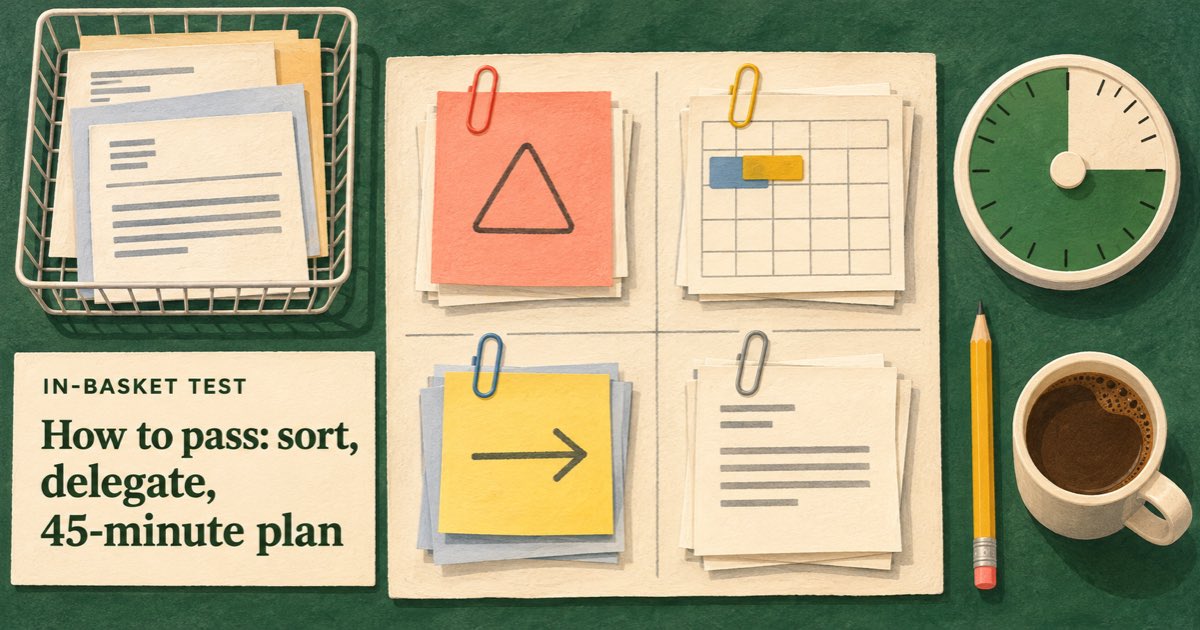
During the skim, put every item in one box. The matrix is ours: it is the common urgent-and-important grid with one extra row, because in an in-basket the question is not only when to act but who should. The verbs in the last column are the five decisions you will write.
The in-basket sorting matrix (our method)
You act now, or a named person acts now and you confirm.
You stay accountable. Delegate tasks within others' authority, keep your own decisions, put a date on it.
Delegate to the person whose job it is, with a deadline.
Redirect to the right department or file it, in one line.
Escalate to your manager or the named office (HR, legal, communications) with the facts, and say what you have done meanwhile.
Original ProSyllabus method: a sorting aid, not an official scoring key.
| Box | Typical items | Who acts | Decision |
|---|---|---|---|
| A. Urgent and important | A safety hazard, a legal or statutory deadline today, your director asking for figures by noon, a resident at the counter with a real problem | You act now, or you hand it to a named person now and confirm it is done | Act |
| B. Important, not urgent | A routine performance follow-up, a budget review due Thursday, a policy change to roll out: anything whose facts and deadline leave time to plan. Judge complaints one by one; some need action now | You stay accountable: delegate tasks within others' authority, keep the decisions reserved to your role | Plan |
| C. Urgent, not important to you | A routine records request, a supply order, a room booking, a reminder that a form is due | The staff member whose job it is, with a deadline | Delegate |
| D. Neither | A sales email, an old newsletter, a request meant for another department, a duplicate of another item | Nobody, or the right department; say so in one line | Redirect or file |
| Above you | Anything outside your authority: a decision about someone you do not supervise, a media enquiry, spending over your limit, a possible legal claim | Your manager or the named office (HR, legal, communications), with the facts | Escalate |
Three checks catch most sorting errors. Risk, not rank: judge priority by risk, urgency and consequences, not by who sent the item; an immediate safety hazard reported by a clerk can come before a routine request from the director. Judge people problems on their facts: in the NY State sample, the keyed first memo was a staff complaint with a transfer threatened, ahead of a colleague's workload memo and training idea. Look for links: if two items mention the same person, date or problem, check whether they affect each other, but keep their priorities and actions separate where they differ, and follow any instruction that items are independent.
Seven delegation rules
Delegation runs through almost every supervisor in-basket. San Francisco's Sheriff's Captain manual asks, for every scenario, what you would do and to whom you would communicate, and lists "reviews, schedules and assigns duties" among the tasks (Sheriff's Captain manual). The rules below are ours, written for a general office supervisor.
- Delegate to a named person, never to "staff". Use the org chart: the person whose job it is, who is in the office today.
- Check they can take it. Before you hand something over, check the calendar and the other items: is that person on leave, overloaded, or the subject of a complaint in the same inbox?
- Say what done looks like and by when. "Draft a reply to the resident for my review by 3 pm Wednesday" makes the task, the review point and the deadline clear; "please handle" leaves all three open.
- Set a check-back. Put a follow-up on your calendar. Delegating the work does not delegate your responsibility for it.
- Check who has authority. Keep the decisions reserved to your role, assign other work only to staff allowed to do it, protect confidential matters, and involve HR, legal, finance or another named office when the item or policy requires it.
- Protect people from a safety risk first. Close the area or stop the work if you can do so safely, or direct the right person to act at once; then arrange a qualified check and repair, and confirm it is safe before reopening.
- Tell the people who need to know. If you move work, tell the person it came from and, where it matters, your manager. A good decision nobody hears about can still go wrong.
Two worked items: sorting and delegating
Two short items of our own, one on sorting and one on delegating. They are illustrations, not items from any employer's exam. For a full inbox answered and scored, see the in-basket exercise examples guide.
Worked item 1: sort three items (our illustration)
You are the new supervisor of a county permits office. It is Monday, 8:05 am. Three of your items:
- (a) Your director: "I need last month's permit fee figures against budget for Thursday's meeting."
- (b) A counter clerk, sent Friday at 4:50 pm: "Water is dripping from the ceiling tile onto the power strip behind counter 2."
- (c) Two counter clerks have each asked for this Friday off. Policy allows only one counter clerk on leave at a time, and the item gives no rule for choosing between competing requests.
Sort: (b) is A, urgent and important: a possible electrical hazard reported on Friday, with nothing to say it has been made safe. (a) is B: important, due Thursday, yours to own. (c) is B on the facts given: a staffing decision to settle before Friday, after you check coverage and your approval authority.
Decisions: (b) close counter 2 and keep people away from the power strip now, call facilities, tell the clerk and your director in two lines. (a) ask your senior clerk to pull the fee report by Tuesday noon; you write the comparison and send it Wednesday. (c) check coverage and any rule for competing requests today, then decide within your authority and explain the outcome to both clerks. Do not invent a first-come rule the item does not give.
Original ProSyllabus example. The trap is (a): the director is the most senior sender, so it feels first. In our illustration, the possible electrical hazard comes before the routine report.
Worked item 2: one item, two delegation notes (our illustration)
It is Monday at 9 am. A resident has asked for copies of the inspection records for their street, and the item gives Friday at 5 pm as the response deadline. Your office assistant, Dana, normally handles records requests and is in the office all week.
Weak note
"Dana, can you deal with this?"
Strong note
"Dana, please handle this records request (attached). The response deadline in the item is Friday at 5 pm, so please have the proposed response and copies ready for my review by Wednesday at noon. Flag any access or redaction questions to me and the designated records officer; nothing goes out before the required review. Please acknowledge to the resident today that we have the request. I have put a check-in for Wednesday at 11."
The strong note names the person, the deadline and the reason for it, what done looks like, a route for access and redaction questions to the people authorised to decide them, a quick reply to the resident, and a check-back. These are the features we look for in this practice example; an employer's criteria may differ.
Original ProSyllabus example. The Friday deadline is invented for the illustration; real deadlines for records requests depend on the state or province and on the item you are given.
FreeTests: Prioritization
The back stairwell exit: free sample
Read the situation, then rate each of its 5 actions, as an in-basket asks. The first 3 of 13 items are free.
3 items free▶ Start nowThis one is free · no sign-in neededUntimed, like the real testCommon mistakes to check for
Each row ties a common mistake to what the official materials say, where they say it. The fixes are ours.
| Mistake | Why it costs points | Fix |
|---|---|---|
| Handling items in the order they arrive | The NY State sample's first question scores which memo you identify as most urgent: the work priority you propose. | Skim all items first, then number them. |
| Picking extra choices "to be safe" | In the NY State sample, if you pick more than allowed, the choices worth 0 are scored first. | Follow each section's instruction: exactly one for ONLY ONE, no more than the maximum for UP TO, every appropriate choice for AS MANY; in the NY State format, mark every choice A or B. |
| Leaving your answer in your notes | San Francisco's Sheriff's Captain manual says notepaper is not read or evaluated; the EMS Captain manual says your completed reports and forms are what the raters read and evaluate. | Plan on scrap paper, but write every decision where the raters will read it. |
| Assuming facts the inbox does not give | The CRA says your decisions "must be based on the circumstances stated" in the test. | Use the facts given. Take or arrange any immediate protective action they justify, and check missing facts before making decisions that depend on them. |
| Acting before checking the records | The NY State key rewards reviewing work records and workload before a conversation, and gives 0 for asking around. | Use the facts and policies given to decide what immediate action and what fact-finding a people problem needs, before any conversation that depends on them. |
| "Please handle" delegation | San Francisco's Sheriff's Captain manual asks who you would tell, how, and what information. | Name, task, what done looks like, deadline, check-back. |
| Doing everything yourself | Assigning duties is a listed task in San Francisco's Sheriff's Captain manual; doing staff work yourself leaves the supervisor's work undone. | Keep the decisions reserved to your role; delegate tasks, and decisions within the other person's authority. |
| Ignoring the calendar | Planning is named by OPM and in San Francisco's Sheriff's Captain manual; a clash left unresolved shows a gap in it. | Check every item's date against the calendar during the skim. |
| Leaving items blank | An item you never address leaves required work unassessed. | Keep time to give the remaining items clear, short actions, or to record selections in the required format. |
| Treating the public as an interruption | The CRA scores Client-oriented and lists client satisfaction among its topics. | Reply to the person waiting, even if the full answer comes later. |
What changes by format
- Multiple choice. Follow your test's selection instructions. In the NY State sample exercise, Section A is "ONLY ONE" and Section B is "UP TO TWO", with every choice marked A or B, and the document's general directions also describe "AS MANY as are appropriate" sections; the CRA says you select the most appropriate statement and publishes no sample questions. Read the background pack carefully: in the NY State sample the first question asks which memo is most urgent. Do not over-select (see the table above).
- Written (Sheriff's Captain style). For each scenario answer the four questions San Francisco's Sheriff's Captain manual prints: what you would do, who you would tell, how (conversation, meeting, email, memo), and what you would say. (San Francisco's EMS Captain exercise is different again: a complaint investigation, an incident report and a review of patient care reports.) Use short numbered lines; raters work from a key, so make each action easy to find and tick.
- Rate the actions (our simulator's style). Sort the items first so you know what is urgent, then judge each possible action on its own merits, not by how it compares with the others: two actions can both be strong. Make the decisions within your authority; escalate when policy, risk, resources or wider consequences need someone above you, and say what you are doing meanwhile.
- Any format. If a preparation guide names references (policies, rules, a reading list), learn where things are in them: San Francisco's Sheriff's Captain manual says copies of the suggested references are provided on the day, so you need to find information in them quickly.
How to practise in the week before
Do one timed inbox early in the week, with the plan above, and mark it honestly: which items did you answer out of order, which delegations had no deadline, which items were blank? Then do the drills: skim 12 items in 8 minutes without answering any; write five delegation notes against the rule list; take one people problem and list any immediate safeguards, the facts you need and who you would speak to, privately. End the week with a second timed inbox. Learn the format of your own exam from its announcement: the length, the number of items, and whether you write or choose.
FreeTests: Prioritization
The back stairwell exit: free sample
Read the situation, then rate each of its 5 actions, as an in-basket asks. The first 3 of 13 items are free.
3 items free▶ Start nowThis one is free · no sign-in neededUntimed, like the real testFrequently asked questions
What is an in-basket test?
A job simulation used to assess supervisors and managers. You play someone new to the job and deal with their inbox of emails, memos, reports and calendar entries in a set time. The US Office of Personnel Management describes it as a frequently used assessment center exercise in which applicants read and react to a pile of memos, messages, reports and articles.
What is an in-basket assessment?
The same exercise under another name. Some employers call it an in-basket exercise, an in-basket job simulation or, in the UK, an in-tray exercise. In the official materials we read it is multiple choice or written; our simulator uses a third format, rating possible actions for each item.
Can you give me an example of an in-basket exercise?
Our fictional example: on Monday morning a clerk reports water dripping onto a power strip, your director wants budget figures for Thursday, and two staff want the same day off. You decide the order (the hazard first), what you do, who you delegate to and by when. Our in-basket exercise examples guide works through a full inbox with scored answers.
What does "in-basket" mean?
It comes from the tray on an office desk where incoming paperwork waited to be dealt with (the in-basket, beside an out-basket). Today the "basket" is usually an email inbox, but the task is the same: deal with everything waiting for you.
How is an in-basket test scored?
It depends on the employer. In the New York State Department of Civil Service sample, each choice is worth +1 or 0 and wrong choices are scored first if you pick too many. The Canada Revenue Agency gives a score out of 5 for each competency. In San Francisco's written in-baskets, two trained raters score each answer against a key built by senior staff.
How long is an in-basket exercise?
The sources we read do not set a standard length. The CRA publishes 90 minutes for 70 questions across 13 situations. San Francisco's EMS Captain manual gives 2 and a half hours for its three items, plus review periods and recorded interviews; the Sheriff's Captain manual has seven scenarios and leaves the time to be set later. The NY State sample does not give the full test's length. Our simulator uses 45 minutes for 12 to 15 items. The tool on this page scales the 45-minute time shares to the length you enter and uses your item count for per-item pacing.
Is there a pass mark for the in-basket test?
None of the official sources we read publishes a pass mark. The CRA reports a score out of 5 for each competency, and the NY State sample says section scores are totalled and scaled. Check your own exam announcement or assessment instructions.
How do I prioritise in an in-basket exercise?
Our method: check the instructions, read the whole inbox first where the format allows, then judge each item's urgency from its facts, deadline and risk, and give it an action and an authorised owner: act now, plan it, delegate it, redirect or file it, or escalate what is outside your authority. Safety risks come early whoever reported them. Follow any order your assessment sets.
What is the in-basket method of training?
The same simulation used for practice rather than selection: trainees work through a realistic inbox and then compare their decisions with a model answer and the reasons behind it. That compare-and-learn loop is how our simulator works.
More in this series
Sources
- official — US Office of Personnel Management: Assessment & Selection, Assessment Centers (the in-basket test), read 11 November 2026
- official — New York State Department of Civil Service: Sample Test Material for Administrative management of work and resources (job simulation in-basket, with its scoring), read 11 November 2026
- official — Canada Revenue Agency: ID - Supervision/Staff Operations (formerly the National Renewable Energies Corporation In-Basket Exercise), read 11 November 2026
- official — City and County of San Francisco, Department of Human Resources: Preparation Manual for the In-Basket Exercise, 8312 Sheriff's Captain (September 2010), read 11 November 2026
- official — City and County of San Francisco, Department of Human Resources: Preparation Manual for the In-Basket Exercise, H-33 Captain, EMS (April 2010), read 11 November 2026
official = a document published by the conducting body. reported = a news or coaching site we could not check against an original. Where sources disagree this page says so rather than picking one.


