
Full Chapter Summary & Detailed Notes - Physical Education: Relationship with Other Subjects Class 10 NCERT works on the full page only.Open it →
Complete Summary and Solutions for Physical Education: Relationship with Other Subjects – NCERT Class X Health and Physical Education, Chapter 1 – Explanation, Questions, Answers
Detailed summary and explanation of Chapter 1 'Physical Education: Relationship with Other Subjects' from the NCERT Health and Physical Education textbook for Class X, covering definitions of physical education, its need and importance (healthy lifestyle, academic achievement, skill development, self-image, relationships, organ systems), objectives (physical fitness, social efficiency, sports culture, mental efficiency), scope, differences between play/games/sport, relationships with other disciplines (science, arts, social science, etc.), and myths about physical education's impact on academics. The chapter includes activities on pulse measurement, eating habits projects, leadership skills, and COVID-19 prevention guidelines along with NCERT assessment questions and answers. It emphasizes physical education's multi-disciplinary nature integrating biology, psychology, sociology, and yoga practices.
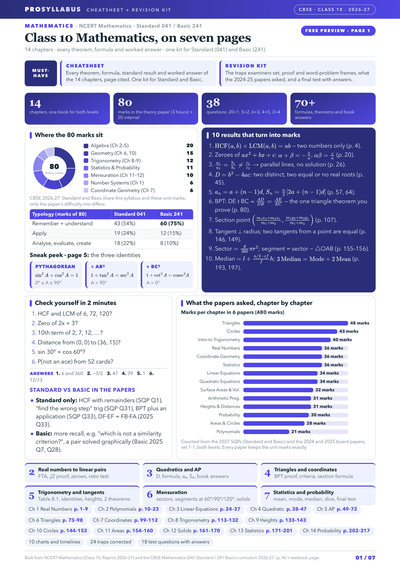
- Marks booster + cheatsheet: key concepts in 2 lines each
- 24 exam traps, listed
- 20 marks: Algebra
- Board-paper counts, chapter by chapter
- 12 marks: Trigonometry
- 11 marks: statistics and probability
 Open the full article →
CBSE Class 10 Board Examination kits
- Marks booster + cheatsheet: key concepts in 2 lines each
- 24 exam traps, listed
- 20 marks: Algebra
- Board-paper counts, chapter by chapter
- 12 marks: Trigonometry
- 11 marks: statistics and probability
- Marks booster + cheatsheet: key concepts in 2 lines each, common traps
- 25 marks each: Units I and II
- 13 marks: electricity and magnetism
- Common traps, corrected
- 12 marks: light and the human eye
- NCERT tables turned into charts
- Marks booster + cheatsheet: key concepts in 2 lines each, common traps
- Timeline: Europe, 1789 to 1914
- Timeline: India, 1915 to 1942
- Common traps, corrected
- Full CBSE map list
- Board questions, 2024–27 papers counted
- Marks booster + cheatsheet: key concepts in 2 lines each, common traps
- 20 of the 80 marks: all 7 chapters
- Crop table: conditions and states
- Map traps, corrected
- Mineral belts and state shares
- The book's data drawn as charts
- Marks booster + cheatsheet: key concepts in 2 lines each, common traps
- Census tables and the data on women
- Four forms of power-sharing
- Common traps, corrected
- Federalism: language policy, third tier
- Party systems, challenges and reforms
- Marks booster + cheatsheet: key concepts in 2 lines each
- 18 exam traps, listed
- What the board asked, 2024–27 papers counted
- Book tables and graph values as charts
- Answer frames for 3- and 5-mark questions
- Ten must-know facts
- Marks booster + cheatsheet: key concepts in 2 lines each, common traps
- 9 prose pieces, each summarised
- 10 poems with their poetic devices
- Common traps to avoid
- Long-answer pairs the board has set
- 10 marks each: grammar and writing formats
- Marks booster + cheatsheet: key concepts in 2 lines each, common traps
- 9 stories: plot, characters, themes
- Character-sketch frames
- Common traps to avoid
- Diary-entry and long-answer frames
- Values in all 9 stories
- Marks booster + cheatsheet: key concepts in 2 lines each
- Protocol tables: purpose matched to protocol
- HTML skeleton, headings, lists, attributes
- Tables with spanning cells, links, media
- Form inputs and CSS style properties
- Cyber ethics: licences, privacy, fraud
- Marks booster + cheatsheet: key concepts in 2 lines each
- 20 marks: writing formats (खंड घ)
- 16 marks: grammar (खंड ख)
- 8 marks (4+4): Kritika's three पाठ
- Poets and authors of every पाठ
- Alankar in the poems
- Marks booster + cheatsheet: key concepts in 2 lines each
- 22 marks: writing (खंड घ)
- 16 marks: grammar (खंड ख)
- 11 marks each: poetry and prose sections
- 6 marks: Sanchayan, 2 of 3 questions
- Board trends, 2024–27 papers counted
- Marks booster + cheatsheet: key concepts in 2 lines each
- 17 marks: pratyaya to error correction
- 15 marks: rachna, with answer frames
- 10 marks: apathit
- 8 marks: sandhi and samasa
- Question-making, anvaya, event order
Exam alertsGet alerts for CBSE Class 10 Board ExaminationDates, results and cutoffs, by email when they are announced. Free.Sign in to get alerts
Exam pagePreparing for CBSE Class 10 Board Examination?Syllabus, exam pattern, dates and every guide we have on CBSE Class 10 Board Examination, in one place.Open the CBSE Class 10 Board Examination page →

