
Checked 11 November 2026. Paper dates from CBSE’s 2027 date sheet (06.11.2026); the theory, practical, project and internal-assessment split and the practical windows from CBSE’s circular of 05.11.2026; unit weightage from the 2026-27 subject curricula. Each school sets its own pre-boards and practical dates inside CBSE’s window.
Short answer: good Class 12 marks come from two places, and you can plan both. Every subject is out of 100. In the subjects covered here, the CBSE board paper carries 70 or 80 of them and your school assesses the other 30 or 20 through practicals, a project or internal assessment, with an external examiner in most practical and project subjects. So: secure the school-assessed part first, then spend most of your hours on the units that carry the most marks in each theory paper, practise on CBSE’s 2026-27 sample papers and mark yourself with the marking scheme’s step marks. The Class 12 board exams run from 16 February to 9 April 2027, starting with Physics.
CBSE date sheet 06.11.2026; CBSE circular 05.11.2026; Examination Bye-laws 40.1.
Where your 100 marks come from in each subject
CBSE’s circular of 05.11.2026 lists, for every Class 12 subject, the theory marks, the practical, project or internal-assessment marks, and whether the board appoints an external examiner. The subjects covered here use the following marks splits.
| Subject | Board theory paper | School-assessed part | External examiner | Board paper (2027) |
|---|---|---|---|---|
| Physics | 70 | 30 (practical) | Yes | Tue 16 Feb |
| Chemistry | 70 | 30 (practical) | Yes | Sat 27 Feb |
| Biology | 70 | 30 (practical) | Yes | Thu 25 Mar |
| Mathematics | 80 | 20 (internal assessment) | No | Tue 9 Mar |
| Computer Science | 70 | 30 (practical) | Yes | Wed 31 Mar |
| Informatics Practices | 70 | 30 (practical) | Yes | Wed 31 Mar |
| Accountancy | 80 | 20 (project or practical) | Yes | Tue 23 Feb |
| Business Studies | 80 | 20 (project) | Yes | Thu 1 Apr |
| Economics | 80 | 20 (project) | Yes | Tue 16 Mar |
| Applied Mathematics | 80 | 20 (internal assessment) | No | Tue 9 Mar |
| History | 80 | 20 (project) | Yes | Sat 27 Mar |
| Political Science | 80 | 20 (project) | Yes | Fri 19 Mar |
| Geography | 70 | 30 (practical) | Yes | Thu 25 Feb |
| Psychology | 70 | 30 (practical) | Yes | Tue 2 Mar |
| Sociology | 80 | 20 (project) | Yes | Tue 30 Mar |
| English Core | 80 | 20 (internal assessment) | No | Fri 5 Mar |
| Hindi Core | 80 | 20 (internal assessment) | No | Sat 13 Mar |
Practical and project marks are not a formality. CBSE’s pass rule for Class 12 needs 33% in each subject, and in a subject with practical work, 33% in the theory and 33% in the practical separately. Practicals, projects and internal assessment for 2027 are held from 1 January to 13 February 2027 in regular schools, and from 9 November to 19 December 2026 in winter-bound schools.
Where other pages get this wrong
CBSE’s Class 12 mark sheet shows marks in each subject, not an overall percentage.
Commonly published instead: “Your CBSE percentage”, as if the board printed one on the mark sheet.
The 2026-27 scheme of studies says the mark sheet cum certificate shows marks in each subject separately and mentions no aggregate score or percentage; a college or institution works out a percentage by its own rules. So “good marks” is decided subject by subject, and each subject is worth planning on its own. The board does replace a failed main subject with a sixth subject, if you took one, as long as Hindi or English stays among the main five.
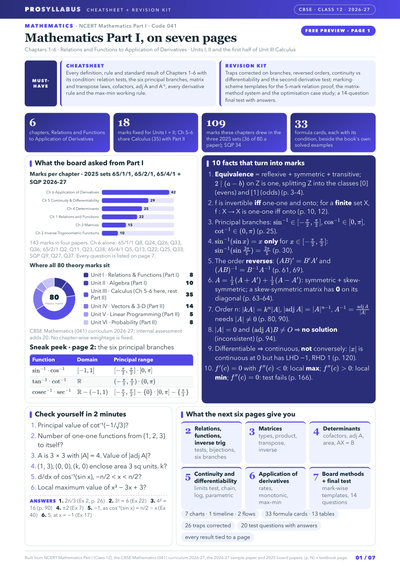
- Marks booster + cheatsheet: key concepts in 2 lines each, common traps
- 35 marks: Calculus, shared with Part II
- 10 marks: Algebra, Ch 3–4
- Common traps that cost marks, listed
- 6 principal branches of inverse trig
- Every derivative rule with its condition
The marks map by stream
Each subject curriculum for 2026-27 gives a weightage for every unit of the theory paper. The bars below put the largest unit first. Use them to decide the order of revision: a unit worth 35 marks deserves more hours than one worth 5, but no unit is safe to skip, because each paper can ask from all of them.
Science
CBSE subject curricula 2026-27 (Physics, Chemistry, Mathematics, Biology). Physics combines units where its curriculum gives a shared weightage; Electronic Devices has its own 7 marks.
| Subject | Unit or part | Marks | Share of the theory paper (rounded) |
|---|---|---|---|
| Physics (70 theory) | Electrostatics + Current Electricity | 16 | 23% |
| Magnetic Effects of Current and Magnetism + Electromagnetic Induction and AC | 17 | 24% | |
| Electromagnetic Waves + Optics | 18 | 26% | |
| Dual Nature of Radiation and Matter + Atoms and Nuclei | 12 | 17% | |
| Electronic Devices | 7 | 10% | |
| Chemistry (70 theory) | Electrochemistry | 9 | 13% |
| Aldehydes, Ketones and Carboxylic Acids | 8 | 11% | |
| Solutions | 7 | 10% | |
| Chemical Kinetics | 7 | 10% | |
| d- and f-Block Elements | 7 | 10% | |
| Coordination Compounds | 7 | 10% | |
| Biomolecules | 7 | 10% | |
| Haloalkanes and Haloarenes | 6 | 9% | |
| Alcohols, Phenols and Ethers | 6 | 9% | |
| Amines | 6 | 9% | |
| Biology (70 theory) | Genetics and Evolution | 20 | 29% |
| Reproduction | 16 | 23% | |
| Biology and Human Welfare | 12 | 17% | |
| Biotechnology and its Applications | 12 | 17% | |
| Ecology and Environment | 10 | 14% | |
| Mathematics (80 theory) | Calculus | 35 | 44% |
| Vectors and Three-Dimensional Geometry | 14 | 18% | |
| Algebra | 10 | 13% | |
| Relations and Functions | 8 | 10% | |
| Probability | 8 | 10% | |
| Linear Programming | 5 | 6% |
In Mathematics, Calculus alone carries 35 of the 80 theory marks. In Physics, Electromagnetic Waves with Optics (18), Magnetism with Electromagnetic Induction and AC (17) and Electrostatics with Current Electricity (16) add up to 51 of 70. In Biology, Genetics and Evolution (20) and Reproduction (16) make up more than half the paper. Chemistry is spread evenly: no chapter carries more than 9 of 70, so it rewards covering every chapter. Kits: Physics Physics Part I · Physics Part II · Chemistry Chemistry Part I · Chemistry Part II · Biology Biology · Mathematics Mathematics Part I · Mathematics Part II.
Commerce
CBSE subject curricula 2026-27 (Accountancy, Business Studies, Economics, Applied Mathematics). Business Studies groups chapters per weightage, as its curriculum does.
| Subject | Unit or part | Marks | Share of the theory paper (rounded) |
|---|---|---|---|
| Accountancy (80 theory) | Accounting for Partnership Firms | 36 | 45% |
| Accounting for Companies | 24 | 30% | |
| Analysis of Financial Statements (Financial Statement Analysis route) | 12 | 15% | |
| Cash Flow Statement (Financial Statement Analysis route) | 8 | 10% | |
| Business Studies (80 theory) | Organising, Staffing, Directing, Controlling | 20 | 25% |
| Nature and Significance of Management + Principles of Management | 16 | 20% | |
| Financial Management + Financial Markets | 15 | 19% | |
| Marketing + Consumer Protection | 15 | 19% | |
| Business Environment + Planning | 14 | 18% | |
| Economics (80 theory) | Current Challenges facing Indian Economy | 20 | 25% |
| Determination of Income and Employment | 12 | 15% | |
| Development Experience (1947-90) and Economic Reforms since 1991 | 12 | 15% | |
| National Income and Related Aggregates | 10 | 13% | |
| Development Experience of India: a Comparison with Neighbours | 8 | 10% | |
| Money and Banking | 6 | 8% | |
| Government Budget and the Economy | 6 | 8% | |
| Balance of Payments | 6 | 8% | |
| Applied Mathematics (80 theory) | Calculus | 15 | 19% |
| Financial Mathematics | 15 | 19% | |
| Numbers, Quantification and Numerical Applications | 11 | 14% | |
| Algebra | 10 | 13% | |
| Probability Distributions | 10 | 13% | |
| Linear Programming | 8 | 10% | |
| Time-based Data | 6 | 8% | |
| Inferential Statistics | 5 | 6% |
In Accountancy, Partnership Firms (36) and Companies (24) together are 60 of the 80 theory marks. In Economics, each book carries 40; the single largest unit is Current Challenges facing Indian Economy (20). Business Studies splits 50 marks for Principles and Functions of Management and 30 for Business Finance and Marketing. In Accountancy, Part B has two routes: Financial Statement Analysis (12 + 8 theory marks, with a 20-mark project) or Computerised Accounting (20 marks, with 20-mark practical work). Mathematics and Applied Mathematics cannot be taken together. Kits: Accountancy Accountancy Part I · Accountancy Part II · Computerised Accounting · Business Studies Business Studies Part I · Business Studies Part II · Economics Macroeconomics · Indian Economic Development.
Humanities
CBSE subject curricula 2026-27 (History, Political Science, Geography, Psychology, Sociology).
| Subject | Unit or part | Marks | Share of the theory paper (rounded) |
|---|---|---|---|
| History (80 theory) | Themes in Indian History Part I | 25 | 31% |
| Themes in Indian History Part II | 25 | 31% | |
| Themes in Indian History Part III | 25 | 31% | |
| Map work | 5 | 6% | |
| Political Science (80 theory) | Contemporary World Politics (7 chapters; six carry 6 marks, Globalisation 4) | 40 | 50% |
| Politics in India since Independence (8 chapters; Recent Developments 8, Planned Development 2) | 40 | 50% | |
| Geography (70 theory) | Human activities, transport and trade (world book, ch. 4–8) | 19 | 27% |
| Resources and development in India (ch. 3–6) | 10 | 14% | |
| World population and human development | 8 | 11% | |
| Transport, communication and trade in India | 7 | 10% | |
| Map work (world map) | 5 | 7% | |
| Map work (India map) | 5 | 7% | |
| Population of India | 5 | 7% | |
| Geographical perspective on selected issues (India) | 5 | 7% | |
| Human Geography (nature and scope) | 3 | 4% | |
| Human Settlements (India) | 3 | 4% | |
| Psychology (70 theory) | Variations in Psychological Attributes | 13 | 19% |
| Self and Personality | 13 | 19% | |
| Psychological Disorders | 12 | 17% | |
| Meeting Life Challenges | 9 | 13% | |
| Therapeutic Approaches | 9 | 13% | |
| Attitude and Social Cognition | 8 | 11% | |
| Social Influence and Group Processes | 6 | 9% | |
| Sociology (80 theory) | Indian Society (4 evaluated chapters, 10 each) | 40 | 50% |
| Social Change and Development in India (5 evaluated chapters: 5 + 5 + 10 + 10 + 10) | 40 | 50% | |
| English Core (80 theory) | Literature: Flamingo and Vistas | 40 | 50% |
| Reading skills | 22 | 28% | |
| Creative writing skills | 18 | 23% |
History gives 25 marks to each of the three Themes in Indian History books and 5 to the map. Geography carries 10 marks of map work, 5 in each book, and its practical is 30 of the 100. In Psychology, the first two units, Variations in Psychological Attributes and Self and Personality, carry 13 each. In English Core, literature from Flamingo and Vistas is 40 of the 80. Kits: History Themes in Indian History I · Themes II · Themes III · Political Science Contemporary World Politics · Politics in India since Independence · Geography Fundamentals of Human Geography · India: People and Economy · Practical Geography Part II · Psychology Psychology · Sociology Indian Society · Social Change and Development in India · English Core Flamingo · Vistas.
Your 2027 papers and the gaps between them
All Class 12 papers start at 10:30 am. The table shows an illustrative five-subject combination in each stream and the days between papers (our count from the date sheet). The gaps are fixed, so plan now what goes into each one: a long gap gives the most room to the subject whose paper comes after it, and a short gap needs that subject revised well before the exam period.
| Stream | Papers in date order (calendar days since the previous paper) | Longest gap |
|---|---|---|
| Science (PCM) | Physics Tue 16 Feb → Chemistry Sat 27 Feb (11 days) → English Core Fri 5 Mar (6 days) → Mathematics Tue 9 Mar (4 days) → Computer Science Wed 31 Mar (22 days) | 22 days, before Computer Science |
| Science (PCB) | Physics Tue 16 Feb → Chemistry Sat 27 Feb (11 days) → Psychology Tue 2 Mar (3 days) → English Core Fri 5 Mar (3 days) → Biology Thu 25 Mar (20 days) | 20 days, before Biology |
| Commerce | Accountancy Tue 23 Feb → English Core Fri 5 Mar (10 days) → Mathematics Tue 9 Mar (4 days) → Economics Tue 16 Mar (7 days) → Business Studies Thu 1 Apr (16 days) | 16 days, before Business Studies |
| Humanities | Geography Thu 25 Feb → English Core Fri 5 Mar (8 days) → Political Science Fri 19 Mar (14 days) → History Sat 27 Mar (8 days) → Sociology Tue 30 Mar (3 days) | 14 days, before Political Science |
Your combination may differ: Hindi Core is on 13 March, Physical Education on 18 February, Psychology on 2 March, and Computer Science, Informatics Practices and Information Technology all on 31 March. CBSE says over 40,000 subject combinations were checked so that no two of a student’s papers fall on the same day.
Turn a target into theory marks: a planner
If the planner cannot run (some readers and saved pages remove it), use this table. It assumes 27 of 30 or 18 of 20 in the school-assessed part; if you expect fewer, the theory paper has to make up the difference. In a subject with practical work, CBSE also needs 33% in theory and 33% in practical separately.
| Paper | Assumed school-assessed marks | Theory needed for 75 | for 85 | for 95 |
|---|---|---|---|---|
| 70 theory + 30 practical (e.g. Physics, Chemistry, Biology, Geography, Psychology, Computer Science, Informatics Practices) | 27/30 | 48/70 (68.6%) | 58/70 (82.9%) | 68/70 (97.1%) |
| 80 theory + 20 project, practical or internal assessment (e.g. Mathematics, Applied Mathematics, English Core, Hindi Core, Accountancy, Business Studies, Economics, History, Political Science, Sociology) | 18/20 | 57/80 (71.3%) | 67/80 (83.8%) | 77/80 (96.3%) |
Two worked examples
Worked example 1: Physics, target 90
- Expect 28 of 30 in the practical. The theory paper must give 90 − 28 = 62 of 70, which is 88.6%.
- The three largest weightage groups carry 51 of the 70 theory marks: Electromagnetic Waves and Optics (18), Magnetism, Electromagnetic Induction and AC (17), Electrostatics and Current Electricity (16).
- If your last test showed 70% in theory, the gap is about 19 points. Revise those three groups first, then Dual Nature with Atoms and Nuclei (12) and Electronic Devices (7), and test yourself on a full sample paper before 16 February.
Our computation from CBSE’s Physics curriculum 2026-27 and circular of 05.11.2026.
Worked example 2: Accountancy, target 85
- On the Financial Statement Analysis route, expect 18 of 20 in the project (project file 12 and viva, an oral question round, 8, assessed with an external examiner). The theory paper must give 85 − 18 = 67 of 80, which is 83.75%.
- Partnership Firms carries 36 of the 80 theory marks and Companies 24. A strong grip on those two units covers most of the paper; Analysis of Financial Statements (12) and the Cash Flow Statement (8) complete it.
- The Accountancy paper is on 23 February, the first paper in the illustrative commerce combination above, so start it early.
Our computation from CBSE’s Accountancy curriculum 2026-27 and circular of 05.11.2026.
- Marks booster + cheatsheet: key concepts in 2 lines each, common traps
- 35 marks: Calculus, shared with Part II
- 10 marks: Algebra, Ch 3–4
- Common traps that cost marks, listed
- 6 principal branches of inverse trig
- Every derivative rule with its condition
Eight habits that move Class 12 marks
- Bank the school-assessed marks. Finish the practical file, project or internal assessment work before your school’s assessment date, inside CBSE’s window. In most practical and project subjects an external examiner checks it; be ready to explain your own practical or project work in any viva.
- Revise by weightage. Use the marks map above to set the order of revision in each subject. Larger units first, but every unit covered.
- Work from the NCERT textbook. The 2026-27 curricula for these subjects prescribe NCERT textbooks; your kit, notes and question banks sit beside the textbook, not in place of it.
- Expect application questions. The 2026-27 papers are designed around competencies: in Mathematics 20 of 80 marks are for applying and 16 for analysing, evaluating and creating; in Physics 22 and 21 of 70; in Accountancy 24 and 24 of 80. Practise questions you have not seen before, not only textbook exercises.
- Mark yourself with the marking scheme. CBSE publishes a marking scheme with each sample paper and for past board papers. Compare your long answers step by step with it to see where marks go.
- Write full papers against the clock. Every theory paper for the subjects in this guide is three hours. One timed paper a week from December, more in January, builds the pace.
- Recall, don’t reread. Close the book and write what you remember, then check. Try short daily recall of formulas, dates and definitions, then check your answers.
- Plan the gaps. The days between your papers are fixed. Decide now what you will revise in each gap, and give weaker subjects extra time before the exam period starts.
For the last month before the boards, our last 30 days strategy guide sets out a day-by-day revision approach; this guide is for the months before that.
If you are a parent
Class 12 is the year your child is becoming an adult. CBSE’s Parenting Calendar for 2026-27 describes the parent’s task in Class 11 and 12 as accompanying rather than directing, and warns that coaching, mock tests and revision can leave a Class 12 student with no life outside preparation. Here is what helps in the months before the boards.
- Ask about the plan, not the percentage. “Which subject needs the most work, and when is its paper?” opens a better conversation than a target number. Sit together with the planner above for ten minutes.
- Check the school-assessed part. Ask whether practical files and projects are complete and when your child’s school holds its practicals inside CBSE’s window (1 January to 13 February 2027 for regular schools).
- Help with one subject, not five. Agree on the subject with the biggest gap and a daily slot for it. The free first page of its Marks Booster kit ends with a short self-check; do it together and let the score decide what to revise.
- Protect one non-academic anchor. The Parenting Calendar asks parents to keep one thing such as sport, music or time with friends as a mental-health necessity, not an indulgence. Sleep counts too.
- Keep your hopes separate from their result. The calendar asks parents to separate their own identity from their child’s aspirations and results, especially with entrance exams running alongside the boards.
When it is more than marks
- Watch for withdrawal, changes in sleep or appetite, and a loss of interest in things your child used to enjoy. CBSE’s Parenting Calendar notes that self-harm risk in adolescents peaks in the Class 9–12 years in India, and that asking directly whether a child is thinking of hurting themselves does not plant the idea; it opens the door.
- Talk to the school counsellor. If your child talks about not wanting to go on, stay with them and seek urgent professional help the same day. Tele-MANAS (14416) is the Government of India’s free 24x7 mental health line. If there is immediate danger, call 112, India’s emergency number.
CBSE Parenting Calendar 2026-27; Ministry of Health and Family Welfare (Tele-MANAS).
Which Marks Booster kit to open first
Each Marks Booster kit is a 7-page PDF for one Class 12 book, built on the 2026-27 curriculum and the NCERT book and used beside the NCERT textbook, not instead of it. It is a revision sheet, not a full course. The first page is free to read on the kit page. If you decide to buy, start with the subject the planner put first.
Board paper Tue 23 Feb 2027
Accountancy
Accountancy Part I kit →Accountancy Part II kit →Computerised Accounting kit →
Board paper Thu 1 Apr 2027
Business Studies
Board paper Fri 19 Mar 2027
Political Science
Contemporary World Politics kit →Politics in India since Independence kit →
Board paper Thu 25 Feb 2027
Geography
Fundamentals of Human Geography kit →India: People and Economy kit →Practical Geography Part II kit →
Board paper Tue 30 Mar 2027
Sociology
Indian Society kit →Social Change and Development in India kit →
Practise it, don't just read it
After revising a unit, check it. Our Class 12 chapter quizzes are ten questions each: a quick test of recall on the topics they cover. Full sample papers under time show broader progress.
The ProSyllabus CBSE Class 12 library has chapter quizzes for Physics, Chemistry, Biology, Mathematics, English, Accountancy, Business Studies, Economics, History, Political Science, Geography, Sociology and Psychology. You can start free.
Frequently asked questions
How can I score good marks in Class 12 CBSE?
Secure the practical, project or internal-assessment marks your school gives (20 or 30 of each subject’s 100), revise the units that carry the most theory marks first without skipping any, practise on CBSE’s 2026-27 sample papers, and mark your answers with the marking scheme. Plan what you will revise in each gap between papers.
How are Class 12 marks divided between theory and practical?
Each subject is out of 100. Physics, Chemistry, Biology, Geography, Psychology, Computer Science and Informatics Practices are 70 theory + 30 practical. Mathematics, Applied Mathematics, English Core and Hindi Core are 80 + 20 internal assessment. Business Studies, Economics, History, Political Science and Sociology are 80 theory + 20 project. Accountancy is 80 theory + 20 project on the Financial Statement Analysis route, or 80 theory + 20 practical on the Computerised Accounting route. Sources: CBSE circular of 05.11.2026 and the Class XII Accountancy curriculum 2026-27.
When do the CBSE Class 12 board exams start in 2027?
On Tuesday 16 February 2027 with Physics. Chemistry is on 27 February, English on 5 March, Mathematics and Applied Mathematics on 9 March, Economics on 16 March, Biology on 25 March and Business Studies on 1 April; the last Class 12 papers are on 9 April. Every paper starts at 10:30 am.
How many marks do I need in theory to score 90 in Physics?
Subtract the practical marks you expect from 90; worked example 1 shows it with 28 of 30 in the practical. The planner on this page does the same for every subject with your own numbers.
Is there a pass mark for theory and practical separately?
Yes. CBSE’s Examination Bye-laws require 33% in each subject and, in a subject with practical work, 33% in the theory and 33% in the practical separately.
Does the CBSE mark sheet show my overall percentage?
No. The 2026-27 scheme of studies says the board shows marks in each subject separately and no aggregate percentage; a college works out a percentage by its own rules.
Is a Marks Booster kit enough to score well?
No. It is a 7-page revision sheet for one book, meant to be used with the NCERT textbook, sample papers and your teacher’s feedback. Its job is to show what to revise first and to check recall.
Sources
- official — CBSE — Date Sheet for Class X and Class XII Board Examinations 2027 (CBSE/Date Sheet/X-XII/2026-27, 06.11.2026)
- official — CBSE — Circular: Practical Examinations / Internal Assessment for Classes X and XII, 2027, with subject-wise marks (CBSE/Coord/Marks distribution/163685/2026-2027, 05.11.2026)
- official — CBSE Academic — Senior Secondary Curriculum 2026-27, Part II (scheme of studies and assessment)
- official — CBSE — Examination Bye-laws: scheme of examinations and pass criteria (40.1, Senior School Certificate)
- official — CBSE Academic — Class XII sample question papers and marking schemes 2026-27
- official — CBSE — Marking schemes of past board papers
- official — CBSE — Previous years’ question papers
- official — CBSE Academic — Physics curriculum and question paper design, Classes XI–XII 2026-27
- official — CBSE Academic — Chemistry curriculum and question paper design, Classes XI–XII 2026-27
- official — CBSE Academic — Biology curriculum and question paper design, Classes XI–XII 2026-27
- official — CBSE Academic — Mathematics curriculum and question paper design, Classes XI–XII 2026-27
- official — CBSE Academic — Applied Mathematics curriculum and question paper design, Classes XI–XII 2026-27
- official — CBSE Academic — English Core curriculum and question paper design, Classes XI–XII 2026-27
- official — CBSE Academic — Accountancy curriculum and question paper design, Classes XI–XII 2026-27
- official — CBSE Academic — Business Studies curriculum and question paper design, Classes XI–XII 2026-27
- official — CBSE Academic — Economics curriculum and question paper design, Classes XI–XII 2026-27
- official — CBSE Academic — History curriculum and question paper design, Classes XI–XII 2026-27
- official — CBSE Academic — Political Science curriculum and question paper design, Classes XI–XII 2026-27
- official — CBSE Academic — Geography curriculum and question paper design, Classes XI–XII 2026-27
- official — CBSE Academic — Psychology curriculum and question paper design, Classes XI–XII 2026-27
- official — CBSE Academic — Sociology curriculum and question paper design, Classes XI–XII 2026-27
- official — CBSE — Parenting Calendar 2026-27 (29.04.2026), Phase 5: Class 11 to Class 12
- official — Ministry of Health and Family Welfare — Tele-MANAS, 24x7 mental health helpline 14416
official = a document published by the conducting body. reported = a news or coaching site we could not check against an original. Where sources disagree this page says so rather than picking one.


