Checked 21 October 2026. From GSIUR 1998, HSE L56, IGEM criteria documents and Gas Safe Register pages read 21 Oct 2026. The fee is the one shown on Gas Safe's Apply page on that date.
Passing CCN1 does not, by itself, let you fit a boiler. The ACS scheme is built as a core plus modules, and the law then requires registration on top of competence. This guide puts the three layers in order, using the scheme's and Gas Safe Register's own words.
Our summary of GSIUR regulation 3, IGEM's criteria documents and Gas Safe Register's pages, read 21 Oct 2026.
Layer 1: the law
"No person shall carry out any work in relation to a gas fitting or gas storage vessel unless he is competent to do so."
"Without prejudice to the generality of paragraphs (1) and (2) above and subject to paragraph (4) below, no employer shall allow any of his employees to carry out any work in relation to a gas fitting or service pipework and no self-employed person shall carry out any such work, unless the employer or self-employed person, as the case may be, is a member of a class of persons approved for the time being by the Health and Safety Executive for the purposes of this paragraph."
HSE's L56 (para 102): "At the time of publication of this ACOP, the class of persons approved by HSE are those who are registered with Gas Safe Register". Regulation 3(7) adds that "No person shall falsely pretend to be a member" of that class. These are the Great Britain regulations; Gas Safe Register lists separate laws for Northern Ireland, the Isle of Man, Guernsey and Jersey.
Layer 2: the core and the modules
LCL Awards, a UKAS-accredited ACS certification body, puts it simply: "In all areas of gas work there is a core gas safety assessment which must be achieved before an individual appliance assessment can be undertaken." The appliance criteria documents say the same in their prerequisites; CENWAT and HTR1 both require "CCN1 (taken since April 2012) OR equivalent change over elements" or a QCF or S/NVQ.
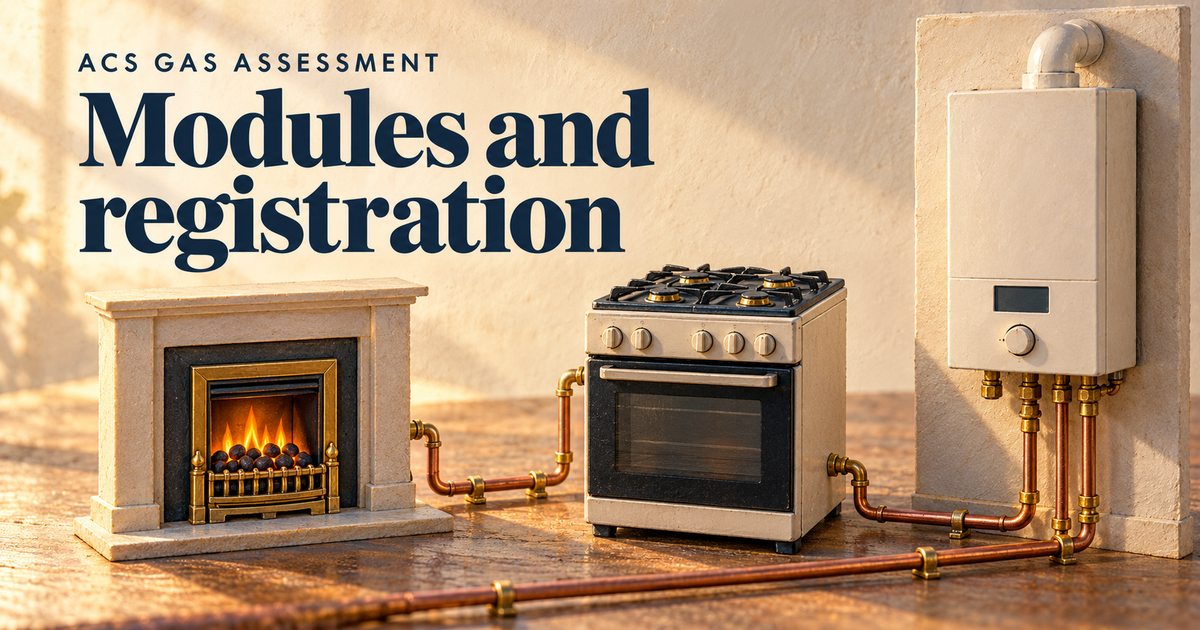
| Module | Covers (criteria document title) | Closest Gas Safe domestic card category (our match) |
|---|---|---|
| CCN1 | Core domestic gas safety, natural gas | Pipework is described as core domestic gas safety knowledge |
| CENWAT | Central heating/hot water boilers and circulators, combination boilers, storage water heaters and instantaneous water heaters | Boiler |
| CKR1 | Domestic cooking appliances | Cooker |
| HTR1 | Gas fires and wall heaters | Fire/Space Heater |
| DAH1 | Domestic ducted air heaters (GN8 Table 3) | Warm Air |
| MET1 | Installation of domestic meters (GN8 Table 3) | Meters |
Gas Safe Register summarises the certificates it receives into the plain categories shown on the card. Its Registration Policy gives the example: "‘Central Heating DOM NG’ is summarised as ‘Gas Boilers’". Its domestic category list defines Boiler as competent in "the install, exchange, commission, disconnect, service, repair, safety checking and breakdown of domestic gas fired central heating/hot water boilers including fire-back/boilers, circulators, combi boilers, storage water heaters and instantaneous water heaters." Pipework is defined as "Core domestic gas safety knowledge and understanding including the installation and testing of gas pipework up to 35mm diameter in a domestic environment."
Layer 3: registering with Gas Safe
Gas Safe Register registers businesses, and lists engineers against them. Its Registration Policy says a business must always have "a minimum of one engineer, holding current certificates of gas safety competence". The steps, from Gas Safe's own pages:
| Step | What | Source |
|---|---|---|
| 1 | Complete whatever training your entry route requires and achieve recognised evidence of gas safety competence (ACS certificates or a qualification on the recognised list) | Gas Safe path-to-registration page; IGEM GN8 |
| 2 | Your awarding or certification body sends the evidence to Gas Safe electronically; it is "only recognised once received from the awarding body concerned" | Gas Safe path-to-registration page |
| 3 | Apply (Gas Safe: "You can apply for registration easily online."). On 21 Oct 2026 a new application cost £319.96 plus VAT, including one engineer, a digital licence card and one year's registration | Gas Safe Apply page |
| 4 | Probationary registration: the path page says "Probation lasts three months"; the Registration Policy says it "will normally last for approximately 3 months" and may be extended or reduced | Gas Safe path-to-registration page |
| 5 | Renew the registration every 12 months; a valid core (CCN1 or COCN1) is needed to renew | Gas Safe "Path" and "Renew" pages |
Gas Safe warns not to register too early: "If you are unable to provide evidence of gas work within your probationary period the business will be suspended", so it advises registering only when you intend to start gas work. Engineers qualified abroad need certificates issued through a UKAS BS EN 17024 accredited certification body; Gas Safe's overseas page says "NO gas work can be legally undertaken without registration."
What Gas Safe Register does, and what it does not
Gas Safe Register describes itself as "the official gas registration body in the United Kingdom, Isle of Man, Jersey and Guernsey". It keeps the register, inspects engineers' gas work, runs a national investigations team for illegal gas work and investigates complaints about unsafe work. It also lists what it does not do: it "does not employ" the engineers, "does not recommend" one business over another and "does not perform" criminal background checks.
Registration belongs to the business, which matters if you are employed. The Registration Policy (section 5.1): "An engineer who does not hold their own personal registration may not use the details of their employer (or any other registration) to undertake gas work outside their terms of employment, e.g., on a private basis." An employed engineer who wants to do private jobs needs a registration of their own.
Changing sector later
A domestic engineer who later wants commercial or LPG work can extend their scope. GN8 calls it that, and its Table 4 gives indicative hours for existing Gas Safe engineers. Examples: natural gas to LPG installations (CoNGLP1 PD, LAV, RPH, B) 13 hours or 2 days; installation and servicing of non-domestic heating appliances (CoDNCO1, CIGA1, CDGA1 and CORT1) 40 hours or 6 days; commercial to domestic natural gas (CoCDN1) 45 hours or 7 days. GN8 adds that the durations "are indicative and should not be considered as a minimum, maximum or fixed", and its Table 2 marks training "Required" for a Category A holder extending scope (route 4). GN8 note 2 requires evidence to the centre of at least twelve months since your qualification or core ACS; an engineer extending sooner must take an MLP- Bridge through a recognised training provider (GN8 exempts CCN1 holders training for MET1, REGT1 or CESP1/CMA1/CMA3).
What an engineer may do is also limited to what they hold. HSE's L56 (para 83): "The level and range of competence should match the full extent of work done, but needs only to be sufficient for and relevant to that work." And a customer can see it: the licence card lists the engineer's work categories, and Gas Safe's web search lets anyone check the gas services a business can offer.
Try one question
A self-employed engineer holds current CCN1 and CENWAT certificates but has not registered with Gas Safe. May they install a boiler in a customer's home in England?
- A. Yes, the ACS certificates are enough
- B. Yes, if the customer agrees in writing
- C. No, regulation 3(3) requires a self-employed person doing such work to be a member of the HSE-approved class of persons
- D. Yes, for the first three months
Show the answer
C. Regulation 3(3) says no self-employed person shall carry out work on a gas fitting unless they are a member of the class of persons approved by HSE, which L56 identifies as Gas Safe Register. The exceptions in paragraph (4) cover only replacing certain hoses and regulators, not installing a boiler. The three months is Gas Safe's probation, which starts after registering.
Our own question, written from the regulation quoted. It is not an ACS assessment question.
Frequently asked questions
What ACS modules do I need to fit boilers?
IGEM's example: CCN1 (core domestic gas safety) and CENWAT (Domestic Central Heating Boilers).
Can I take CENWAT without CCN1?
CENWAT's criteria document gives CCN1 taken since April 2012, equivalent changeover elements, or a QCF or S/NVQ as its prerequisite. The core comes first.
Who can register with Gas Safe?
Gas Safe registers gas businesses. A registered business must always have at least one engineer holding current certificates of gas safety competence, and Gas Safe recognises competence evidence only once it arrives from the awarding body. Registration then starts as probationary, normally for about three months.
How much does Gas Safe registration cost?
On 21 Oct 2026 Gas Safe's Apply page showed £319.96 plus VAT for a new application, including one engineer, a digital licence card and one year's registration. Check the page for the current fee.
Can an employed gas engineer do private jobs?
Not on the employer's registration. Gas Safe's Registration Policy says an engineer without their own registration may not use the employer's details for gas work outside their terms of employment, such as private work.
Does Gas Safe registration cover Northern Ireland?
Gas Safe Register is the registration body for the UK, the Isle of Man, Jersey and Guernsey, but each place has its own law: Northern Ireland has the Gas Safety (Installation and Use) Regulations (Northern Ireland) 2004.
Is Gas Safe registration the same as ACS?
No. ACS certificates prove your competence and last five years. Gas Safe registration is the membership of the HSE-approved class that regulation 3(3) requires of employers and self-employed people doing gas work covered by the Regulations, and it is renewed every year.
ProSyllabus is an independent study site, not part of Gas Safe Register, HSE, IGEM or any ACS certification body. Rules here are quoted from the regulations and the scheme's own documents; ask your assessment centre how your own assessment will run.
Sources
- official — legislation.gov.uk: GSIUR 1998, regulation 3 (Qualification and supervision)
- official — HSE: L56 "Safety in the installation and use of gas systems and appliances", ACOP and guidance, fifth edition 2018 (paras 81, 85, 87, 102)
- official — LCL Awards (UKAS-accredited certification body No. 0230): What is the ACS Gas Scheme
- official — IGEM resource library: assessment criteria documents (CENWAT Issue 6.2, CKR1 Issue 5.5, HTR1 Issue 5.5 and others)
- official — IGEM: Assessment, overview of Matters of Gas Safety, ACS and other routes to competence (read 21 Oct 2026)
- official — Gas Safe Register: Defining the domestic ID card work categories
- official — Gas Safe Register: Registration Policy, P001_REG001 v9.0, February 2026 (sections 5.2, 7 and 7.8)
- official — Gas Safe Register: Path to Gas Safe registration (read 21 Oct 2026)
- official — Gas Safe Register: Apply for Gas Safe registration (fee as shown 21 Oct 2026)
- official — Gas Safe Register: How to renew your Gas Safe registration (read 21 Oct 2026)
- official — Gas Safe Register: Overseas applicants (read 21 Oct 2026)
- official — Gas Safe Register: About Gas Safe registration (regulations by territory)
official = a document published by the conducting body. reported = a news or coaching site we could not check against an original. Where sources disagree this page says so rather than picking one.