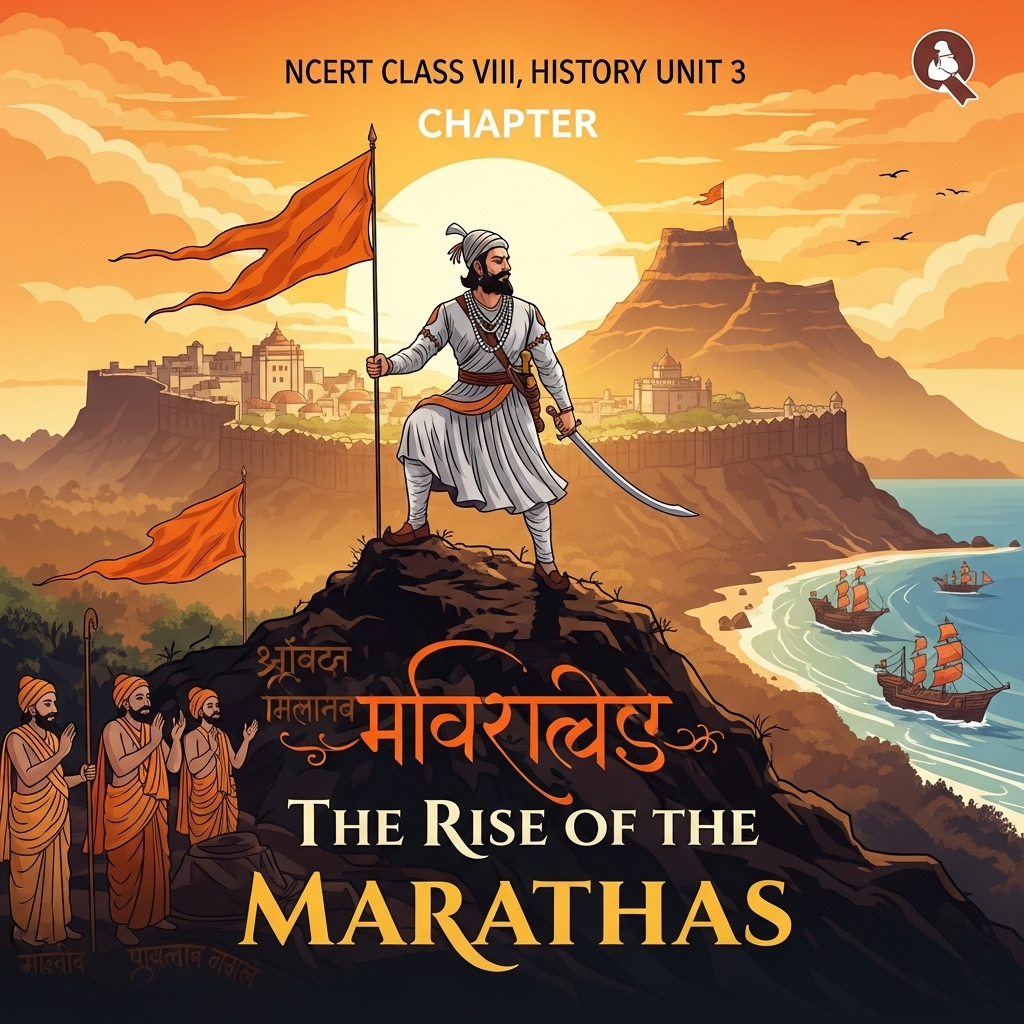
The Rise of the Marathas
Chapter 3: Tapestry of the Past
Complete Study Guide with Interactive Learning
Chapter Overview
What You'll Learn
Maratha Identity
Who the Marathas are, their language, and cultural foundation from saints.
Rise under Shivaji
The foundation of Maratha power, Shivaji's strategies, and establishment of Swarajya.
Governance Features
Administrative system, military innovations, and economic policies of the Marathas.
Historical Impact
The legacy of the Maratha Empire in Indian history and resistance to foreign powers.
Historical Context
This chapter covers the rise of the Marathas as a pan-Indian power, their governance, and lasting impact, drawing from historical events and figures like Shivaji.
Comprehensive Chapter Summary
1. Introduction to the Marathas
The Marathas are a group of people native to the Deccan plateau, specifically present-day Maharashtra, identified with the Marathi language, which boasts a rich literary history dating back to the 12th century with works of poetry and prose. They rose as a powerful political entity, altering India's historical trajectory. During the 13th century, Maharashtra was ruled by the Yadava dynasty with Devagiri (now Daulatabad) as its capital, a period marked by cultural and political stability. In the early 14th century, the Yadava dynasty fell to the Khilji Sultanate from Delhi, ushering in a new era of external influence. The region faced political upheavals, yet cultural traditions persisted, setting the stage for the Maratha rise.
2. Cultural Foundation and Saints
Bhakti Tradition
Amidst political changes, the bhakti movement flourished from the 7th to 17th centuries, emphasizing devotion over ritualism for spiritual upliftment. Saints from diverse backgrounds composed devotional songs and poetry in local languages like Marathi, spreading messages of equality and devotion. This movement gained momentum with figures like Dnyaneshwar, who wrote the Dnyaneshwari, a Marathi commentary on the Bhagavad Gita, making spiritual texts accessible to the masses.
Role of Saints
Saints such as Namdev, Tukaram, and Ramdas played pivotal roles by translating sacred texts like the Upanishads and Bhagavad Gita into Marathi, enhancing literacy and spiritual awareness. Tukaram’s abhangs (devotional poems) and Ramdas’s emphasis on social organization mirrored the Sikh gurus’ efforts, fostering a strong cultural foundation that later supported political unity and resistance against foreign powers.
Early Attempts
By the 17th century, Maratha chiefs made initial attempts at establishing sovereignty, often clashing with Deccan sultanates. These efforts were largely unsuccessful until Shivaji emerged, uniting the Marathas under a shared vision of independence, leveraging the cultural strength built by saints and local leaders.
3. Foundation of Maratha Power and Rise of Shivaji
Shivaji's Early Life
Born in 1630 into the Bhonsle clan, Shivaji was the son of Shahji, a military leader serving Deccan sultanates, and Jijabai, who instilled strong moral and educational values. Growing up in the Pune jāgīr, Shivaji was influenced by the region’s turmoil due to constant infighting among Deccan sultans, which caused widespread hardship and inspired his early resolve to establish order.
Early Campaigns
At the age of 16 in 1646, Shivaji began military campaigns, capturing neglected forts like Torna and strengthening their defenses. His vision of Swarajya—encompassing political sovereignty, economic self-reliance, and cultural preservation—grew, culminating in the consolidation of the Pune region and laying the groundwork for a broader empire.
Establishment of Navy
By 1657, Shivaji expanded his kingdom to the west coast, recognizing the need for a navy to secure maritime resources and protect against European traders. Unlike the Bijapur Sultanate, which relied on merchant ships, or the Mughal Empire with its limited naval use, the Maratha Navy, with forts like Sindhudurg, became legendary for its strategic coastal defense.
Guerrilla Warfare
Shivaji employed guerrilla warfare, using small, agile groups with intimate knowledge of the terrain to outmaneuver larger armies. This tactic proved decisive when he faced Afzal Khan of Bijapur in 1659 at Pratapgad. During a one-on-one meeting, Shivaji killed Khan, and hidden Maratha forces routed the enemy, showcasing his tactical brilliance.
Expansion and Conflicts
Shivaji’s successes drew Mughal attention, leading to his imprisonment in Agra in 1666, from which he famously escaped. His Dakṣhiṇa digvijaya in 1677 extended Maratha influence southwards. Crowned Chhatrapati in 1674 at Raigad Fort, this event marked the formal inception of the Maratha Empire, solidifying his legacy as a unifying leader.
4. Governance and Administration
Shivaji’s administration was marked by the Ashtapradhan council, a group of eight ministers overseeing various domains like defense and finance. His revenue system was fair, encouraging agriculture and reducing exploitation. The military was disciplined, with soldiers receiving regular salaries to prevent plunder. Religious tolerance was a hallmark, and the navy played a crucial role in protecting coastal regions from European merchants, as advised in Ramachandrapant Amatya’s Ādnyāpatra (1715).
5. Conflicts and Legacy
The Mughal-Maratha wars (1682-1707) tested the empire’s resilience, with prolonged resistance against Aurangzeb. The Battle of Panipat in 1761 was a significant defeat, yet Maratha control over Delhi from 1754 showed their reach. The Anglo-Maratha wars—victory in the First (1775-1782) and defeat in the Third (1818)—marked the end of their power. Their legacy includes being the largest pan-Indian power before the British, influencing governance, and inspiring future nationalist movements.
Key Concepts and Definitions
Bhakti
Devotion to the divine or a particular deity, preferred by saints over external ritualism.
Swarājya
Sovereign kingdom envisioned by Shivaji, extending to political, economic, and cultural aspects.
Jāgīr
A piece of land given by a ruler as reward for service; collector could gather taxes.
Guerrilla Warfare
Tactic using small groups with speed, surprise, terrain knowledge to defeat larger armies.
Chhatrapati
Title meaning 'lord of the umbrella', signifying sovereignty, adopted by Shivaji.
Ashtapradhan
Council of eight ministers advising the king in Maratha administration.
Dakṣhiṇa Digvijaya
Conquest of the South by Shivaji in 1677.
Ādnyāpatra
Treatise on statecraft by Ramachandrapant Amatya in 1715.
Literary History
Historical development of writings in prose or poetry in a language.
Important Facts and Figures
Questions and Answers from Chapter
Short and Medium Questions
Q1. Who were the Marathas?
Q2. What is the literary history of Marathi?
Q3. Who ruled Maharashtra in the 13th century?
Q4. What happened to the Yadava dynasty in the early 14th century?
Q5. What path did saints prefer for spiritual upliftment?
Q6. Name some saints in Maharashtra.
Q7. What did saints do to make philosophy accessible?
Q8. How did saints contribute to society?
Q9. When was Shivaji born?
Q10. Who were Shivaji's parents?
Q11. What was Shahji's role?
Q12. Where did Shivaji grow up?
Q13. What affected the Pune region?
Q14. When did Shivaji launch military campaigns?
Q15. What was Shivaji's vision?
Q16. When was the Maratha navy founded?
Q17. Who was Afzal Khan?
Q18. Where did Shivaji kill Afzal Khan?
Q19. When was Shivaji imprisoned?
Q20. What is Dakṣhiṇa digvijaya?
Long Questions
Q1. Who were the Marathas? How did they manage to become the largest pan-Indian power before the British took over?
Q2. What were some features of their governance?
Q3. What impact did the Maratha Empire leave in Indian history?
Q4. Have you ever heard the term ‘bhakti’? What does it mean to you? Choose a bhakti saint from any part of India and learn about their life, their teachings, and the message they shared. You can also find one of their poems or bhajans and share it with your classmates.
Q5. If you could time-travel and meet Shivaji, what three questions would you ask him and why?
Q6. Discuss the role of saints in Maratha society and how they contributed to political awareness.
Q7. Explain the significance of Shivaji's coronation in 1674.
Q8. Describe Shivaji's military strategies and their effectiveness.
Q9. How did the Marathas deal with European merchants as per Ādnyāpatra?
Q10. Analyze the impact of Mughal-Maratha wars on the empire.
Q11. Discuss the administrative system under Shivaji.
Q12. Explain the role of the Maratha navy in protecting coastal regions.
Q13. How did the Anglo-Maratha wars affect Maratha power?
Q14. Describe the cultural contributions of Maratha saints.
Q15. Analyze Shivaji's vision of Swarajya and its aspects.
Q16. Explain the significance of the Battle of Panipat in 1761.
Q17. Discuss the role of Raigad Fort in Maratha history.
Interactive Knowledge Quiz
Test your understanding of The Rise of the Marathas
Quick Revision Notes
Marathas
- Native to Deccan, speak Marathi
- Cultural foundation from saints
- Rise under Shivaji
Shivaji
- Born 1630, coronation 1674
- Navy, guerrilla warfare
- Swarājya vision
Governance
- Ashtapradhan council
- Fair revenue, tolerance
- Military discipline
Legacy
- Pan-Indian power
- Resisted Mughals, British
- Historical impact
Exam Strategy Tips
- Understand Shivaji's strategies
- Discuss governance features
- Analyze historical impact
- Use timelines for events
- Connect saints to cultural foundation