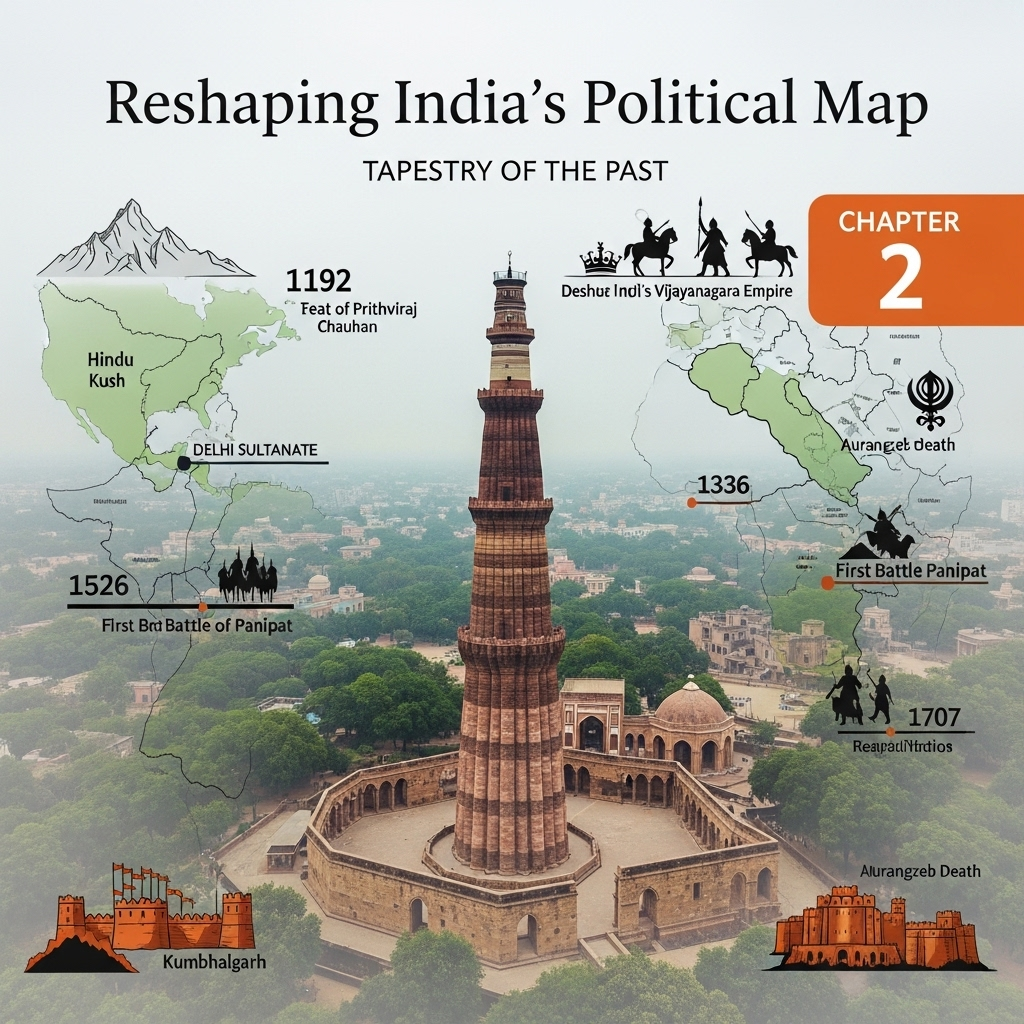
Reshaping India's Political Map
Chapter 2: Tapestry of the Past
Complete Study Guide with Interactive Learning
Chapter Overview
What You'll Learn
Delhi Sultanate
The rise and fall of the Delhi Sultanate, including its dynasties and key rulers.
Resistance Movements
How various kingdoms and groups resisted invasions and the Sultanate's expansion.
Vijayanagara and Mughal Empires
The establishment, expansion, and cultural contributions of these empires.
Social and Economic Impacts
The effects of political instability on society, economy, and daily life.
Historical Context
This chapter explores the medieval period in India, focusing on invasions, empire building, and resistance, drawing from historical accounts and folklore.
Comprehensive Chapter Summary
1. Introduction to the Period
The period from the 11th to the 17th centuries is known as the medieval period in Indian history. It was marked by foreign invasions from Central Asia, mainly Turkic and Afghan, reshaping India's political boundaries. Invaders were drawn to India's riches and territorial ambitions, often spreading their religion by force. The term 'medieval' is borrowed from European history but applies differently to India. A new era began in the early 11th century with invasions from beyond the Hindu Kush mountains. Many invaders were Central Asian — Turkic or Afghan — drawn to India's reputed riches, territorial ambitions, and to spread their religion by force if necessary.
2. Rise and Fall of the Delhi Sultanate
Dynasties
Mamluks, Khiljis, Tughlaqs, Sayyids, Lodis — five successive dynasties ruled the Sultanate, starting after the defeat of Prithviraj Chauhan in 1192.
Key Rulers and Policies
Ala-ud-din Khilji expanded the empire through campaigns, repelling Mongols, and his slave-general Malik Kafur conquered southern kingdoms, plundering wealth to finance the military. Muhammad bin Tughlaq expanded territories but his schemes like shifting the capital to Daulatabad and token currency failed, causing economic decline.
Social and Economic Aspects
Sultans lived luxuriously, funded by plunder, taxes, slave trade, and jizya on non-Muslims. Iconoclasm led to temple destruction. Successions were violent, with average reigns short. Timur's 1398 invasion devastated Delhi, leading to the Lodis' rise, but the Sultanate shrank due to resistance.
Military and Administrative Details
The Sultanate saw territorial expansion with military campaigns raiding villages, plundering temples. Wealth from conquered regions supported the army. The elite engaged in slave trade for labor and sale. The period was marked by political instability combined with efforts at territorial expansion, resulting in military campaigns that raided villages and cities, and plundered and destroyed temples and seats of learning. The city of Delhi assumed a bigger role in the political landscape of northern India. While certain parts of northern India came under the control of the Delhi Sultanate, neighbouring kingdoms like the Eastern Gangas and Hoysalas resisted its advance and emerged as thriving centres of art, culture, and administration.
3. Resistance to the Delhi Sultanate
Eastern Ganga Kingdom
Narasimhadeva I repelled Sultanate invasions, defeated Bengal's governor, and built the Konark temple to commemorate victories.
Musunuri Nayakas
Rallied 75 chieftains to form a confederacy, defeated Sultanate forces, and expelled them from Warangal around 1330-1336.
Hoysalas
Fended off attacks but weakened by conflicts, absorbed into Vijayanagara in mid-14th century. Built magnificent temples like Belur and Halebidu. The Hoysalas ruled parts of southern India (mostly present-day Karnataka) and fended off several attacks from the Delhi Sultanate, remaining the only independent kingdom in the south.
Bahmani Sultanate
Rose in mid-14th century in Deccan, leading to alliances and wars with other regions like Gujarat and Bengal.
Rana Kumbha
Repelled invasions from sultanates in 15th century, built Kumbhalgarh Fort. Parts of Rajasthan remained beyond the reach of the Delhi Sultanate; Rana Kumbha successfully repelled invasions from later sultanates.
4. Vijayanagara Empire
Established by Harihara and Bukka in 1336. Reached peak under Krishnadevaraya, known for military prowess, cultural patronage, and works like Amuktamalyada. The empire was a center of art and administration. Destroyed after Battle of Talikota in 1565 by Deccan sultanates.
5. The Mughals
Babur founded the empire in 1526 after First Battle of Panipat. Humayun faced challenges but regained throne. Akbar expanded through conquests and alliances, promoted religious tolerance with sulh-i-kul, abolished jizya. Jahangir and Shah Jahan focused on art, architecture like Taj Mahal. Aurangzeb expanded but reimposed jizya, faced rebellions from Marathas, Sikhs, leading to decline after 1707.
6. Resistance to the Mughals
Peasant rebellions, tribal groups like Bhils and Gonds resisted. Rajputs under Maharana Pratap used guerrilla warfare at Haldighati. Ahoms defeated Mughals at Saraighat using terrain. Sikhs under Guru Tegh Bahadur and Guru Gobind Singh (formed Khalsa in 1699) resisted persecution.
7. Philosophy and Legacy
The period saw political instability, cultural flourishing in art, architecture, literature. Economic adaptations through trade, agriculture despite plunder. Social impacts included taxes, conversions, but also exchanges. Remember atrocities to honor victims without contemporary blame.
Key Concepts and Definitions
Sultanate
A territory ruled by a 'Sultan' — a title adopted by some Muslim rulers.
Turkic
Refers to peoples, languages, and cultures from Central Asia to Turkey and Siberia.
Iconoclasm
The rejection or destruction of religious images considered idolatrous.
Infidel
Someone who does not share the faith of a given religion.
Rana
A title often used for Rajput kings.
Jizya
A tax on non-Muslim subjects for protection and exemption from military service.
Guerrilla Warfare
A style of fighting using surprise attacks and ambushes by small groups familiar with the terrain.
Khalsa
A martial brotherhood in Sikhism committed to justice, equality, and defense of the faith.
Sulh-i-kul
Akbar's doctrine of 'peace with all' or tolerance of all faiths.
Paik System
Ahom system where men received land in exchange for military or labor service.
Token Currency
Muhammad bin Tughlaq's system where copper coins had the value of silver/gold, leading to confusion and counterfeiting.
Pati
Sanskrit term meaning 'lord' or 'master', used in titles like Gajapati (lord of elephants).
Jauhar
Rajput practice of mass self-immolation by women to avoid capture during defeats.
Important Facts and Figures
Questions and Answers from Chapter
Q1. How did foreign invasions and the rise of new dynasties reshape India’s political boundaries during this period?
Q2. How did Indian society respond to invasions? How did India’s economy adapt during times of political instability?
Q3. What impact did this period have on the lives of the people?
Q4. Looking at Fig. 2.6, why do you think Ala-ud-din Khilji called himself ‘the second Alexander’?
Q5. What kind of resources do you think were needed to maintain an army and wage war in those days? Discuss in groups the various types of expenditure involved, from weapons or food for soldiers to animals used in warfare, road construction, etc.
Q6. Why do we use the term ‘image’ rather than common terms like ‘idol’ or ‘icon’?
Q7. Do you think it would have been an easy task to bring together 75 leaders in those days?
Q8. Why do you think such locations were chosen for many of the medieval forts? Discuss advantages and disadvantages.
Q9. Have you noticed the term pati in titles like ‘Gajapati’? What does it mean? Give examples of other such titles.
Q10. In Fig. 2.14, what elements do you observe? What do they tell you about life then?
Q11. What strikes you in Babur’s impressions of India?
Q12. Why do you think Akbar employed different strategies to expand his empire?
Q13. Compare the maps in Figs. 2.3, 2.12 and 2.16. What differences do you observe?
Q14. In his last letters to two of his sons, Aurangzeb wrote... What do these words tell us about Aurangzeb?
Q15. Some of the invaders and rulers mentioned above committed terrible deeds...
Q16. Discuss in class how the paik system affected the daily lives of the people in the Ahom kingdom
Q17. How did the Ahoms use the rivers, hills and forests of Assam to their advantage?
Q18. The sculpture in Fig. 2.9 narrates the story behind the Hoysalas’ emblem. Kannada folklore recounts the story of Sala, a young man who fought a lion to save his guru, giving the dynasty its name — ‘Hoy (strike)! Sala’.
Interactive Knowledge Quiz
Test your understanding of Reshaping India's Political Map
Quick Revision Notes
Delhi Sultanate
- Dynasties: Mamluks, Khiljis, Tughlaqs, Sayyids, Lodis
- Key Rulers: Ala-ud-din Khilji, Muhammad bin Tughlaq
- Decline: Internal instability, resistance, Timur's invasion
Resistance
- Eastern Ganga: Narasimhadeva I
- Hoysalas, Musunuri Nayakas
- Rajputs: Rana Kumbha, Maharana Pratap
Empires
- Vijayanagara: Harihara, Bukka, Krishnadevaraya
- Mughals: Babur, Akbar, Aurangzeb
- Ahoms, Sikhs: Resistance groups
Key Terms
- Iconoclasm, Jizya, Guerrilla Warfare
- Sulh-i-kul, Khalsa, Jauhar
- Paik System, Farmans
Exam Strategy Tips
- Use timelines and maps to visualize changes
- Discuss key rulers and their policies
- Connect resistance movements with outcomes
- Explain social and economic impacts
- Remember definitions and examples