
Checked 5 November 2026. Wages are Job Bank figures updated 19 November 2025 (Canada and the provinces: 2023-2024 data; Northwest Territories and Yukon: 2024 estimates). The three-year job outlooks were updated 10 December 2025. Re-check both, and the Red Seal exam standard, every few months.
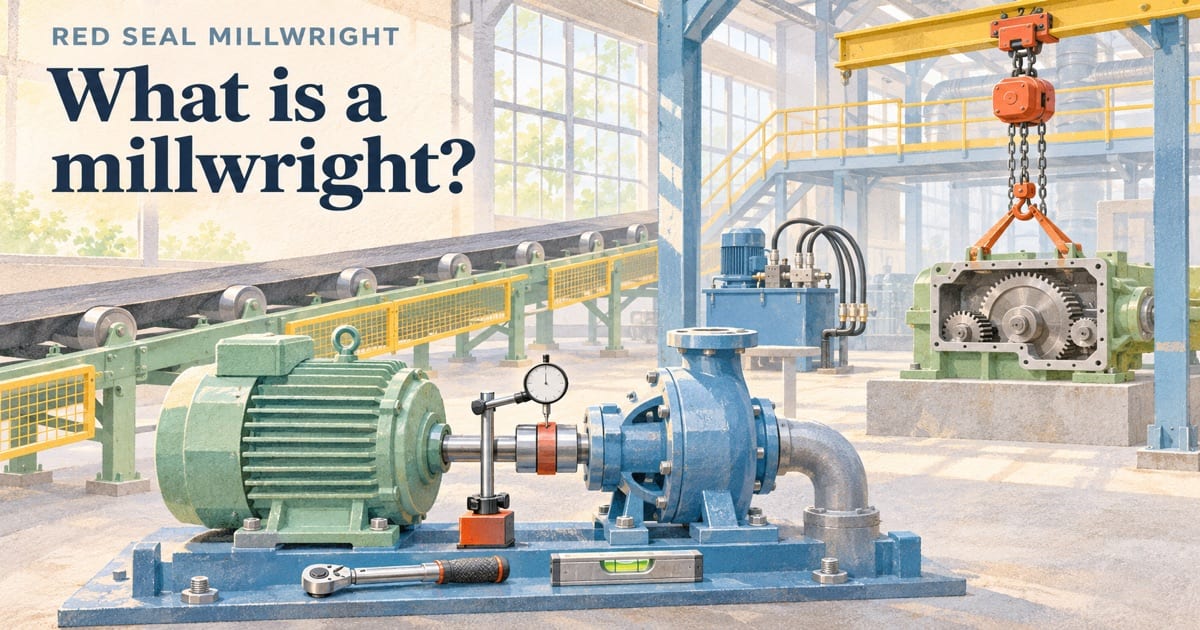
A millwright is a tradesperson who installs, maintains, troubleshoots, overhauls and repairs stationary industrial machinery and mechanical equipment: pumps, fans, conveyors, gearboxes, compressors, presses, generators, hydraulic and pneumatic systems, robotics and other automated equipment. The official Red Seal title for the trade is Industrial Mechanic (Millwright); provincial and territorial titles vary a little. It is a Red Seal trade, and in the National Occupational Classification it is NOC 72400, "Construction millwrights and industrial mechanics".
Job Bank puts the median wage for the trade at $37.00 an hour across Canada, and millwrights work across the many industries that use mechanical moving equipment: mines, petrochemical plants, power plants, factories, forestry operations and food processing plants. This guide explains what millwrights do day to day, the different job titles, where they work, what they earn in each province, the job outlook, and how you become a certified millwright with a Red Seal. "Red Seal certified" is the everyday phrase: in practice you hold a provincial or territorial certificate with a Red Seal endorsement on it.
ProSyllabus is an independent study site. It is not part of the Red Seal Program, Employment and Social Development Canada (ESDC), Job Bank or any provincial or territorial apprenticeship authority. The trade, pay and exam facts on this page come from the official pages listed at the end; the yearly pay figures are our own arithmetic.
Job Bank, NOC 72400: Wages and Job prospects pages. Checked 5 Nov 2026.
What does a millwright do?
Job Bank lists these as the main duties of construction millwrights and industrial mechanics. In plain terms, a millwright:
- reads blueprints, diagrams and schematic drawings to plan the work;
- installs, aligns, dismantles and moves stationary machinery such as pumps, fans, tanks, conveyors, furnaces and generators, using hand and power tools;
- runs cranes, jacks and other hoisting and lifting equipment to put machines and parts in place;
- inspects machines to find faults and malfunctions;
- installs, troubleshoots and maintains power transmission, vacuum, hydraulic and pneumatic systems, and programmable logic controls;
- adjusts machinery and repairs or replaces worn or broken parts;
- uses machine tools such as lathes and grinders to make parts during an overhaul or set-up;
- cleans, lubricates and carries out routine maintenance;
- builds foundations for machinery, or directs others who build them;
- assembles machinery before it is installed, using hand and power tools and welding equipment.
Job Bank, Millwright in Canada, Description (NOC 72400).
The 2026 Red Seal Occupational Standard, the newest national description of the trade, adds the full life of a machine: industrial mechanics (millwrights) assemble, install, fabricate, align, commission, maintain, repair, diagnose, inspect, dismantle, demolish, move and decommission equipment. They also use precision tools. Skilled Trades Ontario lists laser alignment equipment, dial indicators, micrometers and optical levels, and testing such as vibration analysis for preventive and predictive maintenance.
Do millwrights weld?
They may, depending on the job. The Red Seal standard lists welding, cutting, preparing bases for equipment, rigging and machining among the other tasks a millwright may do, and Job Bank lists welding equipment among the tools used to assemble machinery before installation.
Can millwrights do electrical work?
Not as electricians. The Red Seal standard says industrial mechanics (millwrights) "are not electricians" and that provincial and territorial rules restrict or prohibit them from electrical work. In some places they may do limited work on electromechanical parts such as switches, relays and solenoids while installing or diagnosing hydraulic, pneumatic or automated equipment, so a working knowledge of voltage, current, resistance and a multimeter is part of the trade.
Millwright, industrial mechanic, construction millwright: is it the same job?
The names overlap in everyday use. Job Bank groups construction millwrights and industrial mechanics in one occupation (NOC 72400), while the certificate titles and routes vary by province and territory. The Red Seal trade title is Industrial Mechanic (Millwright); Red Seal also lists other titles used in some provinces and territories:
| Trade title | Used in |
|---|---|
| Industrial Mechanic (Millwright) (Red Seal trade title) | Alberta, British Columbia, Manitoba, New Brunswick, Newfoundland and Labrador, Nova Scotia, Prince Edward Island, Quebec, Saskatchewan, Yukon |
| Industrial Mechanic Millwright (other title used) | Ontario |
| Millwright – Industrial Mechanic (other title used) | Northwest Territories, Nunavut |
| Industrial Mechanic (other title used) | Quebec |
Job Bank explains the split inside the occupation. Construction millwrights are employed by millwrighting contractors. Industrial mechanics are employed in manufacturing plants, utilities and other industrial establishments. Both are counted as NOC 72400, along with apprentices and industrial textile machinery mechanics. Job Bank adds that construction millwright certification is available, but voluntary, in Quebec and Ontario, and lists related job titles such as maintenance millwright and plant equipment mechanic under the same occupation.
Where do millwrights work?
The Red Seal standard says industrial mechanics (millwrights) are employed in all sectors of industry that involve mechanical moving equipment, naming mining, petrochemical, power generation, manufacturing, forestry and processing facilities (food and service, among others). Job Bank lists the typical workplaces as industrial establishments, utilities, manufacturing plants and millwrighting contractors.
What the work is like
Job Bank says millwrights usually work 35 to 40 hours a week. The Red Seal standard notes the work "often" involves shift work, and that it can mean confined spaces, working underground in mines, at heights, with heavy equipment and around moving machinery, with a lot of standing, kneeling and lifting. Job Bank lists noise, hazardous machinery, dangerous chemicals, extreme temperatures and outdoor work in some jobs, along with standard and specialized safety equipment.
- 2 timed mocks: 135 questions in 4 hours each
- Weighted task by task as Red Seal publishes
- Your score by Major Work Activity and your time per question
- Every answer explained against its sub-task
- Calculations with every step shown, using Red Seal's formula sheet where it applies
- 4 questions free
Millwright pay in Canada by province
| Area | Low ($/hour) | Median ($/hour) | High ($/hour) | Data year |
|---|---|---|---|---|
| Canada | $24.00 | $37.00 | $52.00 | 2023-2024 |
| Alberta | $27.95 | $42.00 | $59.63 | 2023-2024 |
| British Columbia | $25.25 | $42.00 | $55.00 | 2023-2024 |
| Manitoba | $24.00 | $35.00 | $50.00 | 2023-2024 |
| New Brunswick | $21.00 | $30.00 | $50.43 | 2023-2024 |
| Newfoundland and Labrador | $26.00 | $42.35 | $57.30 | 2023-2024 |
| Northwest Territories | $25.63 | $46.48 | $74.64 | 2024 |
| Nova Scotia | $22.44 | $33.00 | $45.60 | 2023-2024 |
| Ontario | $23.00 | $35.59 | $48.50 | 2023-2024 |
| Prince Edward Island | $22.00 | $30.04 | $37.00 | 2023-2024 |
| Quebec | $24.00 | $33.33 | $49.00 | 2023-2024 |
| Saskatchewan | $26.00 | $42.00 | $57.83 | 2023-2024 |
| Yukon | $22.43 | $42.07 | $58.17 | 2024 |
These are Job Bank's wages for NOC 72400, updated on 19 November 2025. Provincial figures come from Statistics Canada's Labour Force Survey for 2023-2024; the Northwest Territories and Yukon figures are 2024 estimates from a Statistics Canada model (Small Area Estimation), so compare them with the survey-based provincial figures with care. Job Bank shows no figure for Nunavut. Job Bank also says 94.6% of workers in the occupation get at least one non-wage benefit. Its definition is broad: it includes employer contributions to Employment Insurance and the Canada or Quebec Pension Plan and leave entitlements, so the figure does not mean 94.6% have an employer pension or health plan.
Job Bank, NOC 72400, wages updated 19 November 2025. Green: at or above the Canada median of $37.00. Northwest Territories and Yukon: 2024 model estimates; no figure for Nunavut.
What that is a year
The Job Bank figures shown here are hourly wages. At the Canada median of $37.00, a full year of 35 to 40 hours a week works out to about $67,340 to $76,960 before tax (our arithmetic: hourly wage times weekly hours times 52 weeks). Overtime, shift premiums and time off without pay will move a real pay cheque up or down.
Two worked examples (our arithmetic on Job Bank medians)
- Alberta: $42.00 an hour x 40 hours x 52 weeks = $87,360 a year before tax and overtime.
- Ontario: $35.59 an hour x 40 hours x 52 weeks = $74,027 a year, about $13,333 less than the Alberta median on the same hours.
Median, not a starting wage. Your own pay depends on employer, sector, union agreement, shift and experience.
Is millwright a good trade? The job outlook
Job Bank's published three-year outlooks for each province and territory, updated 10 December 2025:
| Province or territory | Published three-year outlook |
|---|---|
| Newfoundland and Labrador | Good |
| Nova Scotia | Good |
| Saskatchewan | Good |
| Prince Edward Island | Moderate |
| New Brunswick | Moderate |
| Quebec | Moderate |
| Ontario | Moderate |
| Manitoba | Moderate |
| Alberta | Moderate |
| British Columbia | Moderate |
| Yukon, Northwest Territories, Nunavut | Undetermined |
Over a longer period, the Canadian Occupational Projections System, as quoted by Job Bank, expects this occupation to face a moderate risk of labour shortage nationally from 2024 to 2033. About 88,500 people worked in it in 2023, and the median retirement age in 2023 was 63.0. Job Bank also gives 36% of workers as aged 50 or over. Those are reasons demand for new millwrights may hold up; they are not a promise of a job in any one town or plant.
The work is changing too. The Red Seal standard points to more automation and robotics in plants, smart sensors and monitoring systems, and predictive maintenance, where reading equipment data and graphs helps spot failures before they happen. With experience, the standard says, millwrights may specialise in vibration analysis, thermography, tribology (fluid analysis) or laser and optical alignment, or move up to mentor, supervisor, planner, superintendent, manager, instructor or trainer.
Skills you need to be a millwright
The Red Seal standard names mechanical aptitude, problem-solving, communication, job planning and organizing, and the ability to do trade calculations as key skills. Good coordination, manual dexterity and spatial visualization matter too, as does the ability to detect malfunctions through sensory tests, which the standard says are often confirmed by condition-based monitoring. The trade overlaps with steamfitter/pipefitters, instrumentation and control technicians, power engineers, welders, machinists and industrial electricians.
How to become a millwright and earn the Red Seal endorsement
Job Bank's summary of the National Occupational Classification says completion of secondary school and training courses or a vocational program is usually required. To be eligible for trade certification you usually need either a three- to four-year apprenticeship or over five years of work experience plus industry courses in industrial machinery repair or millwrighting. The usual path looks like this:
| Step | What happens |
|---|---|
| 1. Find a sponsor and register | Apprenticeship combines workplace training with technical training. Check your province's or territory's apprenticeship authority for its registration and sponsorship requirements. |
| 2. Learn on the job and in class | Most of the time is on-the-job training with a skilled worker, plus technical training in school. Skilled Trades Ontario gives about 8,000 hours (around four years: 7,280 on the job and 720 in school); SkilledTradesBC gives 6,360 work-based hours and 28 weeks of technical training over four years. |
| 3. Write the Red Seal exam | The Red Seal Industrial Mechanic (Millwright) exam has 135 multiple-choice questions. Most provinces and territories use it as the final certification exam. With a pass, and your authority's other requirements met, you get your provincial or territorial certificate with the Red Seal endorsement. |
Hours, levels and school rules differ by province, so check with your own province's or territory's apprenticeship authority before you plan your training.
Already working as a millwright? The trade qualifier route
If you have years of experience in the trade but never did an apprenticeship, there is a second route. Job Bank's summary lists over five years of work experience plus industry courses in industrial machinery repair or millwrighting as the usual requirement on that route; your apprenticeship authority decides whether you qualify. Red Seal calls people on this route trade qualifiers; British Columbia calls it challenging the certification exam. Red Seal says each province's or territory's apprenticeship authority decides who can write the exam, that the rules differ for apprentices and trade qualifiers, and that you must be experienced in the full scope of the trade. SkilledTradesBC, for example, describes a path for people with experience but no Canadian certification to challenge the certification exam, and Skilled Trades Ontario has a Trade Equivalency Assessment for experienced workers.
Do you need a certificate to work as a millwright?
Not everywhere. Job Bank's summary of the National Occupational Classification says industrial mechanic (millwright) certification is "available, but voluntary, in all provinces and territories", and Skilled Trades Ontario calls the trade non-compulsory in Ontario. Ask your provincial or territorial authority what applies where you work.
What the Red Seal actually is
The Red Seal is not a separate licence. Red Seal says tradespeople who pass the Red Seal exam receive a Red Seal endorsement on their provincial or territorial trade certificate. It shows you have the knowledge required by the national standard for the trade, and Red Seal says it "facilitates labour mobility" between provinces. Holders may use the letters RSE (Red Seal Endorsement) after their name. On its own, Red Seal adds, the endorsement does not mean a province has certified you to practise the trade; that is your provincial certificate.
The Industrial Mechanic (Millwright) trade has been designated Red Seal since 1964 and is Red Seal in every province and territory. Note that Red Seal says the current exams are still based on the previous standard (2017); exams based on the 2026 standard are under development. For the exam itself, read our Red Seal millwright exam guide: format, pass mark, the breakdown by task, question types and which standard the current exam follows. The formula sheet guide explains every formula you are given in the exam room.
Try 4 Red Seal millwright practice questions free
These play in our practice player: press Start, answer them, and the result page explains each answer. They are our own independent practice questions, not Red Seal questions; Red Seal does not endorse any test preparation company. For more free questions with worked answers, see our Red Seal millwright practice questions.
Free sample: a few timed questions in our test player, with your score, time per question and the reason behind every answer. Start the free sample.
Getting ready for the Red Seal exam?
Most provinces and territories use the Red Seal exam as the final certification exam for the trade. Our Red Seal Industrial Mechanic (Millwright) Practice Test has two timed mocks of 135 questions in four hours, weighted task by task as Red Seal publishes for the current exam, with every answer explained against its sub-task, so you can see which parts of the trade to review before exam day.
See the Red Seal millwright practice test. Independent practice; not made or endorsed by the Red Seal Program or any apprenticeship authority.
Frequently asked questions
What is a millwright in simple terms?
A tradesperson who installs, maintains and repairs industrial machinery and mechanical equipment, such as pumps, conveyors, gearboxes, compressors and automated equipment. The official Red Seal title for the trade is Industrial Mechanic (Millwright).
What is the difference between a millwright and an industrial mechanic?
The names overlap. Job Bank groups both in one occupation, NOC 72400: construction millwrights are employed by millwrighting contractors, industrial mechanics by plants, utilities and other industrial sites. The Red Seal trade is Industrial Mechanic (Millwright), and certificate titles and routes vary by province and territory.
How much does a millwright make in Canada?
Job Bank's median is $37.00 an hour across Canada (2023-2024 data, updated 19 November 2025), with provincial and territorial medians from $30.00 in New Brunswick to $46.48 in the Northwest Territories (no figure for Nunavut). At 35 to 40 hours a week that is about $67,340 to $76,960 a year before tax (our arithmetic).
Which province pays millwrights the most?
Among the provinces, Newfoundland and Labrador has the highest Job Bank median ($42.35 an hour), then Alberta, British Columbia and Saskatchewan ($42.00 each). The Northwest Territories is higher, at $46.48; Yukon's median is $42.07. Both territorial figures are model estimates for 2024.
Do millwrights weld?
They may, depending on the job. The Red Seal standard lists welding and cutting among the other tasks a millwright may do, along with preparing bases for equipment, rigging and machining.
Is millwright a good trade?
Job Bank rates prospects as good in Newfoundland and Labrador, Nova Scotia and Saskatchewan and moderate in the other provinces, and expects a moderate risk of labour shortage nationally from 2024 to 2033. Every province's Job Bank median is $30 an hour or more.
How long does it take to become a millwright?
Usually three to four years as an apprentice, depending on the province or territory and the program. Skilled Trades Ontario gives around 8,000 hours, and SkilledTradesBC 6,360 work-based hours plus 28 weeks of technical training. Experienced workers may instead qualify to write the exam as trade qualifiers.
Do I need a Red Seal to work as a millwright?
Job Bank describes industrial mechanic (millwright) trade certification as voluntary in all provinces and territories; check with your authority about the rules for your work and location. The Red Seal endorsement goes on your provincial or territorial certificate when you pass the Red Seal exam.
What is on the Red Seal millwright exam?
It has 135 multiple-choice questions spread across the tasks of the trade. Our Red Seal millwright exam guide sets out the format, the pass mark and the full breakdown from red-seal.ca.
Sources
- official — Job Bank: Millwright in Canada, Description (duties, workplaces, work environment, hours)
- official — Job Bank: Millwright in Canada, Wages (NOC 72400; updated 19 November 2025; Labour Force Survey 2023-2024)
- official — Job Bank: Millwright in Canada, Job prospects (by province; Canadian Occupational Projections System 2024-2033)
- official — Job Bank: Millwright in Canada, Requirements (National Occupational Classification employment requirements)
- official — Red Seal: Industrial Mechanic (Millwright) trade page (NOC, designation, trade titles by province)
- official — Red Seal: Red Seal Program (what the Red Seal endorsement is)
- official — Red Seal: Red Seal Exam Preparation Guide (who may write the exam)
- official — Red Seal: Industrial Mechanic (Millwright) - Exam Information (135 questions, breakdown by task)
- official — Red Seal Occupational Standard, Industrial Mechanic (Millwright), 2026 (trade description, work environment, skills, trends)
- official — Red Seal Occupational Standard, Industrial Mechanic (Millwright), 2017 (the standard the current exams are based on)
- official — Skilled Trades Ontario: Industrial Mechanic Millwright trade information
- official — SkilledTradesBC: Industrial Mechanic (Millwright)
official = a document published by the conducting body. reported = a news or coaching site we could not check against an original. Where sources disagree this page says so rather than picking one.


