
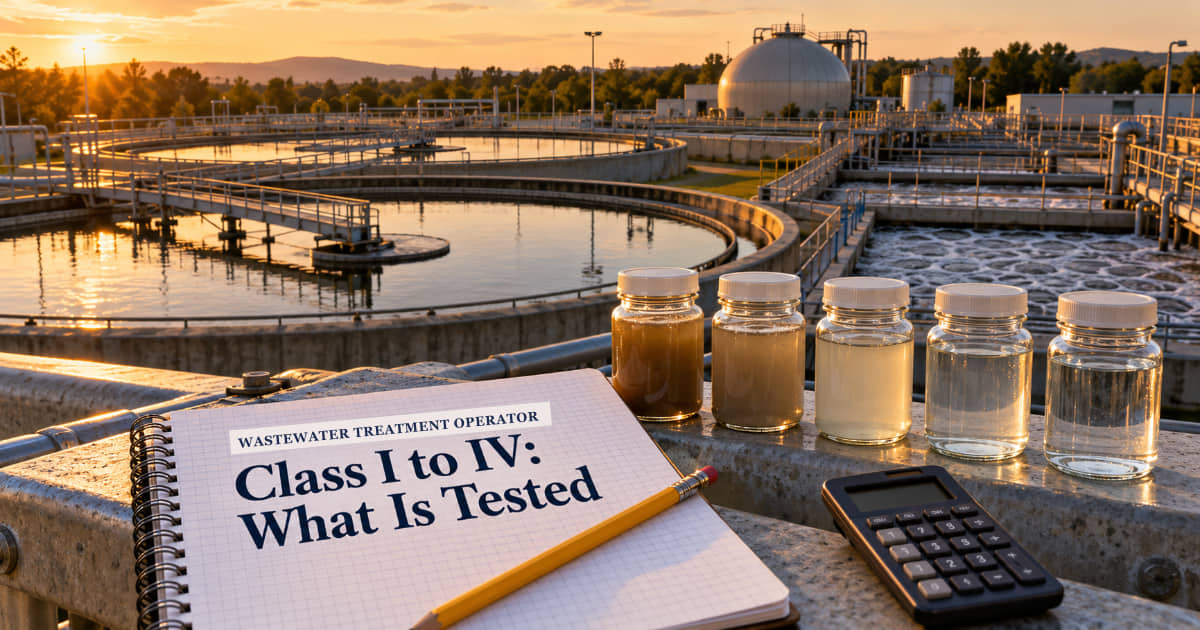
Checked 30 October 2026. Content, counts and rules as in Water Professionals International (WPI) 2025 Need-to-Know Criteria (read 30 October 2026) and exam pages (read 23 October 2026). Each certifier chooses which exams it gives; ask yours about classes, rules, fees and scoring before you apply.
Each certifying authority chooses which exams it gives. WPI (Water Professionals International) offers standardized Wastewater Treatment Operator exams in four classes, I to IV, and some certifiers use them. This guide sets out what those exams cover, how many questions each class has in each area, how the calculation questions and the Formula/Conversion Table work, and how to prepare, and gives you two practice questions. ProSyllabus is an independent study site, not part of Water Professionals International.
WPI 2025 Need-to-Know Criteria, Wastewater Treatment Operator Class I, II, III and IV, read 30 Oct 2026.
Who sets your exam
Each certifying authority chooses which exams it gives. WPI says each certification program has the authority to determine the content of its own exams, not every program uses WPI's testing service (ABC Testing), and not every client that does uses WPI's standardized exams. Contact the certifying authority for your state to find out which exam and which preparation materials apply to you, and ask it about experience requirements and fees too.
WPI cannot tell you your score either. Its FAQ says WPI is not authorized to release scores and that you should contact your certifying authority; its Information for Examinees page says test results are provided to individual examinees only by the certifying authority that issues the certificates. The Need-to-Know Criteria and the WPI exam pages listed under Sources state no passing score and no time limit for the standardized wastewater treatment exams, so we quote neither; ask your certifying authority for both.
FreeTests: Equipment Evaluation, Maintenance, and/or Operation · Treatment Process Evaluation and Adjustment · Security, Safety, and Administrative Procedures
Wastewater Treatment Operator Class I Practice Exam: free sample
Answer 3 questions against the clock, like the real exam. You then see the right answer, the reason and your time on each. About 5 minutes · free · no sign-in.
3 questions to answer▶ Start nowThis one is free · no sign-in neededYour result shows how long each question took you.What the WPI Class I to IV exams cover
Every class is built on the same four content areas. WPI's Need-to-Know Criteria list the job tasks in each area and the number of scored questions the exam devotes to it:
| Content area | Class I | Class II | Class III | Class IV |
|---|---|---|---|---|
| Equipment Evaluation, Maintenance, and/or Operation | 39 | 37 | 30 | 28 |
| Treatment Process Evaluation and Adjustment | 38 | 40 | 40 | 42 |
| Laboratory Analysis | 10 | 10 | 15 | 15 |
| Security, Safety, and Administrative Procedures | 13 | 13 | 15 | 15 |
| Total scored questions | 100 | 100 | 100 | 100 |
Source: the four 2025 Need-to-Know Criteria documents (our table). Each says an exam may also include up to 10 extra unscored pre-test questions that are not identified and do not count toward your score.
WPI sorts questions into two cognitive formats. A recall question asks you to recognize a fact, concept or procedure. An application question asks you to solve a problem, interpret data or calculate; calculation items are part of the application questions. By WPI's counts, the balance shifts as the class rises, and the calculation items move between areas:
| Class | Recall | Application | Calculation items |
|---|---|---|---|
| Class I | 31 | 69 | 10 (9 Treatment Process, 1 Laboratory) |
| Class II | 30 | 70 | 12 (2 Equipment, 6 Treatment Process, 3 Laboratory, 1 Safety and Administration) |
| Class III | 27 | 73 | 14 (4 Equipment, 5 Treatment Process, 4 Laboratory, 1 Safety and Administration) |
| Class IV | 25 | 75 | 16 (7 Equipment, 4 Treatment Process, 5 Safety and Administration) |
WPI 2025 Need-to-Know Criteria, Wastewater Treatment Operator Class I to IV: calculation items per content area, added up.
Counts added up from the per-area tables in the 2025 Need-to-Know Criteria (our arithmetic). The exams are multiple choice; WPI's FAQ says most questions have four options, one correct answer and three distractors.
- 100 original questions, one full exam
- The four content areas in the shares WPI publishes
- 10 calculation questions on the constants of WPI's published formula table
- Your score by content area
- The reason behind every answer
Examples of what each step up adds
The task lists overlap a great deal from class to class, and these Need-to-Know Criteria do not say how a class maps to a plant size or to the experience your state requires. Comparing the four documents, these are some examples of equipment and processes that appear in a class's outline and not in the outline of the class below it:
| Class | Examples the Need-to-Know Criteria add |
|---|---|
| Class II (not in Class I) | Plate and frame presses among the dewatering equipment. The Class II outline also leaves out ponds and lagoons and rapid infiltration basins, which Class I includes. The other change is in the mix of questions: fewer equipment questions, more treatment process and calculation items. |
| Class III (not in Class II) | Anaerobic digestion, with and without cogeneration; thickening (for example DAF, belt and rotary drum) and gravity thickeners; membrane filtration and microscreens; odor control devices such as biofilters and scrubbers; land application of solids. |
| Class IV (not in Class III) | Membrane bioreactors; ozonation; reclaim and non-potable reuse; and advanced analytical methods in the laboratory, such as metals and volatile organic compounds. |
The table highlights selected additions between adjacent class outlines; it is not a complete list, and higher-class outlines also leave out some earlier topics. Confirm with your certifying authority which classes and requirements apply to you.
The calculation questions and the Formula/Conversion Table
WPI designs its standardized exams for use in both the United States and Canada, so calculation items are shown in US standard units first with the metric units in parentheses, and each item can be solved in either set of units on its own.
WPI says its standardized wastewater exams are administered with a Formula/Conversion Table containing mathematical formulas and common abbreviations that may be present on the exam. The Wastewater Treatment, Collection, Industrial Waste, and Wastewater Laboratory table that WPI publishes includes formulas for BOD (seeded and unseeded), loading rate in lb/day and mass in lb, feed rate with purity, chemical feed pump settings, detention time, surface and weir overflow rates, hydraulic and organic loading (including trickling filters and RBCs), food-to-microorganism ratio, mean cell residence time, return sludge rate by solids balance, sludge volume index, solids capture for centrifuges, filter yield, volatile solids reduction, oxygen uptake rates, horsepower and wire-to-water efficiency, and the geometric mean. Its conversion factors include 7.48 gallons per cubic foot, 8.34 pounds per gallon of water, 694 gpm per MGD, 2.31 feet of water per psi and 1% = 10,000 mg/L. Ask your certifying authority which table you will be given.
A made-up ProSyllabus example using the table. The table gives Loading Rate, lb/day = (Flow, MGD)(Concentration, mg/L)(8.34 lb/gal). A plant receives 2.2 MGD of raw wastewater with a BOD of 185 mg/L: (2.2)(185)(8.34) = about 3,394 lb of BOD per day. Leaving out the 8.34 gives 407, a common slip that understates the load more than eightfold.
The rules on exam day
WPI's Information for Examinees page says its exams are given on paper or on computer, and that all of its standardized exams are closed book: no reference material, programmable calculators, computers or cameras are allowed in the examination site. It tells candidates to bring only photo identification, a non-programmable calculator, two sharpened soft-lead (#2 or HB) pencils and an eraser, and to leave anything else outside. If you think a question has an error, WPI's FAQ says to comment on it during the exam.
WPI's wastewater exam page says its new 2025 standardized exams are available in Spanish for Classes I and II. Ask your certifying authority whether it offers them in Spanish.
FreeTests: Equipment Evaluation, Maintenance, and/or Operation · Treatment Process Evaluation and Adjustment · Security, Safety, and Administrative Procedures
Wastewater Treatment Operator Class I Practice Exam: free sample
Answer 3 questions against the clock, like the real exam. You then see the right answer, the reason and your time on each. About 5 minutes · free · no sign-in.
3 questions to answer▶ Start nowThis one is free · no sign-in neededYour result shows how long each question took you.How to prepare
WPI's FAQ recommends that you review the Need-to-Know Criteria for your exam to find the areas where you may need more preparation, and says you may also wish to familiarize yourself with the Formula/Conversion Table provided for your use during the exam. Each Need-to-Know document names the two most prominent reference books for each content area. For Class I, for example, the primary reference is California State University, Sacramento (CSUS) Operation of Wastewater Treatment Plants (8th edition): Volume 1 for the equipment, treatment process and laboratory areas, and Volume 2 for security, safety and administrative procedures, with the Water Environment Federation's Wastewater Treatment Fundamentals I (Liquid Treatment) as a secondary reference for treatment and laboratory questions. For Class II and Class III equipment questions the secondary reference is Wastewater Treatment Fundamentals II (Solids Handling and Support Systems).
WPI lists these as approved reference sources for its standardized wastewater treatment exams and asks operators to use the latest edition: from CSUS Foundation, Office of Water Programs, Operation of Wastewater Treatment Plants (Volumes I and II), Advanced Waste Treatment, Utility Management and Manage for Success; from Michigan State University, Supervisory Management in the Water/Wastewater Field; from the National Environment Training Center for Small Communities, Protecting Your Community's Assets: A Guide for Small Wastewater Systems; from the Water Environment Federation, Operation of Water Resource Recovery Facilities (MOP 11), Safety, Health, and Security Standards for Water Resource Recovery (MOP 1, 7th Edition), Activated Sludge and Nutrient Removal, Wastewater Treatment Fundamentals and Managing the Water and Wastewater Utility; Standard Methods for the Examination of Water and Wastewater; and regulations: the US Code of Federal Regulations, Title 40, and state regulations.
Try two practice questions
These are original questions written to the content areas above. The first is an equipment question; the second is a calculation item of the kind that makes up 10% of a Class I exam. Try each before you open the answer.
Practice question · Class I style · Equipment
A centrifugal pump is pumping much less than normal and the motor current is low. Which cause is most likely?
- A. The impeller or suction line is partly clogged with rags.
- B. The wet well level is higher than usual.
- C. The pump is running at a higher speed than its nameplate speed.
- D. The discharge valve is fully open.
Show the answer and why
Answer: A.
A clogged impeller or suction reduces the water the pump moves, and less water moved means less work, so the motor draws less current. Wastewater pumps often clog with rags. Higher speed or a higher wet well level would increase flow.
An original ProSyllabus practice question, written to the content areas WPI publishes. It is not a WPI exam question. The formula in the calculation question is the one on WPI's Wastewater Formula/Conversion Table; calculated answers and options are rounded to the whole numbers shown.
Practice question · Class I style · calculation
The settled sludge volume after 30 minutes is 270 mL/L and the MLSS is 2,450 mg/L. What is the sludge volume index (SVI)?
- A. 9 mL/g
- B. 110 mL/g
- C. 11 mL/g
- D. 662 mL/g
Show the answer and why
Answer: B.
SVI, mL/g = SSV30, mL/L x 1,000 mg/g / MLSS, mg/L = 270 x 1,000 / 2,450 = 110 mL/g. Common slips: dividing MLSS by the settled volume without the 1,000 gives 9; using 100 in place of 1,000 gives 11; multiplying the settled volume by the MLSS and dividing by 1,000 gives 662.
An original ProSyllabus practice question, written to the content areas WPI publishes. It is not a WPI exam question. The formula in the calculation question is the one on WPI's Wastewater Formula/Conversion Table; calculated answers and options are rounded to the whole numbers shown.
Frequently asked questions
How many questions are on a WPI wastewater treatment operator exam?
Each standardized exam (Class I to IV) has 100 scored questions, according to WPI's 2025 Need-to-Know Criteria. The exam may also include up to 10 unscored pre-test questions that are not identified.
What is the passing score for the wastewater operator exam?
The WPI source documents quoted in this guide do not state a passing score. WPI says it cannot release scores and that results come from your certifying authority, so ask your state or certifying authority what score you need.
How long is the wastewater treatment operator exam?
The WPI documents and pages listed under Sources do not state a time limit. Ask your certifying authority how long you have.
Can I use a calculator?
Yes, a non-programmable one. WPI's Information for Examinees says to bring a non-programmable calculator, and that programmable calculators, computers and cameras are not allowed. The exams are closed book, and a Formula/Conversion Table is provided.
How many calculation questions are there?
WPI's 2025 Need-to-Know Criteria give 10 in Class I, 12 in Class II, 14 in Class III and 16 in Class IV, out of 100 scored questions, shown in US standard units with metric units in parentheses.
Is the wastewater exam the same as the water treatment exam?
No. WPI publishes the Wastewater Treatment Operator exams separately from its water treatment exams, and the wastewater exams have their own Need-to-Know Criteria with four content areas: Equipment Evaluation, Maintenance, and/or Operation; Treatment Process Evaluation and Adjustment; Laboratory Analysis; and Security, Safety, and Administrative Procedures.
Is the exam the same in every state?
No. Each certifying authority chooses its exams, and WPI says not all programs use its testing service or its standardized exams. Ask your certifying authority which classes and requirements apply to you.
More in this series
Sources
- official — WPI: 2025 Need-to-Know Criteria, Wastewater Treatment Operator Class I (exam content, question counts, formats, references)
- official — WPI: 2025 Need-to-Know Criteria, Wastewater Treatment Operator Class II
- official — WPI: 2025 Need-to-Know Criteria, Wastewater Treatment Operator Class III
- official — WPI: 2025 Need-to-Know Criteria, Wastewater Treatment Operator Class IV
- official — WPI: Wastewater Treatment Operator Classes & Examination Guide (standardized exams, Formula/Conversion Table, approved references)
- official — WPI: Standardized Exams (each certifier chooses which exams it gives)
- official — WPI: Information for Examinees (closed book, what to bring, results come from the certifying authority)
- official — WPI: ABC Testing FAQ (multiple choice, four options, scores come from your certifying authority)
- official — WPI: Wastewater Treatment, Collection, Industrial Waste, and Wastewater Laboratory Formula/Conversion Table
- official — WPI: 2025 WPI Standardized Exams, Classes I and II, available in Spanish
official = a document published by the conducting body. reported = a news or coaching site we could not check against an original. Where sources disagree this page says so rather than picking one.
FreeTests: Equipment Evaluation, Maintenance, and/or Operation · Treatment Process Evaluation and Adjustment · Security, Safety, and Administrative Procedures
Wastewater Treatment Operator Class I Practice Exam: free sample
Answer 3 questions against the clock, like the real exam. You then see the right answer, the reason and your time on each. About 5 minutes · free · no sign-in.
3 questions to answer▶ Start nowThis one is free · no sign-in neededYour result shows how long each question took you.

