
Checked 27 October 2026. Rules from OPM’s General Schedule Qualification Policies (General Schedule Operating Manual) and the USAJOBS Help Center articles on experience, degrees, grades, eligibility and writing a resume, read on 27 October 2026. The qualification standard for the series and the job announcement decide what counts for a particular job.
Most federal jobs above the entry level ask for specialized experience, and on a two-page resume it is easy to have the experience and still not show it. This guide explains what OPM means by specialized experience, how the “one year at the next lower grade” rule works at each grade, how a year is counted when you worked part time, and then works through four fictional announcements, turning each one’s wording into resume bullets built only from the applicant’s own facts. Every rule is quoted from OPM or USAJOBS, read on 27 October 2026; our own advice is labelled.
The short answer
Specialized experience is work “in or related to the work of the position”. For most General Schedule jobs above the entry level, you need one year of it at the level of the next lower grade in the job’s normal line of progression.
The announcement spells out what counts for that job. Your resume has to show it in the work you describe, with dates and hours, because “The hiring agency will not make assumptions about what’s in your resume.”
OPM General Schedule Qualification Policies; USAJOBS Help Center, read 27 October 2026.
What specialized experience is
OPM’s qualification policy describes two kinds of experience:
| Kind | OPM’s description |
|---|---|
| General experience | Usually required at grades GS-2 to GS-4, where the knowledge and skills of the job are not a prerequisite but applicants must have shown the ability to acquire them. |
| Specialized experience | Required for positions above the entry level, where applicants must show they can perform the duties successfully after a normal orientation period. It is “typically in or related to the work of the position to be filled.” |
USAJOBS puts it in one line: “‘Specialized experience’ is work experience that’s directly related to the job which you are applying.” OPM adds two points that decide how you should write it. First, if a standard distinguishes the two, “general experience cannot be credited as specialized experience”. Second, titles, military ranks and pay rates are not used to evaluate specialized experience: “The work actually performed by the applicant must be reviewed and evaluated to determine equivalency to a grade.” A title such as “Senior Analyst” proves nothing on its own; the bullets underneath it are the evidence.
OPM also tells agencies that its standards are broad enough to cover hundreds of positions, so “agencies and examining offices must clearly describe the specific experience or education required to qualify for the positions covered by an examination or job announcement.” That is why the specialized experience sentence in your announcement is the one to write to.
- Paste one USAJOBS announcement and your work history
- Pulls out the specialized-experience lines and the grade
- Shows which words of each line your history already uses
- Lists the job details USAJOBS asks for that we could not find
- Writes each relevant job against the specialized experience
- Writes from the facts you give; a check removes lines with a number, acronym or known tool name not in your text
The one-year rule, grade by grade
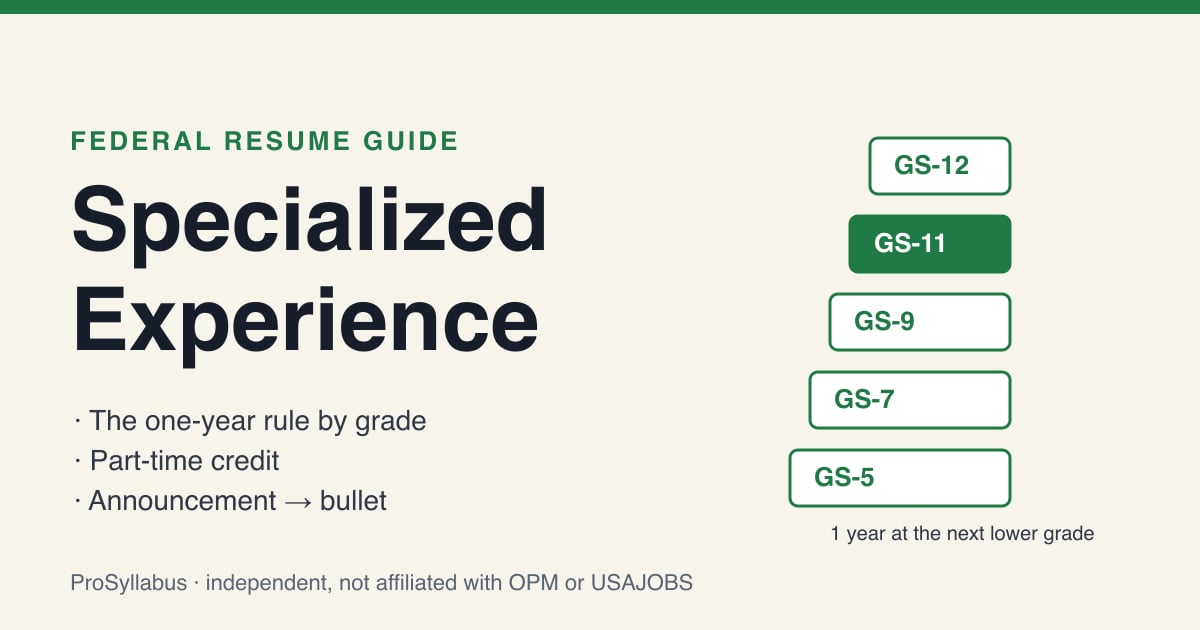
USAJOBS says that to qualify at GS-7 and above “you must have specialized experience”, with at least one year of it equivalent to the next lower grade: for GS-12, one year equivalent to GS-11. OPM’s operating manual states the same rule from GS-5: at GS-5 and above, the qualification standards for most series call for one year of specialized experience equivalent to at least the next lower grade “in the normal line of progression”. Which applies depends on the series: OPM’s education table lets a bachelor’s degree qualify at GS-5 where the standard allows it, while other series ask for a year of specialized experience equivalent to GS-4. The qualification standard and the announcement decide.
“Next lower grade” is not always one grade lower. OPM explains that most two-grade interval series progress GS-5, GS-7, GS-9, GS-11, then GS-12, GS-13 and up, so the year you need is:
| Grade you apply for | Two-grade interval series: one year equivalent to | Or education instead (OPM table, where the standard allows) |
|---|---|---|
| GS-7 | GS-5 | Bachelor’s degree with Superior Academic Achievement, or 1 academic year of graduate education, directly related to the job |
| GS-9 | GS-7 | Master’s or equivalent graduate degree, or 2 academic years of progressively higher-level graduate education, directly related |
| GS-11 | GS-9 | Ph.D. or equivalent doctoral degree, or 3 academic years of progressively higher-level graduate education, directly related; for research positions only, completion of all requirements for a master’s or equivalent degree in a course of study directly reflecting the job-related competencies |
| GS-12 | GS-11 | Research positions only: all requirements for a doctoral or equivalent degree, in a course of study directly reflecting the job-related competencies needed for the position |
| GS-13 and above | The next lower grade (GS-12 for GS-13) | None: “At GS-13 and above, appropriate specialized experience is required for all positions” |
Two exceptions in OPM’s policy are worth knowing. Where an agency has established an even-numbered grade such as GS-8 in the normal line of progression, a GS-9 applicant needs a year equivalent to GS-8, and a year at GS-7 does not qualify. And in one-grade interval series (many clerical and technician jobs), the year is equivalent to the grade directly below; where an organization has no position one grade lower in the normal line of progression, a year at the second lower level is creditable for inservice applicants, while outside applicants still need a year equivalent to at least the next lower level. Our reading: the announcement usually states the grade it is measuring your year against; write to that grade.
One limit in OPM’s qualification policy: “education alone may not be considered qualifying when using a multiple hurdle assessment approach.” Read the announcement’s qualification and assessment sections before you rely on a degree alone.
Education and experience can sometimes be combined. USAJOBS says “Many times you can substitute specialized experience, or experience related to the work to be performed in the job, for education”, and the grade’s rules for combining them are in the qualification standard. Some series also have a basic education requirement that experience cannot replace; the announcement will say so.
How one year is counted
OPM says the year is met by “either 12 months or 52 weeks of creditable work experience, whichever comes first”, and that credit is based on the normal work week, which in most occupations is 35 to 40 hours. Part-time work counts in proportion:
| What you worked | Credited as (OPM proration) | What the resume must show |
|---|---|---|
| 40 hours a week for 12 months | 12 months: the full year | Start and end month and year, and 40 hours per week |
| 20 hours a week for 12 months | 6 months (OPM’s own example) | The same, with 20 hours per week; you would need 24 months at 20 hours for a year |
| Full time for 9 months a year, as a seasonal employee | The same credit as 30 hours a week for a year (OPM’s example) | Each season’s dates, so the months can be added up |
| A job with qualifying and non-qualifying duties | Credited “based on the percentage of time spent on the creditable experience” | Bullets that make the qualifying work clear; our advice: put it first |
| Unpaid or volunteer work | “the same credit as comparable paid experience” | The same details as a paid job: dates, hours, tasks |
OPM: part-time work is prorated in crediting experience; 20 hours a week for 12 months is credited as 6 months. The other rows apply the same proportion to a 40-hour week, our arithmetic; in most occupations OPM puts the normal full-time week at 35 to 40 hours, and the agency applies the norm for the job.
OPM also says credit should generally be based on hours in a pay status, excluding overtime, rather than scheduled hours: overtime does not stretch a year.
This is why OPM and USAJOBS ask for the month and year of each start and end date and the hours you worked per week. Our reading: without them, the agency has no way to count your year, and a resume that leaves them out to save space has saved space in the wrong place.
OPM adds one more limit: no more than one year of experience can be credited for any 12-month period, so two jobs held at the same time do not add up to two years. A second concurrent job counts toward specialized experience only if it contributes significantly to the competencies the position needs.
Time-in-grade is a separate rule
If you are a current federal employee applying for a promotion, there is a second clock. USAJOBS describes time-in-grade as a specified amount of time an employee must spend in a grade before being eligible for promotion (5 CFR 300.604), and says you typically need at least one year in grade. Our reading: specialized experience is about what work you did and at what level; time-in-grade is about how long you held your current General Schedule grade. A promotion announcement can ask for both.
- Paste one USAJOBS announcement and your work history
- Pulls out the specialized-experience lines and the grade
- Shows which words of each line your history already uses
- Lists the job details USAJOBS asks for that we could not find
- Writes each relevant job against the specialized experience
- Writes from the facts you give; a check removes lines with a number, acronym or known tool name not in your text
Announcement → resume bullet: four worked examples
Each example starts from a fictional announcement’s specialized experience sentence, splits it into tasks, lists what the fictional applicant actually did, and then shows a weak bullet and a stronger one. The stronger bullet uses the announcement’s terms only where they describe the applicant’s real work, and adds nothing the facts do not contain. The USAJOBS rule behind them: “Use similar terms and address every required qualification.”
Worked example 1 · GS-7 Program Support Assistant · fictional
| The announcement says | “One year of specialized experience equivalent to the GS-5 level: scheduling meetings and travel for a program office, entering time and attendance records, and tracking correspondence to due dates.” |
|---|---|
| The tasks inside it |
|
| The applicant’s facts | Office assistant at a state agency, 40 hours a week for two years. Booked meetings and travel for nine staff; entered biweekly timesheets for 25 people; kept a spreadsheet of incoming letters and who owed a reply. |
| Before | Provided administrative support to the office, including scheduling and recordkeeping. |
| After | Scheduled meetings and booked travel for 9 staff; entered biweekly time and attendance records for 25 employees; kept a spreadsheet of incoming correspondence and the staff member responsible for each reply. |
| Why it works | The first two tasks appear in the announcement’s terms with their scale. The third stops where the facts stop: the applicant kept a list of who owed a reply, which is not the same as tracking due dates. If they also chased replies before due dates, they can say so; if not, the gap is real and the line must not hide it. |
Worked example 2 · GS-9 Human Resources Specialist · fictional
| The announcement says | “One year of specialized experience equivalent to the GS-7 level: reviewing applications against qualification requirements, answering applicant questions about the hiring process, and preparing referral lists.” |
|---|---|
| The tasks inside it |
|
| The applicant’s facts | HR assistant at a county government, 40 hours a week for 18 months. Screened about 300 applications a quarter against posted minimum requirements; ran the hiring inbox; built the list of eligible candidates sent to each hiring manager. |
| Before | Supported recruitment activities and responded to inquiries. |
| After | Reviewed about 300 applications a quarter against the posted minimum qualification requirements; managed the hiring inbox; prepared the list of eligible candidates sent to each hiring manager. |
| Why it works | “Supported recruitment” could mean anything; the stronger line names two of the tasks with a volume. “Managed the hiring inbox” stays as the facts give it: if the applicant answered applicants’ questions about the process there, they should say so, because that is the second task; if not, it is a gap. It says “posted minimum qualification requirements” because that is what the applicant did; it does not claim federal qualification standards they never used. |
Self-check · one question
A GS-9 announcement asks for one year of specialized experience equivalent to GS-7 “analyzing program data and preparing written reports for management”. Which bullet shows it?
- A. Detail-oriented analyst with strong written communication skills.
- B. Analyzed monthly enrollment data for 14 programs in Excel and wrote the quarterly summary report for the division director.
- C. Responsible for analysis and reporting duties as assigned.
- D. Completed a course in data analysis and report writing.
Show the answer and why
Answer: B.
B names both tasks in the announcement’s terms (analyzing program data, preparing written reports for management) and gives their scale. A describes qualities, not work. C says “responsible for” without saying what was done, and OPM says the work actually performed is what is evaluated. D is training, not experience; the education route has its own rules in the qualification standard. For B to count, the job’s dates, hours and level must also be on the resume.
An original ProSyllabus question built from OPM’s qualification policy and the USAJOBS writing article.
Worked example 3 · GS-11 IT Specialist (INFOSEC) · fictional
| The announcement says | “One year of specialized experience equivalent to the GS-9 level: monitoring security logs to detect incidents, tracking vulnerability findings to remediation, and preparing security documentation.” |
|---|---|
| The tasks inside it |
|
| The applicant’s facts | Security analyst at a regional hospital, 40 hours a week for three years. Watched the SIEM alert queue on day shifts; ran a monthly scan and chased server owners for fixes; updated the incident response plan once a year. |
| Before | Responsible for cybersecurity and compliance. |
| After | Monitored the hospital’s SIEM alert queue on day shifts; ran monthly vulnerability scans and followed up with server owners about fixes; updated the incident response plan each year. |
| Why it works | “Responsible for” says nothing about the work done, and OPM says titles are not used to judge specialized experience: “The work actually performed by the applicant must be reviewed.” The stronger line describes the work, and only the work the facts give. If the applicant also escalated incidents or can count findings closed, those would strengthen it; they are left out because the facts do not say so. |
Worked example 4 · GS-12 Contract Specialist · fictional
| The announcement says | “One year of specialized experience equivalent to the GS-11 level: preparing solicitations, evaluating offers including price analysis, and administering contracts after award.” |
|---|---|
| The tasks inside it |
|
| The applicant’s facts | Buyer at a state university, 40 hours a week for two years. Wrote requests for proposals for services up to $2 million; compared bids and wrote the price comparison memo; handled change orders on 20 open contracts. |
| Before | Managed the full procurement lifecycle for a wide range of contracts. |
| After | Prepared requests for proposals for service contracts of up to $2 million; compared offers and wrote the price comparison memo; administered 20 open contracts, including processing change orders. |
| Why it works | The before line borrows a phrase but shows none of the tasks. The after line keeps the applicant’s own term (“requests for proposals”) beside the announcement’s task, and the scale ($2 million, 20 contracts) lets a reviewer judge the level. Whether a state university buyer’s work is equivalent to GS-11 is the agency’s call; the resume can only describe it clearly. |
What the four have in common, as our advice: one line per task named in the announcement; a number where the applicant has one; the applicant’s own system or document names where they help a reviewer see the level; and no task claimed that the facts do not support.
Free checker
Put your year of specialized experience on the page? Check the details a reviewer needs.
Drop your resume PDF into the ProSyllabus federal resume checker. Your browser reads the file; nothing is uploaded or stored. It tells you the page count, the file size, whether the PDF carries attachments, the font, font sizes and margins it finds, and, for each job it identifies, whether it finds the header details OPM and USAJOBS ask for: title and employer, start and end dates with month and year, hours per week, and series and grade for federal jobs. “Not found” means the checker could not find it, so check those lines yourself. It does not judge your descriptions: the bullets still have to show you can do the announcement’s tasks at the required level.
A planning aid by ProSyllabus, not affiliated with OPM or USAJOBS. The hiring agency decides whether you qualify.
Mistakes that hide specialized experience
| Mistake | Why it costs you |
|---|---|
| A strong title, vague bullets | OPM: titles, ranks and pay rates are not used to evaluate specialized experience; the work actually performed is. |
| Years without months, or no hours per week | OPM and USAJOBS list month and year and hours per week; part-time work is prorated. |
| The qualifying job buried on page two | OPM’s hint: “Prioritize most relevant and recent experience.” Our advice: put the qualifying job first. |
| Announcement words pasted in with no real task behind them | USAJOBS: all information in your resume must be true and accurate; false statements may be grounds for not hiring or for firing, and may be punishable by fine or imprisonment. |
| Coursework listed as if it were work | Coursework alone is not work performed; education counts through the routes the qualification standard allows. Real work in a supervised or work-study program can be credited as experience under OPM’s conditions, but not twice (as education and as experience). |
| Acronyms only your old employer used | USAJOBS: “Use plain language. Avoid using acronyms and terms that are not easily understood.” |
One more point from OPM is reassuring. Agencies are told that applicants “should not be screened out if their background does not reflect 1 year of experience at the next lower grade level performing all of the duties in a position description”. OPM still expects the grade-controlling work at the next lower level and experience showing the other required competencies at the right level, but not every duty in the position description.
Where specialized experience is checked
USAJOBS separates eligibility from qualifications. Eligibility is whether you are in a hiring path the announcement is open to; the agency reviews qualifications only after that. It then rates you against OPM requirements to decide whether you are minimally qualified and ranks you against the job’s factors; some announcements add an assessment. The specialized experience question is answered at the rating step, mostly from your resume, which is why it must stand on its own.
The Merit Hiring Plan essay questions are separate again. The memo said announcements graded GS-05 or above would include four short essay questions, with applicants certifying they used their own words without a consultant or AI. ProSyllabus does not write, suggest or grade them.
To lay all this out on two pages, start from our free federal resume template and see three finished examples at GS-7, GS-11 and GS-12. Everything on federal resumes and USA Hire is on the USAJOBS federal resume exam page.
What we could not find
Not on any official page we read
- A list of which series qualify at GS-5 on general experience and which need GS-4 specialized experience; that is in each series’ qualification standard.
- A rule on how many bullets or words a specialized experience description needs.
- How a particular agency judges whether private-sector work equals a General Schedule grade beyond OPM’s instruction to use the grade-level criteria in the classification standards.
Pages read on 27 October 2026: OPM General Schedule Qualification Policies, the USAJOBS Help Center articles on experience, degrees, grades, time-in-grade, eligibility, writing a resume and false statements, and the Merit Hiring Plan memo.
Frequently asked questions
Frequently asked questions
What does specialized experience mean on a federal resume?
Work experience directly related to the job you are applying for. OPM describes it as experience “typically in or related to the work of the position to be filled”, and each announcement states what counts for that job.
What is one year of specialized experience at the next lower grade?
At least 12 months or 52 weeks of full-time-equivalent work, at the level of difficulty and responsibility of the grade below the one you apply for in the job’s normal line of progression. For GS-12, that is one year equivalent to GS-11.
Does GS-7 need specialized experience?
Yes, for most jobs. USAJOBS says GS-7 and above need specialized experience; in a two-grade interval series the year is equivalent to GS-5. Some standards let education qualify instead, such as a bachelor’s degree with Superior Academic Achievement or a year of graduate study.
Does part-time work count as specialized experience?
Yes, prorated. OPM’s example: 20 hours a week for 12 months is credited as 6 months. That is why each job on your resume needs its hours per week.
Does volunteer work count as specialized experience?
Yes, if it is qualifying. OPM says unpaid or volunteer work is evaluated with the same criteria and given the same credit as comparable paid experience.
Can private-sector experience count as specialized experience?
Yes. OPM says the work actually performed is evaluated to determine its equivalency to a grade, and titles and pay rates are not used. Describe the work clearly enough for the agency to judge its level.
Should I copy the specialized experience wording into my resume?
Use the same terms where they describe work you really did; USAJOBS says to use similar terms and address every required qualification. Never claim a task you did not do: everything on the resume must be true and accurate.
Sources
- official — OPM: General Schedule Qualification Policies (General Schedule Operating Manual): experience requirements, crediting experience, qualifying education, read 27 October 2026
- official — USAJOBS Help Center: How many years of experience do I need to qualify for a job? (edited 10 July 2026), read 27 October 2026
- official — USAJOBS Help Center: Do I need a college degree to qualify for a job? (edited 24 June 2026), read 27 October 2026
- official — USAJOBS Help Center: What grade or pay am I qualified for? (edited 17 June 2026), read 27 October 2026
- official — USAJOBS Help Center: What is time-in-grade? (edited 23 June 2026), read 27 October 2026
- official — USAJOBS Help Center: What is the difference between eligibility and qualifications? (edited 20 October 2026), read 27 October 2026
- official — USAJOBS Help Center: Rating and ranking (edited 24 June 2026), read 27 October 2026
- official — USAJOBS Help Center: How do I write a resume for a federal job? (edited 21 October 2026), read 27 October 2026
- official — USAJOBS Help Center: Signature and false statements (edited 17 June 2026), read 27 October 2026
- official — OPM: Applicant Guidance on the Two-Page Resume Limit (Merit Hiring Plan resources), read 27 October 2026
- official — Merit Hiring Plan, memorandum from the Assistant to the President for Domestic Policy and the Acting Director of OPM (29 May 2025)
official = a document published by the conducting body. reported = a news or coaching site we could not check against an original. Where sources disagree this page says so rather than picking one.


