
Checked 29 September 2026. From the JELET-2026 Information Bulletin (marking, subject split, tie-break) and the 2026 answer-key notices JEEB/Reg-82, 88 and 96/26. The 2027 bulletin may change any of this; it had not been released on 29 September 2026.
JELET looks like an ordinary 100-question OMR paper, but it is marked in two different ways. In Paper I (engineering), 80 questions are Category-1: one correct option, one mark, minus a quarter for a wrong answer. The other 20 are Category-2: one or more correct options, two marks, partial credit and no negative marking. Most candidates lose marks not on the physics or the maths but on misreading those two rules. This guide sets out both exactly as the bulletin states them, works through the cases, and shows what the 2026 key actually looked like.
JELET-2026 Information Bulletin; final answer keys JEEB/Reg-96/26.
- 5 topic tests for JELET, one topic at a time
- Every answer explained in full
- A full report on every attempt — what went wrong and what to revise
- Unlimited retakes — one payment, yours for good
The paper at a glance
| Item | JELET 2026 |
|---|---|
| Mode | OMR (pen and paper), multiple choice, four options per question |
| Date and time | Saturday 13 June 2026, 11:00 to 13:00 |
| Duration | 2 hours |
| Language | English only |
| Paper I (Diploma Engg/Tech, B.Sc., D.Voc, B.Voc) | 100 questions, 120 marks |
| Paper II (D.Pharm) | 100 Category-1 questions, 1 mark each |
| Ranks | GMR from Paper I, PMR from Paper II |
Where other pages get this wrong
Paper II has 100 questions of one mark each — the bulletin sets the count and the mark, so the total is 100.
Commonly published instead: Paper II total "unsettled — 100 or 120".
The JELET-2026 Information Bulletin lists Paper II (Pharmacy) as 100 Category-1 questions carrying one mark each. The bulletin gives the question count and per-question mark rather than a printed total; 100 × 1 = 100 is our arithmetic. The 120 figure belongs to Paper I only, because of its 20 two-mark Category-2 questions.
Paper I: the subject split
| Subject | Category-1 questions | Category-2 questions | Total questions | Marks | 2026 key numbers (Set A) |
|---|---|---|---|---|---|
| Mathematics | 30 | 10 | 40 | 50 | Q1–40 (Cat-2 Q31–40) |
| Physics | 25 | 5 | 30 | 35 | Q41–70 (Cat-2 Q66–70) |
| Chemistry | 15 | 5 | 20 | 25 | Q71–90 (Cat-2 Q86–90) |
| Fundamentals of Electrical & Electronics Engg | 10 | 0 | 10 | 10 | Q91–100 |
| Total | 80 | 20 | 100 | 120 |
Bulletin for the split; the 2026 final key (JEEB/Reg-96/26) for the question numbers in Set A. Mathematics alone is 50 of the 120 marks — more than Chemistry and the electrical paper put together.
Category-1: one answer, quarter-mark penalty
Each Category-1 question has exactly one correct option. A correct answer earns 1 mark; a wrong answer costs a quarter of a mark; a blank earns nothing and costs nothing. Marking more than one option is treated as a wrong answer, so it also costs a quarter.
The quarter-mark penalty sets the break-even for guessing. With four options and no way to eliminate any, a blind guess is worth one chance in four of +1 and three in four of −¼: 0.25 − 0.1875 = +0.0625 on average (our arithmetic). Eliminate one option and the value of guessing among the remaining three rises to about +0.17; eliminate two and it is +0.375. So blind guessing is roughly neutral and informed guessing pays — but every wrong answer also hurts you in the first tie-break, which is fewer total negative marks.
| Category-1 situation | Marks |
|---|---|
| Correct option marked | +1 |
| Wrong option marked | −0.25 |
| More than one option marked | −0.25 (treated as wrong) |
| Left blank | 0 |
| Expected value of a blind guess, 4 options (our arithmetic) | +0.0625 |
| Expected value, one option eliminated (our arithmetic) | +0.17 |
| Expected value, two options eliminated (our arithmetic) | +0.375 |
Category-2: one or more answers, partial credit, no penalty
Category-2 questions have four options, and one or more of them are correct. The bulletin's rule has three parts. Mark all the correct options and nothing else: 2 marks. Mark any incorrect option: 0 for that question, however many correct ones you also marked. Mark only some of the correct options and nothing wrong: 2 × (correct options marked) ÷ (total correct options). There is no negative marking anywhere in Category-2.
| Key has | You mark | Marks |
|---|---|---|
| 1 correct option | that option only | 2 |
| 2 correct options | both, nothing else | 2 |
| 2 correct options | one of them only | 1 |
| 3 correct options | two of them only | 1.33 |
| 3 correct options | one of them only | 0.67 |
| 3 correct options | all three plus a wrong one | 0 |
| any | nothing | 0 |
Worked from the bulletin formula; 1.33 and 0.67 are 4 ÷ 3 and 2 ÷ 3 rounded by us.
The strategic reading is simple. In Category-2, a wrong mark does not subtract, but it wipes out the question. An option you are sure of is worth marking on its own — it earns partial credit if the question has more correct answers. An option you are unsure of is a gamble with the whole question at stake, not a quarter-mark. Because there is no negative marking, never leave a Category-2 question blank if you are confident of even one option.
What the 2026 key looked like
The 2026 final key shows how often "one or more" meant more than one. Of the 20 Category-2 questions in Set A, 12 had two or three correct options; only the other 8 had a single answer. A candidate who assumed one answer per question and stopped after the first would have capped their marks on more than half the section.
| Subject | Category-2 questions (Set A) | With more than one correct option | Count |
|---|---|---|---|
| Mathematics | Q31–40 | Q36 (B, C), Q37 (C, D) | 2 of 10 |
| Physics | Q66–70 | Q66 (B, C, D), Q67 (B, D), Q68 (A, B), Q69 (A, C), Q70 (A, C, D) | 5 of 5 |
| Chemistry | Q86–90 | Q86 (C, D), Q87 (A, B), Q88 (B, D), Q89 (A, C), Q90 (B, C) | 5 of 5 |
| Total | 20 | 12 of 20 |
Our count from the final key, JEEB/Reg-96/26 (13.07.2026). Question 79 (Chemistry, Category-1) was withdrawn and its mark given to every candidate who appeared. The pattern in one year is not a rule for the next, but it is a strong hint that multi-answer questions are the norm in Physics and Chemistry.
Your score, all at once
| Example (our arithmetic) | Marks |
|---|---|
| Category-1: 52 right, 14 wrong | 52 − 3.5 = 48.5 |
| Category-2: 6 fully right | 12 |
| Category-2: partial credit on other questions | 3 |
| Total | 63.5 of 120 (52.9%) |
The calculator starts on this example. The Board publishes no score-to-rank table and no rank list — each candidate gets a rank card — so marks cannot be turned into a rank here.
Ties: the nine-step rule
With 120 marks and quarter-mark steps, ties are common, and the bulletin resolves them by penalty first and subject order second. The first test is not who scored more in Mathematics but who made fewer mistakes overall.
| Step | Paper I tie-break |
|---|---|
| 1 | Less total negative marks |
| 2 | More positive marks in Mathematics |
| 3 | Less negative marks in Mathematics |
| 4 | More positive marks in Physics |
| 5 | Less negative marks in Physics |
| 6 | More positive marks in Chemistry |
| 7 | Less negative marks in Chemistry |
| 8 | More positive marks in FEEE |
| 9 | Less negative marks in FEEE |
| then | Older candidate (date of birth), then lower application number |
Answers are marked by darkening the bubble completely with a blue or black ballpoint pen; a response cannot be changed once marked, so a stray second bubble in Category-1 is a quarter-mark lost.
Paper II uses a shorter rule: less total negative marks, then date of birth, then application number.
Keys, challenges and the result
| Step (2026) | Date | Detail |
|---|---|---|
| Provisional keys published | 24 June 2026 | JEEB/Reg-82/26 |
| Last date to challenge a key | 26 June 2026 | ₹500 per question; one submission only |
| Last date to challenge an OMR response | 4 July 2026 | ₹500 per response; JEEB/Reg-88/26 |
| Final keys | 13 July 2026 | JEEB/Reg-96/26; Q79 withdrawn |
| Result | 14 July (Collegedunia) or 15 July (Careers360) | reported; no official result notice found |
| Score grievance | by email within 24 hours of the result | attach OMR, rank card and your calculation |
| Calculation sheet from the Board | up to 60 days after the result or until counselling ends, whichever is later | ₹500 demand draft |
The two aggregators disagree on the result date and the Board's own result notice is not on its site, so we print both. The 2024 result, by contrast, was declared on 2 August 2024 by an official notice (WBE/Ex-72).
For PwD candidates the bulletin allows 20 minutes of compensatory time per hour — 40 minutes on this two-hour paper — on written application at least 30 days ahead, with the special arrangement available only at the Board office in Kolkata.
| PwD provision (2026 bulletin) | Value |
|---|---|
| Compensatory time | 20 minutes per hour (40 minutes in total) |
| Apply at least | 30 days before the exam, in writing |
| Application fee concession | 40% |
Practise it, don't just read it
Category-2 is where a careful candidate gains on a fast one. Practise stopping after the options you are sure of.
The ProSyllabus JELET library has five 10-question quizzes: Engineering Mathematics, Physics, Chemistry and Electrical and Electronics Engineering (the four Paper I subjects), plus Engineering Mechanics and Computer Fundamentals, which is outside the official syllabus. There is no Pharmacy (Paper II) quiz yet.
Frequently asked questions
What is the JELET marking scheme?
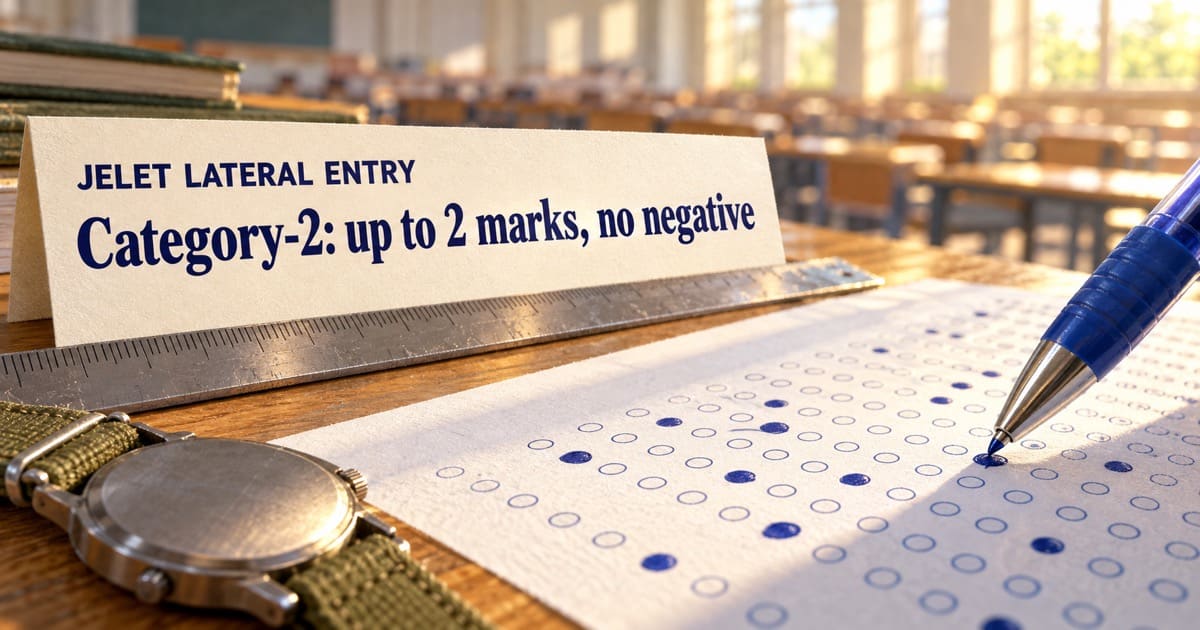
Category-1: +1, −¼ for a wrong answer. Category-2: up to 2 marks with partial credit and no negative.
How many marks is JELET Paper I?
120, from 100 questions: 80 Category-1 and 20 Category-2.
How many marks is JELET Paper II (Pharmacy)?
100 Category-1 questions at 1 mark each, so 100 marks.
Is there negative marking in JELET Category-2?
No. A wrong option makes that question zero, never negative.
What happens if I mark two options in a Category-1 question?
It counts as a wrong answer: −¼.
How is partial marking calculated?
2 × correct options marked ÷ total correct options, if no wrong option is marked.
How long is the JELET exam?
Two hours, 11:00 to 13:00, on OMR sheets, in English only.
Does JELET publish a rank list?
No. Candidates get a rank card; the Board publishes no merit list.
Sources
- official — WBJEEB — JELET-2026 Information Bulletin (18.03.2026)
- official — WBJEEB — Provisional answer keys notice, JEEB/Reg-82/26 (24.06.2026)
- official — WBJEEB — OMR response challenge notice, JEEB/Reg-88/26 (02.07.2026)
- official — WBJEEB — Final answer keys, JEEB/Reg-96/26 (13.07.2026)
- official — WBJEEB — JELET-2024 result notice, WBE/Ex-72 (01.08.2024)
- reported — Collegedunia — JELET exam page (result date 14 July 2026; reported)
- reported — Careers360 — JELET exam page (result date 15 July 2026, "19,336 seats"; reported)
official = a document published by the conducting body. reported = a news or coaching site we could not check against an original. Where sources disagree this page says so rather than picking one.


