
Full Chapter Summary & Detailed Notes - Emerging Trends Class 11 NCERT works on the full page only.Open it →
Complete Summary and Solutions for Emerging Trends – NCERT Class XI Informatics Practices, Chapter 2 – Explanation, Questions, Answers
Detailed summary and explanation of Chapter 2 'Emerging Trends' from the NCERT Informatics Practices textbook for Class XI, covering topics like artificial intelligence (AI) and machine learning, natural language processing (NLP), immersive experiences including virtual and augmented reality, robotics and its applications, big data and its characteristics, data analytics, Internet of Things (IoT) and Web of Things (WoT), smart cities, cloud computing models (IaaS, PaaS, SaaS), grid computing, and blockchain technology. The chapter also includes insights into applications and challenges of these technologies along with exercises and activities for students.
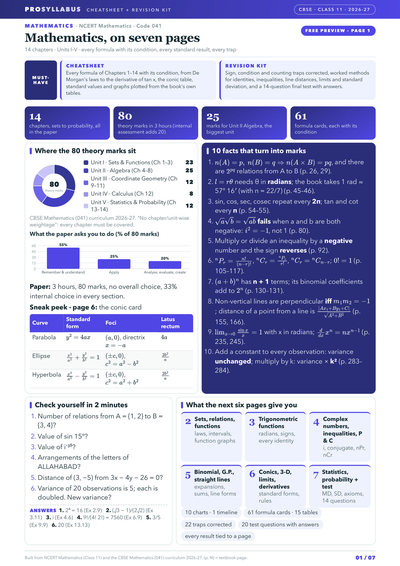
- Marks booster + cheatsheet: key concepts in 2 lines each, common traps
- 25 marks: Unit II, Ch 4–8
- 23 marks: Unit I, Ch 1–3
- Common traps, corrected
- Conic table and standard values
- Graphs plotted from the book's own tables
 Open the full article →
CBSE Class 11 Annual Assessment kits
- Marks booster + cheatsheet: key concepts in 2 lines each, common traps
- 25 marks: Unit II, Ch 4–8
- 23 marks: Unit I, Ch 1–3
- Common traps, corrected
- Conic table and standard values
- Graphs plotted from the book's own tables
- Marks booster + cheatsheet: key concepts in 2 lines each, common traps
- 23-mark block: Ch 1–4
- 17-mark block: Ch 5–7
- Common traps, corrected
- 7 chapters: every solved-example result
- Every unit and dimension, listed
- Marks booster + cheatsheet: key concepts in 2 lines each, common traps
- 20-mark block: Ch 8–12
- 10-mark block: Oscillations and Waves
- Common traps, corrected
- 7 chapters: every solved-example result
- Sound, standing waves and beats covered
- Marks booster + cheatsheet: key concepts in 2 lines each, common traps
- 9 marks each: Atom and Thermodynamics
- Constants and formulas, with page numbers
- Common traps, corrected
- Periodic trends from the real data
- pH, buffers and solubility product
- Marks booster + cheatsheet: key concepts in 2 lines each, common traps
- 10 marks: Hydrocarbons
- Every reaction with reagent and condition
- Common traps that cost marks, listed
- IUPAC naming rules
- Oxidation-number rules and balancing
- Marks booster + cheatsheet: key concepts in 2 lines each, common traps
- 18 marks: Unit V, breathing to hormones
- 15 marks each: Units I and III
- Common traps, corrected
- Five kingdoms classification table
- Physiological numbers, with page numbers
- Marks booster + cheatsheet: key concepts in 2 lines each, common traps
- 44 marks: Unit 2, recording to depreciation
- Journal formats and special purpose books
- Traps from all seven chapters
- Bank reconciliation adjustments
- Depreciation formulas, book's worked figures
- Marks booster + cheatsheet: key concepts in 2 lines each
- 12 exam traps, listed
- Five calculations the paper keeps asking
- Each adjustment: one entry, two effects
- Both formats: trading and P&L, balance sheet
- Yogita illustration solved line by line
- Marks booster + cheatsheet: key concepts in 2 lines each, common traps
- 20 marks: finance and MSME units
- 20 marks: internal and international trade
- Five comparison tables, insurance to retail
- Case cues for each chapter
- Common traps, corrected
- Marks booster + cheatsheet: key concepts in 2 lines each, common traps
- 15 marks: Ch 1–4, data to diagrams
- 7 chapters: every formula, worked numbers
- Common mistakes, corrected
- Book exercise answers included
- Part C project route
- Marks booster + cheatsheet: key concepts in 2 lines each, common traps
- 14 marks: Production and Costs, Unit 6
- 8 marks: Market Equilibrium, Unit 7
- Common traps, corrected
- PPF, TU–MU, MRS and cost table drawn
- Demand and supply schedules from the book
- Marks booster + cheatsheet: key concepts in 2 lines each, common traps
- 20 marks: Empires section
- 20 marks: Changing Cultural Traditions
- 15 marks: Paths to Modernisation, Japan
- 5 marks: map work on the book's maps
- Common traps, corrected
- Marks booster + cheatsheet: key concepts in 2 lines each, common traps
- 8 marks: Climate unit, Ch 7–10
- 5 marks: map work, covered
- 4 marks: ocean data as charts, Unit V
- Heat budget and five air layers as charts
- Common traps, corrected
- Marks booster + cheatsheet: key concepts in 2 lines each, common traps
- 12 marks: Climate, Vegetation (Unit III)
- Full CBSE map-work list, chapter by chapter
- Indus, Ganga, Brahmaputra river systems
- Monsoon mechanism, onset and four seasons
- Common traps, corrected
- Marks booster + cheatsheet: key concepts in 2 lines each
- 4 marks: Map Scale, conversions worked
- 4 marks: Latitude, Longitude and Time
- 4 marks: Topographical Maps, contours
- 5 marks: practical file and viva
- Conical and Mercator's construction steps
- Marks booster + cheatsheet: key concepts in 2 lines each, common traps
- 8 marks together: Citizenship, Nationalism
- 6 marks each: Social Justice, Secularism
- 8 chapters: thinkers and a timeline
- Liberty, equality, justice side by side
- Common traps, corrected
- Marks booster + cheatsheet: key concepts in 2 lines each
- 12 marks: Executive to Judiciary
- Constitution-making timeline
- Institution-by-institution comparisons
- 6 marks: elections, FPTP, PR, reserved seats
- Fundamental Rights and Directive Principles
- Marks booster + cheatsheet: key concepts in 2 lines each, common traps
- 10 marks each: Units 1 and 2
- 20 marks: project work, covered
- Tables: groups, stratification, marriage
- Every thinker and concept of Chapters 1–4
- Common traps, corrected
- Marks booster + cheatsheet: key concepts in 2 lines each, common traps
- 12 marks each: Units 7, 9 and 10
- 7 thinkers: dates, works, examples
- Four Indian sociologists, in tables
- Ideal type, bureaucracy, division of labour
- Common traps, corrected
- Marks booster + cheatsheet: key concepts in 2 lines each
- 11 marks each: Units I and III
- 9 marks: Learning, Unit V
- 8 marks each: Perception and Memory
- Every school with its founder
- Comparisons examiners ask for
- Marks booster + cheatsheet: key concepts in 2 lines each, common traps
- 8 marks: note-making and summary
- 5 poems compared, cross-text themes
- Common traps, corrected
- Poetic devices with short quotes
- Grammar each chapter teaches
- Marks booster + cheatsheet: key concepts in 2 lines each, common traps
- 4-, 3- and 6-mark answers: how to write them
- Plot timeline for every text
- Common traps, corrected
- Every character, with evidence
- Cross-text themes, side by side
- Marks booster + cheatsheet: key concepts in 2 lines each, common traps
- Poetic forms and rhyme schemes
- Devices with short quotes
- Common traps, corrected
- Essay arguments, essay by essay
- Words each chapter teaches
- Marks booster + cheatsheet: key concepts in 2 lines each
- 16 writers placed on one timeline
- 60- and 40-word answer frames
- 8 काव्य पाठ: प्रतीक and काव्य-सौंदर्य
- Lines worth remembering, with page refs
- 12 common mistakes, corrected
- Marks booster + cheatsheet: key concepts in 2 lines each
- 10 marks (2 × 5): answer frames
- 5-mark answers in about 60 words
- 4 lessons: argument, events, characters
- Lines worth remembering, by page
- 12 common mistakes, corrected
- Marks booster + cheatsheet: key concepts in 2 lines each
- 16 writers placed on one timeline
- 40-word and व्याख्या answer frames
- 8 काव्य पाठ: प्रतीक, उपमान, काव्य-सौंदर्य
- Lines worth remembering, with page refs
- 12 common mistakes, corrected
- Marks booster + cheatsheet: key concepts in 2 lines each
- 5-mark, 100-word answer frames
- 9 exercise questions: आवारा मसीहा
- 7 exercise questions: हुसैन की कहानी
- Life events linked to the works
- 12 common mistakes, corrected
- Marks booster + cheatsheet: key concepts in 2 lines each
- 20 marks: grammar, from text words
- Sandhi, pratyaya and lakar examples
- Anvaya and bhavartha answer method
- Source text and author for every lesson
- 10 common errors, corrected
- Marks booster + cheatsheet: key concepts in 2 lines each
- 20 marks: grammar, भाग ग, from the text
- 10 marks: history of literature
- Sandhi, samasa, pratyaya, upapada examples
- Source text and author for every lesson
- Common errors, corrected
- Marks booster + cheatsheet: key concepts in 2 lines each
- Author, genre and characters per lesson
- Couplets explained: Insha and Fani ghazals
- Grammar for Section A
- Letter and advertisement formats
- 10 common mistakes, corrected
- Marks booster + cheatsheet: key concepts in 2 lines each
- 38 marks: the answer frame
- 13 genres, each introduced
- 18 writers and poets: dates and works
- Literary devices (صنعتیں) and key words
- Common mistakes, corrected
- Marks booster + cheatsheet: key concepts in 2 lines each
- 10 marks: literary forms, covered
- 5 geets, each with its poet
- Nazm defined, with its four kinds
- Answer points for the book's questions
- Common mistakes, corrected
- Marks booster + cheatsheet: key concepts in 2 lines each, common traps
- 15 marks: Unit 3, society, law and ethics
- 10 marks: Unit 1, number-system conversions
- Common traps that cost marks, listed
- Truth tables for Boolean logic
- String, list and dictionary methods
- Marks booster + cheatsheet: key concepts in 2 lines each, common traps
- 25 marks: Python, lists, NumPy (Unit 2)
- 10 marks: Computer System (Unit 1)
- Common traps, corrected
- Every list and dictionary method, with output
- SQL queries re-run on the book's tables
- Marks booster + cheatsheet: key concepts in 2 lines each, common traps
- 23 marks: Unit II
- 15 marks: Unit III, health and hygiene
- Common traps, corrected
- Five food groups, RDA and the pyramid
- Nine fibres and the burning test
- Marks booster + cheatsheet: key concepts in 2 lines each
- 15 marks each: Childhood and Adulthood units
- RDAs and diet quantities by age
- Vaccine ages
- Budget steps and investment principles
- Stain-removal methods
- Marks booster + cheatsheet: key concepts in 2 lines each
- 15 marks each: the two theory units
- What to write when asked to appreciate
- Bharhut, Sanchi and the cave sites
- Temple architecture: how a temple is built
- Bronzes and Indo-Islamic buildings
- Marks booster + cheatsheet: key concepts in 2 lines each, common traps
- 20 marks each: Units II and III
- Enzyme kinetics and bioenergetics
- Common traps, corrected
- Mendel-to-operon genetics
- Tables and numbers, each with its page
- Marks booster + cheatsheet: key concepts in 2 lines each, common traps
- 15 marks: language and literature
- 14 marks: the nine darśanas
- Common traps, corrected
- 13 marks: astronomy in India
- 4 chapters, each with answer frames
- Marks booster + cheatsheet: key concepts in 2 lines each
- Frames for news, interview and review
- Inverted pyramid and the six ककार
- Play-writing frame
- Translation rules, with solved examples
- Common mistakes, corrected
- Marks booster + cheatsheet: key concepts in 2 lines each
- 50 marks: games and sports strand
- 25 marks: health and fitness strand
- Eight team games, side by side
- Fitness tests, norms and formulas
- Yoga asanas for wellness
- Marks booster + cheatsheet: key concepts in 2 lines each
- 22 श्रुतियाँ and 10 थाट, defined
- बिहाग, भीमपलासी, भैरवी with बंदिश notation
- तीनताल, एकताल, चौताल: ठाह, दुगुन, चौगुन
- तानसेन, भातखंडे, पलुस्कर profiled
- 12 common mistakes, corrected
- Marks booster + cheatsheet: key concepts in 2 lines each
- वादी-संवादी, पकड़ and बंदिश for each राग
- तीनताल, एकताल, चौताल: ठाह, दुगुन, चौगुन
- तानसेन, भातखंडे, पलुस्कर profiled
- Four classes of instruments, तानपुरा, सितार
- 12 common mistakes, corrected
- Marks booster + cheatsheet: key concepts in 2 lines each
- 6 marks each: all five units
- ठाह, दुगुन, तिगुन, चौगुन written out
- 14 artists with dates
- कुदऊ सिंह and नाना पानसे: two lives
- 14 common mistakes, corrected
Exam alertsGet alerts for CBSE Class 11 Annual AssessmentDates, results and cutoffs, by email when they are announced. Free.Sign in to get alerts
Exam pagePreparing for CBSE Class 11 Annual Assessment?Syllabus, exam pattern, dates and every guide we have on CBSE Class 11 Annual Assessment, in one place.Open the CBSE Class 11 Annual Assessment page →

