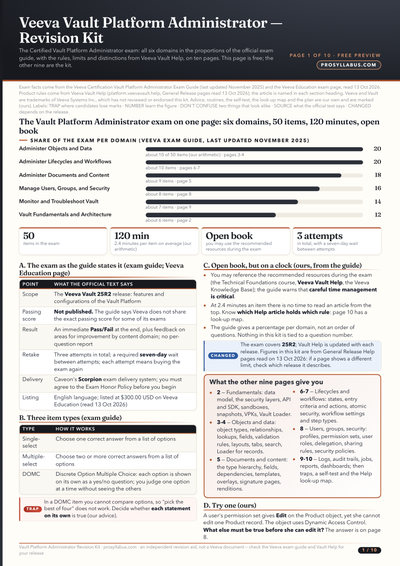

- Cheatsheet + revision sheet: key concepts in 2 lines each, common traps
- Six domains with official percentages
- Parent-child v. reference relationships
- 14 traps and a 16-question self-test
- Entry criteria v. entry actions v. user actions
- Every workflow step type
Veeva certification exams at a glance
| Exam | Fee | Length | Recommended experience |
|---|---|---|---|
| Vault Platform Administrator | 300 USD | 50 items, 120 minutes | 3 to 6 months hands-on with Vault Platform |
| Vault CRM Administrator | 300 USD | 50 items, 120 minutes | 6 to 12 months hands-on with Vault CRM |
| Veeva EDC Study Builder | 300 USD | Timed; duration given in the exam guide | Not stated on the catalogue page |
| Veeva DQS Clinical Data Programmer | 300 USD | Timed; duration given in the exam guide | Not stated on the catalogue page |
| Vault CRM Associate | Included with course enrolment | Timed; duration given in the exam guide | Entry level; taken alongside the course |
| Veeva Quality Associate | Included with course enrolment | Timed; duration given in the exam guide | Entry level; taken alongside the course |
Associate-level exams are bundled into the course purchase, so the 300 dollar fee applies only to the administrator and specialist credentials. Veeva directs candidates to the downloadable exam guide for each credential's subject areas and timing, and the catalogue page does not repeat a duration for every exam.
- Cheatsheet + revision sheet: key concepts in 2 lines each, common traps
- Six domains with official percentages
- Parent-child v. reference relationships
- 14 traps and a 16-question self-test
- Entry criteria v. entry actions v. user actions
- Every workflow step type
Dates and windows
| What | When | Status |
|---|---|---|
| Booking a Veeva certification exam | No fixed sitting dates; purchased from the Veeva Education Services catalogue | Rolling |
| 2026 Certification Maintenance Program fee | 300 USD, due 30 April 2026 | Closed |
| Maintenance exam for an existing credential | Any time before the credential's own expiration date | Rolling |
| Credential extension on passing maintenance | Exactly one year from the original expiration date | Confirmed |
| Vault 26R1 general release | 17 April 2026 to general release PODs | Confirmed |
| Vault 26R2 general release | 7 August 2026, listed as proposed | Tentative |
| Result notification | Immediately at the end of the sitting, as pass or fail | Rolling |
There is no exam calendar to plan around. The only hard dates in the Veeva certification year are the maintenance fee deadline and the Vault general release dates, which set what the current exam and maintenance content is written against.
- Cheatsheet + revision sheet: key concepts in 2 lines each, common traps
- Six domains with official percentages
- Parent-child v. reference relationships
- 14 traps and a 16-question self-test
- Entry criteria v. entry actions v. user actions
- Every workflow step type
What this means for your preparation
The mistake that costs most is misreading the maintenance programme. The 300 dollar Certification Maintenance Program fee and the maintenance exam are two separate obligations, and Veeva explicitly warns that paying the fee without holding an active credential buys Learning Library access only and does nothing for renewal. Lapse the credential and no amount of retrospective payment restores it; the route back is the full 300 dollar certification exam.
Sit the maintenance exam early, not late
Veeva states that passing a maintenance exam extends the credential exactly one year from the original expiration date rather than from the date you sit it. That removes the usual incentive to wait until the last week. Sitting three months early costs nothing in coverage and leaves room to retake if the result is a fail, whereas sitting in the final days leaves no margin at all. Since the maintenance exam is open book and up to 20 questions, the realistic preparation is a read through the release notes for the current Vault releases and the Learning Library material, not a full re-study of the original certification syllabus.
Discrete Option Multiple Choice changes technique
Alongside single-select and multiple-select items, Veeva uses Discrete Option Multiple Choice, in which options are shown one at a time and answered yes or no. There is no full option list to compare against, so the elimination habit that works on conventional multiple choice does not apply. Each option has to be judged on its own merits as a true or false statement about the product. Practically, that rewards precise knowledge of what a specific configuration setting or object type actually does, and punishes the pattern-matching approach of picking the longest or most detailed-looking answer. Practice questions written in conventional format will not prepare you for it.
Pace against 50 items in 120 minutes
Both administrator exams are published at 50 items in 120 minutes, which is a little over two minutes per item. That is generous by comparison with most vendor certifications, and the reason is the item mix: multiple-select questions requiring two or more correct answers and DOMC sequences both take longer than a single-select. The planning implication is that the timing pressure is not uniform. Budget close to a minute for straightforward recall items and bank the difference for the multiple-select configuration scenarios, which are where the time actually goes. Veeva publishes each exam's subject areas in a downloadable exam guide, and that is the document to weight revision against.
No numeric pass mark to aim at
Veeva reports results as pass or fail with no exact score, and supplies a breakdown by content domain instead. There is therefore no published threshold to target and no way to know how close a fail was overall. The useful signal is the domain feedback: it identifies which subject areas dragged the result down, and a retake should be built around those domains rather than a general re-read. Because there is no score to optimise, the sensible strategy is broad competence across every listed subject area rather than depth in a favoured one, since the domain-level reporting suggests weakness in any single area is visible and consequential.
Track the release, not the calendar
Certification content follows the product, and the product moves on a published release schedule. Vault 26R1 reached general release PODs on 17 April 2026 and 26R2 is listed with a proposed general release of 7 August 2026. An administrator certified against an earlier release should assume that configuration behaviour, feature names and admin console paths have moved at least twice since. The maintenance exam exists precisely to cover that drift, so the sequence that works is to read the general release notes as each release lands, keep notes on what changed in your own area, and use those notes for the open-book maintenance sitting.
Common questions
Frequently asked questions
How much does a Veeva certification exam cost?
The Vault Platform Administrator, Vault CRM Administrator, Veeva DQS Clinical Data Programmer and Veeva EDC Study Builder exams are each listed at 300 US dollars on Veeva Education Services. The Vault CRM Associate and Veeva Quality Associate exams have no separate fee and are included with enrolment on the associated course. Separately, the annual Certification Maintenance Program fee is also 300 US dollars, and the certification collection page gives 30 April 2026 as the due date for the 2026 cycle.
When can I schedule a Veeva Vault certification exam?
There are no published sitting dates. Exams are purchased from the Veeva Education Services catalogue rather than booked against a calendar, and the pages consulted do not name a proctoring partner or a scheduling window. All exams are timed, and results are returned immediately as a pass or fail at the end of the sitting. In practice that means the constraint on when you certify is your own readiness and your employer's budget approval, not an exam schedule.
What is the pass mark for the Vault Platform Administrator exam?
Veeva does not publish one. Candidates receive a pass or fail outcome with no exact numerical score, together with performance feedback broken down by content domain. The exam itself is 50 items in 120 minutes and Veeva recommends three to six months of hands-on Vault Platform experience beforehand. Because there is no threshold published, the only actionable feedback after a fail is the domain breakdown, which should determine what a retake focuses on.
What does the Certification Maintenance Program fee cover?
The 300 US dollar fee gives access to the 2026 Certification Maintenance Program, which includes the Learning Library and the maintenance exams for the credentials you hold. One payment covers renewal access for all held credentials rather than one fee per credential. Veeva stresses that eligibility is the holder's responsibility to verify before paying, because the fee grants Learning Library access only if you do not hold active credentials, in which case it does not count toward renewal. The fee is non-transferable and non-refundable.
How does Veeva recertification work?
Through maintenance exams rather than a full re-sit. Maintenance exams are open book and up to 20 questions in length, and must be completed before the credential expires. Passing extends the credential exactly one year from the original expiration date, so there is no penalty for sitting it early and no gain from leaving it late. The content tracks the Vault general releases, with 26R1 reaching general release PODs on 17 April 2026 and 26R2 listed as proposed for 7 August 2026.
What question formats does Veeva use?
Three. Single-select multiple choice, multiple-select multiple choice where two or more answers are correct, and Discrete Option Multiple Choice, in which options are presented one at a time for a yes or no response. The DOMC format is the one that most surprises candidates, because you cannot see the whole option set and cannot use elimination. Each option has to be assessed independently as a correct or incorrect statement, which favours precise product knowledge over comparative reasoning between answer choices.


