
Checked 6 November 2026. Ontario steps and values are from the Official Air Brake Handbook on ontario.ca (read 5 November 2026). Saskatchewan steps and values are from SGI’s online Air Brake Manual (pages marked Rev. 2022) and BC items from ICBC’s pre-trip test forms MV2933 and MV2950 (January 2023), both read 6 November 2026. Alberta values are from the April 2012 instructor manual and its practical test form; Alberta schools may use a newer form. Manitoba and BC technical limits (pressures, leak rates, stroke) were not available to us and are not given; ICBC’s forms list the scored inspection items and demerit limits, but not the technical limits. Check your own province’s manual before your test.
An air brake pre-trip inspection is the check you make before you drive a vehicle with air brakes. You look at the parts, then you test the system: the governor, the air-loss (leak) rate, the low-air warning, the spring brakes, tractor protection and the build-up time. Then you check brake adjustment by measuring the pushrod stroke at each brake. It is also what you show the examiner on an air brake practical test.
This guide gives the steps in order as one printable checklist, the pass values side by side for Ontario, Saskatchewan and Alberta, how to measure pushrod stroke, how a manual slack adjuster is adjusted, and how the manuals differ on who adjusts brakes. For the written (knowledge) test, see our free air brake practice test guide.
ProSyllabus is an independent study site. It is not part of any provincial government, SGI, ICBC or any air brake course provider, and this page is not an official checklist. The steps and values are quoted or summarised from the official manuals and forms listed at the end. Your course, examiner and employer may use a different order; follow theirs.
Ontario Official Air Brake Handbook (5 Nov 2026); SGI Air Brake Manual (6 Nov 2026); Alberta Air Brake Manual for instructors (April 2012).
- 3 practice tests of 30 questions
- A practice set for each part of the air brake system
- Alberta and Ontario test figures, each named
- Every explanation names its official source: a handbook, manual or provincial government page
- Your score by topic and your time per question
- 4 questions free
Before you start: tools and safety
The tools you must bring differ by province. Ontario’s handbook lists what to bring to its practical test (the table below). ICBC’s pre-trip test forms list “has appropriate tools” as a scored item, which can cost you a demerit (a mark against you), and name a timer, flashlight, pry bar and wrench (the Class 2 and 4 form leaves out the flashlight).
| Item | Why you need it |
|---|---|
| Wheel chocks or blocks | You release the spring brakes during the tests. Chocks stop the vehicle rolling. |
| Stopwatch or a watch with a second hand | For the build-up time and the air-loss test. |
| Chalk, soapstone or a marker | To mark the pushrod for the stroke measurement. Ontario says the marks must be narrow and precise. |
| A ruler or stroke measuring device | To measure applied pushrod stroke. |
| A way to hold the brake pedal down | For the stroke check and the leak test if you work alone. |
| The size and type of every brake chamber | The adjustment limit depends on both. Ontario says you are most likely to learn the chamber size from your employer or the vehicle owner’s manual; you must also know the type. |
| Protective eyewear and headgear | You work under the vehicle and near air lines. Ontario’s list includes both (they and the marker and measuring device do not apply to motor coaches). |
Saskatchewan has one extra rule for its test: SGI says you complete the practical demonstration without any assistance and without using a checklist, on air brake equipment that you provide. So practise until you know the order by heart.
FreeTests: Air supply: compressor, governor, tanks, dryer · Spring parking and emergency brakes · Trailer brakes and tractor protection · Pre-trip inspection and air brake tests
Canada Air Brake Practice Test: free sample
Answer 4 questions against the clock, like the real exam. You then see the right answer, the reason and your time on each. About 5 minutes · free · no sign-in.
4 questions to answer▶ Start nowThis one is free · no sign-in neededYour result shows how long each question took you.The air brake pre-trip, step by step
This is the order we recommend for a daily check. It joins Ontario’s mechanical and functional checklists with SGI’s pre-trip procedure. On a test, follow your province’s order, and say what you are checking at each step: Ontario’s handbook asks for this at the practical examination.
Air brake pre-trip checklist (print this part)
- Secure the vehicle. Park on level ground, apply the spring (parking) brakes and put wheel chocks or blocks in place. Ontario’s handbook says never to leave the driver’s seat or get under the vehicle unless the spring brakes are applied or the wheels are blocked. Alberta’s manual says leaving the transmission in gear does not replace chocks. Some brake parts cannot be reached safely without a hoist, pit or ramp: do not crawl where you cannot work safely.
- Under the hood. With the engine stopped, check that the compressor and its brackets and fasteners are secure. If it is belt-driven, check the drive pulley and the belt (not loose, cut or frayed, and properly tight). Check the air lines you can reach.
- Drain the tanks. Ontario’s test is done with the pressure in the normal range: drain the supply (wet) tank first until only clean air comes out, then drain the others, and check that every drain valve works. Report a significant amount of moisture from any tank other than the supply tank, and any oil in another tank. Visible oil in the supply tank should be reported or repaired. A sudden increase in moisture or oil, and any drain valve that does not work, must be reported and repaired. (SGI simply asks for the tanks to be drained, if possible, before you start.)
- At each wheel. Foundation brakes: no damaged, missing or malfunctioning parts; linings not cracked, loose, missing or contaminated, not below the minimum thickness; they must touch the drum when the brakes are applied and be clear of it when the brakes are released. Brake chambers: no cracks and no holes that were not made by the manufacturer. (Listen for chamber leaks later, when the spring brakes are released and the service brakes are applied: Ontario says that is when chambers are checked for leaks.) On a steering axle, both chambers must be the same size and both slack adjusters the same effective length (the distance from the centre of the camshaft to the clevis pin). Drums or rotors: not cracked or broken. Hoses and lines: no leaks or damage, and no improper fittings or repairs. Look closely at worn lines even if they do not leak: Ontario says a line is defective when the damage reaches the reinforcing or inner layer. Air tanks and their brackets: secure when you look and when you try to move them.
- Build pressure and check the governor. With the wheels chocked, release the spring brakes. Start the engine. Watch the gauges until the pressure stops climbing (the air dryer purge also tells you): that is cut-out. Then press and release the brake pedal until the pressure starts to climb again: that is cut-in.
- Air-loss (leak) test. With a trailer, first charge the trailer and release its brakes too, so the whole combination is tested. Release the spring brakes and shut off the engine with the pressure in the normal operating range (Ontario) or at maximum pressure (SGI). Press and hold the brake pedal fully applied. Wait for the first drop to settle, then time the loss. Listen for leaks, including at the brake chambers, while you hold.
- Low-air warning. Start this test with the pressure above 90 psi (Ontario). Key on. Press and release the brake pedal again and again (“fanning”). Watch both the primary and the secondary gauges and note the pressure when the warning light or buzzer comes on.
- Spring brake control. Keep fanning. Note when the parking brake button pops out. On some vehicles it never does: then, with the wheels still blocked, check at a rear wheel that the brakes have applied (SGI: the slack adjuster and pushrod should be at a 90-degree angle).
- Tractor protection (towing vehicle). Rebuild the pressure to the normal range. Close (pull out) the trailer supply valve, disconnect the trailer service-line coupler from the trailer, or from its storage (dead-end) coupler if no trailer is attached, and put it where you can see it, then press and hold the brake pedal: no air may come out of the service line. (Ontario: if there is a concern that the vehicle has no anti-compounding valve, make sure the vehicle is secure and release the spring brakes before you apply the service brakes. If you do not know whether your vehicle has this valve, ask your instructor or employer before this step.) Reconnect the line. With a trailer, then open (push in) the trailer supply valve to fully charge the trailer, with the pressure in the normal range, and close it again: the trailer spring brakes must apply by themselves.
- Build-up time. Lower the pressure (Ontario: below 80 psi), run the engine at the speed your manual gives, and time the rise over the range your manual gives. With a trailer, keep the trailer supply valve closed so you time the truck only.
- Brake adjustment. Ontario’s method: at 90 to 100 psi, engine off, spring brakes released, service brakes fully applied, measure the applied pushrod stroke at each brake you can reach safely, and compare it with the limit for that chamber (see the next section). Some brakes have covers that hide the linkage; use the method for your vehicle and province. Alberta’s manual says not to leave the ignition key in the vehicle while you do this. (SGI checks adjustment earlier, right after building pressure.)
- Final moving checks. If an earlier check found a defect, stop here: do not move the vehicle; report the defect and have it repaired first. Otherwise, make sure every line is connected, the trailer is charged and the pressure is back in the normal range. Put the parking (spring) brakes on and remove the chocks. Where the system lets you test one vehicle at a time, test the chosen vehicle with the other vehicle’s brakes released; Ontario prefers testing the towing vehicle’s spring brakes, and says separate testing may not be possible on some combinations. Gently apply engine power in a low gear: Ontario says the vehicle may rock, but it must not move significantly. SGI’s combination procedure also tests the trailer emergency brakes alone (trailer brakes applied, truck parking brakes released, gently pull ahead), then recharges the trailer and tests the truck parking brakes only. Then release all parking brakes, move off slowly and test the trailer brakes alone with the hand valve, if fitted. Then, separately, move ahead slowly and make a foot brake application. SGI repeats the hand and foot valve tests on both sides of the unit, and in winter checks for frozen wheels.
If anything fails, report it and do not drive the vehicle until it is repaired. Ontario says drivers must report defects and that it is illegal to drive a defective vehicle.
Order and wording combined from Ontario’s Official Air Brake Handbook, SGI’s pre-trip procedures and Alberta’s air brake manual. ICBC’s forms were used only to cross-check the scored item names, not the order. The published procedures differ; for your test, follow your course and examiner. The pass values are in the table below.
The order is not the same everywhere. SGI checks brake adjustment early, before the pressure tests; among its governor, leak, low-air and build-up tests, the governor comes first and build-up last. Ontario’s functional checklist starts with the low-air warning and the build-up time. Alberta’s 2012 practical form starts with the tractor protection system, with the engine off and the key in the “run” position. The provinces test many of the same core functions, but their forms and checklists do not cover exactly the same items.
Pass values by province
These are the numbers you must know. They are not the same in every province, so learn your own manual’s values. Ontario’s full test-by-test table is in our Ontario air brake test guide.
| Test | Ontario | Saskatchewan | Alberta (2012 form) |
|---|---|---|---|
| Governor cut-out | Within the maker’s range and not above 145 psi (1000 kPa). The chapter’s key points also call cut-out below 100 psi (690 kPa) defective | 120 to 145 psi (828 to 1,000 kPa) | 120 to 135 psi (828 to 931 kPa) |
| Governor cut-in | Not below 80 psi (552 kPa); normally 20 to 25 psi below cut-out | Usually 20 to 25 psi below cut-out, but at least 100 psi (690 kPa) | 20 to 25 psi (138 to 172 kPa) below cut-out |
| Air loss, brakes applied, engine off (after the first drop) | 1 minute: 3 psi (21 kPa) truck, tractor or bus; 4 psi (28 kPa) with a trailer; 6 psi (41 kPa) with two or more trailers | 1 minute: 1 psi for a single unit; 4 psi (28 kPa) for a combination | 2 minutes: 4 psi (28 kPa) for a power unit, plus 2 psi (14 kPa) for each trailer |
| Low-air warning | Watch both gauges. Fails if it does not come on by 55 psi (380 kPa); most come on above 60 psi | Must operate at a minimum of 60 psi (414 kPa) | Must come on by 60 psi (414 kPa) |
| Build-up time | 85 to 100 psi (587 to 690 kPa) in 2 minutes or less, at 600 to 900 rpm | 85 to 100 psi (586 to 690 kPa) in less than 2 minutes, at 600 to 800 rpm | 50 to 90 psi (345 to 621 kPa) within 3 minutes, at a fast idle around 1200 rpm |
| Trailer supply (red) valve | No pressure given. When you close the valve on a fully charged trailer, the trailer spring brakes must apply | During the low-air fanning, it should shut off air to the trailer at a minimum of 20 psi (138 kPa) | In the tractor protection test (engine off, both trailer lines disconnected, red button pushed in), it should pop out at 40 to 60 psi (276 to 414 kPa) or higher |
| Parking (yellow) valve | No pop-out pressure given; the spring brakes must hold the vehicle | May pop out (no pressure given); if not, check at a rear wheel that the brakes applied | Must pop out at 20 to 45 psi (138 to 311 kPa) |
Ontario Official Air Brake Handbook (read 5 Nov 2026); SGI Air Brake Manual, single-unit pre-trip procedure (read 6 Nov 2026); Alberta Air Brake Practical Test form DPLS0003 (April 2012). Bar length shows psi lost per minute; Alberta’s 2-minute figure is divided by 2 (our arithmetic).
British Columbia and Manitoba: ICBC’s pre-trip test forms score build-up time, governor operation, push rod travel, the leakage test and brake adjustment, but the forms do not print the pressure or pushrod-stroke pass values, and we could not read ICBC’s or Manitoba’s current manual in full. Take the values from your course or your province’s manual, not from another province’s table.
Brake adjustment: how to measure pushrod stroke
As the brake linings wear, the pushrod has to travel further before the brake works. You cannot feel this while driving: Alberta’s manual says drivers may not notice a change in braking under normal conditions, and that brakes which feel good may fail when more is needed of them. Ontario’s handbook says pushrod stroke must be checked at least daily, and that measuring the applied pushrod stroke is the most reliable method.
Ontario’s step-by-step method
| Step | What you do |
|---|---|
| 1 | Chock the wheels. |
| 2 | Make sure the pressure is above 90 psi (621 kPa) and release the spring brakes. |
| 3 | Method 1: mark the pushrod where it leaves the chamber (or at a fixed point). Method 2: measure from a point on the pushrod to a fixed point on the chamber. This is measurement 1. |
| 4 | Bring both gauges to 90 to 100 psi (621 to 690 kPa): run the engine to raise the pressure, or pump the brake pedal (press and release it again and again) to lower it. |
| 5 | Shut off the engine. Press the brake pedal fully down and use a suitable means to hold it applied, so you can leave the cab to measure. |
| 6 | Method 1: measure from the same chamber edge or fixed point you marked against, to your mark. Method 2: measure again (measurement 2) and subtract measurement 1. The result is the applied pushrod stroke. |
| 7 | Find the chamber size (such as 20, 24 or 30) and type (standard or long-stroke), then its adjustment limit. |
| 8 | Any brake whose stroke is over the limit is defective. Ontario’s Highway Traffic Act prohibits driving with a brake out of adjustment. |
A full brake application matters. Alberta’s manual says a partial application does not push the rod out to its full applied stroke, so the measurement would look better than it is.
Know your chamber type
The limit depends on the chamber. Ontario’s handbook says long-stroke chambers can be identified by square ports where the air lines connect (standard chambers have round ports), a trapezoidal tag under the clamp bolt that shows the maximum stroke (not the adjustment limit), and markings on the body. Its chart also lists “L” long-stroke chambers, marked by an L in the cover and a stroke tag. So check every marking and tag, not only the port shape, and use the chart for that exact type. Alberta’s manual says Type 20 chambers are usual on steering axles and Type 30 on load-bearing axles. Three common limits, from Ontario’s chart (Alberta’s manual gives the same out-of-service values):
| Chamber | Adjustment limit (applied stroke) | Where you usually see it |
|---|---|---|
| Type 20, standard | 1-3/4 in (45 mm) | Steering axle |
| Type 30, standard | 2 in (51 mm) | Drive and trailer axles |
| Type 30 LS (long stroke) | 2-1/2 in (64 mm) | Drive and trailer axles |
The full chart, with sizes 6 to 36, is printed in Ontario’s handbook and in our Ontario air brake test guide.
SGI’s check and the 90-degree rule
SGI’s manual describes the same marking method: mark the pushrod at the chamber with the brakes released, make a full application, mark it again, and measure between the marks. It says to compare the stroke with a recommended maximum of 1-1/2 in (38 mm) to determine whether adjustment is necessary. This is SGI’s figure for its check, not one of Ontario’s chart limits. SGI also checks the angle between the slack adjuster arm and the pushrod: more than 90 degrees with the brakes released, no less than 90 degrees with the brakes applied at 20 psi (138 kPa), and the same travel on every slack adjuster.
Manual slack adjusters: how adjustment is done
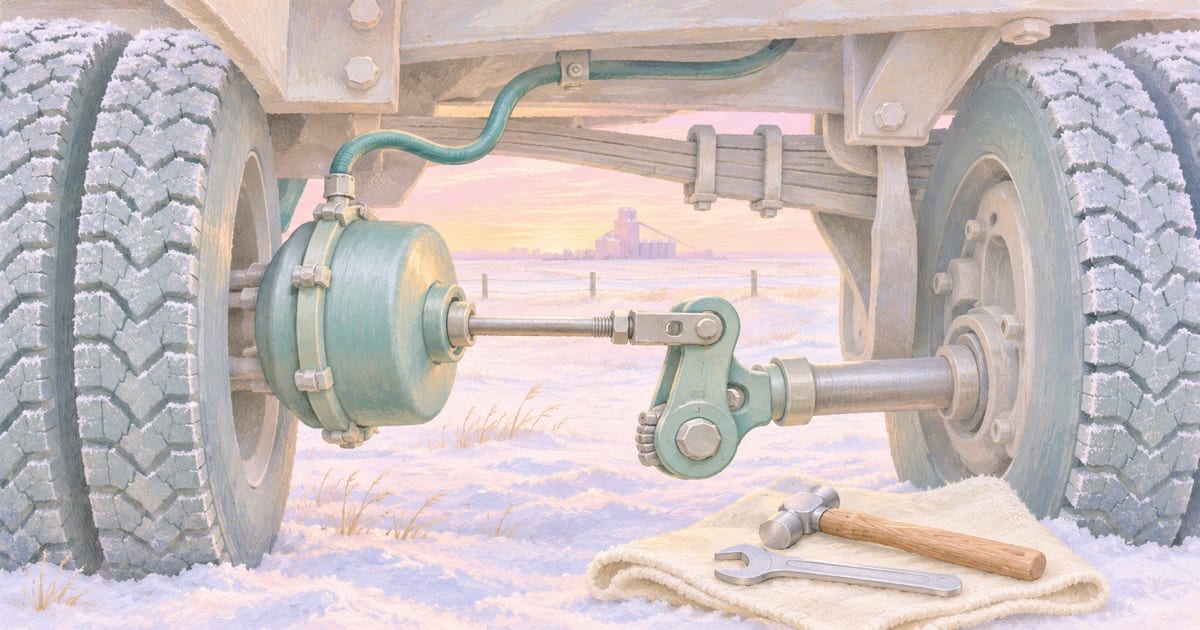
A slack adjuster is the arm that links the chamber pushrod to the brake camshaft. On a manual slack adjuster, you take up the slack by turning an adjusting bolt. In Ontario, do not do this unless you are a certified technician or hold Ontario’s air brake adjustment certificate (see the table below). The SGI and Alberta manuals give these points. They are a summary, not a full procedure: if you are trained and allowed to adjust brakes, follow the complete procedure for that slack adjuster.
| Point | What the manual says | Source |
|---|---|---|
| Target | SGI: whatever the chamber size or arm length, adjust so there is 1/2 to 3/4 in (12.7 to 19 mm) of pushrod travel when you pull the rod out by hand until the shoes touch the drum. Alberta: 1/2 in (13 mm) free stroke is the best, and 3/4 in (19 mm) is the guideline for re-adjusting. | SGI manual; Alberta manual (2012) |
| Which way to turn | There is no one direction. Turn the bolt so that the camshaft turns the way it does when the brake applies. If the pushrod starts to come out of the chamber, you are turning the wrong way. | Alberta manual (2012) |
| Back off | When you adjust a manual slack adjuster, back it off about one-third of a turn as a general guide. | Alberta manual (2012) |
| Check for drag | Tap the drum gently with a metal hammer. A ringing sound means the shoes are clear. A dull sound means the brake is dragging; re-adjust until the drag is gone. | SGI manual |
| Not too tight | Strokes should be less than the out-of-service limit, but if the brakes are adjusted too tight they will drag when released. | Alberta manual (2012) |
| Check again | Measure the pushrod travel again after adjusting. If the brake cannot be adjusted, inspect the foundation brake for worn or broken parts. | SGI manual |
Adjustment training and who may adjust, by province
Ontario’s handbook states the rule plainly. The SGI and Alberta material we read describes the procedure and the training, but does not set out the full legal rule, so ask your course or your province before you adjust brakes yourself.
| Province | What the manual says about adjusting manual slack adjusters | On the practical test |
|---|---|---|
| Ontario | Only certified technicians, or drivers who hold Ontario’s air brake adjustment certificate. The certificate does not cover automatic slack adjusters. | You must show a method of measuring applied pushrod stroke. |
| Saskatchewan | SGI’s manual explains how to adjust them. | Includes adjusting a manual slack adjuster, and explaining aloud how an automatic slack adjuster is adjusted. |
| Alberta | The 2012 course includes hands-on practice adjusting a manual slack adjuster. | The 2012 form asks you to confirm brake adjustment on both brakes of one axle, within the 15-minute test. |
| British Columbia | Not stated on the ICBC pages and forms we read. | ICBC’s form scores push rod travel and brake adjustment. The air brake pre-trip is failed at more than 3 demerits for Class 1 and more than 2 for Classes 2 and 3. |
FreeTests: Air supply: compressor, governor, tanks, dryer · Spring parking and emergency brakes · Trailer brakes and tractor protection · Pre-trip inspection and air brake tests
Canada Air Brake Practice Test: free sample
Answer 4 questions against the clock, like the real exam. You then see the right answer, the reason and your time on each. About 5 minutes · free · no sign-in.
4 questions to answer▶ Start nowThis one is free · no sign-in neededYour result shows how long each question took you.Automatic slack adjusters
Automatic slack adjusters keep the brakes adjusted, but you still check them every day: Ontario says the inspection must be done whether the slack adjusters are automatic or manual, and SGI says they must be checked daily.
SGI gives two numbers for the daily check: less than 1 in (25.4 mm) of pushrod travel when you pull the rod by hand, and less than 2 in (50.8 mm) when the brake is applied. SGI says that normally two to four brake applications of 100 psi a day keep the brakes properly adjusted, and that badly out-of-adjustment brakes may take up to 12 such applications; if they are still out of adjustment, a qualified person should repair them. Alberta’s manual adds that a parking brake application is only about half a full service application, so it does not properly trigger the automatic adjustment; with the pressure above 100 psi (690 kPa), press the pedal firmly to the floor, with about one second between each application and release.
If an automatic slack adjuster keeps going out of adjustment, it is defective. Ontario says only a certified technician may adjust or repair one. SGI says not to adjust one yourself unless you have been trained by a mechanic or trainer who is familiar with setting up and backing off that type of automatic slack adjuster. Alberta’s manual says hand-adjusting one is only for getting the vehicle safely to a repair shop, never routine maintenance, because it damages the adjuster. Alberta’s manual also says vehicles built with automatic slack adjusters cannot be retrofitted with manual ones.
Two worked questions
These original examples apply the manuals’ values to a situation. Try them before you open the answers.
Worked example 1 · One leak result, two provinces
You test a straight truck with no trailer. You start at maximum system pressure (which is inside the normal operating range), with the spring brakes released and the engine off, and hold the brake pedal fully applied. After the first drop settles, the gauges fall 2 psi in one minute. What is the result of the air-loss test in Ontario, and in Saskatchewan?
- (A) It passes in both provinces
- (B) It passes in Ontario but fails in Saskatchewan
- (C) It fails in both provinces
- (D) It fails in Ontario but passes in Saskatchewan
Show the answer
Answer: (B) It passes in Ontario but fails in Saskatchewan. Ontario’s handbook allows a straight truck, tractor or bus to lose up to 3 psi (21 kPa) in one minute, so 2 psi passes there. SGI’s single-unit pre-trip procedure allows no more than 1 psi in one minute after the initial application, so the same truck fails in Saskatchewan. This is why you learn the values in your own province’s manual.
An original ProSyllabus question written from the provincial manuals named in the answer. Not a question from any official test.
Worked example 2 · After a manual adjustment
In Saskatchewan, you have just adjusted a manual slack adjuster. Pulled by hand, the pushrod now travels 5/8 in before the shoes touch the drum. You tap the drum gently with a metal hammer and hear a dull sound. What does SGI’s manual say to do?
- (A) Nothing; 5/8 in is inside the 1/2 to 3/4 in range, so the brake is correct
- (B) Tighten the adjuster more, because a dull sound means the shoes are too far from the drum
- (C) Re-adjust until the drag is gone, then check the pushrod travel again
- (D) Drive a short distance to let the brake settle, then tap it again
Show the answer
Answer: (C) Re-adjust until the drag is gone, then check the pushrod travel again. The 5/8 in travel is inside SGI’s 1/2 to 3/4 in range, but the hammer check is a separate test. SGI says a ringing sound means the shoes are away from the drum and a dull sound means the brake is dragging, so it must be re-adjusted until the drag is eliminated. Tightening more would make the drag worse. SGI then says to check pushrod travel after adjustment.
An original ProSyllabus question written from the provincial manuals named in the answer. Not a question from any official test.
Try free air brake practice questions
These play in our practice player: each question has an explanation. They are our own independent questions, not questions from any official test.
FreeTests: Air supply: compressor, governor, tanks, dryer · Spring parking and emergency brakes · Trailer brakes and tractor protection · Pre-trip inspection and air brake tests
Canada Air Brake Practice Test: free sample
Answer 4 questions against the clock, like the real exam. You then see the right answer, the reason and your time on each. About 5 minutes · free · no sign-in.
4 questions to answer▶ Start nowThis one is free · no sign-in neededYour result shows how long each question took you.Practise the questions behind the pre-trip
Our Canada Air Brake Practice Test has 185 original items. Two of its eight topic sets match this page: “Pre-trip inspection and air brake tests” (32 questions) and “Brake adjustment and slack adjusters” (23 questions). Their topics include the low-air warning, build-up and governor tests, air-loss limits, tractor protection, chamber types, stroke limits and who may re-adjust brakes in Ontario. Every question in its 12 quizzes comes with an explanation.
Be clear on one thing: the questions are written from Ontario’s Official Air Brake Handbook and Alberta’s air brake manual. There are no questions from SGI’s or ICBC’s manuals yet. Saskatchewan drivers can compare the SGI values in this guide; BC drivers should use ICBC’s manual and their course materials for the technical limits. The kit is practice for the written test; it does not replace hands-on training on a vehicle.
See the Canada Air Brake Practice Test. Independent practice; not made or endorsed by any province, SGI or ICBC.
Frequently asked questions
What is checked on an air brake pre-trip inspection?
The parts first: the compressor and its belt, the air tanks and drains, the air lines, and at each wheel the brake chambers, slack adjusters, linings and drums. Then the system tests: governor cut-out and cut-in, the air-loss rate with the brakes applied, the low-air warning, the spring brake control, tractor protection on a towing vehicle, and the build-up time. Last, brake adjustment, by measuring applied pushrod stroke at each brake.
What is the air leak-down test for air brakes?
With the spring brakes released, the engine off and the pressure in the normal range (Ontario) or at maximum (SGI), you press and hold the brake pedal fully applied and watch the gauges. You ignore the first drop. Ontario allows 3 psi in 1 minute for a single vehicle, 4 psi with a trailer and 6 psi with two or more trailers. SGI allows 1 psi in 1 minute for a single unit and 4 psi for a combination. Alberta’s 2012 form times 2 minutes: 4 psi for a power unit plus 2 psi per trailer.
How do you check air brake adjustment?
Ontario’s method: chock the wheels, make sure the pressure is above 90 psi and release the spring brakes. Mark the pushrod at the chamber. Bring both gauges to 90 to 100 psi and shut off the engine. Fully apply the service brakes, hold them applied with a suitable means, and measure from the chamber to the mark. That is the applied pushrod stroke. Compare it with the adjustment limit for that chamber size and type, for example 2 inches for a standard Type 30 chamber in Ontario’s chart.
How do you adjust a manual slack adjuster?
Adjust one only if you are trained and allowed to (in Ontario, only certified people may re-adjust brakes). With the vehicle secured and chocked, Alberta’s manual says to turn the adjusting bolt so the camshaft turns the way it does when the brake applies, and gives backing off about a third of a turn as a general guide (a summary point, not a full procedure). SGI’s target is 1/2 to 3/4 inch of pushrod travel when pulled by hand. Tap the drum with a hammer: a dull sound means it drags and needs re-adjusting.
Can drivers adjust automatic slack adjusters?
Not as routine. Automatic slack adjusters should not need regular adjustment; if they do, they are defective. Ontario says only certified technicians may adjust or repair them. SGI says not to adjust them yourself unless you have been trained by a mechanic or trainer who is familiar with setting up and backing off that type. Alberta’s manual says hand-adjusting one is only to get the vehicle safely to a repair shop.
At what pressure should the low air warning come on?
Ontario’s handbook says to watch both the primary and secondary gauges: the vehicle fails if the warning does not come on by 55 psi (380 kPa); most come on above 60 psi. SGI’s manual and Alberta’s 2012 practical form both say the warning should come on by 60 psi (414 kPa).
What should governor cut-out and cut-in be?
Ontario: within the maker’s range, cut-out not above 145 psi and cut-in not below 80 psi (the chapter’s key points also call cut-out below 100 psi defective). SGI: cut-out 120 to 145 psi, and cut-in usually 20 to 25 psi lower but at least 100 psi. Alberta’s 2012 form: cut-out 120 to 135 psi and cut-in 20 to 25 psi below cut-out.
How long does the air brake pre-trip take on the test?
Alberta’s April 2012 instructor manual and its practical test form give 15 minutes; ask your school whether that still applies. Ontario, SGI and ICBC do not give a time on the pages and forms we read. In Saskatchewan you must do it without help and without a checklist, so practise until you know the order by heart.
Do I need a separate air brake pre-trip test in BC?
ICBC says you pass a pre-trip inspection test as part of the on-highway air brake endorsement, unless you pass a driver-certification air brake course, which includes 4 hours of pre-trip training. ICBC lists the pre-trip including air brakes at $20 when taken separately, and free when taken at the same time as a commercial road test.
More in this series
Sources
- official — Government of Ontario: Official Air Brake Handbook, “Inspecting Air Brake Components” (read 5 Nov 2026)
- official — Government of Ontario: Official Air Brake Handbook, “Inspecting Air Brake Adjustment” (read 5 Nov 2026)
- official — Government of Ontario: Official Air Brake Handbook, “Inspecting Air Brake System Operation” (read 5 Nov 2026)
- official — Government of Ontario: Official Air Brake Handbook, “Checklists, Charts and Circuit Diagrams” (read 5 Nov 2026)
- official — SGI Air Brake Manual: Pre-trip procedure for air (single unit), Rev. 2022 (read 6 Nov 2026)
- official — SGI Air Brake Manual: Pre-trip procedure for air (combination unit), Rev. 2022 (read 6 Nov 2026)
- official — SGI Air Brake Manual: Manual brake adjustment (read 6 Nov 2026)
- official — SGI Air Brake Manual: Manual slack adjuster check, preferred method (read 6 Nov 2026)
- official — SGI Air Brake Manual: Service tests (slack adjuster angle; read 6 Nov 2026)
- official — SGI Air Brake Manual: Automatic or self-adjusting slack adjusters (read 6 Nov 2026)
- official — SGI: Requirement for an A endorsement (read 6 Nov 2026)
- official — ICBC: Commercial Vehicle Pre-Trip Inspection Test Results, Classes 1 or 3 (form MV2933, 01/2023; read 6 Nov 2026)
- official — ICBC: Commercial Vehicle Pre-Trip Inspection Test Results, Classes 2 or 4 Unrestricted (form MV2950, 01/2023; read 6 Nov 2026)
- official — ICBC: Air brake endorsements and training (read 6 Nov 2026)
- official — ICBC: Driver licensing fees (pre-trip including air brakes $20 when taken separately; read 6 Nov 2026)
- official — Government of Alberta: Air Brake Manual, a guide for instructors (April 2012; includes the Air Brake Practical Test form DPLS0003)
official = a document published by the conducting body. reported = a news or coaching site we could not check against an original. Where sources disagree this page says so rather than picking one.


